Dragonfly on a rectilinear grid

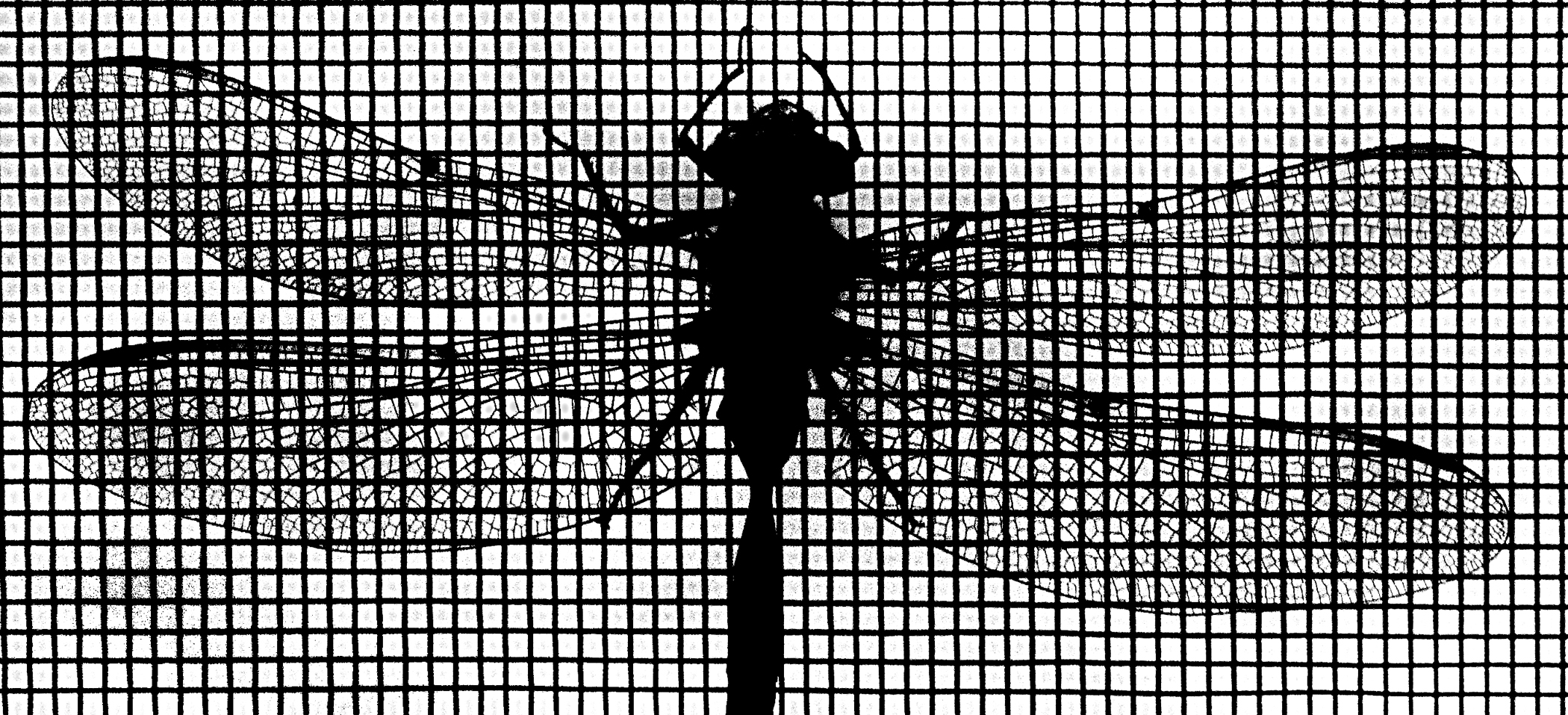
Dragonfly on a rectilinear grid, (c) DE Wolf 2013

Figure 1 – “Dragonfly on a rectilinear grid,” (c) DE Wolf 2013

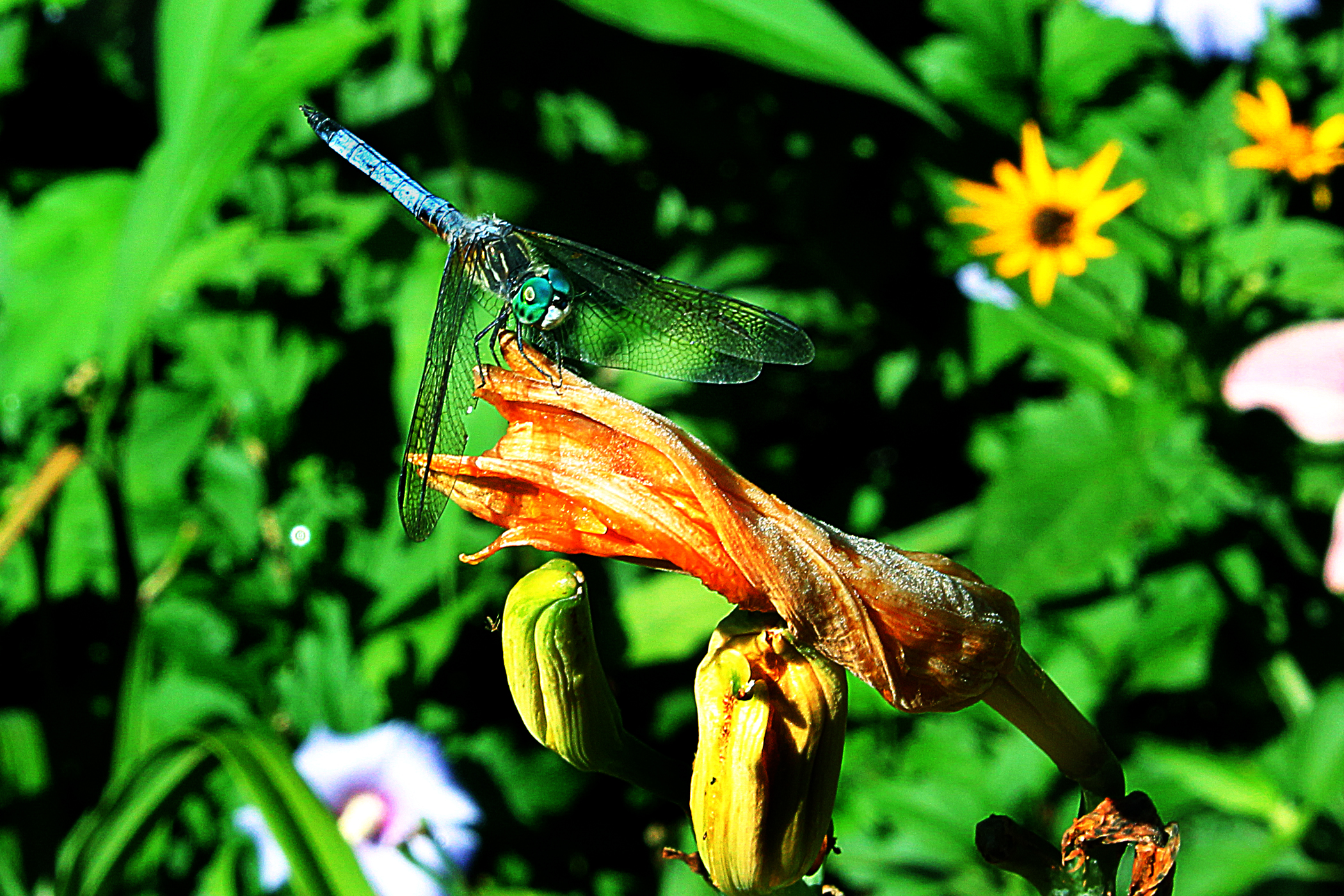
Here is a picture that I did last weekend just for fun.  We have had quite the crop of dragonflies this summer.  I love the intricacy of their wings and the wonderful shiny colors they present. In a recent post I put up an image of one from my friend Eleanor’s garden.  Still, I’ve been too lazy to set up my tripod and stalk them among the wildflowers.  A good picture is going to take a lot of patience and invested time.

So, I was quite delighted to find a large dragonfly hanging on a screen in one of my family room windows on Saturday.  He was, I think, just hanging out and waiting for the sun to wake him from poikilothermic dormancy.  I loved the delicate veins in his wing contrasting against the perfectly rectilinear grid of the screen  How to capture this?

I decided upon my EF70-200mm f/4L USM.  I shot at ISO 3200, since I didn’t want any shake.  I was about 2 feet away, just resting my elbow on the top of a television set for support.  I used a zoom of 113mm, and took the shot AV priority at f5.6 at 1/160 seconds.  To get what I wanted I had to use manual focus.  It took quite a bit of work in Photoshop to get the contrast that I wanted.  I’m certain  that it could have been done better.  But I am reasonably happy with the results.
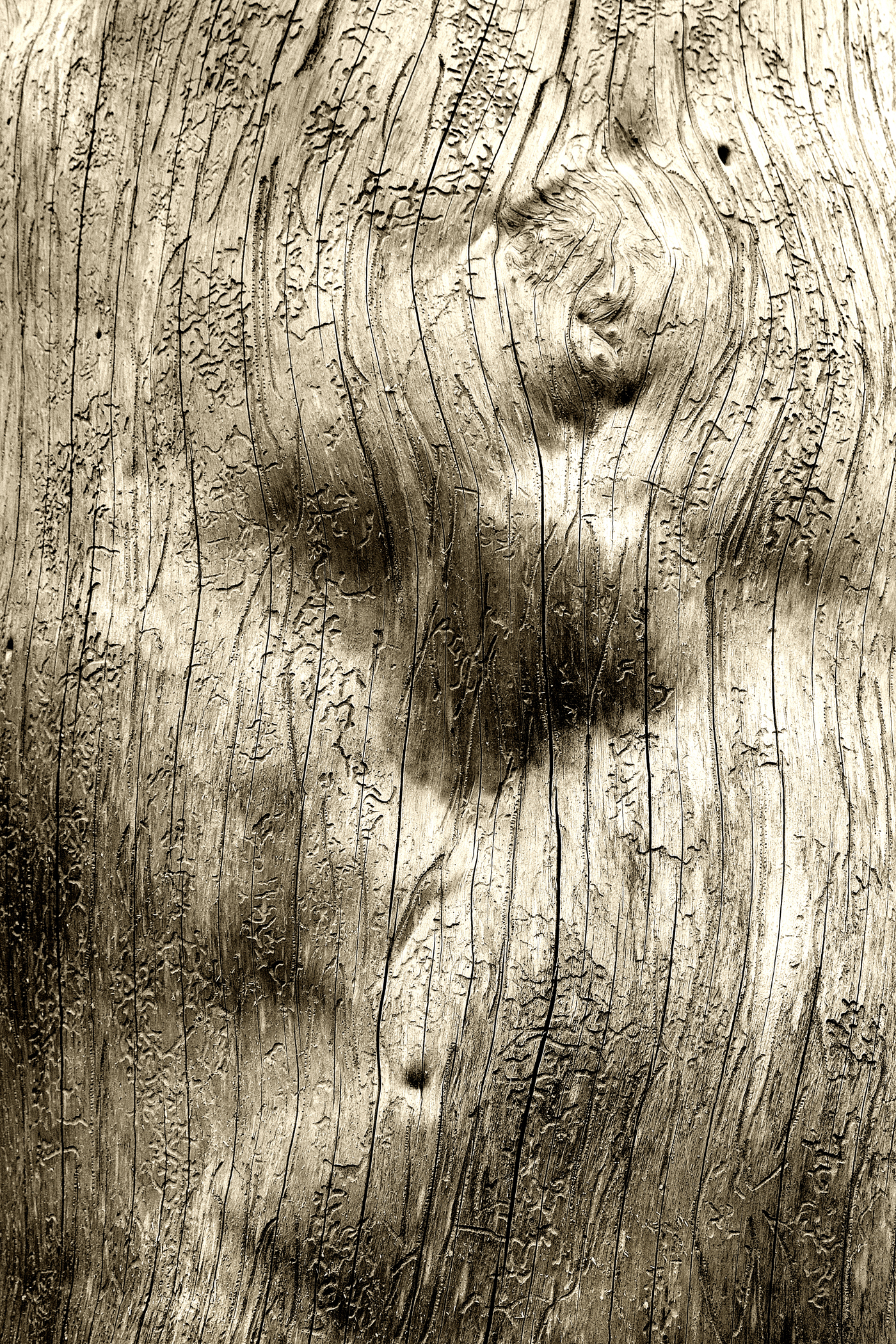
Denuded Tree

Figure 1 - Denuded Tree, Wellesley, MA, (c) DE Wolf 2013.

Figure 1 – Denuded Tree, Wellesley, MA, (c) DE Wolf 2013.

At the Massachusetts Horticultural Society’s Elm Bank Reservation in Wellesley, Massachusetts there is this wonderful dead tree that is totally devoid of bark that they have labelled and use as a “bird habitat.”  It is wonderfully polished, covered with a labyrinth of termite tunnels, like little streets, and presents this marvelously shiny ivory color.

The sky was completely overcast, presenting a very low contrast light.  But I was struck by the textures, the termite tracks and the spots that glistened subtly above the rest of the surface.  These would not have been there in bright high-contrast sunlight.  The scene presented the kind of tone-on-tone challenge that I just love to photograph.  Since I was shooting with IS, but no tripod, I chose an ISO of 800.  I find that with the Canon T2i you can really go much higher than this without getting into grain trouble.  I experimented with manual but found that AF gave me what I wanted.  I do this by zooming in on the fine detail after taking a test shot.  Here the detail was the termite tracks.  The image in Figure 1 was taken with my EFS 18-55 mm (1:3.5-5.6) IS STM zoom at 37 mm in aperture priority at 1/400.

The result was, I think, my best image of the day.

Summer Gardens in New England

[slideshow_deploy id=’3404’]

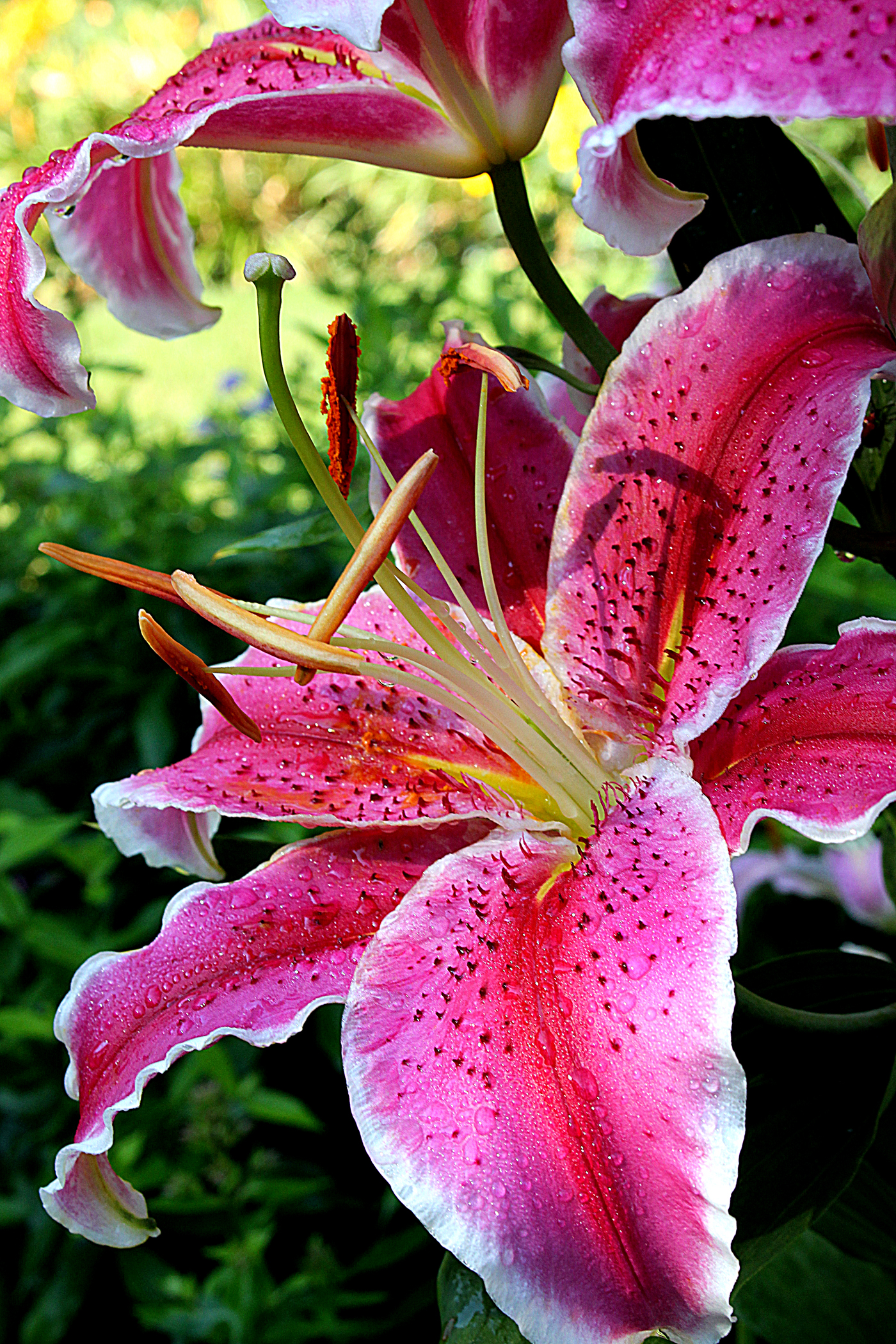
We have reached the beginning of August in New England, and the gardens are all marvelously ablaze with color.  Last weekend my dear friend and reader, Eleanor invited my wife and I to see her garden at the height of its glory.  Eleanor’s garden is filled with the most beautiful lilies imaginable, some of them with a breathtaking lavender hue, that I just love.  Dragon flies and hummingbirds are everywhere (my cat was not invited).  And what made it all very special was the fine mist of water droplets that covered everything with a fresh sense of expectant vitality.

Inspired we went this weekend to a fair that was being held at Elm Bank Reservation in Wellesley, Massachusetts, which is owned by the Massachusetts Horticultural Society.  There I photographed: bees on pink cone flowers, hibiscus, and flowering grasses.  I decided to experiment in this post with a little slide show of my flower work. Note, that if you place your mouse over the picture the title comes up.

Flower photography seems trivial because of power of color to delight our senses.  It is in fact a tricky task.  Finding just the right focus (best done in manual mode) and depth of field is an art.  It is really best done with a tripod and a macrolens.  But while not perfectly successful, I amused myself and got some acceptable if not brilliant images.  I believe that if you’re concentrating on the task at hand and deliberate in your work, you can learn a lot.

So again the end of August and the dog days are near.  I begin to get a bit wistful.  The school traffic will be back soon, and my commute will lengthen.  But the really nice point about New England is that the scene is always changing and the view is ever beautiful.

Beating the heat

Disco Light (c) DE Wolf, 2013

Disco Light (c) DE Wolf, 2013

The weather has been sizzling in the United States.  I heard on the news tonight that 100 million Americans are in a heat wave.  In Massachusetts we have had seven straight days of 90 plus (Fahrenheit) temperatures and are waiting, as I write, for the weather to break, which will almost certainly be heralded in by severe thunderstorms.

Of course, this is nothing in comparison to what readers in Nevada and Arizona have been experiencing. I’m worried about these people, since some articles would suggest that at around 131 deg. F the human body can no longer regulate its temperature.  This, BTW, is not a good thing!

Anyway in the spirit of thinking and being cool, I found an interesting posting on NBC News’ Photoblog  that shows images of people cooling off from summer’s heat fifty years and more ago and today.  There are some great commonalities: children playing in sprinklers or fire hoses, stripping to the barest minimum (legally allowed) on busy city thoroughfares, and eating iced cream.

As for me, on Saturday, we went to Boston’s Museum of Fina Arts.  I took lots of photographs, many that I am quite happy with, but cannot share them because of copyright/distribution restrictions.  There was a marvelous exhibit of “Samurai Armor and another called “Hippy Chic” highlighting clothing from the sixties and seventies.  I will share this one picture that shows the patterns of a disco light on the floor.  Perhaps if all this heat continues we can hypnotize ourselves into thinking cool.


A vist to the Isabella Stewart Gardner Home and Museum

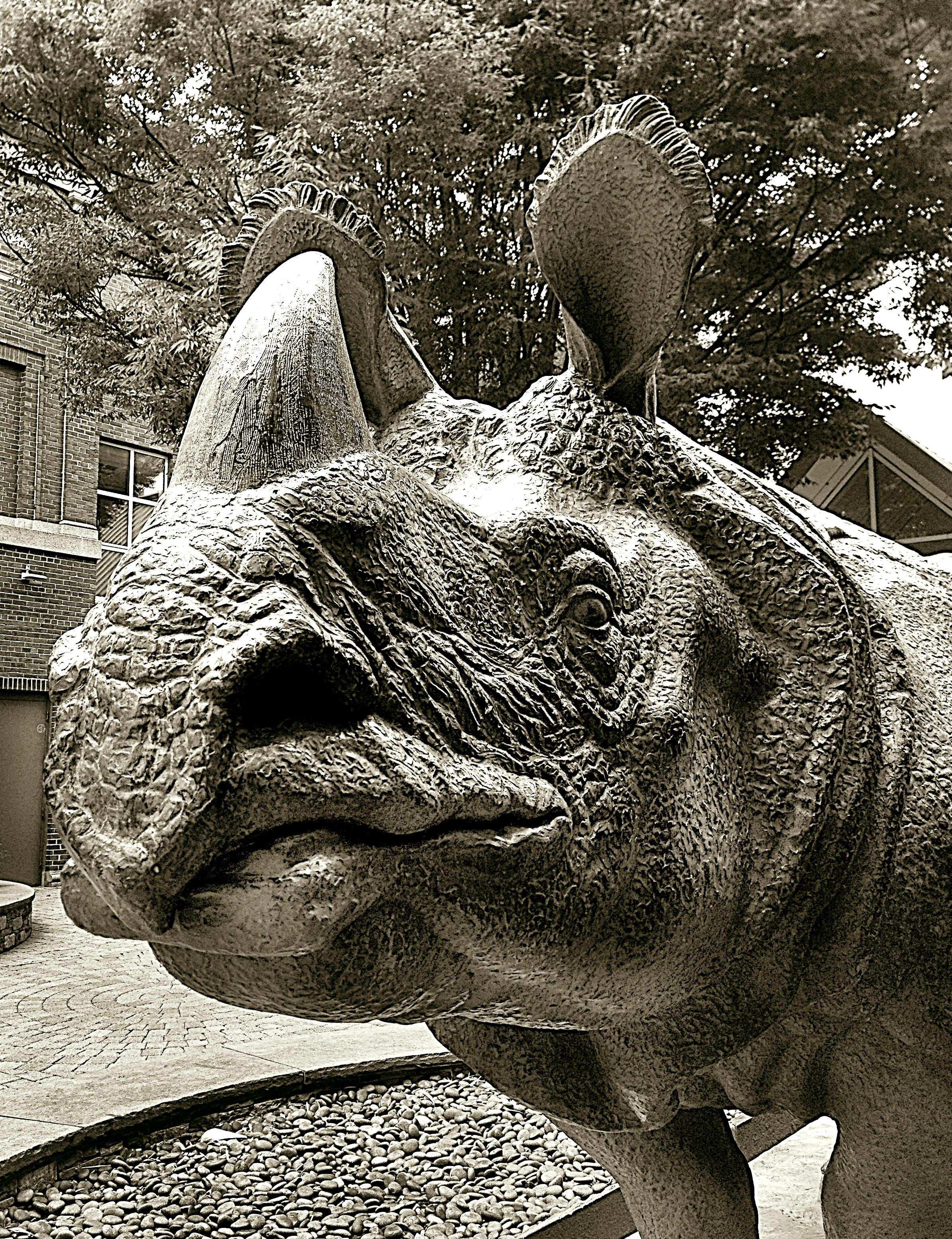
Figure 1 - Rhinoceros Boston, MA, IPhone photograph. (c) DE Wolf 2013.

Figure 1 – Rhinoceros Boston, MA, IPhone photograph. (c) DE Wolf 2013.

One of Boston’s true gems is the Isabella Stewart Gardner Home and Museum on the Fenway.  We are now further graced with the beautiful new wing by architect Renzo Piano. The collection, originally a private collection, is spectacular, if a bit quirky, as it reflects Gardner’s personal taste.  She mandated that the museum, in what is referred to as “The Castle,” remain unchanged.  This has and continues to cause problems.  The lighting is terrible and people are dangerously close to the art.  Still, it remains an absolute must see – especially the indoor courtyard and garden, which can be a cathartic retreat, especially in winter.  Also the concert venue is gorgeous. BTW – my wife and I split in our reviews of the restaurant, me thumbs up, her thumbs down.

There is one major problem, however – no photography allowed – “the unkindest cut of all.”  So I had to leave my camera at home.  I could have carried it through the museum – but, really what for.  As we exited the museum and walked back to the parking garage and past the School of the Museum of Fine Arts, I just couldn’t resist any longer the need to photograph.  Out popped my IPhone, and I amused myself with the two photographs shown here, one of the rhinoceros sculpture and the other of the courtyard tile work, perhaps reflecting on the maze at Chartres.

The Iphone is an always ready and fun camera.  As discussed before it is wonderful for taking true verticals.  I think that if one looks closely at the rhinoceros you can see the limitation of eight bit depth images.  The dynamic range is not quite there and the tonal quality flattens. One way to clearly see this in your own work is to observe the discrete levels of the greyscale histogram.

Figure 2 - Circles, Boston, MA, IPhone photograph, (c) DE Wolf 2103.

Figure 2 – Circles, Boston, MA, IPhone photograph, (c) DE Wolf 2103.

Rain drops and rain clouds

Figure 1 - Storms over the New Jersey shore, IPhone photograph,(c) DE Wolf

Figure 1 – Storms over the New Jersey shore, IPhone photograph,(c) DE Wolf 2013.

I had a less than thrilling day today flying from Detroit to Boston, with a stopover in Philadelphia.  There were however three high points.  The first was when USAirways, in its latest incarnation of coming out of bankruptcy, lied and announced that our plane had had mechanical difficulties (the not amusing part).  We knew that they were lying moments later when they then announced that if we had left our carry-ons on the plane we should go to another gate, the one we originally came in on, and retrieve them because it was about to take off with another load of Boston-bound passengers (the amusing part).  The second highpoint was when a reader emailed me a really beautiful set of rain drop photographs.  I’ve included the link for you here. I’m sorry to say that this is one of those image sets that is circulating the web, and I cannot find out who the original photographer is. The third was the gorgeous thunder storms moving up the east coast.  I amused myself with my IPhone and include as Figure 1 an image of thunder clouds over the New Jersey shore.

A Saturday afternoon in Concord, MA

Eighteenth century graves of the Hartwell Family, Old Hill Burying Ground, Concord, MA, (c) DE Wolf, 2013.

Eighteenth century graves of the Hartwell Family, Old Hill Burying Ground, Concord, MA, (c) DE Wolf, 2013.

It is a sobering thought, but I just realized that I first visited historic Concord, MA almost fifty years ago.  At that time, inspired by Disney’s version of “Johnny Tremain,” I fell in love with the town.  Here and Lexington are where the American Revolution began, and as a result they both remain very special places.

Broken church bell, First Parrish Church, Concord, MA, (c) DE Wolf, 2013.

Broken church bell, First Parrish Church, Concord, MA, (c) DE Wolf, 2013.

This Saturday afternoon I decided that I would explore the path over the Mill Brook and then climb up to the top of the “Old Hill Burying Ground.”  This is Concord’s oldest cemetery.  Like much of the area, Concord and its surrounds are dominated by glacial features.  The “Old Hill Burying Ground” is built on a glacial drumlin.  A drumlin is a hill built up by the pebbly debris left behind by a glacier.  Because of its composition and exposure the “Old Hill Burying Ground” was the first place to thaw in spring.  As a result bodies stored over the winter could be buried as soon as possible.

I think that this particular photography excursion, while not a failure, was not one of my best.  But what I’ve discovered is that every session is a learning experience.  Provided that you focus on the photographic process, on exposure, lighting, and composition; and then subsequently on the process of working the images up on your computer, you’re going to learn something.  And not the least of these is how to use your equipment and how not to make mistakes, or which mistakes can be the most fortuitous.

Lamp Shade Manikin, Concord, MA, (c) DE Wolf, 2013.

Lamp Shade Manikin, Concord, MA, (c) DE Wolf, 2013.

I took several pictures from the top of the hill, which commands a really lovely and interesting view of the town.  I rejected photographing the powder storage building atop the hill.  Most of the pictures that I took, I wound up unhappy with – not that unusual.  An image of the Hartwell family graves turned out reasonably well both in terms of composition and dynamic range.  It certainly captures what the cemetery is like and the nature of the late eighteenth century New England gravestones.

Wandering down the hill and across Lexington Road I discovered the remains of an old and broken church bell in front of the First Parish church.  Despite numerous trips to Concord, I have never noticed this before. Its textures, coloration, and failed repairs seemed interesting, and I took a few pictures.  I cannot say that I reach what I would consider a perfect composition.  The mid afternoon light was probably way too direct and intense to create what I was really looking for; so I am going to have to revisit this sight and try again.

Finally, I went to meet my wife on Walden Street, and my eye caught sight of a slinky manikin in front of “Concord Lamp and Shade” store.  She was a brilliant red and wore a lamp shade on her head.  It seemed a fitting contrast between the old Concord and the new Concord.


Fourth of July – Minutemen and Dinosaurs?

Figure 1 - Color Guard, (c) DE Wolf 2013

Color Guard, (c) DE Wolf 2013

Fourth of July this year in Massachusetts was hot – well maybe not as hot as in the Southwest, but pretty hot for those of us that weather New England winters so as not to have to put up with scorching heat in summer.  The fun part of the Fourth is small town celebrations, and we are fortunate to live right on the parade route of our local Fourth of July parade.  So we bake ourselves, sip on code drinks, talk to politicians, and make our bathroom available to desperate children, who discover one giant slurry too late that there are no public bathrooms on the parade route.  You would think that these patriotic towns would at some point come to the realization that it is “life, liberty, and the pursuit of happiness,” not “the pursuit of restrooms!

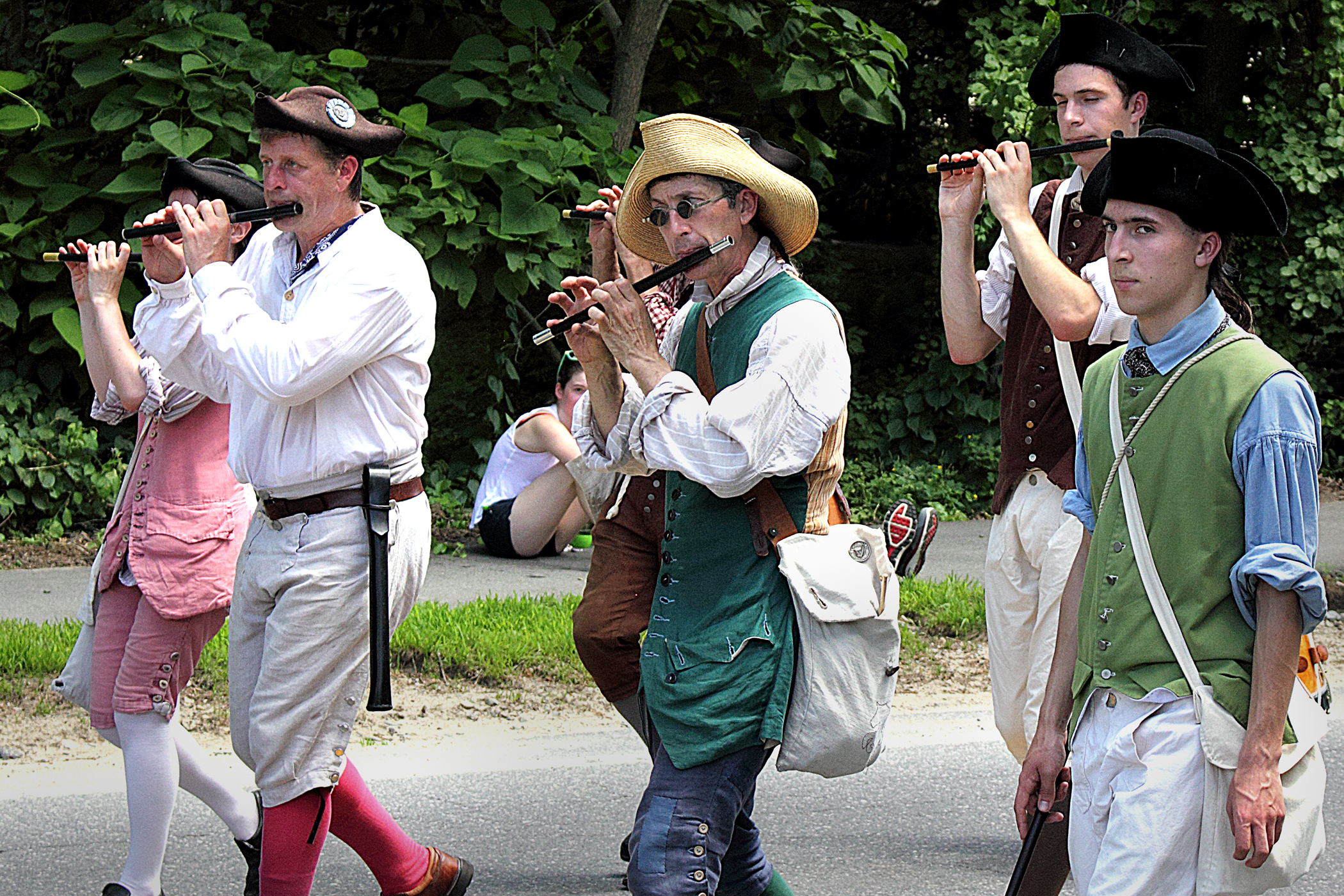
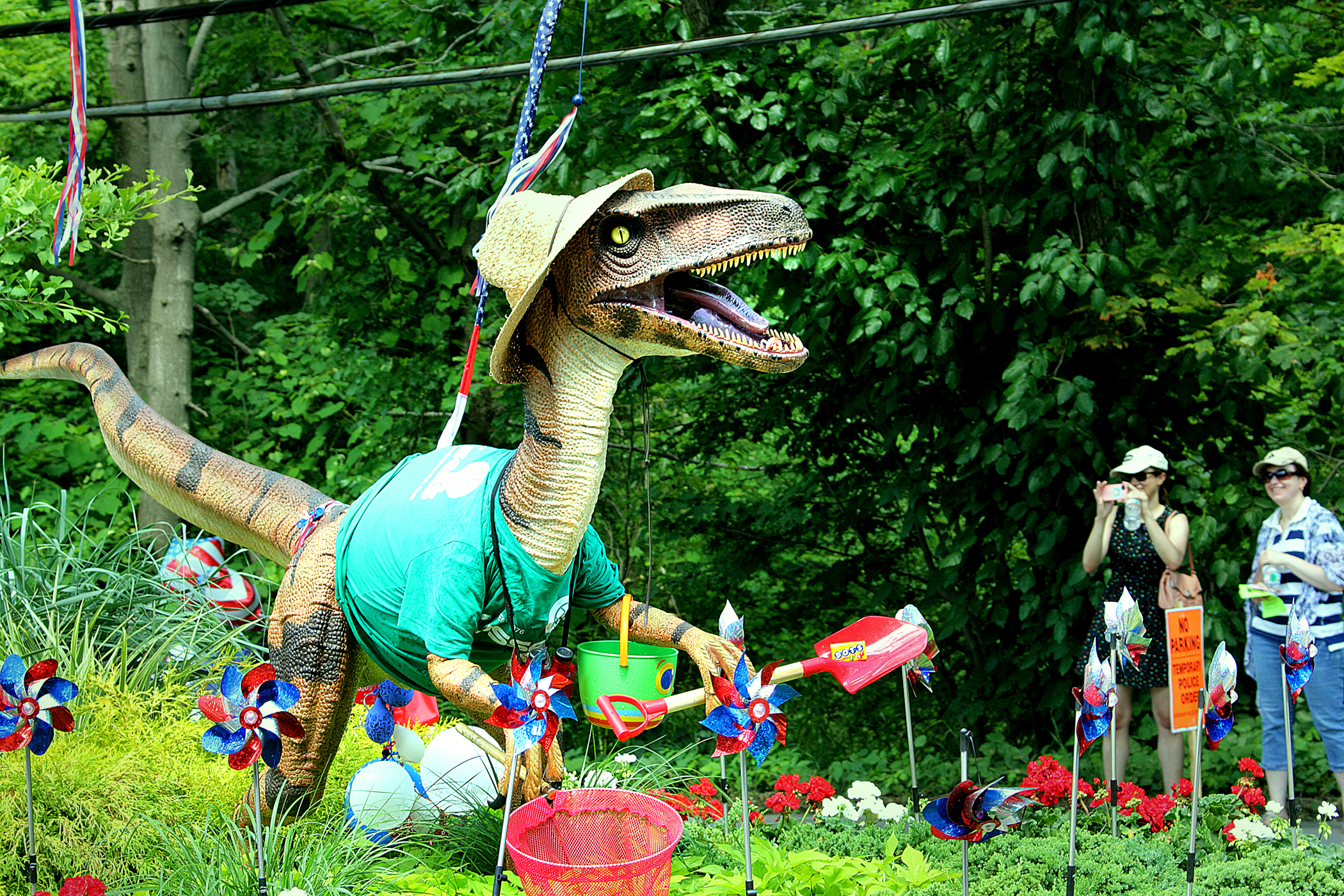
For some reason, I never seem to be satisfied by the pictures that I get.  Maybe I’m just not cut out for snapping well composed snaps of parades.  Or maybe, my photo-preferences lie elsewhere.  Still I try each year to photograph our local minuteman militia, including my own PCP, who by the time that he reaches our end of the hike looks like he may himself soon be in need resuscitation.  And then there are the myriad of bands, and local scout troops, politicos, fife and drummers, people on antique bicycles, and dinosaurs.  Dinosaurs? Yes, our local garden center this year featured a float with a shovel-bearing, gardening T-Rex.  I am including just a few of these images to give the flavor of the day.

Fifers, (c) DE Wolf 2013

Fifers, (c) DE Wolf 2013

Of course, the best part of the day was talking with friends and barbequing after the parade.  Then there was the true Boston ending, watching the Boston Pops and the fireworks from the esplanade.  The national media has deserted us.  So the broadcast this year featured local talent, which was really fine with all of us, as the city pulled off the first major public event since the marred Boston Marathon.

T-Rex, (c) DE Wolf 2013

T-Rex, (c) DE Wolf 2013

The second day of July, 1776, will be the most memorable epoch in the history of America. I am apt to believe that it will be celebrated by succeeding generations as the great anniversary festival. It ought to be commemorated as the day of deliverance, by solemn acts of devotion to God Almighty. It ought to be solemnized with pomp and parade, with shows, games, sports, guns, bells, bonfires, and illuminations, from one end of this continent to the other, from this time forward forever more.*

*Excerpt from a letter by John Adams to Abigail Adams, July 1, 1776.

Flooding on the Concord River

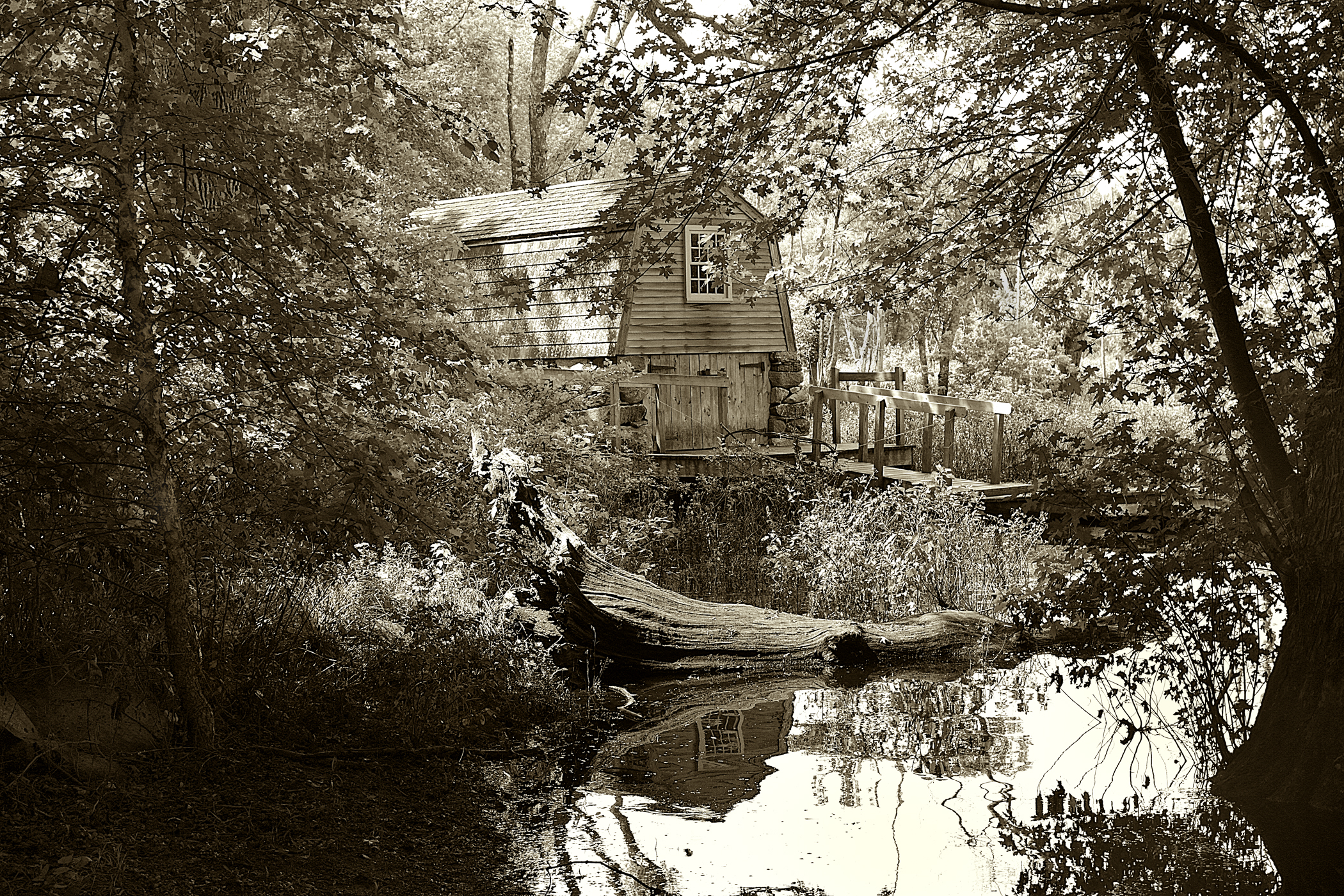
Figure 1 - The Old Manse Boat House, Concord, MA, (c) DE Wolf, 2013

Figure 1 – The Old Manse Boat House, Concord, MA, (c) DE Wolf, 2013.

Two weeks ago I blogged about the flooding at the Minuteman National Historic Park in Concord, Massachusetts.  At the time there was no crossing the river beyond the Daniel Chester French Minute Man statue.  Today I got a late start on a photography jaunt to the Sudbury River marshlands in Lincoln, Massachusetts.  The weather was perfect here(I apologize to friends in the Southwest who are sweltering) and as a result there was no parking at either of the public access points.  As a result, I decided to drive up to Concord and see how much the river had receded.

Things were looking a lot better; so I had some opportunity to continue to test out my new 18-55 mm Canon zoom lens. I took photographs around the Old Manse, where both Ralph Waldo Emerson and Nathaniel Hawthorne lived for a time, in the flooded watershed, and in the secret hedge tunnel.  I have started to work on these and thought that I would share a couple of them here.

The first, Figure 1, was taken at water level of the Old Manse’s boat house.  Readers of this blog may recognize that a color photograph of the boat house surrounded with lupine (the Wolf flower) and taken one spring from the bridge is the banner for the Hati and Skoll site.  Here I was experimenting in sepia toned black and white seeing whether I could successfully get the broad dynamic range necessary to render detail from shadow to highlight.  If I had had my tripod, I might even have tried to photograph in high dynamic range (HDR) with multiple exposure.  Here I under exposed by a stop to prevent the middle tones and highlights from bleaching out.

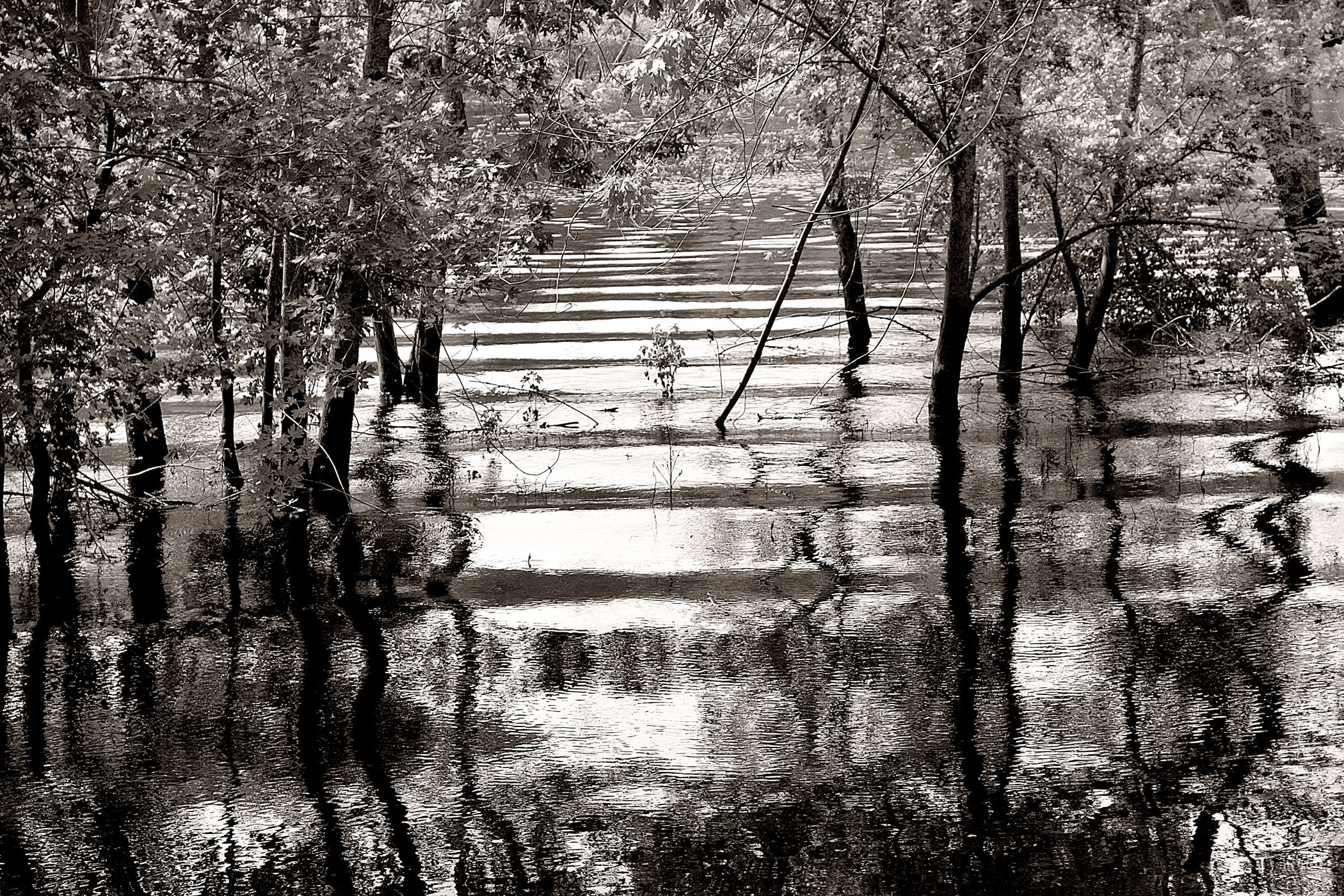
Then after crossing the bridge and contemplating the flood plain, an unusual event occurred.  The river is usually filled with canoes and kayaks.  But for some reason a power boat came through causing an unusual series of intense parallel waves.  As with the ducks, I had little time to react and fortunately was at a reasonably photogenic spot.  The result is Figure 2.  I particularly like the way in which the waves distort the perpendicular shadows of the trees in the lower right.

Figure 2 - Waves on the Concord River Flood Plain, (c) DE Wolf 2013.

Figure 2 – Waves on the Concord River Floodplain, (c) DE Wolf 2013.