Sausage and ‘rooms

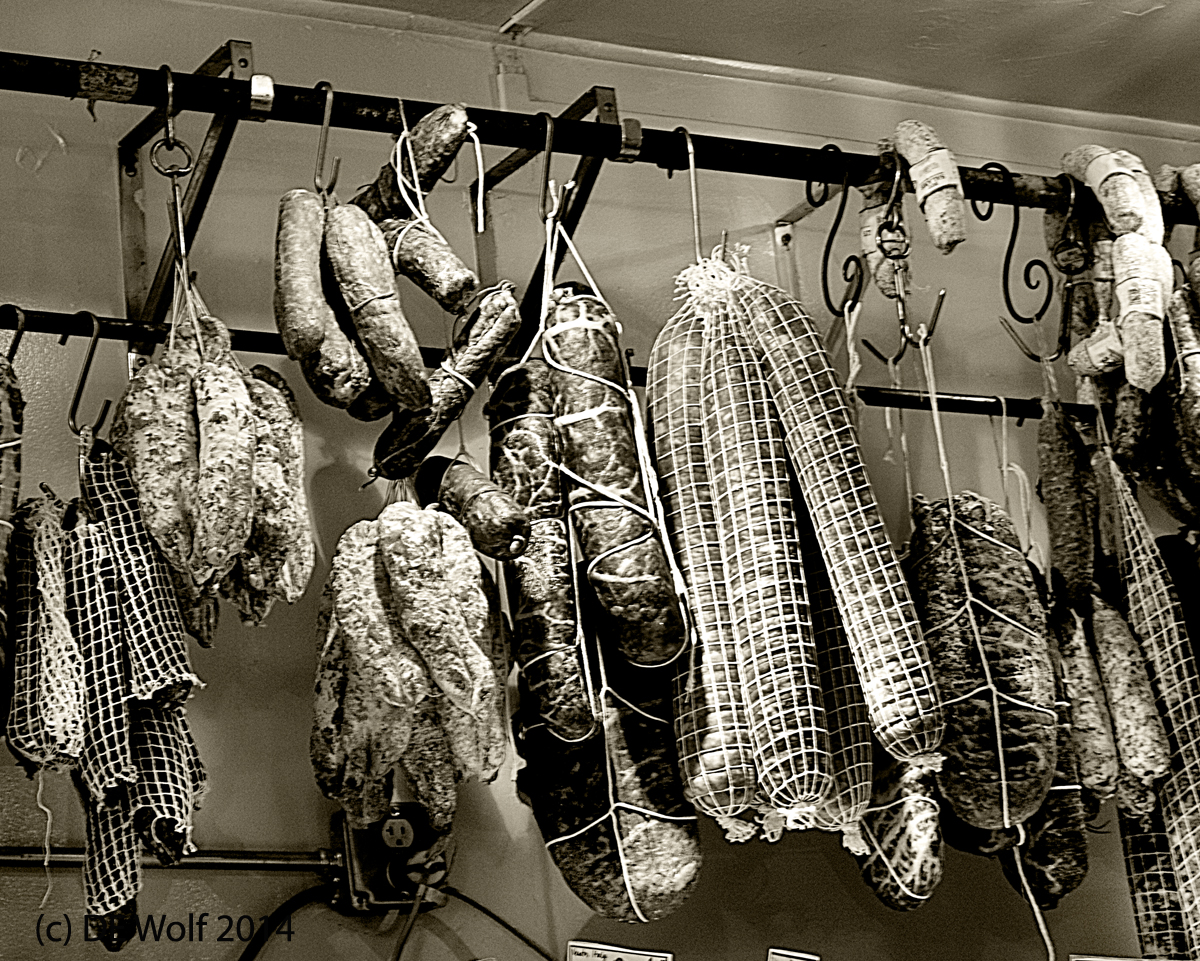
Figure 1 - Sausage at Formaggio Kitchen, Cambridge, MA. (c) DE Wolf 2014.

Figure 1 – Sausage at Formaggio Kitchen, Cambridge, MA. (c) DE Wolf 2014.

When I fail to get a photograph right, I take it as a failure of technique and a learning lesson.  But it sticks with me, sticks in my craw, if you wish. Last October I posted about a trip to the Brooklyn Farmers’ Market in the Grand Army Plaza, where I photographed hydrangeas. What I did not discuss at the time was my absolute failure to successfully photograph some delicious looking mushrooms at the market – dull, boring, fuzzy image.  My son cooked them up that evening for our dinner, and they were truly delicious.  It was a failure noted and to be rectified.

I mentioned my Saturday trip to Formaggio Kitchen in Huron Village.  Food is an art form at Formaggio.  If you can get by the very tempting fare served outside in the summer you enter the cheese and sausage room. I was attracted to the sausages that were hanging out to dry on the wall.  Unfortunately, for the most part my sausage eating days are over. Next to them were some pretty good looking prosciutto.  Memories of the Prosciutto Room at the North Beach Restaurant in San Francisco came flooding back.  Now that was an experience!  But I digress.  While ordering cheese a took a few pictures of the sausage (Figure 1), attracted by the spot lights that illuminated them.  It required a bit more sharpening than I like and wasn’t quite successful in that respect. But the room was dark, and I was hand holding.

You leave the cheese room and enter the vegetable and fruits room, where as my wife shopped, I photographed.  You do not get strange looks.  They know that there food is beautiful!  I found the mushrooms of Figure 2, loved the earth tones, the variety of shapes, and the well, yes, the scrumptious appearance. Food photography, both amateur and profession, I believe, has one of two purposes: either to offer abstract geometry or to make you hungry.  So I count this photograph a success because it makes me hungry.

You finally, enter the flower section, which is a whole different photographic paradise.  Right now, I am dreaming once more of mushrooms sautéed in butter with just a bit of salt and pepper.  I truly hope that someone enjoyed that last night.
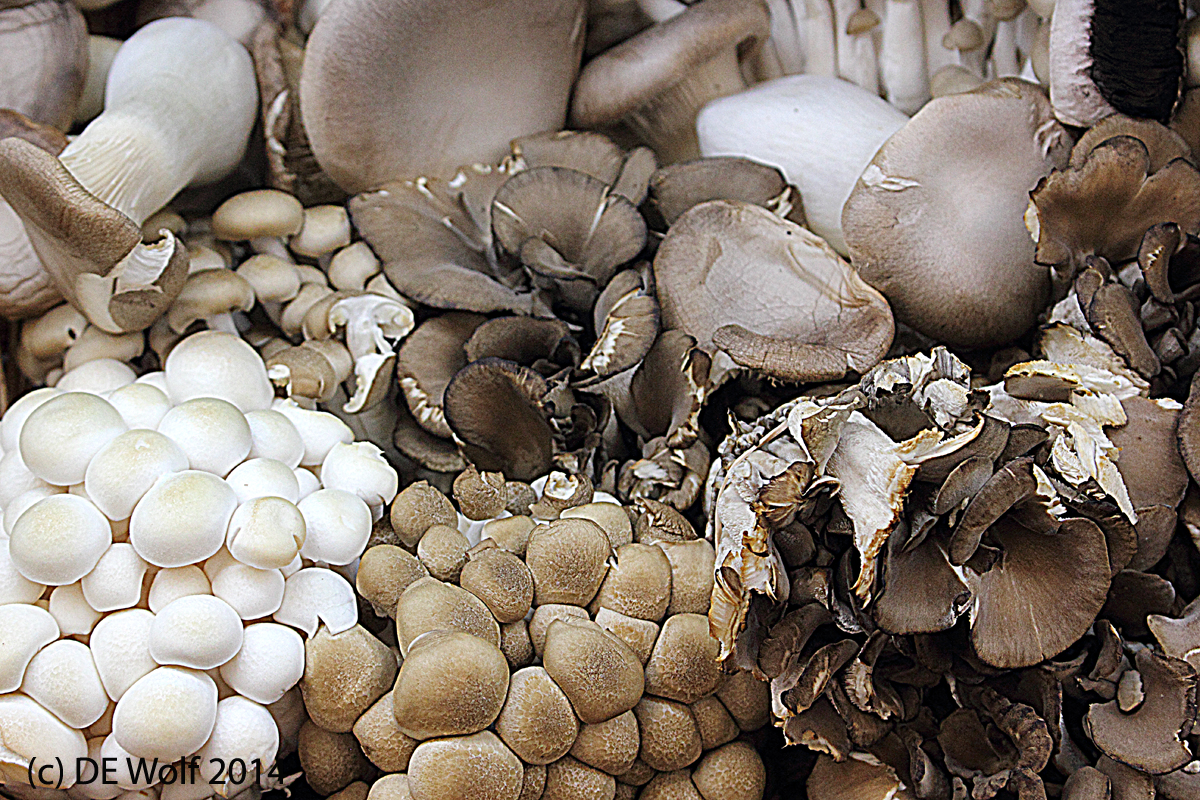
Figure 2 - Mushrooms at Formaggio Kitchen, Cambridge, MA. (c) DE Wolf 2014.

Figure 2 – Mushrooms at Formaggio Kitchen, Cambridge, MA. (c) DE Wolf 2014.

Figure 1 – Canon EF-S18-55mm f/3.5-5.6 IS STM Lens at 50 mm, IS, ISO 800, 1/15th sec. AE Aperture Priority Mode f/7.1, Exposure compensation 0.

Figure 2 – Canon EF-S18-55mm f/3.5-5.6 IS STM Lens at 52 mm, IS, ISO 800, 1/60th sec. AE Aperture Priority Mode f/7.1, Exposure compensation -1.
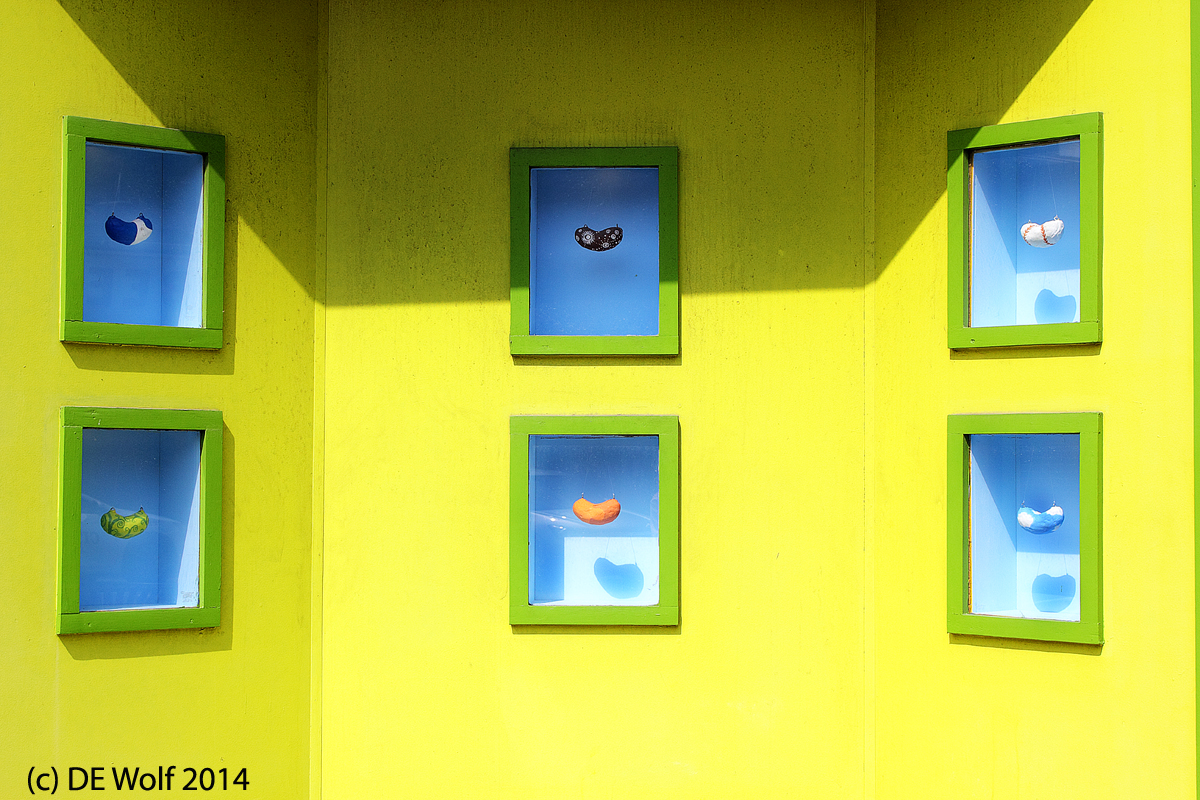

A little bit of California in Cambridge, Massachusetts

Huron Village, Cambridge, MA, Summer 2014. (c) DE Wolf 2014.

Huron Village, Cambridge, MA, Summer 2014. (c) DE Wolf 2014.

We have been basking in the glory of a beautiful New England summer and privately acknowledging that we deserve it after the cold and severe winter of 2013/2014.  Well, bad news people!  I heard on the news this morning that this mild summer with only four 90 + days, so far, is really only a continuation of last winter’s cold trend.  Thank you, Mr Weatherman.  Thank you for raining on my parade.

Still it has been spectacular, and so on a particularly mild, sunny, and gorgeous day my wife and I set out to explore a little bit of Belmont and Cambridge.  As if by magnetic attraction we ultimately found ourselves drawn to what is known as “Huron Village in Cambridge,” one of the “neat and desirable neighborhoods” and home to one of the best cheese shops in the state, “Formaggio Kitchen.” I know what I’m having for breakfast tomorrow morning.

As I wandered around with my camera enjoying the soft sunshine, I came across the facade of the Magic Beans Toy Store, Figure 1 In these dog days of summer it did not seem so incongruous.  Neither did the beans hanging in the window boxes.  They could, indeed, be magic beans. But when snow is about, these vivid, even blinding, California (or are they Miami?), colors will seem transported in space from an alien world.

Stalking the green heron

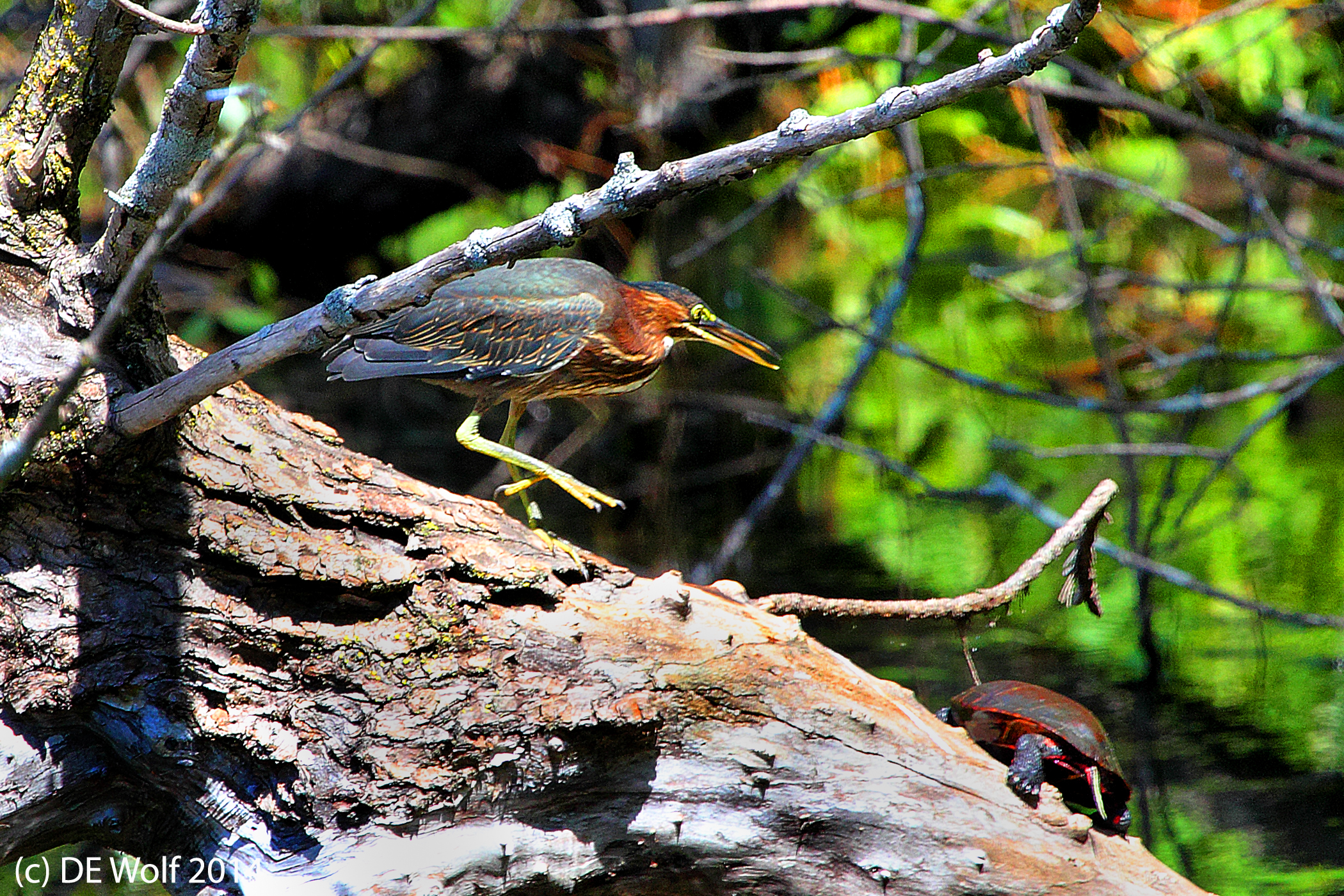
Figure 1 - Green Heron at Black's Nook, Fresh Pond Reserve, Cambridge, MA. (c) DE Wolf 2014.

Figure 1 – Green Heron at Black’s Nook, Fresh Pond Reserve, Cambridge, MA. (c) DE Wolf 2014.

For the last couple of weeks, I have had my eyes on a group of green herons (Butorides virescens) that are summering at a place called Black’s Nook in Cambridge, MA’s Fresh Pond Reserve.  While smaller than the great blue heron (Ardea herodias ), the green heron is beautiful for its iridescent green and blue coloration.

So finally, on Friday I schlepped my big lens and monopod to Black’s Nook and sought out my avian friends.  While they are not totally fond of visitors, they tolerate them, and I was not disappointed.  I learned once more that I have a lot to learn about shooting at 400 mm (really 640 mm with the sensor factor).  Even with the monopod it is hard to hold the camera still enough to get the spot autofocus right.  I set the ISO at 1600 so that I could use a 1/200th sec exposure, that to hopefully stabilize things.  Indeed, if you compare Figure 1 shoot at 1/2000th sec and Figure 2 shot at 1/500th sec, you’ll see that the sharpness award goes to the shorter exposure despite the image stabilization.  And then the trick is shoot, shoot, shoot – just keeping shooting.  I am starting to think that the tripod without image stabilization is the better way to go.  That’s how I got my “Supre Moon” picture. I recently bought myself a set of Manfrotto quick releases, enough to cover all my lenses, my monopod, and my tripod.

When I got home I sorted through the images for sharpest and best pose.  I am pretty happy with Figure 1, which I hope shows Butorides virescens to best advantage and in all its glory. Sharpness is always a big deal for me, but also, of course, the composition and lighting are important.

The proverbial “they” always tell you that you should photograph a bird doing something interesting, something that speaks of its behavior.  So I also include Figure 2. When this fellow landed on this particular log, he found it was already occupied by a turtle sunning itself.  The heron approached the turtle and the two contemplated each other for a moment.  The turtle quickly retreated into its shell.  Finally, the emboldened heron charged the turtle chasing him off of the log.  It is this moment of avian assault and reptilian retreat that Figure 2 captures.

Figure 1 – Canon EF100-400mm f/4.5-5.6L IS USM lens using IS 1 at 400 mm. ISO 1600 with 1/2000th sec with Aperture Priority AE f/7.0 and spot AF.

Figure 2 – Canon EF100-400mm f/4.5-5.6L IS USM lens using IS 1 at 800 mm. ISO 400 with 1/500th sec with Aperture Priority AE f/8.0 and spot AF.

Figure 2 - Green heron charging turtle, Black's Nook, Fresh Pond Reserve, Cambridge, MA. (c) DE Wolf 2014.

Figure 2 – Green heron charging turtle, Black’s Nook, Fresh Pond Reserve, Cambridge, MA. (c) DE Wolf 2014.

Giant heads

Figure 1 - Giant head sculpture by Garcia Antonio Lopez, Boston, MA. (c) DE Wolf 2014

Figure 1 – Giant head sculpture by Antonio Lopez Garcia, Boston, MA. (c) DE Wolf 2014

For several years, I have been trying to figure out how to photograph the two giant heads that adorn the entrance to Boston’s Museum of Fine Arts.  These wonderful visages are by Spanish sculptor Antonio López García. They are, as I said, huge and they also are dramatically disembodied.  One’s immediate reaction is to set them against the giant pillars of the museum or have someone stand in front of them.  Both approaches seem to me to be cliche and hackneyed.  And besides, what seems always to draw me in is the intimacy that contrasts the size.  The faces are intensely black, but their shininess gives them magnificent highlights, and the point seems to be the commanding intensity of feature that demands extreme close-up.  So that is what I show here.  But I remain convinced that there is the perfect light and the perfect way to photograph them – that I have yet to find.

Avoiding old fuddy-duddidom

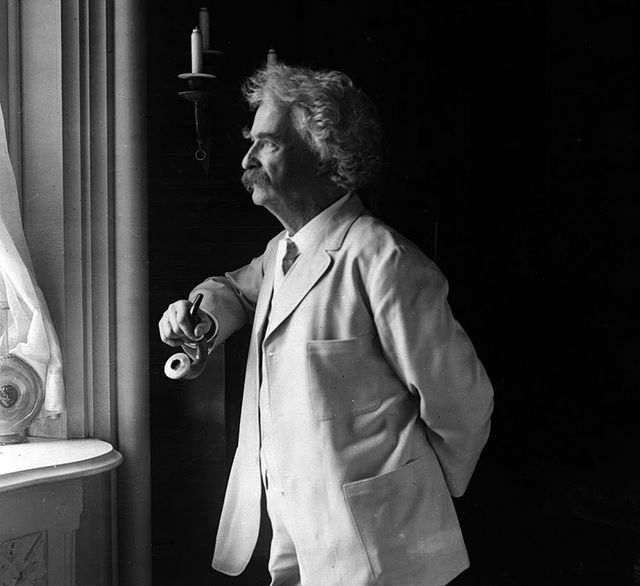
Figure 1 - Mark Twain by Underwood and Underwood, 1907, from the US Library of Congress via the Wikimediacommons and in the public domain.

Figure 1 – Mark Twain by Underwood and Underwood, 1907, from the US Library of Congress via the Wikimediacommons and in the public domain.

Last night I was watching a rerun of Ken Burns’ documentary on the life of Mark Twain.  Long-term readers will know that I love Mark Twain and will take any opportunity to post a picture of him.  Hence Figure 1. This is a wonderful, Vermeer side lit image from 1907 by Underwood and Underwood, who were once the premier distributors of stereographic photographs in the world.

As I was watching this documentary, I kept pointing out to my wife all of the classic historic photographs that Burns was using.  I must be rather annoying.  Still, it is profound to watch Twain evolve before us from daguerreotype to albumin print – as technology itself evolved.  Twain was certainly an adapter of technology.  People in Twain’s “Gilded Age,” saw the promise of technology – and that’s what I really want to talk about today.  He/they would have really loved our digital cameras and world, for sure.

There is no surer way to achieve true fuddy-duddidom than to be a Miniver Cheevy (Yes, I’ve spoken about this before) and deny, fear, and loathe new technology. I have friends who tell me that they cannot deal with these new-fangled computer gadgets and that these young whipper-snappers, with their noses in their cell phones, are going to be the ruination of the world.  Really?  You mean like the bicycle, the motor car, the radio, the telephone, the television?  Give me a break! That, friends, is a fuddy-duddyism, and I am an anti fuddy-duddialist.  Adapt, people! Truly, adopt and adapt, or perish.

Does perish seem a strong word?  Well, it’s not, and that’s because I can pretty much guarantee that you are going to eventually perish like a techno-dinosaur.  The world belongs to the young, for the time being at least.  So their technology is ultimately the world’s technology.  By virtue of their longevity (compared to you), they are right!

I have a particular disaffection for people that deny digital photograph.  Be a proponent of silver gelatin if you want, but don’t give me this story about how vastly inferior digital images are.  They are not.

I love digital.  But years ago I also fell in love with the  brilliant subtlety of platinum-palladium printing. Never done it myself.  Would love to try it.  The same is true of the daguerreotype.  In fact, I have progressed so far that I can now type that word without relying on spell check to keep me literate.  What a pain it would be to have to revert to looking it up in a dictionary, especially since it is one of those words were you might not know where to begin.  And on my recent trip to the MFA I have become totally enamoured of bromoil printing.  That I really want to try.  The painterly effects are amazing and spectacular for all the reasons that, and here’s the real point, I love photography.

Photography is the point.  I can see the virtue of all forms, except possibly wet silver collodion, which just strikes me as a major pain in the ass.  Actually I’m just being cute.  There’s a special beauty in collodion as well.  Here we are talking about photographic art.  Digital photography has done a spectacular job of making the art of great print making widely available.  Don’t be a fuddy-duddy, learn, love embrace all manner of technology.  It is the future!  As far as your photography is concerned, finding your ideal medium is like a singer finding his or her voice.  And remember that your voice matures with time, but never ceases to delight.


The first Nikon One Touch

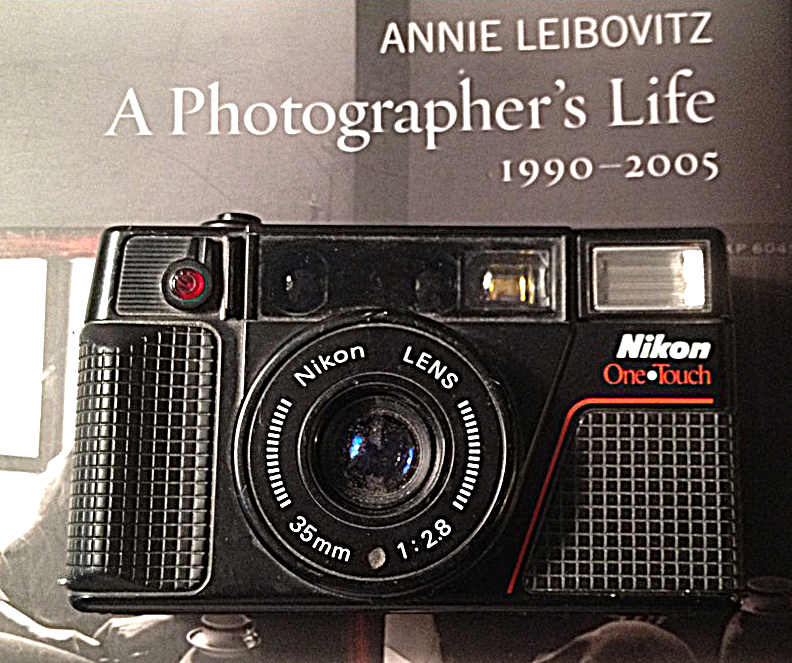
Figure 1 - Nikon "One Touch" autofocus consumer camera, 1985. (c) DE Wolf 2014.

Figure 1 – Nikon “One Touch” autofocus consumer camera, 1985. (c) DE Wolf 2014.

This past weekend I was depositing my trash at the town dump.  It sounds like a simple task.  But among Yankees (I am a Yankee come lately, and BTW this has nothing to do with a certain baseball team that has appropriated the name) this is more of a rite thank a task.  Trash is sorted and recycled, and most importantly treasures are recycled, or passed on to new owners.  I usually focus on the book swap, but this Saturday I wandered into what is fondly referred to as “the put and take.” The name explains it all. And there waiting for me was the little black beauty of Figure 1- a Nikon One Touch.

Now I do not collect old cameras, although I do have a few old consumer cameras of note.  That was a minor collection started for me by my son, who one Christmas gave me a nice little Kodak Brownie. Incongruously, it too is made of black plastic.  Go figure!

Of course, I went home to explore this little Nikon more thoroughly.  As it turns out the “One Touch” is part of the L-Series.  The L-Series began in 1983 with the L35 AF/AD.  This was Nikon’s entrance into the autofocus market for consumer cameras – really a moment in photgraphic technological history.  I use the term “consumer cameras” to distinguish them from SLRs.  That explains the AF.  What the AD stands for is “auto-date” the camera marked each frame with the date. This was pretty high tech for 1983.  In 1985 Nikon introduced the first of the “One-Touch Series,” the  L35AF2/L35AD2/One•Touch. This has a elegant automatic window that covers the lens when it is not in use.

So what’s the point?  The point is that these cameras are elements of a transitional technology that took us from 35mm SLRs with their autofocus and autoexposure features to today’s DSLRs and more importantly today’s pretty sophisticated digital point and shoots.  Today you’ve got to try pretty hard to take bad pictures.  It can be done, however.  But the significant fact is that today’s cameras, which are really little photographic robots complete with their own little microprocessor brains, make it a lot easier to take technically good pictures – freeing the Sunday photographer to fulfill his/her artist destiny.

So my heading into the little “put and take” shed was a sort of trip down memory lane back into into the early eighties.  Those were the days of big hair styles.  Who can forget Meg Ryan in “When Harry met Sally,” which was 1989?  The other part of the nightmare were shoulder pads, which often came in several layers making the women look like football players.

The faceless army

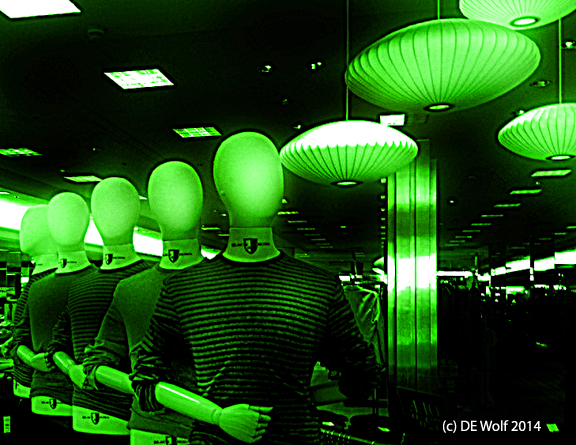
Figure 1 - The faceless army, Natick Massachusetts. (c) DE Wolf, 2014.

Figure 1 – The faceless army, Natick Massachusetts. IPhone photograph. (c) DE Wolf, 2014.

I need to make a confession.  It was a beautiful day here in Massachusetts and despite the glory of the sunshine and a gentle breeze, I went to the Mall for a morning walk.  So I feel that I need to explain why, to explain my strange little foible.  I go in search of espresso.  I end my walk sitting in a chair, observing the shoppers, and sipping on espresso.

Saturday morning is a contemplative time for me.  So in my contemplations I have begun to become aware that there is a silent, faceless, often headless or armless army among us.  These are the manikins or mannequins.  The used to have faces with beautiful painted eyes.  And I have been trying to understand how they have lost their heads and become faceless.  I suspect that it has something to do with the desire to make them neutral so as not to attach a racial or ethic identity to them.  Indeed, where I grew up the eyes were always blue.

But the effect of all this dismemberment and eradication of identity is rather eery.  Today was the most disturbing yet featureless faces covered with canvas, like in a nightmare. They are everywhere and they come across as something very alien – or maybe are all too familiar.  The facelessness or headlessness betrays a social decapitation.

They are not us.  Or worse, they symbolize modern man and modern woman in some disparate existential sort of way.  They are like the homeless, the poor, the slaves – we try to ignore them.

Perhaps less caffeine tomorrow. 8<}


Photographing bronze

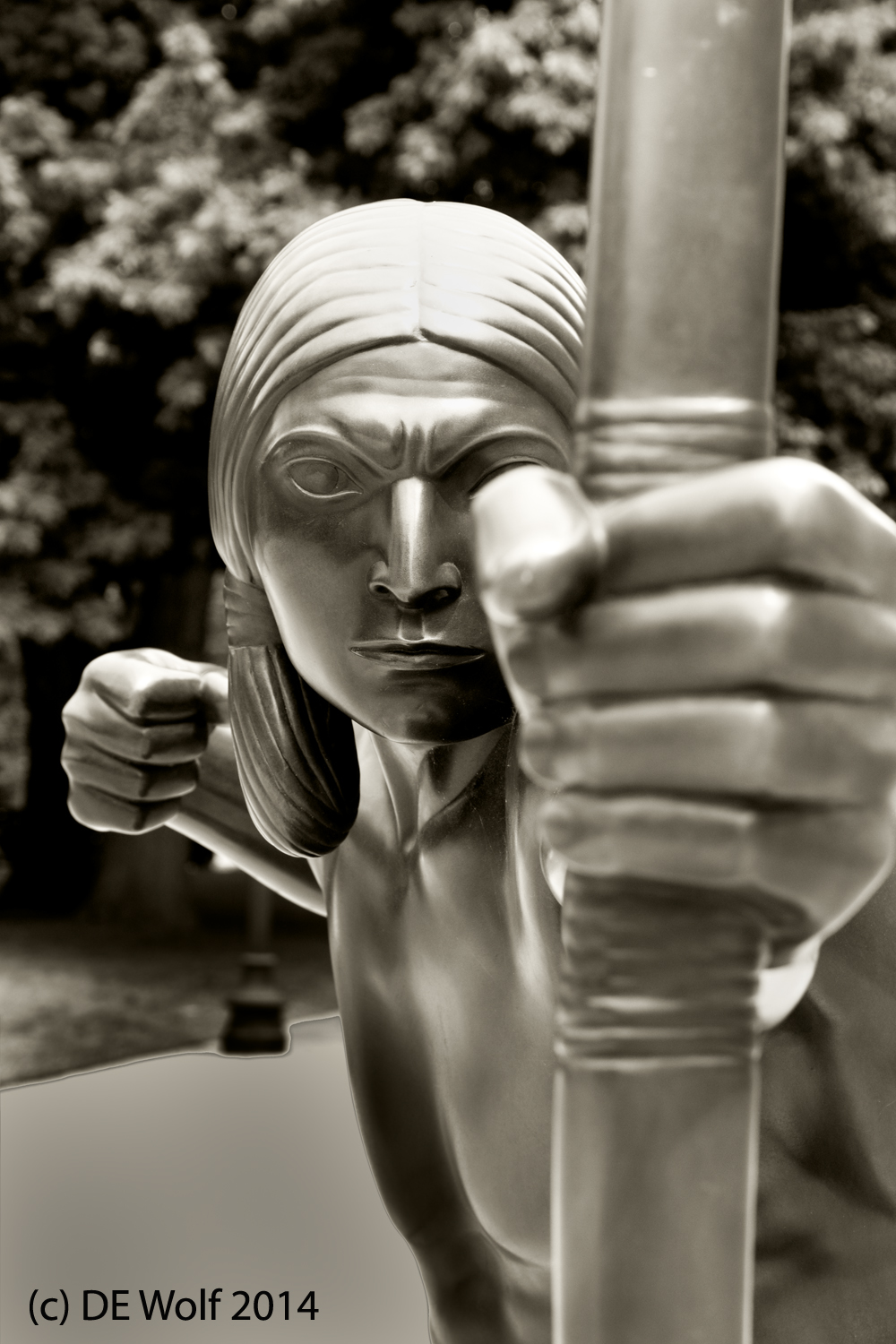
Figure 1 - Paul Manship's Indian Hunter, Boston, MA.  (c) DE Wolf 2014.

Figure 1 – Paul Manship’s Indian Hunter, Boston, MA. (c) DE Wolf 2014.

On Sunday my wife and I headed into the Boston Museum of Fine Arts to catch up on all of the special exhibits that we had been meaning to see.  I was particularly interested in an exhibit on photographic pictoralism and will discuss that in an upcoming blog.

I love museums, and one of the reasons that I love them is that they invariably offer up interesting subjects to photograph.  Among my favorites are bronze and marble sculptures.  I was enraptured on Sunday, as I always am at the MFA.  Unfortunately, I cannot share most of these pictures because one’s not allowed to publish pictures taken in the museum.  That’s part of the agreement when you pay your admission fee.

So, I’d like to share today the photograph of Figure 1, which is of a gorgeous bronze of an Indian (Native American) hunter by Pan Manship (1885-1966), the sculptor who brought us the beautiful statue of Prometheus in Rockefeller Center in NYC. And fortunately this sculpture is in a very public place, right in front of the museum’s historic Fenway entrance.

What I love so much about bronze as a subject matter for photographs is: the subtle yet rich golden color and the dramatic way in which it catches light. I immediately take the image to black and white, suppressing all that beautiful color and then I bring it back by sepia toning as a final step. The amazing part, the true magic of digital photography, is magnifying each region of the image and delicately burning in the highlights with a fine digital brush and similarly darkening the subtle shadows.  It’s a lot of work, but so often worth the effort.

When I first did this I realized how hard it would be to do it on a silver gelatin work.  Although, there were chemical brushwork techniques that the masters used. It is a clear advantage of the digital photographic medium, and best of all you can easily discard your work and start all over again.

The photominimalism project

I have mentioned that I have been working on what I have been calling the Photominimalism Project and today I have put up a Photominimalism Gallery highlighting a first set of photographs from this project.  These are images of strands of seaweed, drenched, wet, or dry taken on the beaches of Kennebunkport, ME in May may also be found at the bottom of this page.

Minimalism as a form in both music and visual art describes work that sets out to strip the subject of non-essential forms, features, and concepts thereby exposing its essential identity. As an artistic movement it evolved in the mid-twentieth century and is strongly associated with prominent artists including: Ad Reinhardt, Tony Smith, Donald Judd, John McCracken, Agnes Martin, Dan Flavin, Robert Morris, Larry Bell, Anne Truitt, and Frank Stella. My son taught me to appreciate this kind of art, given me the gift of his love of this body of work.  And I must say that there is something very exhilarating at encountering  the quintessence of a subject.

A couple of years ago, I walked among the flotsam at tides edge at the beach and I was struck by the minimalist nature of little strands of seaweed perhaps joined perhaps with a shell in the sand.  It reminded me so much of minimalist work.  Of course, I do break the rules here.  Not every image is stripped of detail.  Indeed, some of my subjects revert back to a love of fine detail, like a photograph by Edward Weston.  But I am not going to apologize for that.  Each image stands on its own merit, either is appealing or is not. Such is always the case.

Finally, I should point out that I use the term photominimalism in the concept of minimalist art.  More often the term “photominimalism” refers to a technique in artistic photograph where “more is better. An example would be my recent image of a weathervane.  The subject is essentially enveloped by an expanse of blue sky.  But that was not my purpose here.  My purpose was to delight in very simple things, as if the seaweeds lying in the sand were a form of writing or a graphic in the sand.  They have no more meaning than that, and I hope that you will enjoy them.

Invalid Displayed Gallery