Canada Goose – Branta canadensis

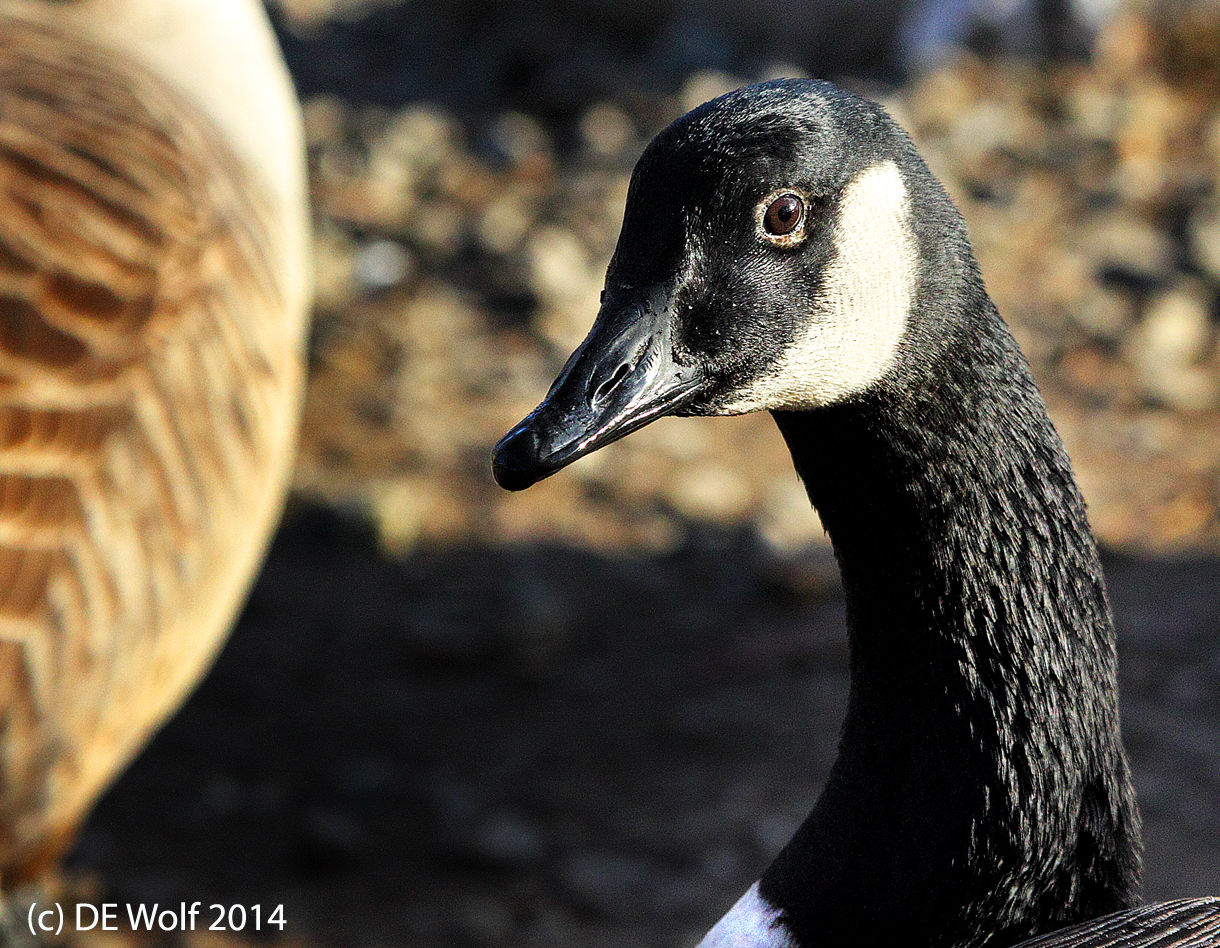
Figure 1 - Canada Goose, Marlborough, MA, December 2014. (c) DE Wolf 2014.

Figure 1 – Canada Goose, Marlborough, MA, December 2014. (c) DE Wolf 2014.

Many a Massachusetts High-techer who found themselves dodging wads of goose poop in the company parking lot or worse being “attacked” by a Canada Goose for coming too close to a nest in the grass beside the lot will long ago have labeled these majestic birds as a nuisance. But I believe them to be noble animals descendants of at least a hundred million years of evolution.

And whenever I see them my thoughts go back to an early spring afternoon, when I was driving from Ithaca to Aurora, NY many years ago.  The sky was a brilliant orange and it was filled with Canada geese (Branta canadensis) on the great migration north.  They were all around us, suddenly descending into a cornfield. The scene was inspiring, and I saw these travelers for what they truly are, the epitome of another realm of nature, where the ability to play out deeply programed instinctual behaviour is dominance.  We have our niche, they theirs.

The Canada goose was in trouble years ago and in many areas had to re reintroduced.  As a result many, indeed most, no longer migrate.  Still to me this tough adherence to avian instinct is part of the great appeal of birds.  In Figure 1, I have tried to capture the eye of the bird and used the sun reflecting from behind and to the right to illuminate the it with a catch-light that creates a sense of vitality. I am wondering exactly what he is thinking about me.
A new look for Hati and Skoll Gallery

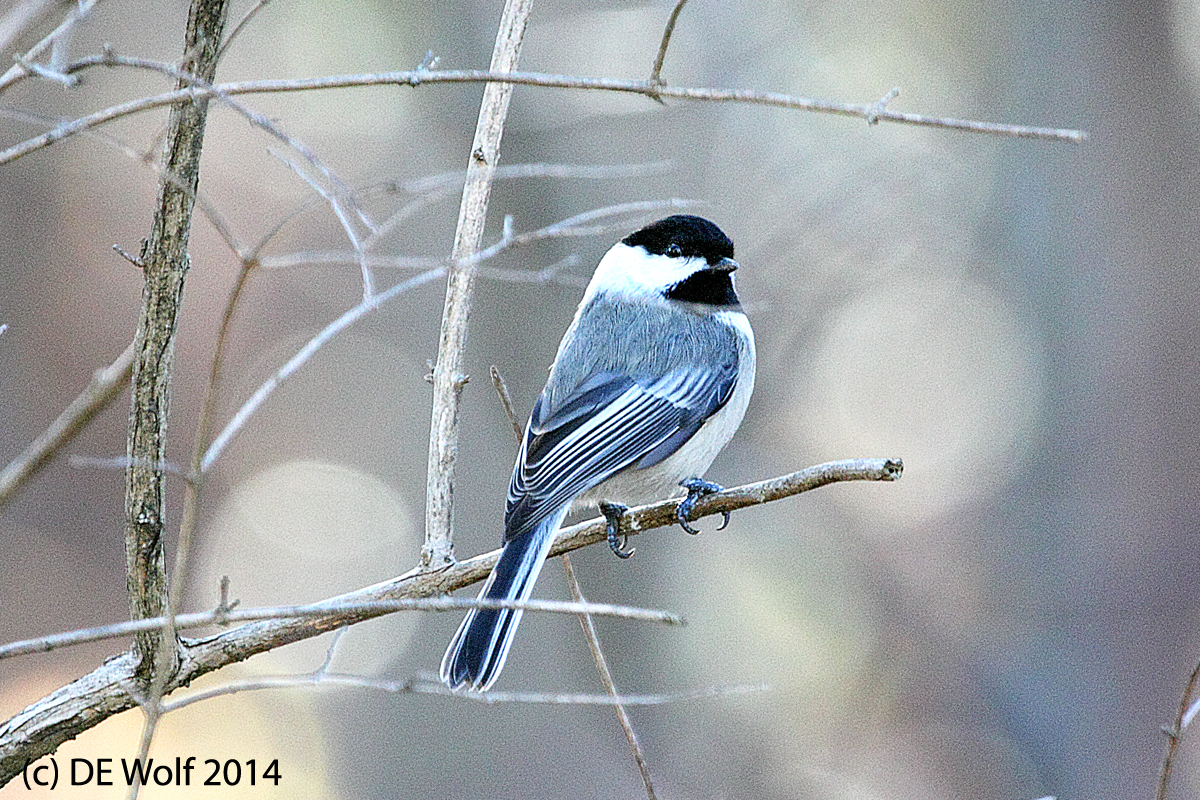
Figure 1 - Black-Capped Chickadee, Poecile atricapillus, Sudbury, MA. (c) DE Wolf 2014.

Figure 1 – Black-Capped Chickadee, Poecile atricapillus, Sudbury, MA. (c) DE Wolf 2014.

Regular readers of Hati and Skoll will probably have noticed that the look of the website changed over the weekend.  I have been dissatisfied with some of the features of the “Theme” that I was using (or lack there of) and have been planning on changing it and making the look zippier.  I welcome any comments on how it is now looking to you.  If you do write, please let me know what device you are using: laptop, laptop wide, IPad or other tablet, vertical or horizontal.  One of the big challenges nowadays is getting it to appear well in all formats , on all devices.

This is not the final refinement of the site.  I just wanted to get the new “Theme” up and running with all the pages intact.  So this is really only a first pass at it, and it will undergo further modification over the next few weeks.

I thought that I would also post the image of Figure 1, which shows the very noble little bird, indeed the Massachusetts state bird, the Black-Capped Chickadee, Poecile atricapillus. Learning to photograph birds is a major educational experience and it is particularly difficult for the smaller song birds like the chickadee. The continues to be a major sharpness issue.  This image was taken using a monopd at 400 mm with IS on, which I find is better than trying to use a tripod with IS off.

Canon T2i with EF100-400mm f/4.5-5.6L IS USM at 400 mm, ISO 1600, Aperture-priority AE mode, 1/250th sec at f/6.3 with +1 exposure compensation.


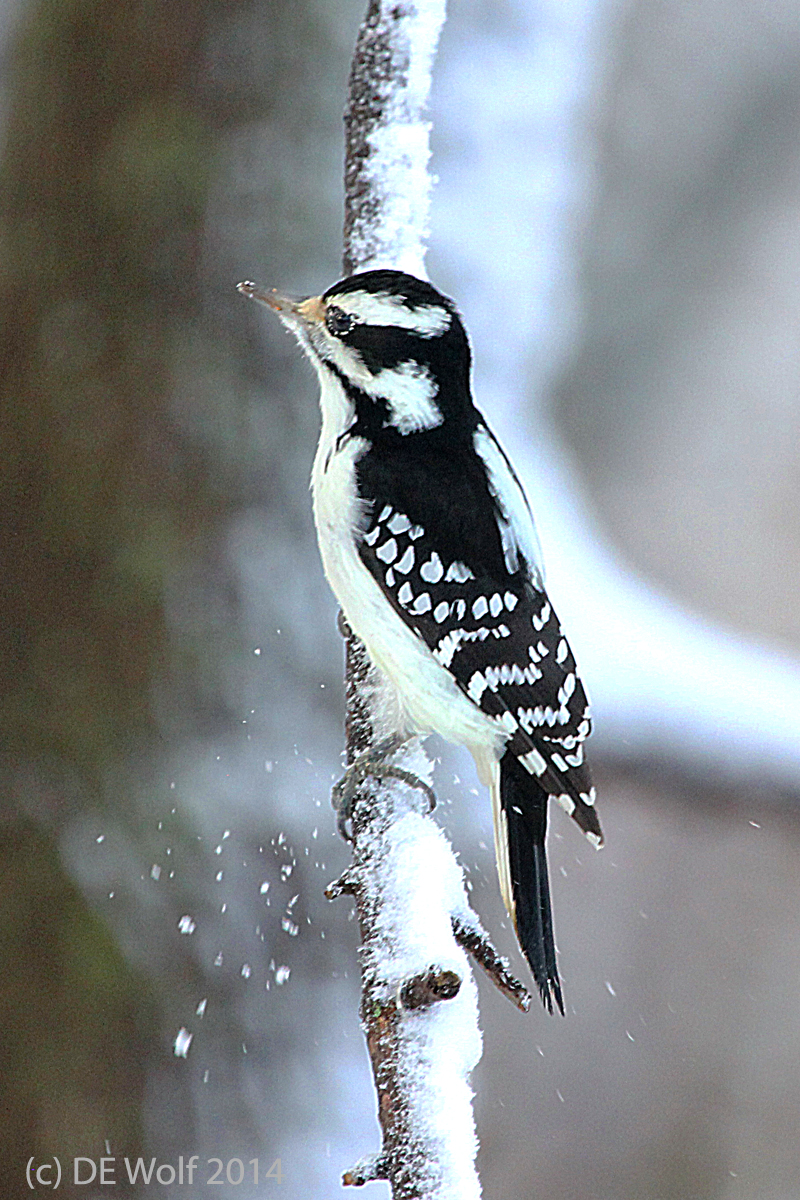
Hairy woodpecker – Picoides villosus

Figure 1 - Hairy woodpecker, Sudbury, MA. (c) DE Wolf 2014.

Figure 1 – Hairy woodpecker, Sudbury, MA. (c) DE Wolf 2014.

I photographed this female hairy woodpecker – Picoides villous – on Thanksgiving morning.  She had just landed on a branch that was covered with new fallen snow, and you can see some of the snow knocked off and falling in space. That is a feature of the image that I really like.  I also chose to set the background dark subduing the it into a twilight state and then dodging out the highlights in the feathers.

The hairy may be compared to the smaller downy woodpecker, distinguished by its size, longer beak, and lack of banding (“ladder”) on its tail feathers.

These are New England’s white-backed woodpeckers and are a common sight pecking away at trees.  Sometimes they awaken you in the morning by pecking at the shingles on your house.

Canon T2i tripod mounted with EF100-400mm f/4.5-5.6L IS USM lens at 400 mm, ISO 1600, Aperture-Priority AE mode, 1/320th sec at f/7.1 with +1 exposure compensation (because of the snow).

Thanksgiving Greetings from Hati and Skoll Gallery

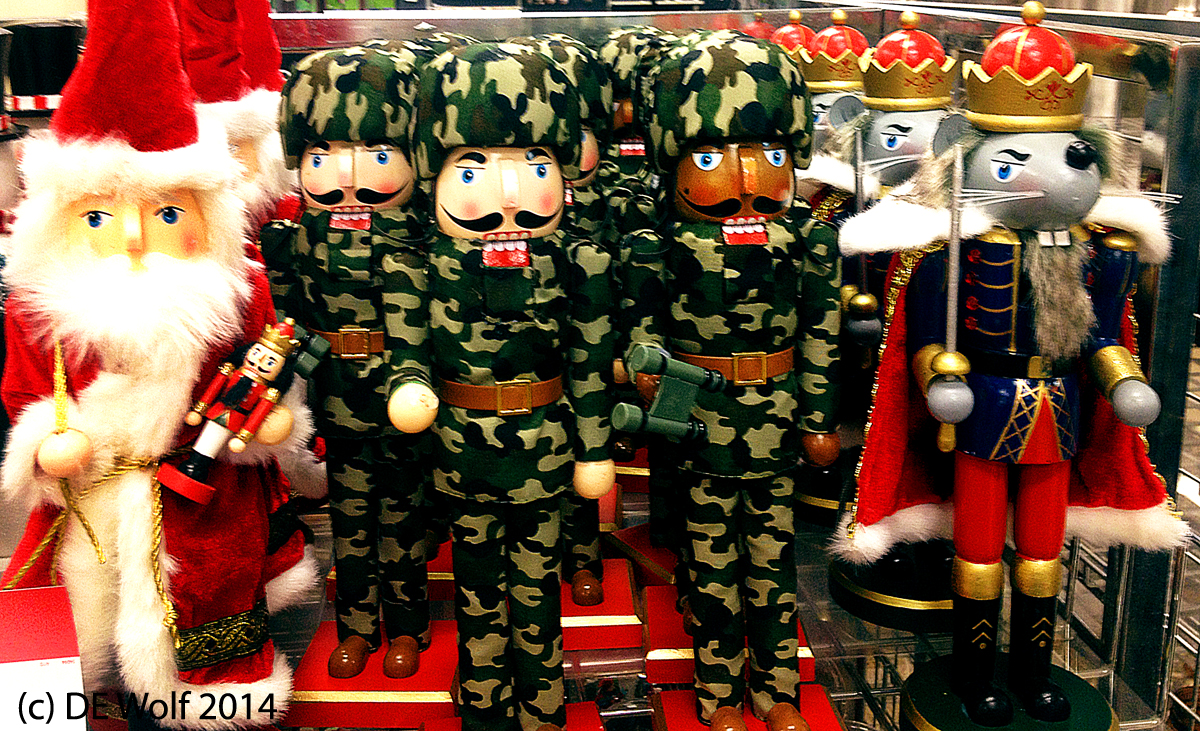
Figure 1 - The nutcracker Army. (c) DE Wolf 2014.

Figure 1 – The Nutcracker Army. (c) DE Wolf 2014.

I wanted to wish my American readers, indeed all of my readers, a very Happy Thanksgiving.  On my mall prowl this past weekend, IPhone in hand, I came upon these little nutcracker figures.  GI Joe nutcrackers struck me, at first, as just a bit odd; so I picked them up and looked at the base to read the labels “Army Caucasian Nutcracker” and “Army African American Nutcracker.” When I thought about it it occurred to me that there really wasn’t anything odd about, just something sad. The original nutcracker, the one in the ballet by that name, was as soldier.

What this modernization points out ever so poignantly is that for the last thirteen years we have been in arms and a minority of families have borne the brunt of that sacrifice.  So many families are spending the holidays apart, so many children won’t have their fathers and mothers with them. For them, these little nutcrackers will be just a bit of pride.  So for Thanksgiving I’d like to offer up this dress parade of nutcrackers of: Army Caucasians, Army African Americans, Mice, and Santa Clauses. I wish you all peace and family in our time.

Northern Cardinal (female) – Richmondena cardinalis

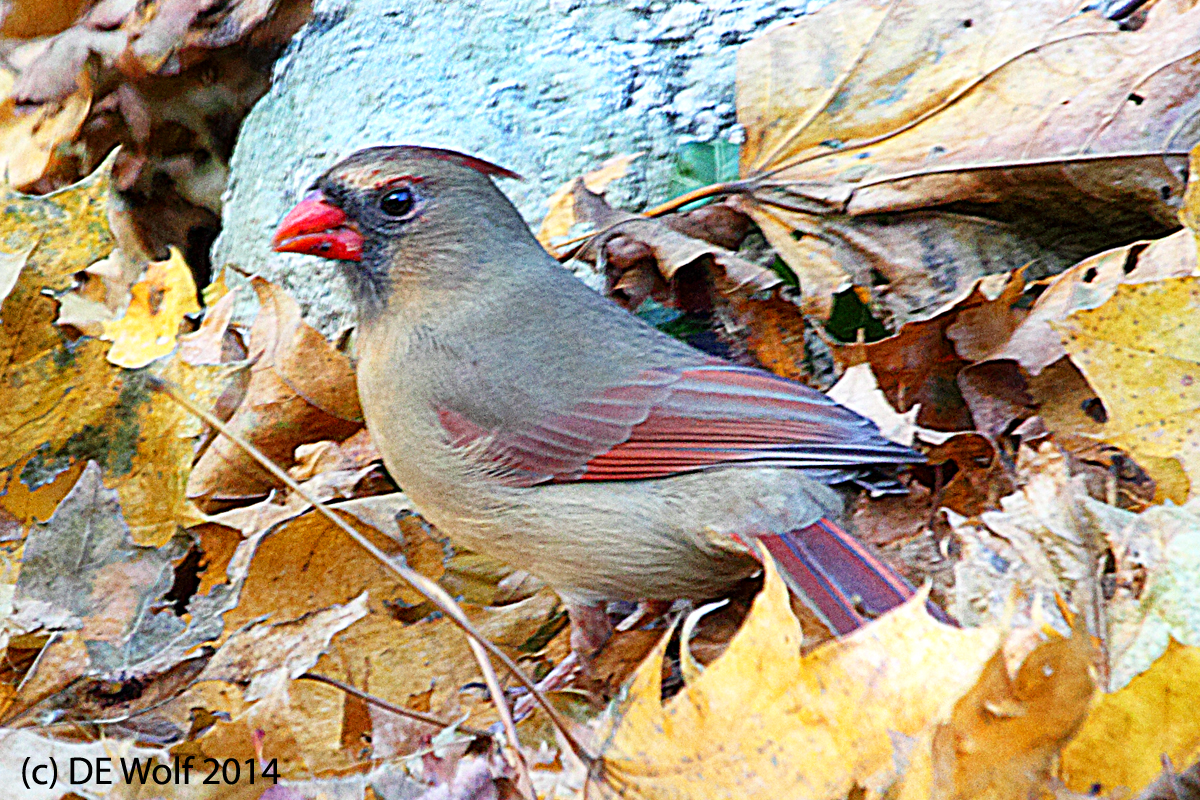
Figure 1 - Female Cardinal, Sudbury, MA. (c) DE Wolf 2014.

Figure 1 – Female Cardinal, Sudbury, MA. (c) DE Wolf  2014.

With winter coming I’m a little bit like a squirrel burying nuts.  I always have this image in my mind, I think it was a Chip and Dale cartoon, where they put up post-it notes about where each of their nuts is buried. “Under the tree by the rock…”So in preparation for being house-bound in the coming months due to cold and snow, I have set up two bird feeders in my backyard.  The key was to place them among the trees; so that I could get as natural a setting for by pictures as possible.  And, of course, the other goal was to place them so that I could shoot from the warmth of my family room, positioned so that if necessary I could eliminate glare with a polarizing filter.  The alternative positioning from all of this is to set up in the darkness of my garage and shoot through the back door.

I figured that it would take a couple of days for the birds to spot the buffet.  But when I returned a half hour after setting up, I was amazed to find that the chickadees, nuthatches, juncos, woodpeckers, sparrows, cardinals, and blue jays had spotted the apparatus.  The squirrels came about a half an hour later.

So Figure 1 is my first effort.  It shows a female Northern Cardinal – Richmondena cardinalis. The male is a brilliant scarlet.  My photographs of him today, did not quite meet my standards.  The female is a bit more subtle in coloration; but with the little tuft on the crown of her head, really just as beautiful.  Here she is under the feeder amongst the now decaying fall foliage.

The image could be a bit sharper to my taste.  I have some ideas about how to accomplish that.  So I will have to experiment.  This was tripod mounted with IS on, which may have been a mistake. The blah-dee-blah follows.

Canon T2I with EF100-400mm f/4.5-5.6L IS USM Lens at 400 mm. Tripod mounted with IS 1 on. ISO 800 Aperture-priority AE mode 1/80th sec at f/8.0 with no exposure compensation.

Sextuplet selfie

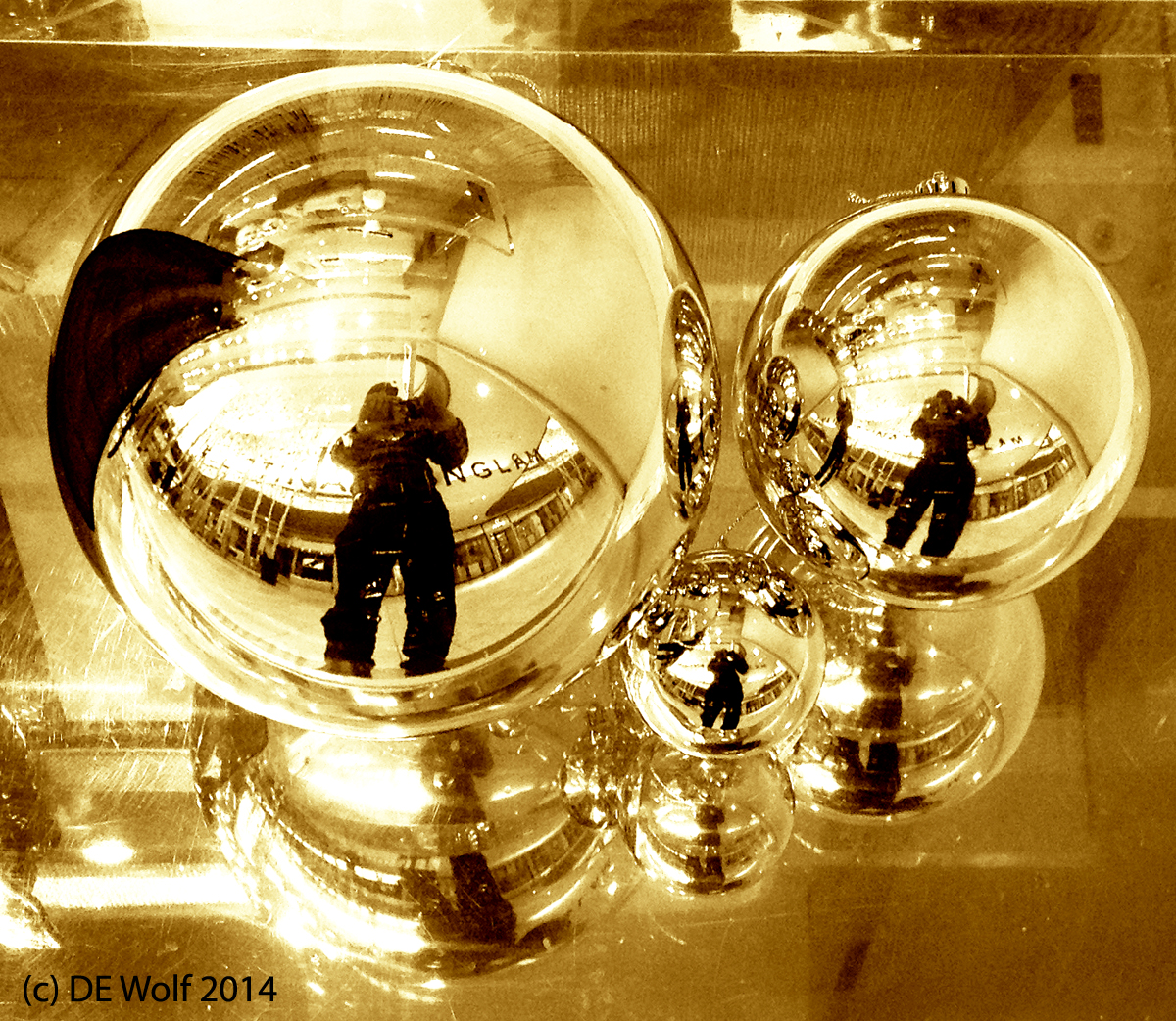
SextupletSelfieFBSeason change at the mall also means that I am intrigued by a whole new crop of bizarre IPhone photo-ops at the mall.  Besides the Santa Claus sign, Saturday I encountered a set of silver Christmas balls sitting on a mirror in a store window.  There they were six little images of me.  So I have gone over to black and white and dubbed the image of Figure 1 as “Sextuplet Selfie.”

Santa returns – more signs of the season

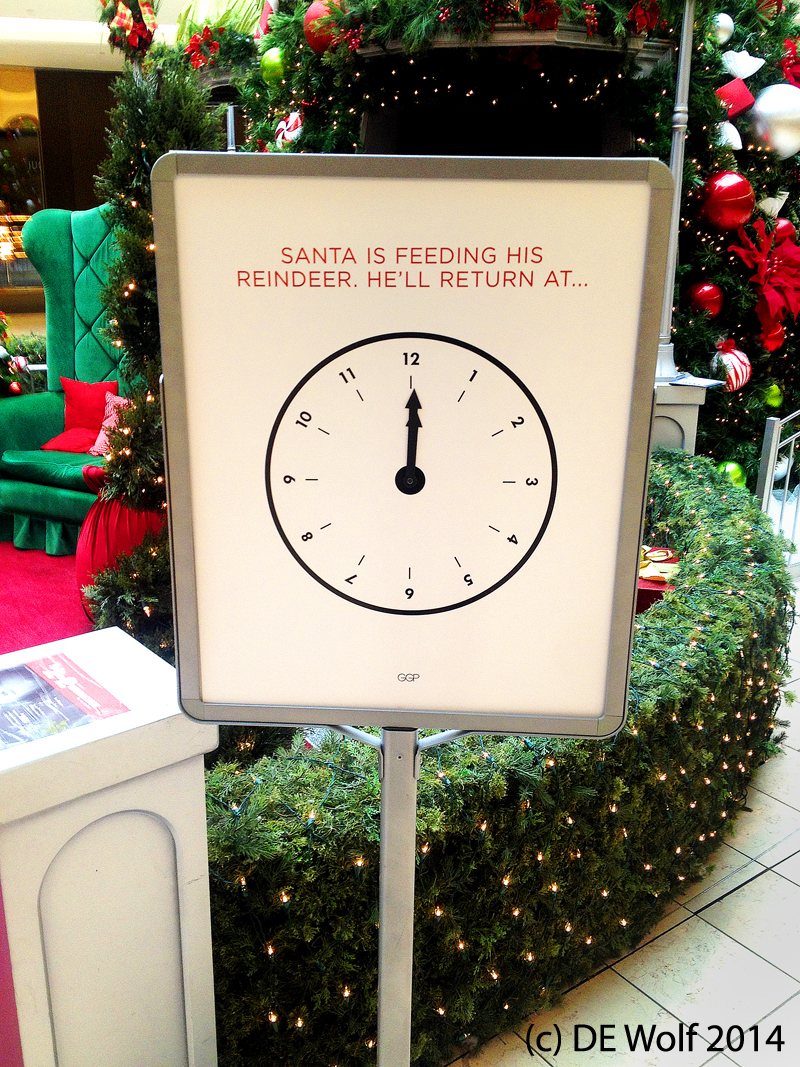
Figure 1 - The return of Santa Claus. (c) DE Wolf 2014.

Figure 1 – The return of Santa Claus. (c) DE Wolf 2014.

As I have mentioned, winter is here in the Northeast,  As for sure signs of the season: there are migrating birds, snowflakes, and nose-nipping cold.  So I was driven to the mall on Saturday to take a walk in the warmth – always capped off by espresso at the Nordstrom’s Ebar.

A few nights ago I had come upon Santa napping in his giant chair at the Mall and decided that snapping his photograph was a bit of an invasion of privacy. Oh alright, it was because I didn’t have my camera with me.  Santa is, of course, the ultimate sign of the holiday season. So he was well worth looking for. On Saturday morning, the Saturday before Thanksgiving, Santa was no where to be found, but to my great relief I soon discovered (see Figure 1) that his arrival was imminent.

The ring-necked duck revisited – Aythya collaris

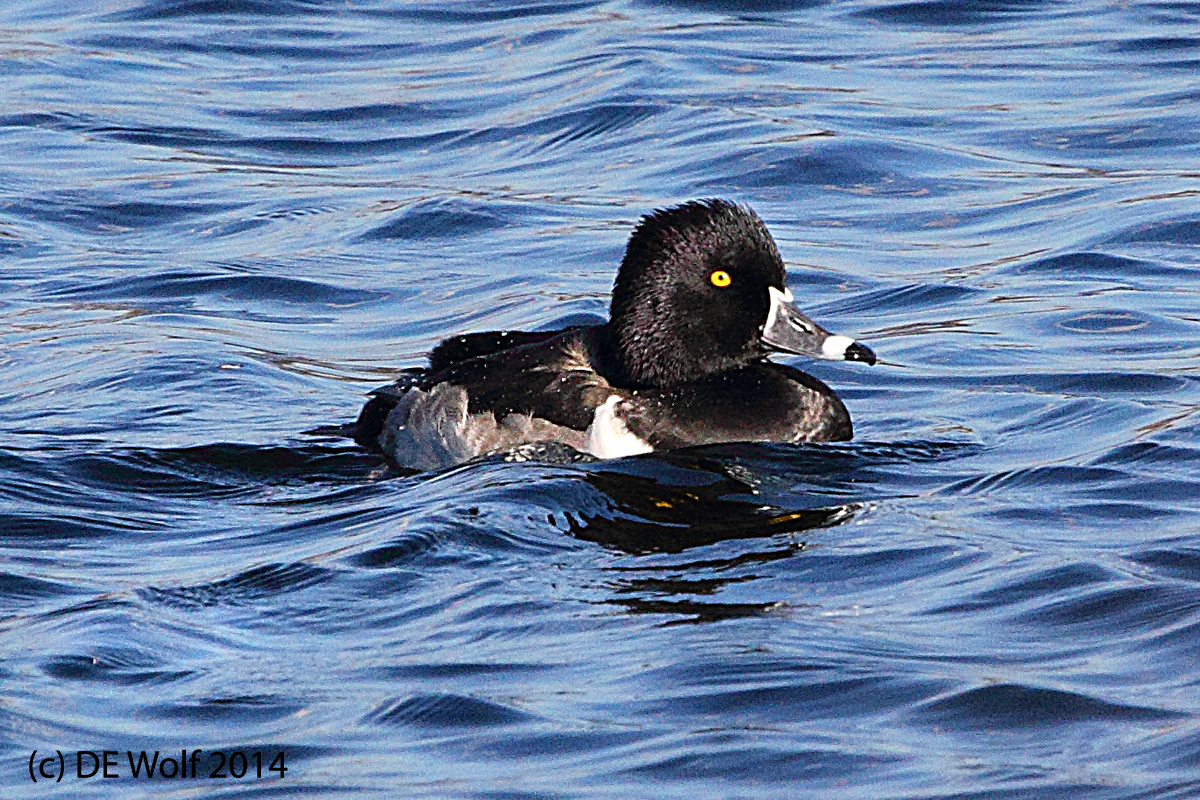
Figure 1 - Ring-necked duck, Fresh Pond Reserve, Cambridge, Ma. (c) DE Wolf 2014.

Figure 1 – Ring-necked duck, Fresh Pond Reserve, Cambridge, Ma. (c) DE Wolf 2014.

Last Thursday on my lunch time walk I brought my big lens in the hopes of photographing some juvenile double crested cormorants and ducks on Fresh Pond.  I wound up taking pictures of ring-necks at essentially the same site as the image I took with my 70 to 200 mm zoom and posted on October 19th. It gave me the opportunity to contemplate the relative virtue of the two lens when it comes to photographing birds.

The 100 to 400 mm zoom is cumbersome, and you have to consciously say to yourself: “Self, I’m going out with my lens and monopod to photograph birds.”  But in the end, and despite the fact that the 70 to 200 mm lens is just a bit technically sharper (It has a superior modulation transfer function), focal length trumps all.  So I think that the photograph of this Thursday (Figure 1) is superior at least in terms of image sharpness.

I learned another interesting point on Thursday.  When you’re walking around with a monstrous lens and photographing birds people think you really know.  People kept stopping and asking me about the identity of the birds that I was photographing and about their migratory behaviour. As it turns out I do have a pretty good knowledge of the birds.  But a major virtue of doing it with a camera is that you get to go home and pull out your Peterson Guide and cruise the internet to check your facts.

My internet searches this time rewarded me with a tidbit of understanding.  I have been wondering why the name, “ring-necked,” when there is no ring to be seen.  It turns out that there is a faint brown ring around the male’s neck that is so seldom seen in the field as to pretty useless as an identifier.

Canon T2i with EF100-400mm f/4.5-5.6L IS USM at 370 mm, ISO 800, Aperture-priority AE mode 1/1250th f/8.0 with no exposure compensation.

Hooded Merganser – Lophodytes cucullatus

Figure 1 - Hood merganser group, male and two females, Blac's Nook, Fresh Pond Reserve, Cambridge, MA. (c) DE Wolf.

Figure 1 – Hood merganser group, male and two females, Blac’s Nook, Fresh Pond Reserve, Cambridge, MA. (c) DE Wolf.

To my eye, the most beautiful of the New England ducks is the Hooded Merganser – Lophodytes cucullatus.  They migrate here in the fall and then again in April.  The hoods on the males are beautiful as are the ruddy and gray fuzzy heads of the females.  I have been trying to photograph them for about two years now.  It required my big lens, since they like to stay on the unpeopled side of Black’s Nook and head over there at the first sign of human presence.  Walk in their direction and they scatter dramatically, skirting over the water as if at play.

This particular morning, I decided to get them in my lens sights and just waiting.  they rewarded me by coming within about 75 meters, which was enough to capture them with the lens fully extended.  I just kept taking photographs and waiting for the right configuration and as a result was able to capture the image of Figure 1 of a male and two females swimming by.  The male’s hood is not extended; but I really like the grouping.  The image is a bit grainier than I like, a combination of using ISO 1600 and the need, even at this focal length to crop the final image.

Canon T2i, EF100-400mm f/4.5-5.6L IS USM Canon lens at 400 mm, IS 1 on, ISO 1600, Aperture-priority AE mode, 1/400th sec at f/8.0 with no exposure compensation, camera monopod mounted.