The Triangle Shirtwaist Fire – America transformed by image

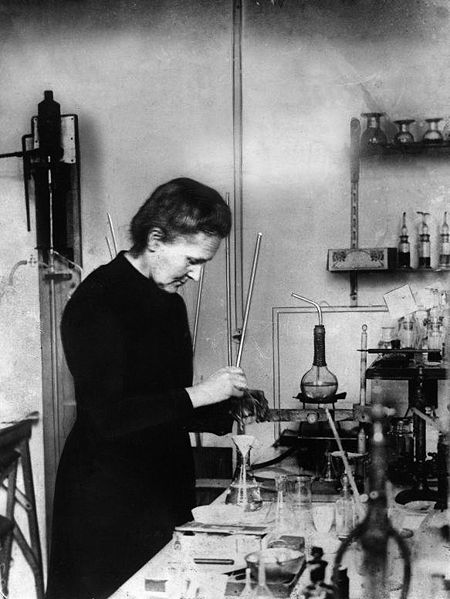
Figure 1 - Alice Roosevelt in shirtwaist, "The ideal Gibson Girl," from the Wikicommons and the Library of Congress in the public domain.

Figure 1 – Alice Roosevelt in shirtwaist, “The ideal Gibson Girl,” from the Wikicommons and the Library of Congress in the public domain.

In John Thompson‘s and Jacob Riis‘ photographs we see two important forces for social progress.  The first is the developing social awareness of the injustice of the industrial age.  The second is the ability of the then relatively new media of photography to spread that message – or as we say today to “take that message viral.”

In the Northeast (of the United States) poverty fueled the garment industry.  If you have the opportunity I strongly recommend a visit to the National Historic Park in Lowell, Massachusetts.  Immigrants poured into America in search of “the American Dream,” and were rapidly sucked up into the vacuum of the garment industry.  Not surprisingly, this lead to a new radicalism, which drew on the socialist movements of Eastern Europe.  In 1909 there were massive strikes in New York’s garment industry, demanding living wages and safe working conditions.  The police were under the control of the Tammany Political machine, in turn under the thumb of management.  Strikers were brutalized and imprisoned.

Sad, terrible, and yet pivotal events occurred on March 25, 2011 when the Triangle Shirtwaist Factory (or sweatshop) on Washington Square, now New York University’s Brown Building went up in flames.  In less than a half an hour 146 people, mostly young girls aged 14 to 23, died of smoke inhalation, fire, or from jumping to death from window ledges or down the elevator shaft.  The emergency exit had been blocked by management, so that the workers could steal scraps of material, and fire rescue ladders could not reach the eight floor were the fire took place.
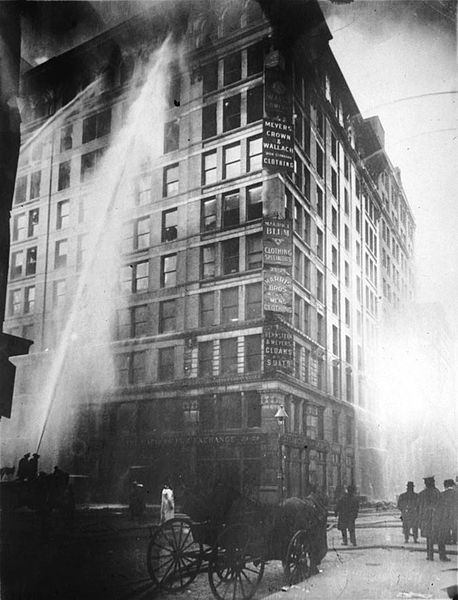
Figure 2 - New York City firemen attempt to controll the Washington Place fire, March 25, 1911 from the LOC and the Wikicommons in the public domain.

Figure 2 – New York City firemen attempt to controll the Washington Place fire, March 25, 1911 from the LOC and the Wikicommons in the public domain.

Vivid photographs of the scene were taken, and these are now archived particularly at the Library of Congress and Cornell University’s School Of Industrial Labor Relations.  Fueled by these striking, vivid images, which to our generation presage the “World Trade Center bombings,” people demanded action.  The Tammany bosses saw the opportunity to turn response into votes and started investigations.  Al Smith, who eventually ran for President in 1928 was a leader in these investigations.  It was a pivotal moment in history, one that led to the emergence of the Democratic Party as the progressive pro-labor American political party.

In these tragic events the role of photography as the collective eye of society emerges.  I think that we can tell this story with three images.  At the turn of the twentieth century, the Edwardian Period in England, the height of women’s fashion, the shirtwaist, was in high demand.  This was romanticized by artist Charles Dana Gibson and his “Gibson Girls.”  Figure 1 is a photograph of Alice Roosevelt (Longworth)(1884-1980), believed by many to be the quintessential Gibson Girl.  Figure 2 shows New York firemen desperately trying to extinguish the Triangle Shirtwaist Factory fire.  Figure 3 shows bodies of the victims being placed in coffins for transport to a makeshift morgue.  As in all such events, the true tragedy is to the lives of the victims and their families, whose lives are ended prematurely or shattered forever.  Their American dream was over, really before it began.
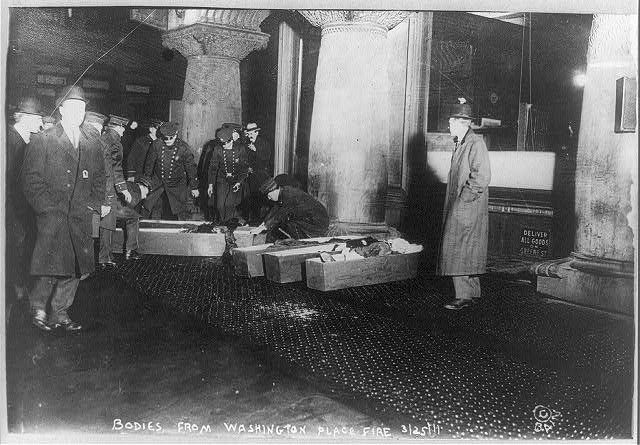
Figure 3 - Bodies of the victims from the Washington Place fire being placed in coffins fro the journey to the morgue, March 25,1911, from the Loc and the Wikicommons in the public domain.

Figure 3 – Bodies of the victims from the Washington Place fire being placed in coffins for the journey to the morgue, March 25,1911, from the Loc and the Wikicommons in the public domain.
Jacob Riis – Images of the slums of New York

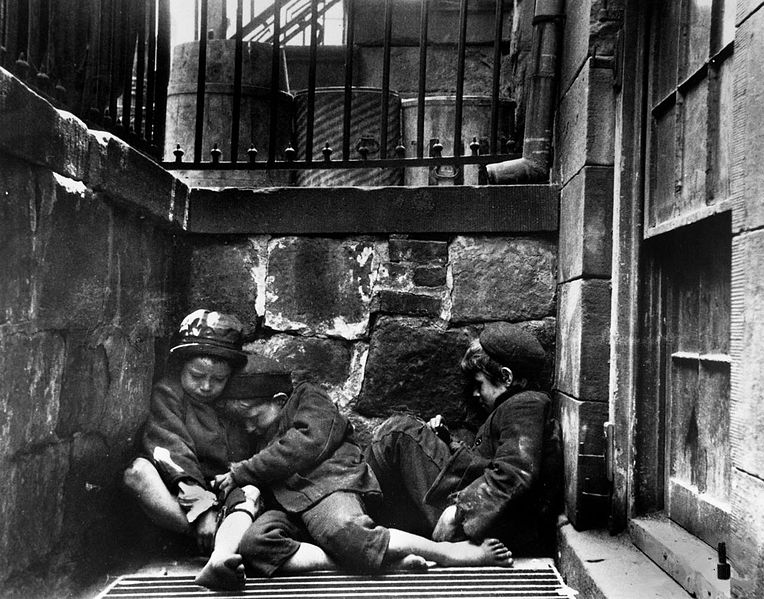
Figure 1 - Jacon Riis, "Children Sleeping in Mulberry Street, 1890," from the Wikicommons and in the public domain.

Figure 1 – Jacon Riis, “Children Sleeping in Mulberry Street, 1890,” from the Wikicommons and in the public domain.

Very much the American counterpart of John Thompson as a documenter of life in the urban slums and crusader for social reform was Jacob August Riis (1849 – 1914).  We see this so vividly in Figure 1 – “Children Sleeping in Mulberry Street, 1890,” which rivals Thompson’s “The Crawlers,” in its raw and gripping social message.  There are three filthy, yet innocent, children, barefoot, and sleeping huddled together above a grating – perhaps some small warmth emanates from beneath.  They are below street level, unseen – or if we see them, turn the other way.  It is as if they are prematurely buried.  They are certainly dead from the perspective of the megalith industrial city – then in its gilded age, that has consumed them.

Riis was a Danish immigrant himself.  He had learned of poverty directly, at one point sleeping on a tombstone in New Jersey, his only food apples that fell fortuitously in his path.  A carpenter by trade, he became a police reporter and this introduced him to the nameless poverty of the slums of inner New York City, acquainting him with the worst places like Mulberry Street where China Town met Little Italy and where police headquarters was.

Riis tried his hand at sketching to illustrate his exposes, but was no good at draughtsmanship; so he turned to photography instead.  Still he was thwarted by the slow lenses and emulsions of the 1880’s.  However, Riis learned of the invention by Germans Adolf Miethe and Johannes Gaedicke of flash photography.  Miether and Gaedicke  mixed magnesium with potassium chlorate and antimony sulfide to add stability.  The was stuffed in a pistol-like device that fired cartridges.   The pistol was both dangerous and threatening to the subject; so Riis soon replaced it with a frying pan in which the powder could be ignited.  The process was simple, albeit frightening.  Remove the lenscap and ignite the flash.  Riis survived and became one of the first Americans to practice flash photography. An eighteen-page article by Riis, entitled How the Other Half Lives, with nineteen of Riis’ photographs rendered as drawings, appeared in the 1889 Christmas edition of the them widely distributed Scribner’s Magazine. This was soon expanded into a book of the same title.

As the images of modern photographer-social reformers testify, Riis work did not eliminate crushing poverty in America.  It did however lead to very serious reform and to the development of America’s progressive movement.  Progress occurs by degrees.  Riis became a life-log friend and colleague of Theodore Roosevelt, himself a campaigner for social reform.  Roosevelt said of him; “Jacob Riis, whom I am tempted to call the best American I ever knew, although he was already a young man when he came hither from Denmark”.


More on John Thompson’s “The Crawlers.”

Figure 1 – John Thompson, The Crawlers, 1876-1877, From the Wikipedia posted by catus.man and in the public domain.

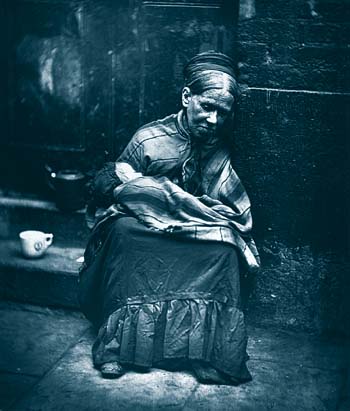
This past Wednesday, I posted about John Thompson’s important photography about poverty and namelessness in Victorian England and I found myself very much haunted by the picture shown there, and reposted here as Figure 1, entitled, “The Crawlers.”  What exactly were “The Crawlers,” what was the miserable story of the old woman shown in the picture?

To find out, I found a copy of John Thompson’s, “Victorian London Street Life.”  My first thought was that a crawler must be a beggar, the people at your feet  begging pennies.  But the despair is worse than that,  In Thompson’s own words:

Huddled together on the workhouse steps in Short’s garden, those wrecks of humanity, the crawlers of St. Giles may be seen both day and night seeking mutual warmth and mutual consolation in their extreme misery.  As a rule they are old women reduced by vice and poverty to that degree of wretchedness that destroys even the energy to beg.  They have not the strength to struggle for bread and prefer starvation to the activity that an ordinary mendicant must display.

In other words they are beggars, who no longer have the will to beg.  We learn that the mother of the child shown was such a crawler, but that she managed to find employment and, of course, her worked demanded that she be absent most of the day.  So she has trusted her baby to the old woman, who does it in exchange for a bit of tea and bread.  Sustenance that doesn’t always come.  And we learn also that the baby has a cough and we are left to wonder whether it will survive.  We already know the answer.

Like Dickens, Thompson’s goal was to raise the awareness of the English Middle Class.  Even a hundred and fifty years later, he succeeds brilliantly.  Next, I would like to discuss the person and work of the person who raised the same banner in America, Jacob Riis.

The Marathon Bombings: Images of terror, heroism, and resilience

I am adamant that I keep the focus of this blog on photography and image and not venture into public events or politics.  Still I cannot help but comment on the images of the Marathon Bombings and their aftermath that have literally bombarded us for the last week.

I woke yesterday at five AM to learn that Watertown, Massachusetts, the town where I work was under police siege; that Boston and all surrounding towns had been ordered into lock-down.  These are bizarre and incredible events.

People know that the Boston Marathon occurs on the holiday Patriots Day – conveniently scheduled on a Monday.  The actual events that started the American Revolution in Lexington and Concord Massachusetts, occurred on April 19, 1775.   So as I staggered downstairs into my kitchen in search of my morning coffee, contemplating the unfolding events of this April 19, I was greeted by musket fire as the Sudbury Minutemen reenacted the events of that April 19th.  The effect was surreal and thought provoking.

For the past week images of horror, of mayhem, of heroism have been played over and over again, seeming endlessly.  For those fortunate enough not to be directly involved, such events are a parade of images that will stay with us throughout our lives.  I can recite a list of mine: the Kennedy assassinations, the King assassination  the War in Vietnam, Kent State… The list plays on inescapable.  You may recall my discussion of Howard G. Davis’ collection of the photographs that haunted him and defined his life. I emphasize that these nightmares are for those fortunate enough not to be directly involved.  Their horror is firsthand; ours shared and collective.  None of the platitudes or aphorisms help the murdered, wounded, or maimed.

In the terrible events of this past week we have seen the power of image unfold in two ways: first in the creation of a common social consciousness and second in the way that peoples mementos, such as photos on an IPhone and photos from robotic eyes all around the city ultimately led to the identification of these terrorists.

I return to the contrast between April 19, 2013 and April 19, 1775.  The President was correct when he said that as, clearly seen in the videos and still images of the events of last Monday, terrorism failed in the first instance as law enforcement, medical personnel, and ordinary citizens rushed to the aid of the wounded, oblivious to personal danger.  I have gone many times to Concord Bridge to watch the reenactments.  It’s usually cold and windy, sometimes wet. And I have wondered what special kind of person could stand on that bridge, armed with a flint lock rifle, and be ready to take on the greatest army in world, oblivious to personal danger and even iminent death.  I understand that a little better now.

Vintage Film of Anna Pavlova as the “The Dying Swan”

Today’s post is for those of you adicted to Masterpiece Theater’s miniseries “Mr. Selfridge.”  Follow this link to see vintage footage of the great and legendary ballerina Anna Pavlova perform her signature piece “The Dying Swan,” which was choreographed in 1905 by Mikhail Fokine.  The actual film was originally silent.  However, it is most often shown dubbed with Camille Saint-Saëns’  “The Swan” from “The Carnival of the Animals (Le carnaval des animaux)”.  Her last words were reported to be “Get my ‘Swan’ costume ready.”

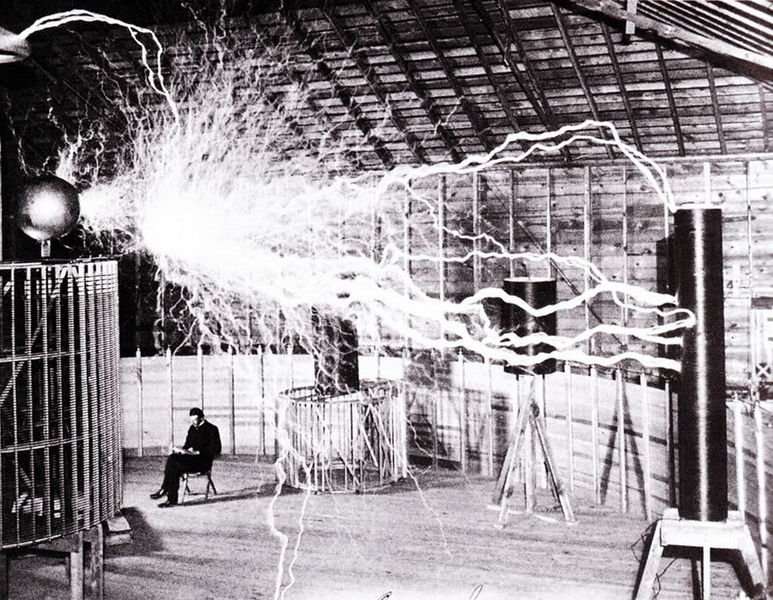
Nikola Tesla in his laboratory

Figure 1 - Nikola Tesla in his laboratory.  From the Wikicommons and in the public domain.

Figure 1 – Nikola Tesla in his laboratory. From the Wikicommons and in the public domain.

Among the great “scientist in the laboratory” photographs is the image of Figure 1, showing the great inventor Nicola Tesla (1856-1943) in his Colorado Springs laboratory.  He sits in deadpan concentration at his reading undaunted by the tremendous (multiexposure) bolts of electricity flashing above him.  It is just what Tesla wanted to portray, the safety of high powered alternating current as opposed to the dangers of high powered direct current.

Tesla was the ultimate showman.  In that respect he is accurately portrayed by David Bowie in the film, “The Prestige,” starring Hugh Jackman and Scarlett Johansonn.  This film is one of my personal favorites, and I recommend it to anyone who likes their period pieces with just a tad of science fiction.

Nikola Tesla was a Serbian-American inventor, physicist, and futurist.  He came to America in 1884 to work with Edison.  However, he soon found his own financial backers and broke with Edison to set up his own laboratory and company.  He sold the rights to his AC induction motor patent to George Westinghouse and served as a consultant for Westinghouse in the development of alternating current, which indeed is a safer form of electrical energy.  Tesla was well known for his high-voltage, high-frequency power experiments in New York and Colorado Springs.  Beyond electrical power he made major contributions to radio transmission, radio control, and the development of practical X-ray instruments.  He was truly one of the intellectual giants of the nineteenth and twentieth centuries.

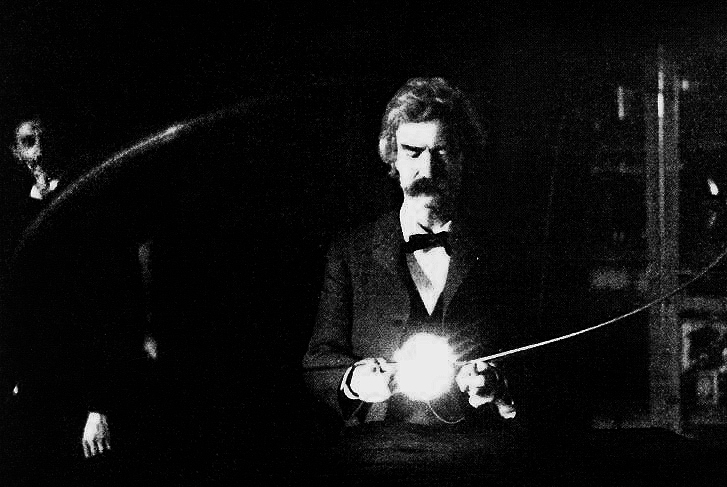
I can never resist a photograph of Mark Twain; so I include below Figure 2, which is an image of Mark Twain in Tesla’s laboratory in 1894.  I believe that what we are looking at is Twain igniting a phosphor coated gas discharge lamp by touching it because he is transmitting high frequency alternating current, from a Tesla coil, over the surface of his body.  In a modern sense the picture is reminiscent of the famous candle lit paintings of sixteenth/seventeenth century French artist Georges de La Tour (1593-1652).  I love the obscure image of Tesla looking on in amusement and the spherical flash of light creating a sphere on the left.

Mark Twain in Tesla's laboratory.  Originally from The Century Magazine from the Wikicommons and in the public domain.

Mark Twain in Tesla’s laboratory. Originally from The Century Magazine 1894 from the Wikicommons and in the public domain.

John Thompson – Street Life in London

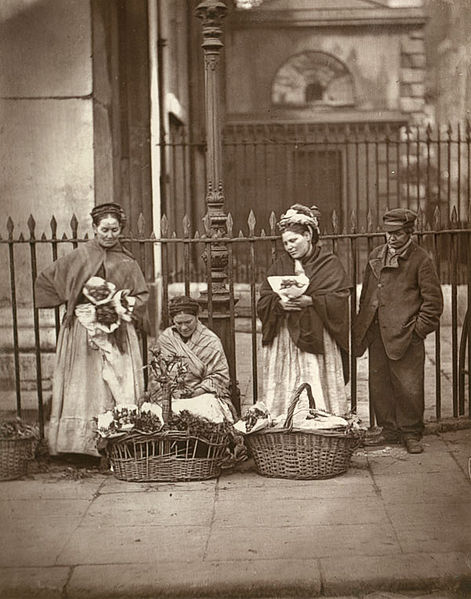
Figure 1 - John Thompson, Flower Girls in Front of Concvent Garden.  From the Wikicommons and in the public domain.

Figure 1 – John Thompson, Flower Girls in Front of Concvent Garden, 1877. From the Wikicommons and in the public domain.

John Thomson (1837 – 1921) was one of the great Scottish photographers of the nineteenth and early twentieth centuries.  In his early career he gained notariety as a travel photographer and was one of the first photographers to document the far east.  In his later career he became a society photographer in Mayfair and was awarded the royal warrant.But what he is most remembered for today is his partnership with radical journalist Adolphe Smith.  The two collaborated in the production of a monthly, Street Life in London, between 1876 – 1877, which was subsequently published in book form in 1878.  The project was to document London street life, the lives of the people who scratched out there living invisible and just beneath the eyes of the middle and upper classes.  These were images of chimney sweeps, and flower girls, and peddlars.

Figure 2 - John Thompson, The Crawlers, 1876-1877, From the Wikipedia posted by catus.man and in the public domain.

Figure 2 – John Thompson, The Crawlers, 1876-1877, From the Wikipedia posted by catus.man and in the public domain.

These powerful images represent one of the first great social commentary photographic series.  and served to create a visual resonance to the stories of Charles Dickens.  Life was not rosey on the streets of London. Take, for instance, figure 1, which shows flower “girls” in front of Convent Garden.  They are not Eliza Doolittle. In Smith and Thompson’s own words:

When death takes one of the group away, a child has generally been reared to follow in her parents’ footsteps; and the” beat” in front of the church is not merely the property of its present owners, it has been inherited from previous generations of flower-women. Now and then a stranger makes her appearance, probably during the most profitable season, but as a rule the same women may be seen standing on the spot from year’ s end to year’s end, and the personages of the photograph are well known to nearly all who are connected with the market…”

Truly, in creating Street Life in London, John Thompson defined the profession of photojournalism.  The powerful images that chronicle social injustice in the twentieth and twenty-first centuries have their roots, and owe their essence to these photographs by John Thompson.

Marie and Pierre Curie in their laboratory

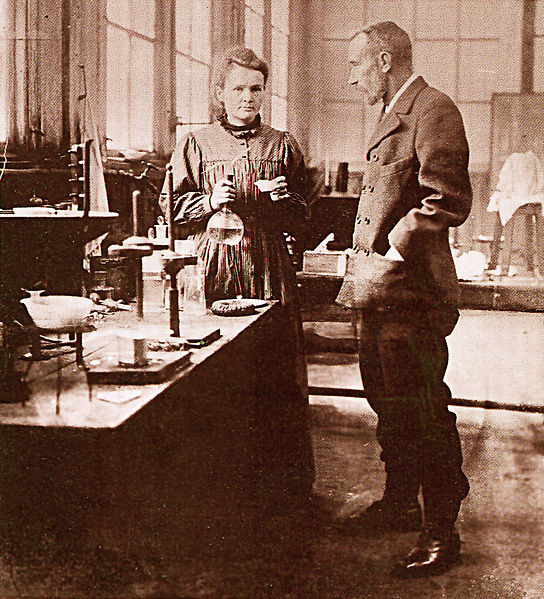
Figure 1 - Marie and Pierre Curie in their Laboratory.  From the Wikicommons and in the public domain.

Figure 1 – Marie and Pierre Curie in their Laboratory. From the Wikicommons and in the public domain.

As classic examples of the photographic genre “Scientists at work in their laboratories,” I offer up, first a picture of Marie (1867-1934) and Pierre Curie (1859-1906) in their laboratory (Figure 1) and then a later picture of Marie Curie alone (Figure 2).  The second most likely dates after Pierre’s untimely death.

Here the camera serves to chronicle, to capture a moment in time, and to place that moment in its historical context.  These images serve three purposes.  First, they are portraits of the Curies.  Second, they recorded, and now show us, what a physics laboratory was like at the dawn of the twentieth century,  And third, pershaps most significantly, since they were at some level posed, they show us the Curies in the way that they wanted people to see them.  Image for public figures was as important then as it is now.  Pierre looks more than a bit fatherly.  And Marie appears demure, not to mention gorgeous in her younger days.  What we see of her is her dedication to science, to family, and to country.  Despite her taking on a then masculine endeavour, she violates no social norms.

Figure 2 - A later laboratory picture of Marie Curie.  From the Wikicommons and in the public domain.

Figure 2 – A later laboratory picture of Marie Curie. From the Wikicommons and in the public domain.

It is important to mention what remarkable people the Curies were.  They were physical chemists in the late nineteenth and early twentieth centuries.  Chemistry text books began with the essential definition of an element as an immutable substance.  You could change its physical form.  You could melt or vaporize it.  You could react it with other elements.  But you could never turn it into another element.  But then the Curies’ measurements showed something very strange, elements could change into other elements.They were brilliant experimentalists.  Look around at the scientific instruments that they used.  Many of them were homebuilt and were the most accurate in the world.  They checked and rechecked their calculations.  But in the end, they opened up their minds and as scientists they embraced the epiphany before them.  And they opened the door to a true understanding of the physical nature of the universe.  In this regard, they are the architype of “the scientists.”

In ending, I’d like to draw your attention to a website that chronicles the arrival of these two Parisian dandies, or so they must have seemed to American westerners, on their arrival in Telluride, Colorado to buy dirt.

Robert G. Edwards and the degrees of image recognition

There are degrees to image recognition.  The meaning of some images is so crystal clear to us that we understand them on first viewing.  An example would be the Madonna and Child.  They appeal instantly to a  collective consciousness, to common mythology, and common  associations.  Arguably, they are culturally read, but as long as you share the cultural context you know what they connote.  I here offer as an example of these some of  of the images of Annie Brigman that we have discussed in previous blogs.  Then there are images that require some level of explanation – footnotes that can be contained within the image so that they become self explanatory.  Consider, for instance, the Barbie Doll image that we spoke about yesterday.  Take an image of an attractive nude woman holding a Barbie Doll and you just about get the point.  Draw lines on her body to show where fantasy ends and reality begins and the whole point comes across.  These lines are your footnotes.  Finally, there are some images that require a historical or otherwise elaborate explanation.  Show me a daguerreotype of a man in a stove pipe hat, and I start to get interested.  Convince me, through facial feature, that it is indeed Abraham Lincoln, and the picture suddenly takes on a greater meaning picture.

A few months ago I discussed an image of Lesley and Louise Brown, a Madonna and Child.  Louise Brown was the world’s first test tube baby and Lesley Brown her mother.  Sadly, the recent publication of the image was to mark the early death of Lesley Brown.  The image appeals to us in the sense of instant recognition, as mother and child.  But, put in its historic context, it takes on a renewed and invigorated meaning.  There is a whole generation of mothers, who could never have been mothers, and children, who could never have been born, without the development by Robert G. Edwards and Patrick Steptoe of in vitro fertilization.

This week there was another image.  It seems to be a family portrait, like a million other family snapshots.  Perhaps, one thinks, it shows a grandfather and grandmother with their daughter and infant granddaughter.  We need the historic context to understand this image fully.  It shows Robert G. Edwards, Lesley Brown, test-tube baby Louise Brown, and  Louise’s own child.  The image was taken to mark the occasion of Edwards being awarded the Nobel Prize in Physiology in 2010.  Sir Robert Geoffrey Edwards, CBE, FRS (1925-2013) died this past Wednesday.