Cultural Democratization – The George Eastman House joins Google Art Project

We learn from PetaPixel that the world’s oldest photography museum, The George Eastman House in Rochester, New York has joined the Google Art Project.  Pictures from the Eastman House on the Google Art Project may be found at this link.

Google Art Project is an online platform which gives the visitor access to high-resolution images of artworks from the projects partner museums.  Google launched the project in February of 2011.  Beyond high resolution images the project offers Google Earth style walk-throughs of the physical museums and a single image chosen to be captured as a gigapixel image.  The Art Project promotes Google’s view that we are in a period of cultural democratization.  The control of knowledge and its dissemination is no longer controlled by a small elite.

At this point it is, perhaps, interesting to consider the works initially chosen by the Eastman House as representative of the history of photography.  We see many of the same faces that we have discussed previously in this blog.  This includes: Julia Margaret Cameron, Oscar Reijlander, Edward S. Curtis, and, Dorothea Lange.  Visiting the Eastman House in this way is exciting and I look forward to other major photography collections coming online in this way

Cal Whipple, George Strock, and the Buna Beach Photograph

The issue of photographs of horrific stories is not a new one. Addison Beecher Colvin Whipple (1918-2013) has passed away. During World War II, Mr. Whipple worked for Time-Life Publishing at the Pentagon. His job was to get photographs cleared by the military for assignments and then to get the images that they returned passed the military censors. In 1943, Whipple, then 25, found himself embroiled in a major controversy. Life magazine wanted to publish a photograph by George Strock of three dead American marines after the amphibious assault on Buna Beach in New Guinea.

Military censors refused Life’s request to publish the photo. Their policy was that no pictures of American soldiers killed in combat were allowed. And this view was amplified when it was realized on close examination that one of the marines lying face down in the sand was being consumed by maggots.  Whipple appealed the decision through the Pentagon. Whipple and Life believed that American’s needed a healthy dose of understanding of what the war was about, what the grim realities of it were.

Finally in September 1943 the decision went to the White House. President Roosevelt, the War Department, and the Director of the Office of War Information, Elmer Davis, decided “that the American people ought to be able to see their own boys as they fall in battle; to come directly and without words into the presence of their own dead.”

It is a controversy that we have seen again during the Iraq and Afghanistan wars.  Sadly seeing the horrible meaning of war appears to offer no deterrent. Like Strock’s photograph the words of Wilfred Owen (1893-1918), killed in “The War to End All Wars” forever go unheeded.

“My friend, you would not tell with such high zest 
To children ardent for some desperate glory, 
The old Lie; Dulce et Decorum est 
Pro patria mori.”

Frederick Cook – sometimes a fraud is simply a fraud

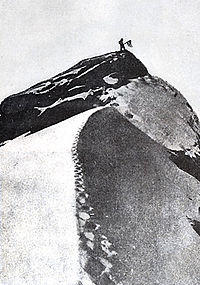
Figure 1 - Frederick Cook's fraudulant photography of his attainment of the summit of Mount McKinley in 1906.This location is now known as "Fake Peak."  From the Wikicommons and in the public domain.

Figure 1 – Frederick Cook’s fraudulant photograph of his attainment of the summit of Mount McKinley in 1906.This location is now known as “Fake Peak.” From the Wikicommons and in the public domain.

We’ve spoken about both sophisticated and unsophisticated photographic fakes.  But it’s important to remember that sometimes there’s no photographic slight of hand to it.  Sometimes a fraud is just a fraud.  Case in point is Frederick Cook’s (1865-1940) photograph of his “successful”  ascent of Mount McKinley, the highest peak in North America.  Besides claiming the first successful climb of Mount McKinley, Cook also claimed, to have reached the North Pole on April 21, 1908, a full year before Peary.  As discussed in yesterday’s blog, both claims are now disputed.

Cook was a physician and explorer.  He was a founding member of two New York both the Arctic Club (1894–1913) and the Explorers Club (1904–present). Dr. Cook was, in fact, the second President of the prestigious Explorers Club.

Cook claimed to have reached the summit of Mount McKinley on  September 1906, which would have made him the first person to do so.  After his claim to the North Pole came into question in 1909, his climb of Mount McKinley also came under scrutiny. Ed Barrill, Cook’s sole companion during the ascent signed an affidavit saying that they never reached the top.

Two modern climbers, Bradford Washburn and Brian Okonek, made it their mission to discredit Cook’s claim.  Between 1956 and 1995 they were able to identify the locations from which most of Cook’s photographs of the ascent were taken.  In 1997 Robert M. Bryce Bryce identified  the locations of the additional photographs, including his “summit” photograph, shown here as Figure 1.  This location, now known as “False Peak,” is approximately twelve miles from the summit and three miles below it.

The point of all of this is that you don’t necessarily need to manipulate images to create a fake.  You just need the imagination to do so and a lot of wishful thinking on the part of your viewer.  And if what I read on the social media is correct, as one false image after another is circulated, wishful thinking is bountiful.

Photographic firsts #11 – first photograph from the South Pole

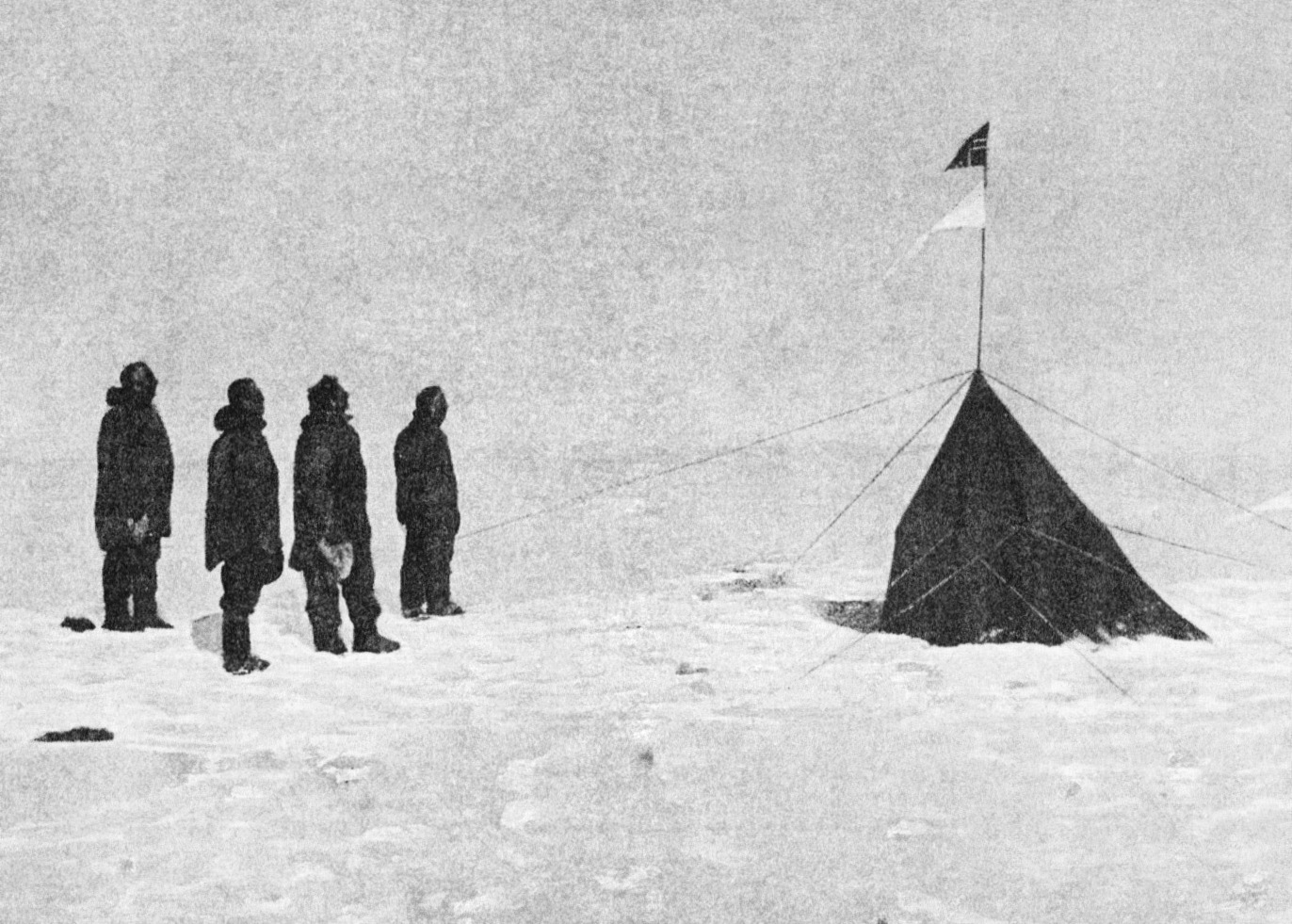
Figure 1 - Roald Amundsen, Helmer Hanssen, Sverre Hassel and Oscar Wisting (l–r) at the South Pole standing before "Polheim", the tent erected at the South Pole on 16 December 1911. Photograph by Olav Bjaaland, the fifth team member.  Originally published in Amundsen's "The South Pole."  From the Wikicommons and in the public domain.

Figure 1 – Roald Amundsen, Helmer Hanssen, Sverre Hassel and Oscar Wisting (l–r) at the South Pole standing before “Polheim”, the tent erected at the South Pole on 16 December 1911. Photograph by Olav Bjaaland, the fifth team member. Originally published in Amundsen’s “The South Pole.” From the Wikicommons and in the public domain.

All this discussion about great South Polar photographers begs the question what was the first photograph taken at the South Pole?  It was not taken by either Herbert Ponting or Frank Hurley.  But I get ahead of myself.

The English polar explorers were unquestionably leaders in scientific exploration.  But if you wanted results, namely the achievement of a goal, the Norwegians were a force.  And most formidable among them was Roald Engelbregt Gravning Amundsen (1872 – 1928).  By 1910, Amundsen has already led the first expedition to successfully traverse, the until then fabled, Northwest Passage across Canada between the Atlantic and Pacific Oceans (1903-1906).  One of our readers has commented how often a polar expedition has come to be labeled as ill-fated.  Amundsen’s South Pole Expedition (1910-1912) was anything but ill-fated.  It’s story is both legendary and remarkable.

After his Norrthwest Passage Expedition, Amundsen set his eyes on the North Pole.  He organized his North Polar Expedition and June 3, 1910, he set sail from Oslo. His ship was the famous Fram, previously used by another great Norwegian polar explorer, Fridtjof Nansen.  Amundsen learned that in 1909 two Americans, Frederick Cook and Robert Peary, separately claimed to have reached the North Pole.  At Medeira, he revealed to his crew his audacious plan.  The North Pole had already been claimed; they would head South.  And he sent a simple telegram to Scott:

"BEG TO INFORM YOU FRAM PROCEEDING ANTARCTIC--AMUNDSEN."

They reached  the eastern edge of the Ross Ice Shelf on 14 January 1911, where Amundsen established basecamp. Amundsen adopted Eskimo-style skin clothing, instead of the wool clothing worn by the English.  He used skis and dog-sleds.  He was an expert logistical planner.  In Amundsen’s own assessment in his book “The South Pole:”

I may say that this is the greatest factor—the way in which the
expedition is equipped—the way in which every difficulty is foreseen,
and precautions taken for meeting or avoiding it. Victory awaits him who
has everything in order — luck, people call it. Defeat is certain for
him who has neglected to take the necessary precautions in time; this is
called bad luck.”

Amundsen’s team, consisting of Olav Bjaaland, Helmer Hanssen, Sverre Hassel, Oscar Wisting, and Amundsen himself, departed on October 19, 1911, with four sledges and fifty-two dogs. On December 14, 1911, the team neared the pole.  Amundsen’s men held back in favor of their leader.  There should be no doubt who was the first man to obtain the “The Great Southern Nail.”  They arrived more than a month before Scott and his team. They left a small tent and letter stating
their accomplishment.  This was just in case they did not return safely home.  They returned to basecamp with eleven dogs, and their great success was announced on March 7, 1912 when they arrived at Hobart, Australia.

As I said, Amundsen was single minded in his attack on the Pole.  There was no science only committment and exploration.  They are known to have taken few photographs of the event.  Figure 1 shows the men standing before the Norwegian Flag on the tent that they left at the pole.

As a curious side note,  in 1926 Amundsen was among sixteen men who made the North polar crossing  in the dirgible “Norge.”   There had been three previous claims to the North Pole: that of Frederick Cook in 1908; of Robert Peary in 1909; and of Richard E. Byrd in 1926.  All of these are all disputed, either because of questionable accuracy in navigation or because of outright fraud.  As a result, it may well be the case that Amundsen was also among the first group of men to attain the North Pole.

Unfortunately, in the end, Amundsen was indeed ill-fated.  He disappeared on June 18, 1928 while flying on a rescue mission looking for missing members of the Nobile’s crew, whose airship had crashed, while returning from the North Pole.  In 2004 and again 2009  the Royal Norwegian Navy unsuccessfully searched with an unmanned submarine for the wreckage of Amundsen’s plane.
 

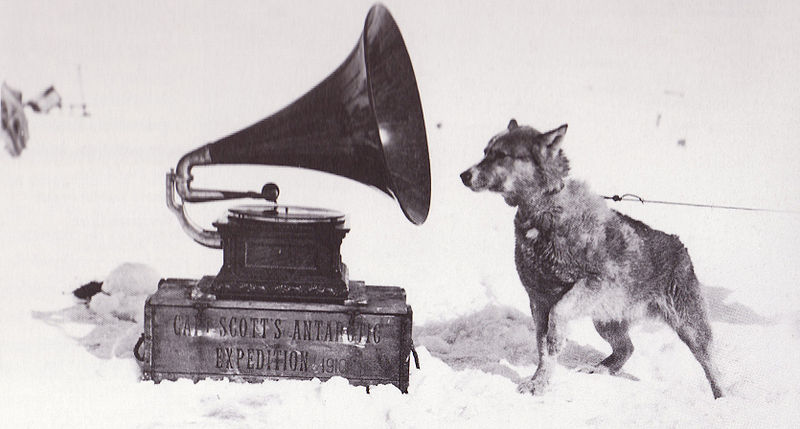
Herbert George Ponting, “Sled dog listening to gramophone, 1910”

Figure 1 - Herbert Ponting's "Sled dog listening to gramophone, 1910."  From the Wikicommons and in the public domain.

Figure 1 – Herbert Ponting’s “Sled dog listening to gramophone, 1910.” From the Wikicommons and in the public domain.

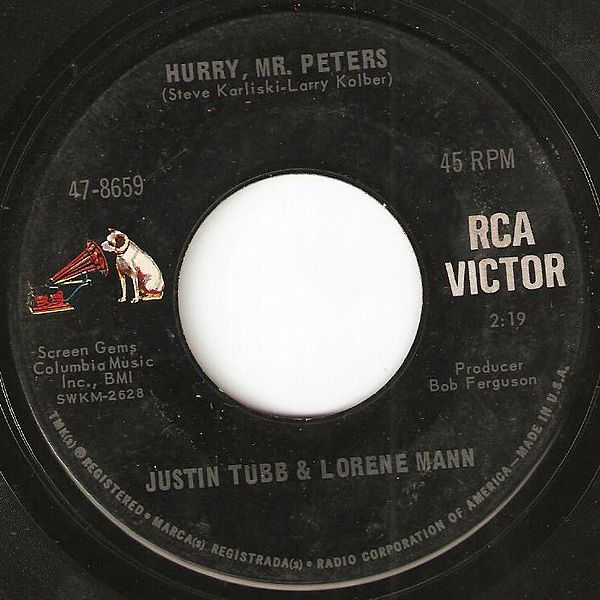
There is another Ponting image that I believe is very telling, and it is shown in Figure 1.  The image is of one of the sled dogs listening intently to a recording being play on a gramophone.  People of my generation will remember the RCA Victor Record Label (Figure 2) with some fondness.  We thought that we were at the height of technology, but really weren’t.  Indeed, there was always the sense that we were moving toward something wonderful and unknown.

Figure 2 - The RCA Victor record label not copywritten and in the public domain.

Figure 2 – The RCA Victor record label not copywritten and in the public domain.

So we have to look at Ponting’s “dog and gramophone” and realize that the image was taken on a glass plate negative barely a century ago.  When you went to the Antarctic in those days you were totally cut off from the world. There was no radio contact with the outside world. Indeed the trapped members of the Shackleton Trans-antarctic Expedition didn’t even know the details of the horrible World War, which nearly halted them in England.

It is tempting to say something cliché like “that dog and gramophone represents a transitional point in technological history.”  However, the fact is that every point in time represents a transitional point in technological history.  We are as separated from the next century as Scott and Ponting were from us.  Indeed, given the exponential growth rate of technology, perhaps, we are more so.  It’s a marvelous thought.

You might question the word “marvelous.”  But it is the right word.  Technology is marvelous because it has consistently increased inter-human communication, even inter-species communication.  And we all get a little thrill at the idea that our technology may some day enable us to communicate with other beings from other worlds.  Technology pushes the boundaries of our knowledge ever outward.

Sometimes it is tempting to talk about the evils of technology.  However, technology is not intrinsically good or evil.  As Shakespeare* pointing out that fault is in ourselves.  Science and technology intrinsically increase human choices and possibilities.  If we make the choice to be underlings, that fault is in ourselves not in our technology.

*”The fault, dear Brutus, is not in our stars but in ourselves that we are underlings.” Julius Caesar, Act 1, scene 2.


Herbert George Ponting, photographer to the Terra Nova Expedition

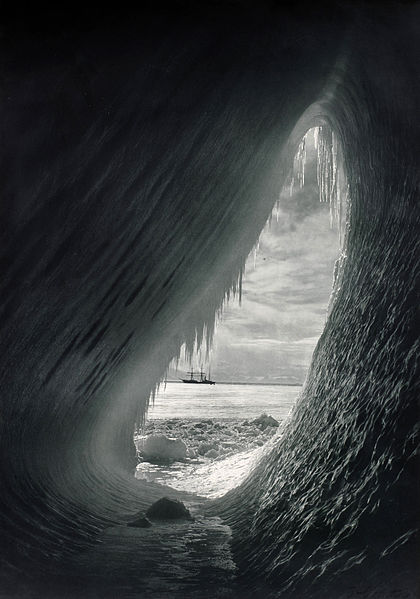
Figure 1 - Herbert Ponting's Ice Grotto.  From Wikicommons and in the public domain.

Figure 1 – Herbert Ponting’s “Ice Grotto”. From Wikicommons and in the public domain.

I cannot mention Frank Hurley without also discussing the other great early twentieth century English Antarctic Photographer, Herbert George Ponting FRGS (1870-1935).  Ponting was photogarpher and cinematographer for Robert Falcon Scott’s ill-fated Terra Nova Expedition to the Ross Sea and South Pole (1910-1913).

Scott achieved the Pole only to find the tent erected by Roald Amundsen‘s Norwegian Expedition.  His team died tragically on the return journey and were eventually found frozen in their tent, having suffered severely from scurvy.

Born in England, the son of a banker, Ponting emigrated to California where he married Mary Biddle Elliot and bought a fruit ranch.  After the ranch failed, Ponting took up free-lance photography and photographed the Russo-Japanese War.  He published his photographs “In Lotus Land Japan,” which led to his being elected to the Royal Geographical Society.  This in turn lead to his being signed on by Scott for the Terra Nova Expedition.

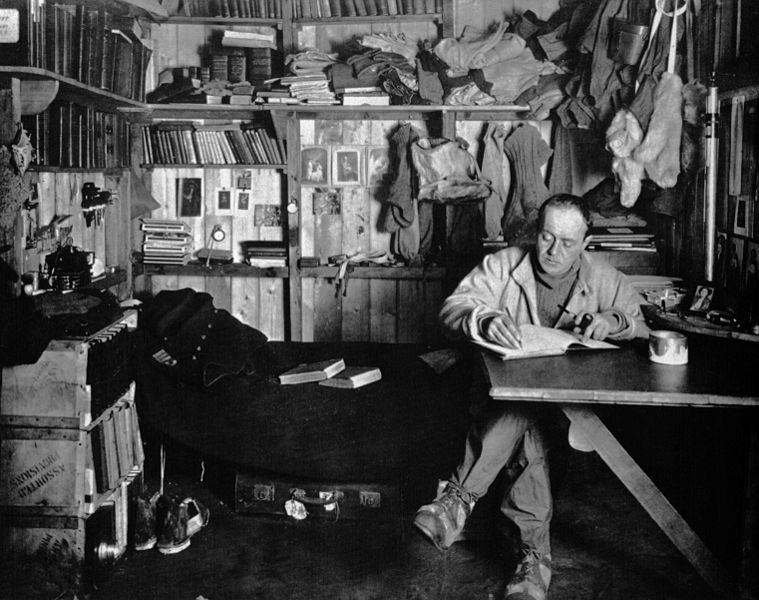
Figure 1 - Herbert Ponting "Robert Falcon Scott  in Winter Camp."  Image from the Wikicommons and in the public domain.

Figure 1 – Herbert Ponting “Robert Falcon Scott in Winter Camp.” Image from the Wikicommons and in the public domain.

In the Antarctic he took outstanding images on glass plates (despite the availability of film) including autochrome plates. To me his most memorable image is “Ice Grotto,” Figure 1.  He also took wonderful flash photographs of expedition members in their hut.  Figure 2 is such a photograph of Scott.

Scott’s death was legendary and a result, after World War I, Ponting published a book of his Antarctic photographs “The Great White South” in 1921.  He also produced two documentary films about the Terra Nova Expedition: “The Great White Silence,” a silent film in 1921 and “Ninety Degrees South” a film with sound in 1933.  Ponting died two years later in 1935.


Victorian spirit photographs

LincolnSpiritPhotograph

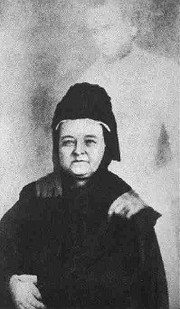
Figure 1 – Photograph of Mary Todd Lincoln in widow’s weeds being consoled by the wraith of her husband, Abraham Lincoln. In the public domain.

I was going to write a detailed discussion about Victorian and Edwardian spirit photographs, but then I found this image of Mary Todd Lincoln in her widow’s weeds being consoled by the ghost of our old fudged friend Abraham Lincoln, which just about says it all.  I mean come on people: double exposures, photo-montage, and tricks of light.  Combine this with the Cottingly Fairies.  It’s all so amateurish that it’s embarrassing that people ever believed this stuff.

I’m saying this despite a long “history” of Lincoln’s ghost sightings in the White House.  Including a sighting by no less a luminary than Winston Churchill, who claimed to have seen Abe’s ghost in the Lincoln Bedroom (there’s a surprise) in the buff – (that was the Prime Minister not Lincoln in his birthday suit).

Mary Lincoln was a firm believer in the occult and is even said to have conducted a seance at the White House.  According to Lincoln biographer (Team of Rivals: The Political Genius of Abraham Lincoln), Doris Kearns Goodwin, Lincoln was not a believer.  She recounts how a neighbor asked Lincoln whether he believed in a future realm. “I’m afraid there isn’t,” he answered. “It isn’t a pleasant thing to think that when we die, that is the last of us.”

Is the lesson that people of the nineteenth and early twentieth centuries were stupider and more gullible?  I don’t think so.  I don’t think that such is the case.  I suspect that it’s just that technology and our exposure to it has led us to be more savvy and sophisticated.  We expect our frauds to be better done.  That’s all.


My favorite photographic fake

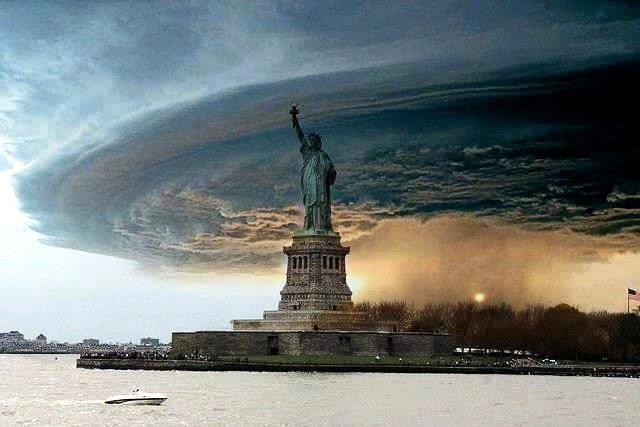
Figure 1 - Fake image of the Statue of Liberty during Hurricane Sandy -  "Human sacrifice, dogs and cats living together... mass hysteria! "

Figure 1 – Fake image of the Statue of Liberty during Hurricane Sandy – “Human sacrifice, dogs and cats living together… mass hysteria! “

I hesitate to admit it, but I do have a favorite photographic fake – or at least a current favorite photographic fake.  I say current because I never know when I am going to log onto Facebook and see a new favorite.  My current favorite is the image of the Statue of Liberty, symbol of the City that Never Sleeps surrounded by hurricane Sandy in all it apocalyptic grandeur – or at least as much apocalyptic grandeur as one can create from a fairly stock image of the Statue of Liberty mated with an image of a tornado in Nebraska.  Actually this is even a recycled image first created when a tornado touched down in Brooklyn two years prior to Hurricane Sandy.

The image is, of course, reminiscent of scenes from the 1984 movie “Ghost Busters.”

Dr. Peter Venkman: “This city is headed for a disaster of biblical proportions.”
Mayor: “What do you mean, “biblical”?
Dr. Ray Stantz: “What he means is Old Testament, Mr. Mayor, real wrath of God type stuff.”

So a question remains.  Where is the divine Ms. Siggy when you need her?  No, sorry that’s not it.  Who is making all these images and why?

Faked “in death” pictures of Abraham Lincoln

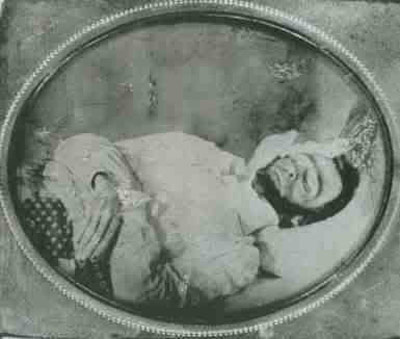
Figure 1 - Posed false image of Abraham Lincoln on his deathbed.  In the public domain.

Figure 1 – Posed false image of Abraham Lincoln on his deathbed. See reference in the text for a detailed discussion.  Image in the public domain.

In the last blog we talked about how Abraham Lincoln’s head was transposed onto John Calhoun’s body.  Ironically this is not the end to the Lincoln head story as it keeps popping up – or maybe not.  Lincoln was assassinated on April 14, 1865.  People were hungry for photographs of the president on his deathbed.  However, Secretary Stanton and the army would not allow it.  This small omission, however, did not stop journalists and entrepreneurs eager to capitalize on the nation’s grief.  There are numerous false images of Lincoln on his deathbed with either other people posing as Lincoln, drawings made to look like photographs, or doctored photomontages. It is all a well heavily studied subject and still somewhat hotly contestrd subject.  An excellent web-based reference on the subject  is “Abraham Lincoln, Nine Hours Before Death.”