Sir Edmund Hillary and Mount Everest

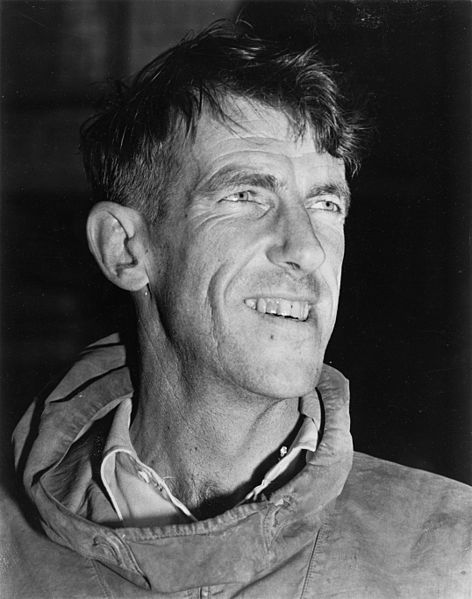
Figure 1 - Sir Edmund Hillary, 1953. From the Wikimediacommons Pascoe, John Dobree, 1908-1972. Edmund Percival Hillary. Ref: 1/2-020196-F. Alexander Turnbull Library, Wellington, New Zealand. http://beta.natlib.govt.nz/records/22676310

Figure 1 – Sir Edmund Hillary, 1953. From the Wikimediacommons.  The original source is  Pascoe, John Dobree, Ref: 1/2-020196-F. Alexander Turnbull Library, Wellington, New Zealand and in the public domain.


As a young boy nothing could thrill me more than a photograph like the one of taken by Sir Edmund Hillary (1919-2008) of Tenzing Norgay planting the flags on the summit of Mount Everest.  This past week we celebrated the sixtieth anniversary of this first successful assault on the world’s highest peak on May 29, 1953.  Yes. it’s all a bit of macho obsession.  But these kinds of photographs represent the limitlessness of human endeavor and accomplishment.  As Tennyson put it:

“I am a part of all that I have met;

Yet all experience is an arch wherethrough

Gleams that untraveled world, whose margin fades

For ever and for ever when I move.”

 When asked why there was no picture of Hillary himself on the summit., he responded that “as far as I knew, he had never taken a photograph before and the summit of Everest was hardly a place to show him how.

About forty years after the event, I had the opportunity to meet Sir Edmund, or Ed as he informed us was his preference.  He was warm and unassuming, quite consistent with his oft quoted response upon reaching camp after the summit climb: “We knocked the bastard off.”  I remember a long discussion with him about climbing without oxygen and its adverse, even lethal, effects.  I think, however, that what really speaks to the nature of the man, and what represents his enduring legacy is his Sir Edmund Hillary Foundation to provide education and healthcare for Sherpa children.  To the end he saw no limits on human endeavor and accomplishment.

The intimacy of image – real and vestigial

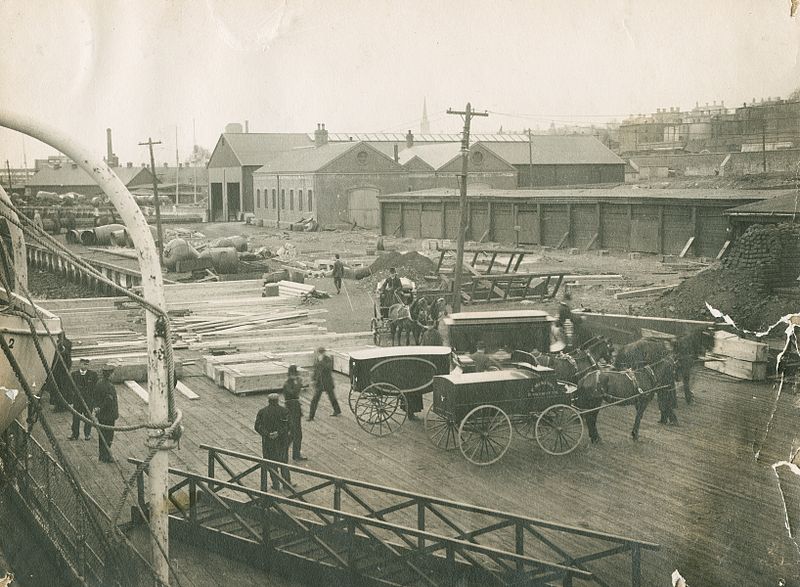
Figure 1 - The need to witness, hearses in Halifax, NS awaiting the arrival of drowning victims of the Titanic, 1912. Photograph from the Wikimediacommons and in the public domain.  Original photograph attributed to attributed to William J. Parker or William Mosher.

Figure 1 – The need to witness, hearses in Halifax, NS awaiting the arrival of drowning victims of the Titanic, May 6, 1912. Photograph from the Wikimediacommons and in the public domain. Original photograph attributed to attributed to William J. Parker or William Mosher.

We have been discussing the great race in the late nineteenth and early twentieth centuries to be able to send images rapidly across the globe.  Of course, much of this centered on photojournalism, and there certainly appears to be a need for people to be eye witnesses to events, to gain tangibility through sight.  While the written word and human imagination can be very powerful tools, nothing compares to actually seeing something.  Sight creates reality.  And, as we have considered before, part of the reality created is that most intense of emotions, empathy.

We see this everyday on the news.  Whenever there is a natural or human caused disaster, we want our news media to be in the thick of it.  It is not enough to read or hear about tornados in Oklahoma or bombings in Boston.   Before the scope and intensity of these events can truly register, we need, at a photographic level, to be eyewitnesses.

To me one of the most curious aspects of this human phenomenon is what I like to refer to as vestigial intimacy.  Vestigial, of course, means to wear the clothes of it.  In biology it refers to a physical trait, often so diminished or diminutive as to be unrecognizable.  Classic examples are the pelvic bones in snakes and in man the appendix and the tail bone.  How does the appendix serve us save, if it becomes inflamed, to necessitate surgery or death?  How does the tail bone serve us, except to hurt like the Dickens if we fall on it?  Still the tail bone ties us to the phylogeny of our species, binds us to our primate ancestors.

So too is vestigial intimacy of image.  I get up early and drink my coffee while watching the local news.  We have three reporters whose jobs appear to be on-the-scene reporting.  We have a storm, and there is Nicole standing perilously on the side of Boston’s beltway, watching the cars and trucks skid out.  Or worse, Steve is essentially standing in the ocean, in danger at any moment of being swept out to sea or electrocuted by his microphone as a hurricane belts our coast.  And my personal favorite, a crime has been committed the previous day, and there is Victoria reporting from outside the victim’s door.  It is dark, and I have to wonder what the purpose is of her breaking the sleepy silence of the neighborhood.  What knowledge do I gain?  How am I better informed or more connected to events by depriving Victoria of sleep, or by putting Nicole or Steve in mortal danger?  It is the powerful need for human connection, to be intimate with events, a need so strong that it still expresses itself in this almost meaningless vestigial fashion.

Never forget the magic of innovation

It is very easy to sit back in the twenty-first century and view the development of photography and of the transmission of photographs as quaint.  I suppose that you could even argue that the importance of an innovation isn’t truly realized until it becomes quaint.  When I began writing this blog, I said that one of the topics was to be the magic of photography.  And I believe that no matter how technical we become in our discussions we are never very far from the magic.

What a moment it must have been in 1838 to see your own image on the shiny surface of a daguerreotype.    Would you not have imagined that the photographer had somehow magically captured a part of your soul in silver? What a moment it must have been in 1858 to hear the clicks of the telegraph and suddenly realize that these were being made by a fellow being across the great ocean.  What feat of prestidigitation was this?  What a moment it must have been when the first images of faces came across the wires with the belinographs.  The sorcerer was no longer satisfied to just capture the visage and soul of a person, but now transported them across the wires.  What sort of wizardry was this? And, of course, it was not long before even the wires were not necessary.

The photograph, the telegraph, the telephone, and the belinograph all were magical devices as were radios and televisions.  But in these we were mostly observers.  Now we are all Morses, and Bells, and Belins.  And this is the other dimension of the magic.  Today we all can send images and messages across the planet.  We all participate in this great dance of the memes.  In this, photography and the internet assume a huge democratizing role.  Today in any corner of the world there might be repressive violence and it can suddenly be seen worldwide.  It is raw;  it is intense;  and it is intimate.  We can sit in our living rooms wearing a shirt made in Bangladesh, but we cannot escape the image of the suffering.  We cannot escape, not so much culpability, as interconnected responsibility.

The hope, of course, is that connectedness leads to mutual respect and understanding.  We know that these powerful tools can just as easily be misused.  False information and doctored images seem just as real as authentic ones.  This argues for a diligence and critical consumerism that is rarely practiced.  But we must all seek to practice it.  It is as if we are in some epic fantasy, like the” Lord of the Rings” or “Star Wars,” where the forces of Evil tilt with the forces of Good.  They are jealous of us, envious of our interconnection, and fearful of an enlightened world.

So, yes I think that all of these quaint inventions were magical.  They affected our world deeply and profoundly and they have made it a better place.  I am reminded again of Mark Twain’s message from “The Mysterious Stranger”, that I spoke about on New Years Day 2013: “Dream other dreams, and better.”

Édouard Belin, the belinograph, and the birth of phototransmission

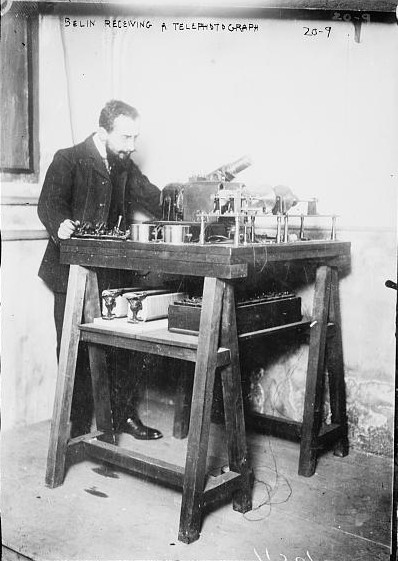
Figure 1 - Édouard Belin receiving a telediagraph image 1920.  From the Wikimediacommons and the LOC in the public domain.

Figure 1 – Édouard Belin receiving a belinograph image 1920. From the Wikimediacommons and the LOC in the public domain.

As we discussed in the previous blog Giovanni Caselli (1815-1891) and his “pantelegraph” of the mid 1850’s represents the first real image transmission system.    These were essentially FAX machines. Systems like Caselli’s, based on insulating ink, reached fruition with   Ernest A. Hummel‘s “telediagraph.”  Starting in 1895, a dedicated circuit  connected the New York Herald and the Chicago Times Herald, the St. Louis Republic, the Boston Herald, and the Philadelphia Inquirer together in a network tansmitting and telediagraph images from electrically scanned schellac-on-foil originals. The telidiagraph did not, however, truly transmit photographs.  A photograph was taken and converted to a line drawing with handwritten notes like: “White Hair.”  Once received, these drawings where filled in to give them full body – producing the kind of detailed line drawings for which the nineteenth century was famous.

A major advance came in 1913, when Édouard Belin‘s developed the “belinograph” of which scanned using a photocell and thus enabled photographs to be transmitted and converted on the receiving end to halftone photographic images.  Figure 1 shows Édouard Belin (1876-1963) with his belinograph around 1920. Note the that the caption uses the word “telephotograph.”

The belinograph ultimately formed the basis for the Associated Press, and images transmitted in this manner were referred to as “belinos.”  Images could be transmitted over standard telephone lines.  Western Union began transmitting halftone photographs in 1921, ATT in 1924, and RCA in 1926.  The Associated Press began its service in 1935.Today, of course, photographs are transmitted digitally via the internet.  However, it all began a century ago with Édouard Belin‘s analogue belinograph.


Early image transmission – Caselli’s “pantelegraph”

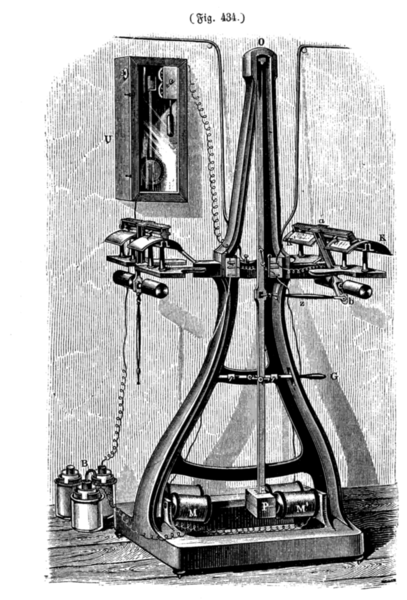
Figure 1 - Caselli's "Pantelegraph" from the German wikipidia and in the public domain. erman Wikipidia, original source: Die gesammten Naturwissenschaften, Dritte Auflage, In drei Bänden, Erster Band, Druck und Verlag von G. D. Bädeker, 1873, Seite 855 unten, Bild

Figure 1 – Caselli’s “Pantelegraph” from the German wikipidia and in the public domain. erman Wikipidia, original source: Die gesammten Naturwissenschaften, Dritte Auflage, In drei Bänden, Erster Band, Druck und Verlag von G. D. Bädeker, 1873, Seite 855 unten, Bild

My reason for discussing analogue vs. digital signals was to put us in a position to explore the early methods for transmitting images across telegraph and telephone lines. All of these early processes were analogue in nature. This means that a voltage is created at the transmitting side and this voltage is converted back on the receiving side to intensity on a surface.  Indeed, it is always a two sided process.  There has to be a means, on the transmitting side, to convert the intensity on the paper to a voltage and, on the receiving side, back to an intensity.

In addition, while the processes of telegraphy and telephony are intrinsically linear – a series of dots and dashes as a function of time or the voice translated to voltage as a function of time, images are intrinsically two dimensional.  Therefore, there needs to be an intrinsic scanning element at both ends, so that the two dimensional image can be properly translated.

The first, system for transmitting images was developed by Giovanni Caselli (1815-1891) in the mid 1850’s.  His “pantelegraph” was demonstrated by no less than French physicist Alexandre-Edmond Becquerel (1820-1891) to the French Academy of Sciences in 1858 (the year of the first transatlantic cable).  The “pantelegraph” is, arguably, more of a facsimile (FAX) machine than an image transmitter.  It copied small handwritten documents (111 mm x 27 mm) of up to 25 words, which it could do in 108 seconds.  For the most part it was used to transmit signatures and, therefore, to verify checks.  Never-the-less the concept of image transmission was born with the “pantelegraph.”

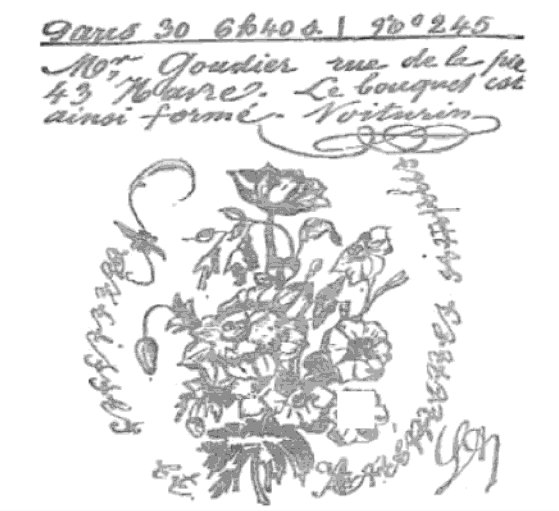
Figure 2 - an example of a Casellli "pantelegram," from the Wikimediacommons and in the public domain.

Figure 2 – an example of a Caselli “pantelegram,” from the Wikimediacommons and in the public domain.

The signature or other writing was drawn on a metal plate with insulating ink.  A pendulum driven scanner scanned an electrode or stylus across the plate and the current between the plate and the stylus was measured.  Wherever there was writing the current would drop.  This was converted to a voltage that was transmitted across the telegraph line.  On the receiving side, paper impregnated with potassium ferricyanide was used.  The process was reversed.  Whenever current flowed across the paper the potassium ferricyanide would darken.

In November of 1860, Caselli demonstrated the “pantelegraph” along a special line between Paris and Amiens.  Caselli successfully transmitted the signature of opera composer Gioachino Rossini (1792-1868) over the 140 km distance. The first “pantelogram was subsequently transmitted from Lyons to Paris on February 10, 1862.

One sees in this the absolute brilliance and creativity of nineteenth century engineers and scientists.  They dwelt in an analogue world, and it presented no limitations.

* I want to thank a Facebook reader for making me aware of Caselli’s “pantelegraph.”  I was going to start with photograph.  But this is an important part of the story.


Analogue vs. digital

First Telegraph Message sent between Washington, DC and Baltimore, MD in 1844 by Samuel Morse.  From the Wikimediacommons and in the public domain.

First Telegraph Message sent between Washington, DC and Baltimore, MD on May 24, 1844 by Samuel Morse. “What hath God wrought?” From the Wikimediacommons and in the public domain.

If you have a picture that you want to transmit to another place, computer, or person you’ve got to decide whether you want to do that in an analogue or a digital mode.  More accurately the nature of the communication system tends to dictate the mode.  So it is useful to consider what we mean by these two terms.

Suppose that you have a signal like a voltage.  Let’s say it’s between 0 and 1 Volt.  if analogue, this voltage can take on any value between 0 and 1.  A digital voltage is broken down into a set of discrete values.  This might be in steps of 0.01 V or some other division, like some power of two.  For instance, when we talk about the intensity level of a pixel for a digital camera, this is a discrete digital number.

Most electronic devices today move back and forth between the analogue and digital world.  If you remember our discussion of how a CCD camera works, we spoke about the fact that each pixel adds up light induced electrons to create a voltage.  When the chip is read that voltage passes through an analogue to digital converter, that converts the voltage to a discrete digitized signal.  Today once you’re digital, you tend to stay digital.  The numbers are handled digitally in your computer, by your image processing software, and then displayed digitally.  In the age of say television with so called cathode ray tubes, everything stayed analogue.

This is the basics of the analogue vs. digital world,  But if you really think about the case of our CCD pixel, it never was really analogue.  The voltage was really a discrete number of electrons.  It was really digital to begin with. In fact most physical signals are based upon inherently discrete processes.

The simplest digital system is the two state or binary system.  The state is on or off zero or one.  That’s how our modern computers work, ultimately in binary.  Multiple zero or one bits are required to express a given number.  For instance, the number 13 is 1 times 8 (or 2^3) plus 1 times four (or 2^2) plus 0 times two (or 2^1) plus 1 times one (or 2^0).  This is usually written as 1101 in so-called binary. This binary number has a eights column, a fours column, a twos column, and a ones column.  This is just like our usual tens power counting system has a hundreds, a tens, and a ones column. So the number 13 in a base ten system is 1 times ten plus 3 times one, or 13.

There are other digital systems.  If you think about our English alphabet, there are 26 letters.  So any word can be expressed by a string of these 26 values.  If you’ve heard about quantum computing that intrinsically is a base four system where any number can be expressed as a series of numbers or columns, where each value is 0,1,2 or 3.

Morse code is very interesting.  Remember telegraphy was the first data transmission system; so you would have thought that it would be analogue.  But, when Morse developed his code.  He expressed everything as dots and dashes.  He used time or duration as a second dimension.  So at any point the signal is either off, on for a short while, or on for a long while.  In a sense this is equivalent to a three state system, where everything is a string of 0’s, 1’s, and 2’s.  All of this can be very clearly seen in the world’s first telegram send by Samuel F. B. Morse between Washington, DC and Baltimore, MD on May 24, 1844, “What hath God wrought?”  If you blow the image up you can clearly see the dots, dashes, and empty spaces recorded on the paper strip as well as Morse’s translation of it below.  The world’s first internet, the telegraphy network, was a digital one.

The birth of the internet

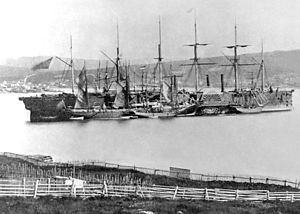
Figure 1 - The ship that lay the 1866 transatlantic cable, The Great Eastern, at Hearts Content. From the Wikicommons and in the public domain.

Figure 1 – The ship that lay the 1866 transatlantic cable, The Great Eastern, at Hearts Content. From the Wikicommons and in the public domain.

We talk about the internet as a new invention, something born of the twentieth and twenty-first centuries.  However, if you think about it and the recognize that the essence of the the internet is not in the computer but is its role as a communications network, joining people on a world-wide web or net, the name of Samuel F. B. Morse (1791-1872), artist and daguerreotypist, immediately arises as the true inventor.

Samuel Morse, invented the telegraph and the Morse code.  On May 24, 1844 along a cable strung between Washington, DC and Baltimore, MD, Morse sent the message: “WHAT HATH GOD WROUGHT.”  The internet was born.

The dream of connecting the United States and Europe evolved between 1854 and 1866 with the laying of the first transatlantic cable by Cyrus West Field and the American Telegraph Company.  On August 16, 1858, the first message was sent from the United States on behalf of President James Buchanan: “GLORY TO GOD IN THE HIGHEST; ON EARTH, PEACE AND GOODWILL TOWARD MEN.” The rate of transmission was painful (2 min. per character or 0.1 words per min.).  Queen Victoria’s letter congratulations back to President Buchanan took sixteen hours to transmit.

The original cable deteriorated extremely rapidly.  Speed of transmission became slower and slower.  Three weeks after the first transmission engineer Widman Whithouse attempted to increase transmission speed by increasing the signal voltage and blow the cable out.  Investor enthusiasm plummeted, and it took another eight years to successfully lay a new cable and restore the system.  This new cable proved long-lasting and, perhaps of equal significance, in the intervening time overland cables had been laid in both Europe and the United States.  Indeed the transcontinental cable in the United States, which united the east and west coasts on October 24, 1861, made the legendery Pony Express obsolete, and it shut down the next day.  With the completion of the transatlantic cable, Europe and the United States were interconnected with what was truly the first internet.

The effect was transformative.  Even with steam ships it took two to three weeks to transmit information by letter between New York and the European capitals.  With the transatlantic cable this communications time was reduced to three minutes.  That’s over ten thousand fold!

The first internet was the wired telegraph.  This followed by wireless telegraphy, wired telephony, and radio. I leave television out, because television largely functioned one way.   Finally we have our current internet, which took the concept to a whole new level by uniting computers or central processing units.  The internet became more than a way of rapid communication, but became a place to store, access, and disseminate information (real, false, and imagined). We have spoken previously about the first image on the modern internet, the image of “Les Horribles Cernettes,”.  But before that came the first transmission of images over telegraph and telephone lines.  How this was done and indeed the underlying nature of transmitting this kind of information is a fascinating one that we we will take up next.


Samuel F. B. Morse, Louis Daguerre, and the birth of photography

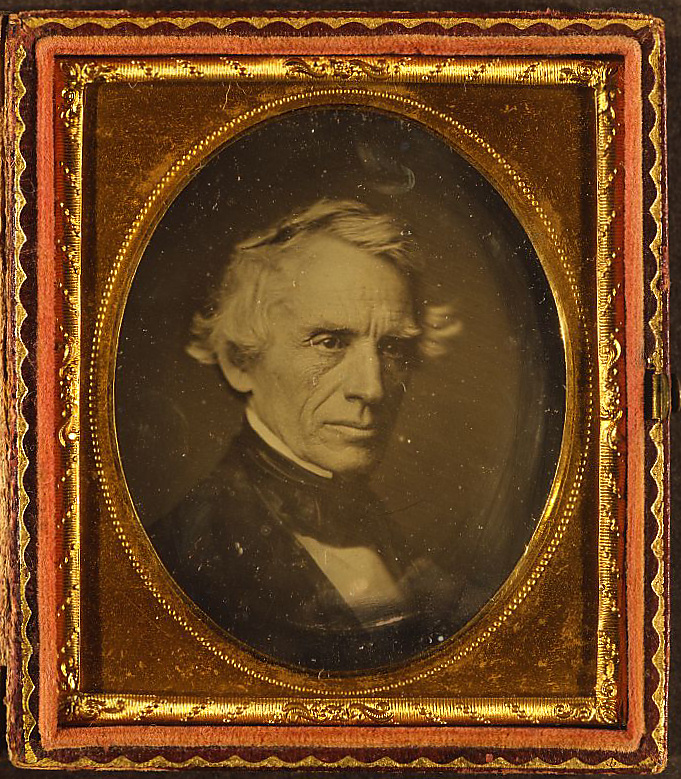
Figure 1 - Daguerreotype of Samuel Finlay Breeze Morse, artist, inventor, photographer, 1845.  From the library of Congress and in the public domain.

Figure 1 – Daguerreotype of Samuel Finlay Breeze Morse, artist, inventor, photographer, 1845. From the library of Congress and in the public domain.

I have spoken before about S. F. B. Morse (1791-1872), his introduction of the daguerreotype to American, and the birth of the modern world.  I have been reading David McCullough‘s interesting history of nineteenth Americans and their physical and intellectual journeys to France, “The Greater Journey, Americans in Paris.”  McCullough quotes Morse’s letter to his brothers describing the moment in which he first sees Daguerre’s invention.  I thought that I would share it with you.

“They are produced on a metallic silver-coated [copper] surface, the principal pieces about 7 inches by 5 [inches], and they resemble aquatint engravings, for they are simple chiaroscuro, and not in colors.  But the exquisite minuteness of the delineation cannot be conceived.  No painting or engraving ever approached it.  For example: In a view up the street, a distant sign would be perceived, and the eye could just discern that there are letters upon it, but so minute as not to be read with the naked eye.  By the assistance of a powerful lens, which magnified fifty times, applied to the delineation, every letter was clearly and distinctly legible, and so also were the minutest breaks and lines in the walls of buildings and the pavements of the streets.  The effect of the lens upon the picture was in a great degree like that of a telescope in nature.”

We read in this the encounter of the nineteenth century intellect with the new world that photography represented.  This was truly a seminal moment, and the beginning of a new world perspective.  Truly the dawn of the modern.

Déjà vu – images of sweatshop disaster

When New Yorkers woke up on Sunday morning March 26, 1911 they were greeted, if you can call it that, by the terrible images of the Triangle Shirtwaist Fire that we discussed yesterday – horrid, raw, and heartbreaking.  “Never again!” people shouted and, as we discussed, this led to serious reform in the garment trade.  Or was it merely to outsourcing?

When we woke up this past Wednesday (April 24, 2013) – that’s 102 years later – still reeling from the Marathon Bombing news, we were greeted by the headline (this from CNN) “Bangladesh building collapse kills at lest 123, injures more than a thousand.”  An overcrowded garment industry sweatshop had literally crumbled in Bangladesh.

Take a look at these images from NBC News.  Again horrid, raw, and heartbreaking. They take us back again to March of 1911 and to lessons never really learned.  A haunting aspect of such photographs is that they bring associations to mind.  That is what images are meant to do.  You hear briefly the songs of 1911 – songs like “Daisy Bell, A Bicycle Built for Two.”  – “Daisy, Daisy, give me your answer true.  I’m half crazy over the likes of you.”   This is the music of young love and premature death.  I can also hear the jingle: “Look for the Union label,” from the ILGWU in the ’70’s.

Terrible photographs and events like this invariably raise in my mind literary quotations.  In this case it is Dickens’ confrontation between Scrooge and the ghost of his former business partner Jacob Marley in “A Christmas Carol.”

“But you were always a good man of business, Jacob,” faltered Scrooge, who now began to apply this to himself.

“Business!” cried the Ghost, wringing its hands again. “Mankind was my business. The common welfare was my business; charity, mercy, forbearance, and benevolence were, all, my business. The dealings of my trade were but a drop of water in the comprehensive ocean of my business!

We see in this this the power of image to raise social consciousness and, in a sense, to break down barriers of time, place, and culture.  They unite us in our common humanity.  To the people “Uptown” in 1911, the garment workers were invisible.  They wanted cheaper clothing, and it was easy to look away.  The message of these powerful images (both those of 1911 and those of 2013) is that we need to look beyond the price tag, when buying clothing, indeed when buying anything.  We need to see the invisible minions, and we need to ask who really pays the price?