Photographing Cape Cod

It was the perfect combination: good friends, great weather, great food, andCape Cod.  It was a late summer weekend onMassachusetts’Cape Cod.  For those of you not intimate withMassachusettsgeography, it divides into five distinct photography zones: Boston, the North Shore, The Berkshires, Northwest Mass, and theSouth Shore andCape Cod.
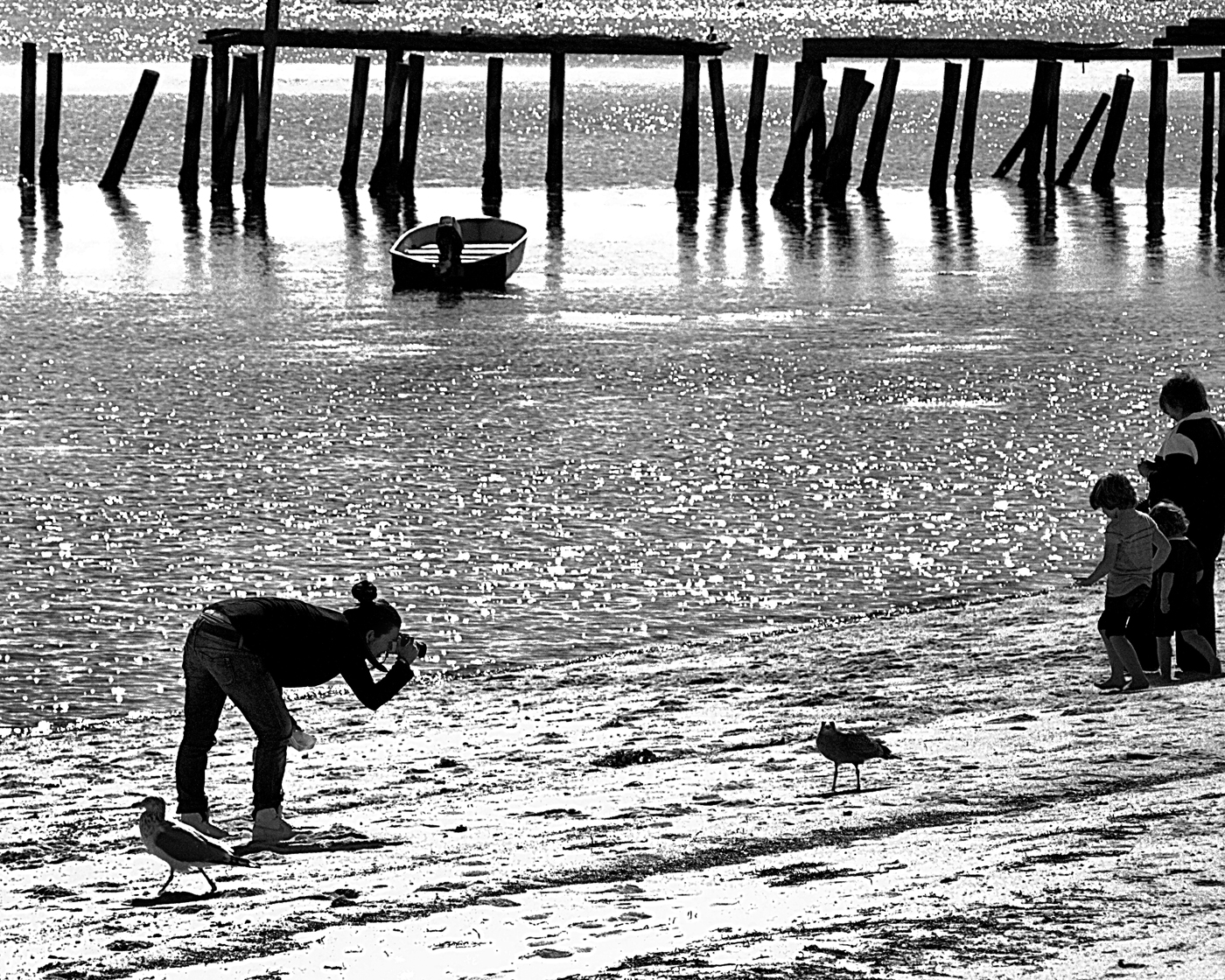
Provincetown, MA photographer on the beach

For photographers the two words, “Cape Cod,” conjure up images of Photographer “Joel Meyerowitz” and his two magnificent works: “Cape Light” and “Red Heads.”  Meyerowitz has made an art form of the apparent but deceptive “snap shot.”  Meyerowitz is also now famous for his important chronicle, “Aftermath,”of the World Trade Center terrorist attack and the subsequent rescue efforts.  A century from now this will be recognized as a significant photochronicle.
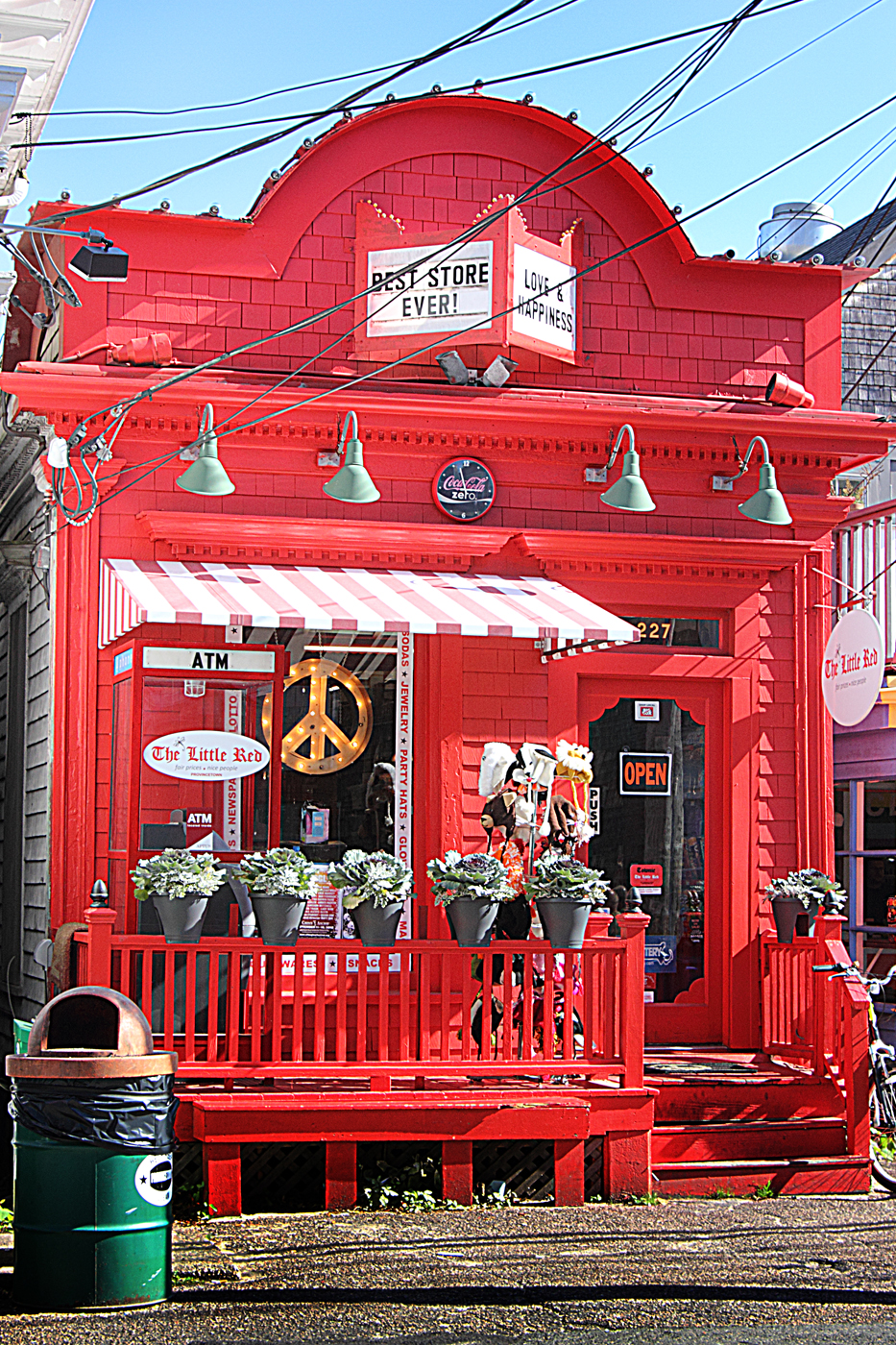
The Little Store, Provincetown, MA

This Saturday we wandered up to Wellfleet and Provincetown.  The first stop was the PB Boulangerie Bistro  in Wellfleet.  According to Zagat: “This has to be the best restaurant on the Cape and definitely on par with the best in Boston.” I have no photographs from PB.  I was too busy eating the wonderful French sandwiches, soups, and pastries.  Screech to a halt and leave your camera in the car.  Although Chef Philippe Rispoli might allow you to take some pictures of him cooking in the wonderful open kitchen.   In the meanwhile check out their mouth-watering photogallery!
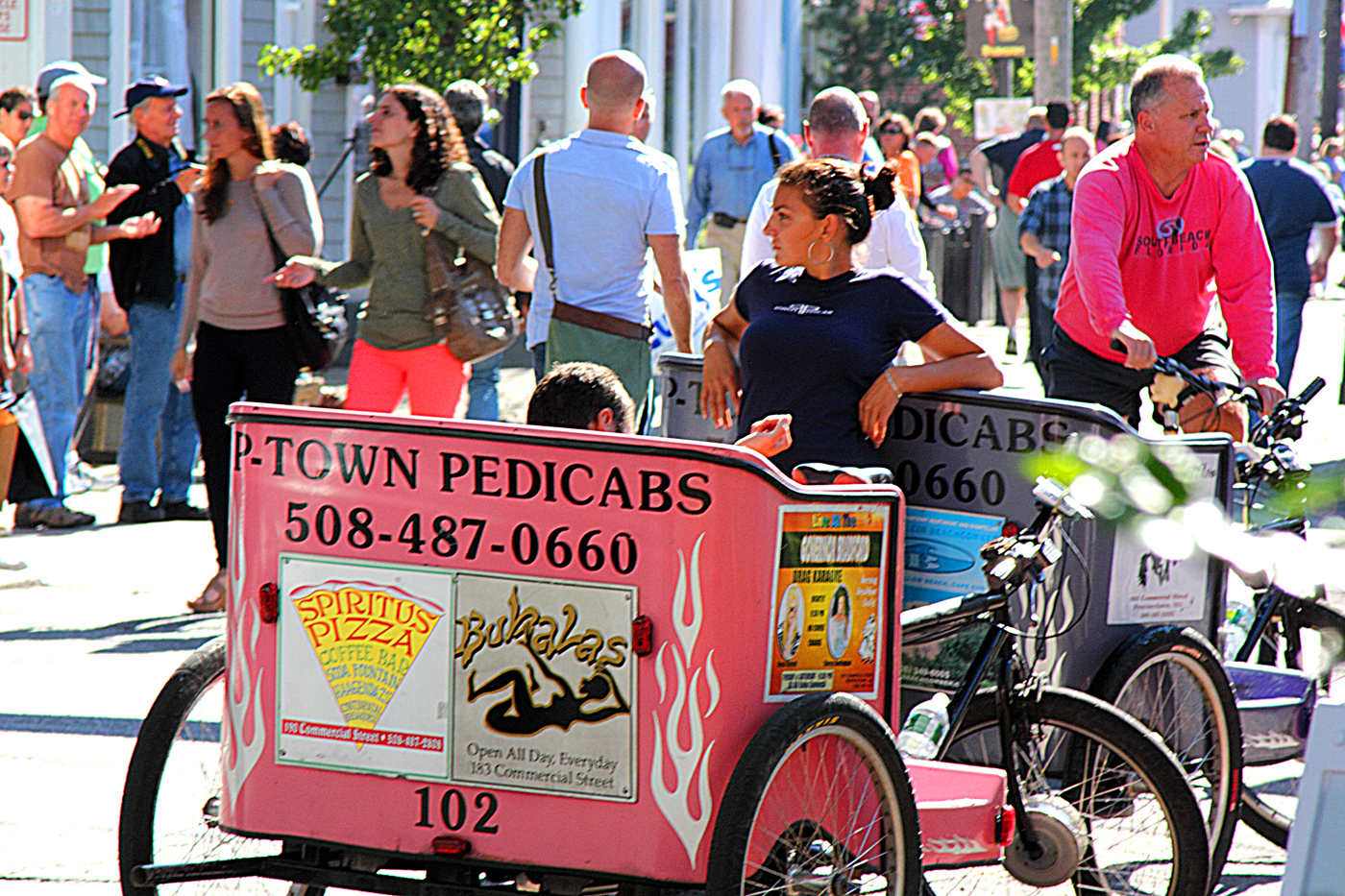
Pedicars, Provincetown, MA

My first photograph of the day, or more accurately photo-disaster was a picture of a woman photographing a seagull on the beach.  I always set my camera for the next likely shot.  And I highly recommend that you do so.  Whatever your shooting mode, anticipate the light.  But I had just gotten out of the car…  Actually there’s no excuse.  At the very least I should have set the camera on one of the auto modes.  So instead, I got an over-exposed.(should have set compensation by at least  a stop because of the bright sand) and I certainly shouldn’t have had the ISO set at 6400.  So I wound up with a pretty substandard silhouette.
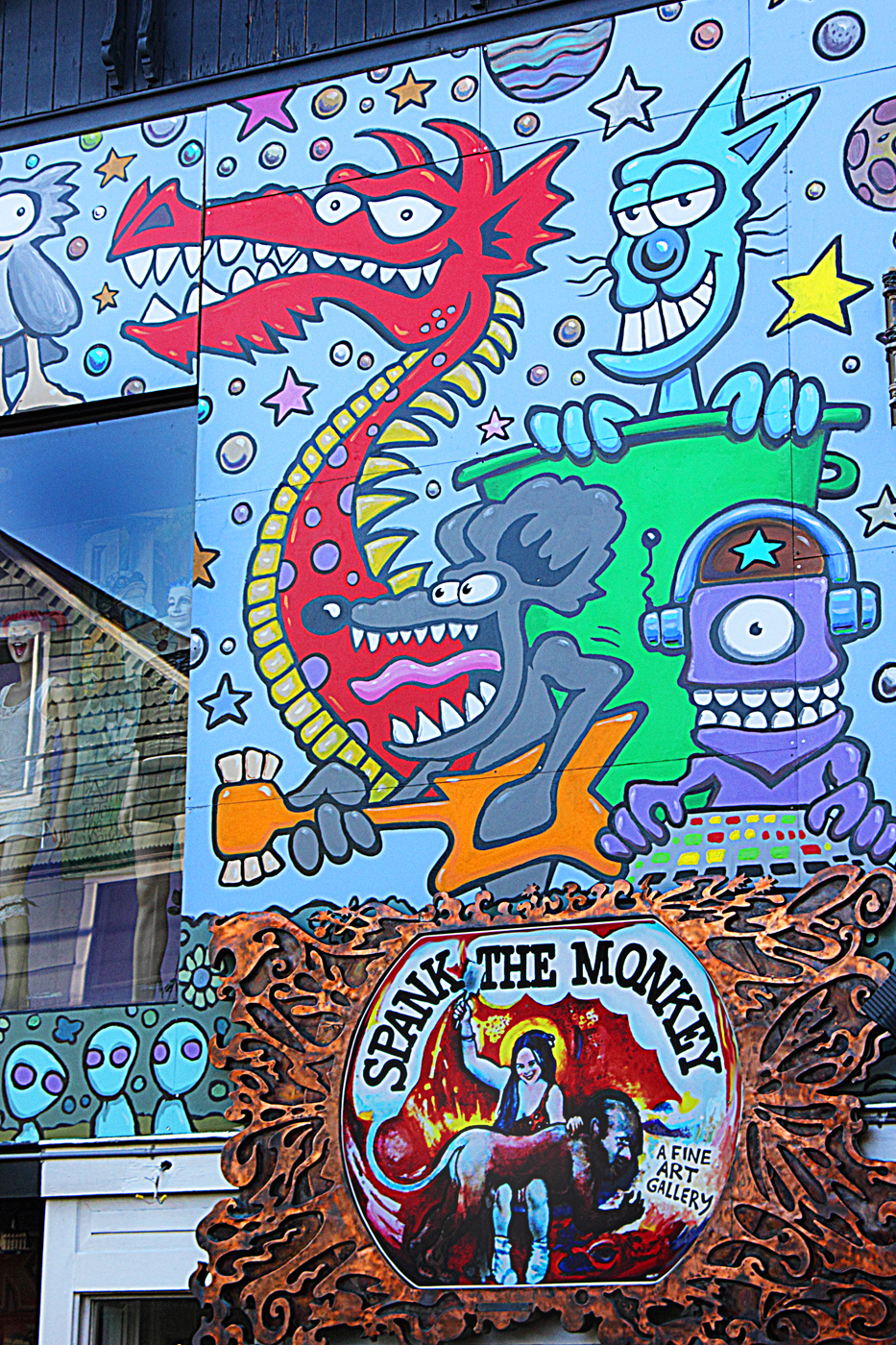
Spank the Monkey, Provincetown, MA

Provincetown on a late summer’s day is a symphony of color; vivid, sometimes bordering on the garrish, but always fun.  You can start with the very bright red “Little Store,” and then move on to the pink “P-Town Pedicars,” and the piece de resistance of color is the wonderful Joey Mars murals that now adorn the “Spank the Monkey” Art Gallery.  Check this graphic pop artist out at his website.  It is well worth the visit.
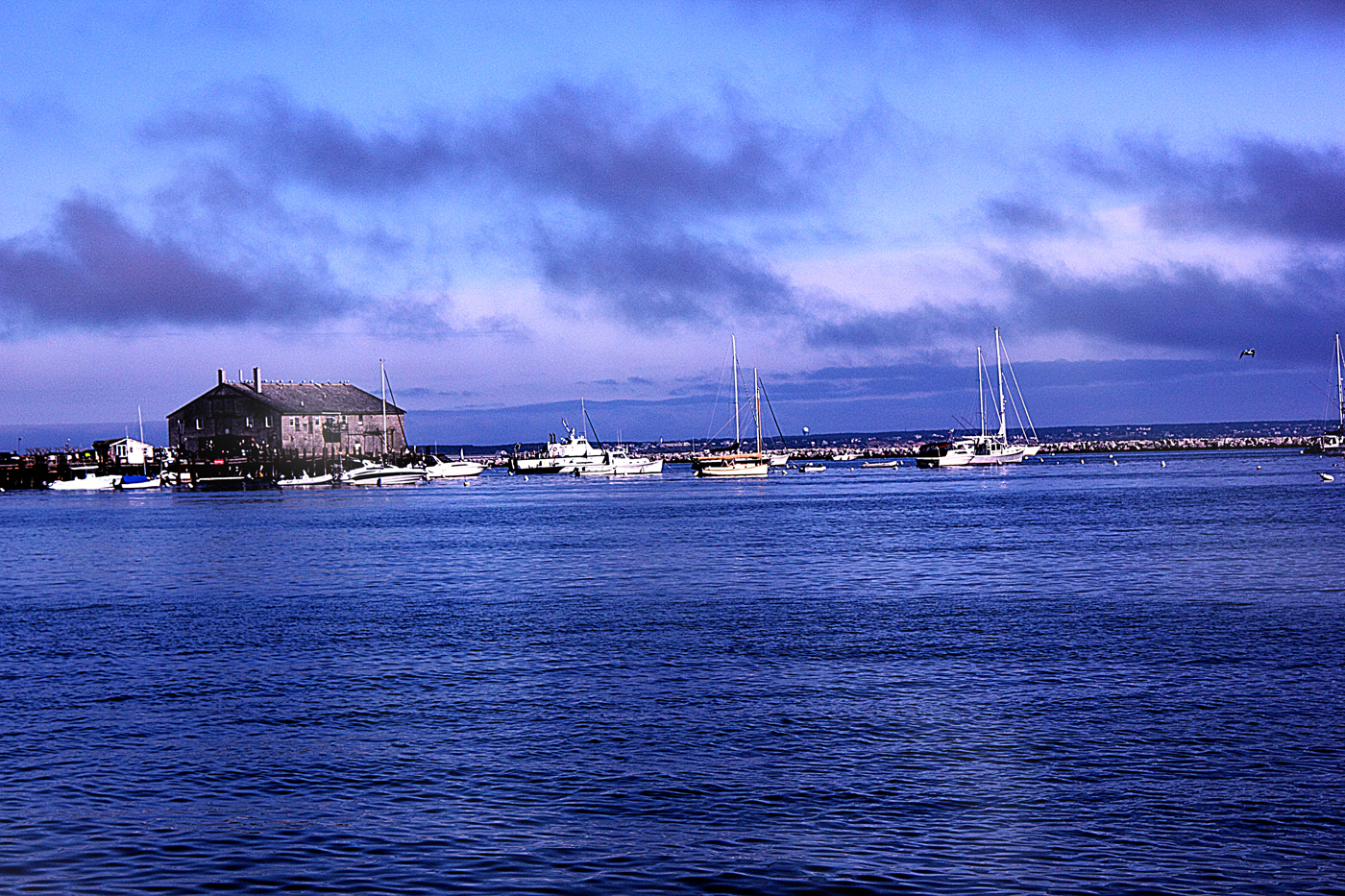
Ocean View, Provincetown, MA

I also stopped to photograph some glass in a shop window that was particularly bathed in sunlight. These weren’t too successful, because despite the best efforts of my polarizing filter reflections from the window glass were overpowering.  I had to console myself with a picture of an ornamental frog to add to a photoessay that I have been doing for several years now.  There is a special appeal to frogs.  Maybe it’s the smile or the eyes.  Or maybe it’s childhood recollection of Kermit and “it’s not essay being green.”
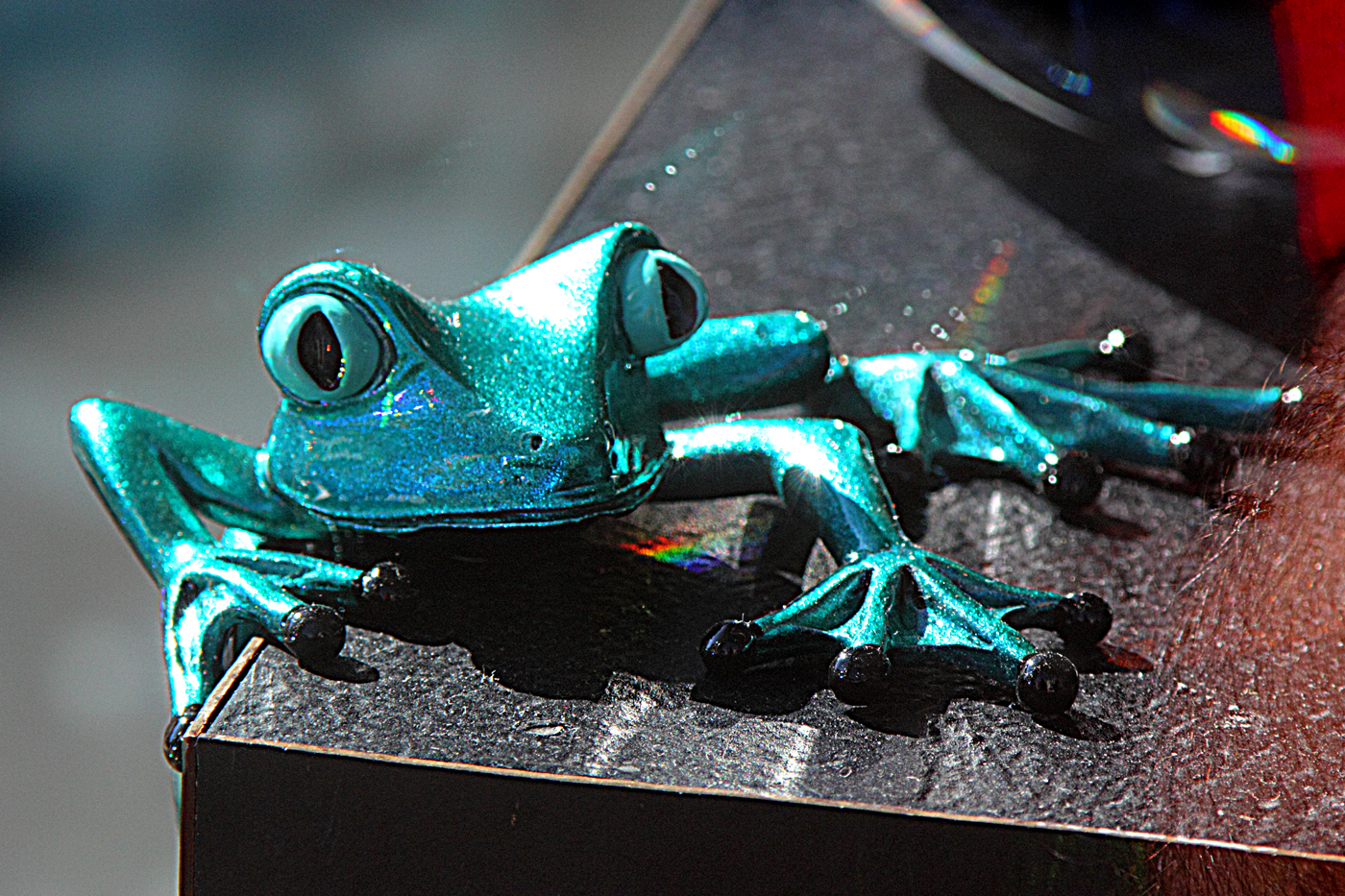
Ornamenal Frog, Provincetown, MA

Of course, on Cape Cod you’re never far from the dunes and the ocean accentuated by sun and atmosphere.  Everyone in P-Town, including us, was having a good time.  We must have seen at least six weddings.  And every time a couple was wed, the street erupted in applause.  It was a most excellent day.
Displaying photographs on computers – a tale of 6 picas

While we’re on the subject of image sensors and pixel limited resolution, it is worth considering the question of what size your images should be for computer reproduction – say to put on a website like this one.

If we again take the Canon T2i are typical, the 18 M pixel sensor chip consists of a 5184 X 3456 pixel array.  As discussed this defines some ultimate resolution for an image. For computer monitors a typical high resolution pixel density is 1024 X 768.  this is 0.786432 M pixels.  That said there is a trend to higher and higher pixel density monitors.For a fairly comprehensive and useful list of monitor pixel densities his site.  The point is that this is what your monitor is capable of displaying.  Anything else is wasted space or more accurately wasted memory.  And it can seriously slow down your website, because of download times.

In addition, you don’t usually display an image as full screen.  A good size, based on aesthetics and the need to have text with your pictures, is about 600 pixels X 400 pixels = 0.24 M pixels. Also, remember that bigger displays, like the ones at sports events and Times Square are meant to be viewed at greater distances.  So the issue with monitor display is usually number of pixels as percentage of screen not pixels per inch as it is with printing. So the happy news, is that where the purpose is displaying images on computers: websites, social media, and emails to aunt Tilly there’s no need send huge images.

One caveat to keep in mind is that Aunt Tilly might want to have the picture printed and there, as we shall discuss, the critical number is pixels per inch and the size of the picture.  I recently wanted to print a family picture someone had posted on Facebook.  It was great on the monitor but as a print – no way!

BTW – there is an interesting and well written website that I would recommend as further reading on the topic of “the myth of dots per inch.”  This site also explains several of life’s more profound mysteries like: why does Photoshop default to 72 pixels per inch, why is your computer screen called a desktop, and why does it have a virtual trash barrel – not to mention the all consuming question: “what’s a pica.”

It appears that in 1737 Pierre Fournier created the ciceros as a unit to measure printing type.  Six ciceros were almost and inch, actually 0.998 in. Then around1770, François-Ambroise Didot made the ciceros bigger; so that it evenly divided the French foot into 6 X 12 or 72 equal parts.  This is 0.1776 in.  Today, and as established in 1886, the American Point System defines a “pica” as 0.166 in.; so that 6 of these make up 0.996 inches.  We have, (ready for this?)12 points per pica and 6 picas per inch.  That is 72 points per inch.  Heard that number before 72 dots (or points) per inch?

When Apple introduced the Macintosh in 1984, they wanted something people could relate to.  Type was meant to follow the rules of print, as in 72 points per inch.  How many people can relate to that – I mean really? We worked on “desktops” and threw old files in the “trash.”

Photograph image sharpness – the pixel limit

There’s a rule-of-thumb that for every equation that you use in writing you lose 90% of your audience.  So to the less than one percent of you that remain after my last blog, I’d like to point out that by determining the magnification of a camera lens, we are finally in a position to begin to address the very import questions: how sharp and image can we hope to achieve?

We showed in the previous post that the magnification, or actually demagnification of a lens is approximately the focal length divided by the distance from the camera to what you are photographing, the so called object distance.  This is great.

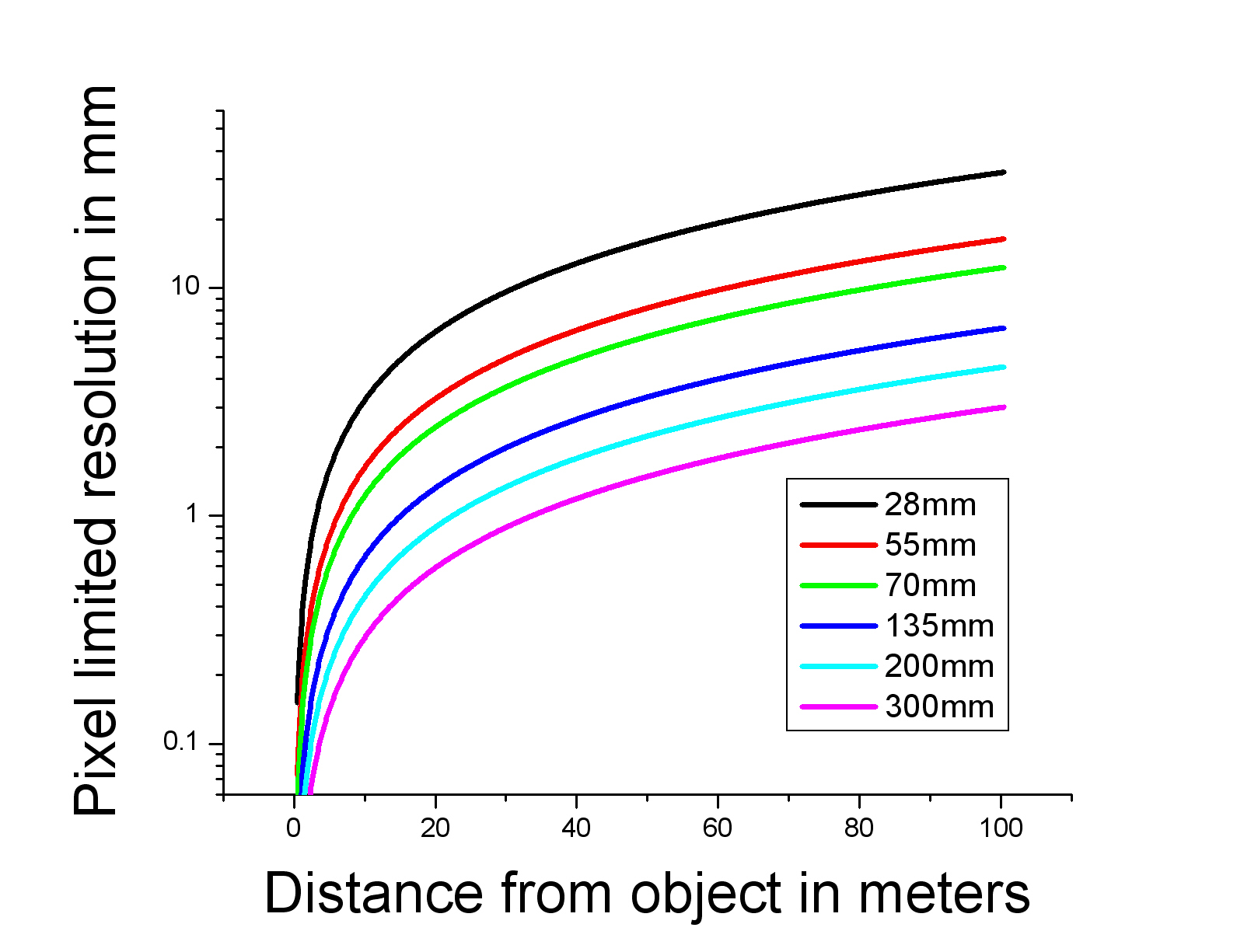
Pixel limited resolution, the smallest thing that you could see, for different lenses as a function of distance from the object

Now recognize that if you had some kind of perfect lens your resolution would be limited by the pixel spacing in your detector.  Remember that the pixels are like a graph paper on which your image is projected.  We can ask a very simple question.  How far apart need two white spots be to be distinguished in a photograph.  Well, there has to be a back spot in between otherwise they would merge into one.  For my Canon T2i this is 8.6 um (that’s .0086 mm). So an estimate of image resolution is to calculate the magnification as a function of distance and then divide the .0086 mm by the magnification to determine the equivalent separation in at the object.  I’m calling this number the pixel limited resolution.

I’ve done this for you in the figure, for a set of typical lens focal lengths.  It’s pretty impressive. Even at 100 m, more than the length of a football field, you would be able to resolve 3 mm.  Effectively we are looking at the finest detail that you could see if your camera’s resolution were pixel limited.  Is it pixel limited?  Well stay tuned!

Camera lens basics

Let’s continue our discussion of the technical basics of photography, building upon our discussions of the pinhole camera. As we’ve seen, pinhole cameras require tiny pinholes to create sharpness. As a result, they collect very little light. How do we solve this problem?

Well, I’m sure you know the answer. You use a lens to collect the light. It’s kind of like trying to drink rain. If you open your mouth to collect rain drops you catch very few. You need a funnel with a very large aperture. Lens are light funnels. The bigger the lens the more light we collect.

In photography this relates to the concept of f-number. The bigger the lens the smaller the f-number and the more light it can collect. Functionally, if you have a dim scene to photograph, you decrease the f-number. The bigger the lens the further down you can go. Significantly, what is important in optics is not the absolute size of the lens aperture, but the ratio of the focal length to the aperture, the f-number.

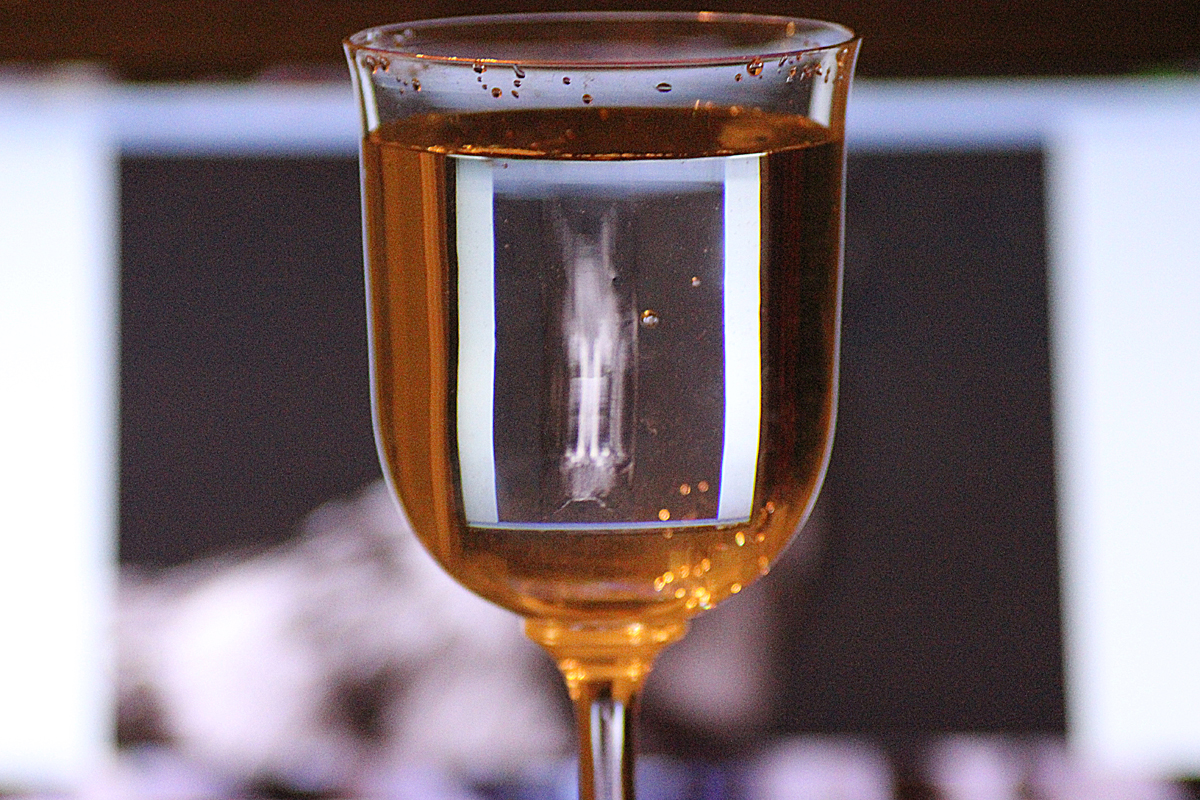
Figure 1 – Refraction causes a glass of wine to bend and partially focus light

In Figure 1, I use a glass of wine as a lens to focus my wolf picture. Because the glass is more curved in one direction than the other the image is smaller in the horizontal direction than the other. But importantly, we observe the bending of light as it moves from air to wine. This bending is referred to as light refraction.

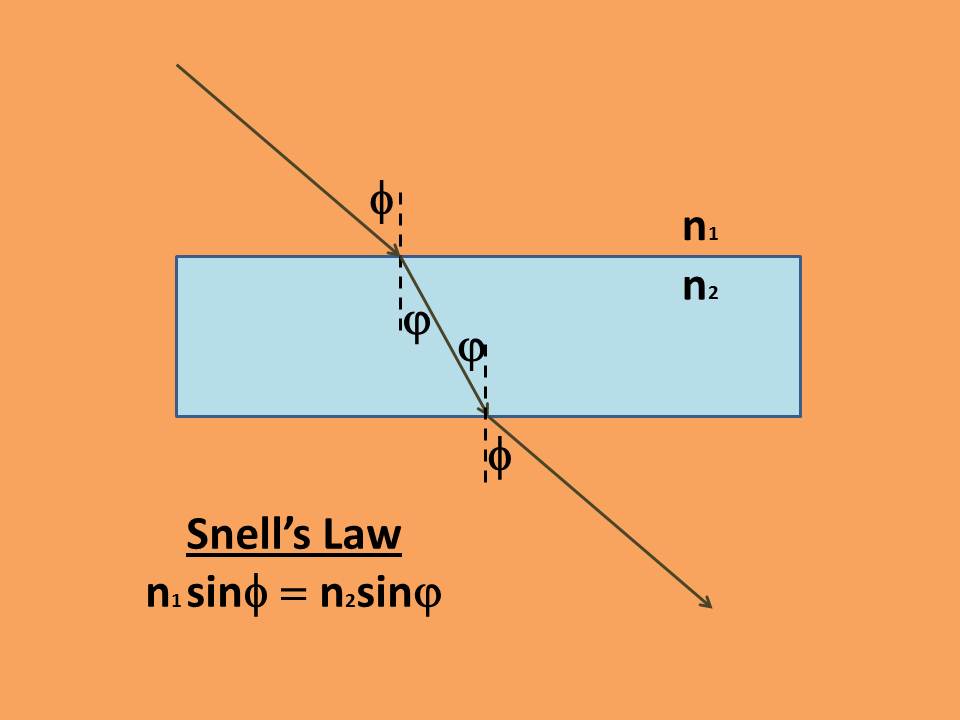
Figure 2 – Light refraction obeys Snell’s law

Refraction is described by Snell’s law or Snell-Descartes’ law. Descartes (1596-1650) is best remembered for his famous statement: “I think therefore I am.” The Snell part refers to the Dutch Astronomer Willebord Snellius (1580-1626). Interestingly, it was first described and used by the Arab scientist Ibn Sahl in 984. Snell’s law describes what happens to light when it moves from air into a denser medium. Transparent media are described by their indices of refraction, let’s call them n1 for the air and n2 for the wine. Referring to Figure 2 we see that when the light ray in the first medium strikes the surface of a medium of higher index of refraction it is bent towards the normal (the dashed line perpendicular to the surface). When it comes back out it bends back away from the normal and is parallel to the original ray, except displaced. If you’ve ever tried to spear a fish from above the surface of a lake (hasn’t everyone?), you find that he’s not where he appears to be. You’ve got to compensate for refraction.

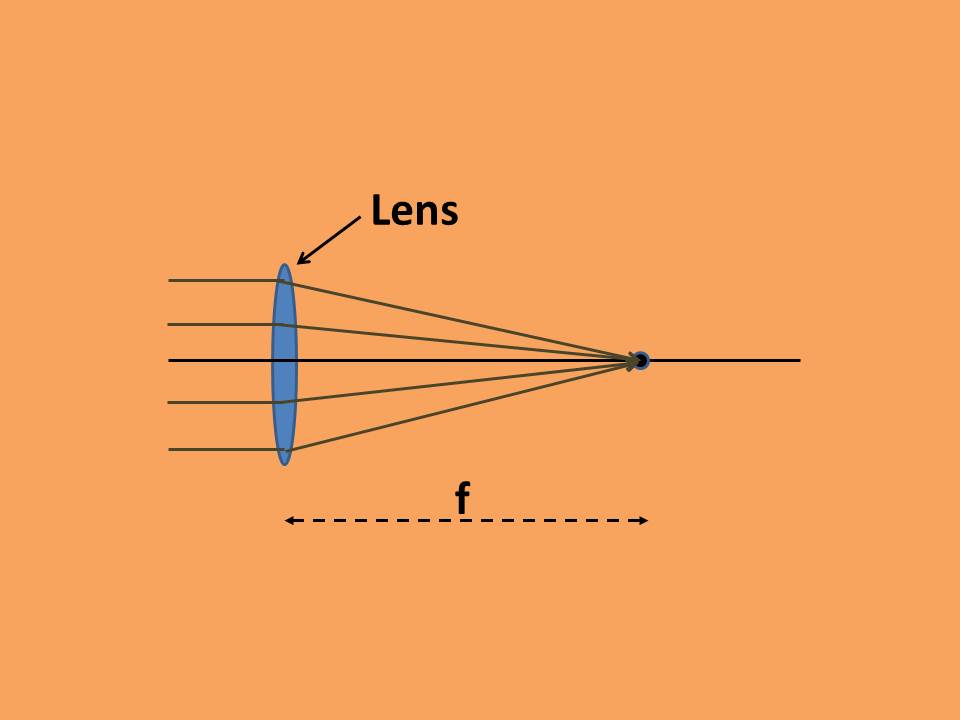
Figure 3 – Light from a distant point are parallel and focus by a lens a distance, f, called the focal distance from the lens

By shaping a lens appropriately you can design it so that all of the light from a distant object (physicists speak about an object at infinity, that’s the distant mountain that you are photographing.) to a point a distance f from the lens, called the focal point and focal length respectively. This is shown in Figure 3. Significantly, all the rays from the object are parallel and parallel rays go through the focal point. I say significantly because we can now consider the more general case where the object is somewhere other than at infinity.

Let’s continue our discussion of the technical basics of photography, building upon our discussions of the pinhole camera. As we’ve seen, pinhole cameras require tiny pinholes to create sharpness. As a result, they collect very little light. How do we solve this problem?

1/o+1/i=1/f.

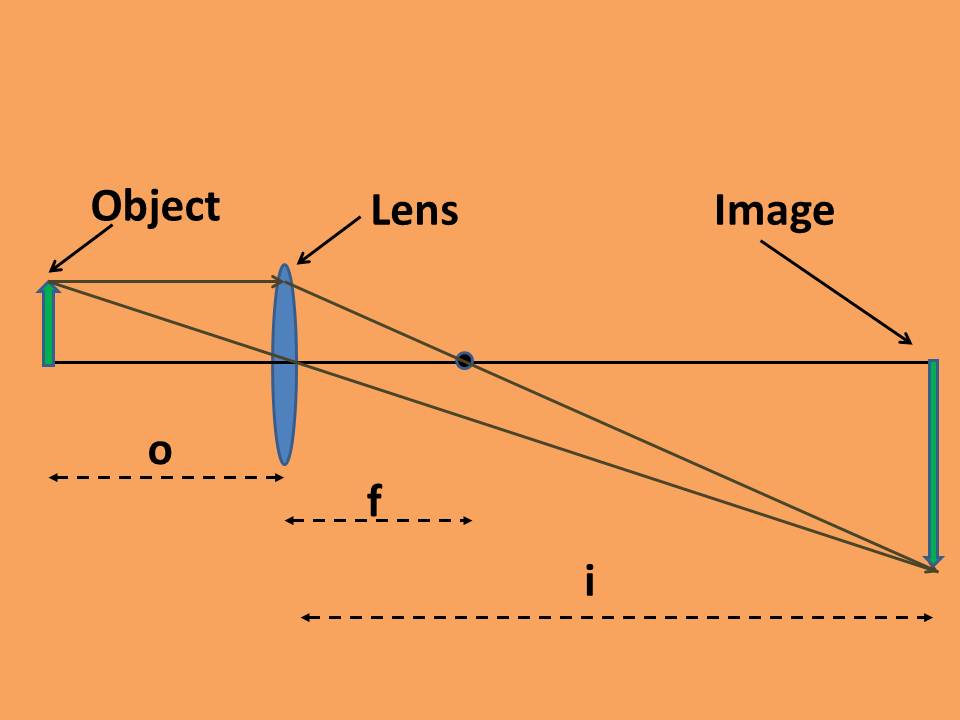
Figure 4 – Lenses cause and image of an object in front of the lens to form a distance i, called the image distance, behind the lens.

So let’s consider the omnipresent arrow again at some distance that we call o in front of the lens. A ray of light coming from the point of the arrow parallel to the center line, referred to as the optical axis of the lens, must pass through the focal point. A ray that hits the center of the lens passes right through it. These two rays cross.The other significant point is that the point the ray that strikes the center of the lens passes straight through it. The two rays cross a distance I behind the lens and form an inverted (aka upside down) image. This is referred to as the image distance. The relationship between o, i, and f is the so call “thin lens equation.Note that in the case that I have drawn the arrow becomes magnified. This is sometimes the case in macrophotography. The more typical; case is when the image becomes demagnified. A tree is usually a lot smaller as a picture than in real life. In any event the magnification, M, is given by

M = (image size)/(object size) .

And geometry teaches us that

(Object size)/(object distance) = (image size)/(image distance).

Finally, and as a result,

M = i/o = 1/(1/f-1/o)o.=1/(o/f-1).

If we note that in general, except for close-up macrophotography, the object distance is much larger than the focal length, the o/f is much greater than 1 so

M ~ 1/(o/f)=f/o.

We will use this simple relationship in a subsequent blog, where we will start to explore the important question of what sharpness can be achieved in a photograph with a given lens.

Let’s summarize what we have discussed so far in these technical blogs from a practical point-of-view.. Cameras typical give us the ability to control three things:

  • We move the lens so as to change the lens position relative to the detector surface and   thereby change what’s in focus
  • We change the lens or the zoom that we are using so as to change the magnification
  • We change the aperture so as to change the depth of focus.

The physical basis of these first two points has been given in this blog post. The physical basis of the last point was touched upon in our discussion of the pinhole camera and will be discussed in more detail in a subsequent post.

William Wegman and anthropomorphic amusement

I make it a point to look at as many photographs as I can.  On business trips I always bring photography magazines and I go to as many photography exhibits as I can.  There’s always something to be learned.  Last week at Bowdoin College’s art museum I went to see an exhibit of the photographs and paintings of William Wegman “Hello Nature.”  Yeah, yeah the guy with the weimaraners .  .

And I have to admit that I have never been all that excited about Wegman’s work.  Maybe it’s because I’m more of a cat person.  Still, like I said, there was something to be learned.

First, of all these are very clever pictures and they do make you laugh.  So, like everyone else, I enjoy these pictures.

Second, I learned from my friendly student guide that there’s no Photoshop or photomontage at work.  Thus, when you see dogs dressed as yachtsmen sailing a boat there was a photographer’s assistant who positioned the dogs and jumped into the water at the last possible instant.

Third, one gets to see some of those large format and soon to be extinct Polaroid images.  Every day as I drive to work I pass the old Polaroid headquarters in Waltham, MA.  The site is now knocked down and a new buildings under construction.

But, I digress.  A few years back I read a useful book by Bill Smith Designing a Photograph.  There are many ways to create an image to grab one’s viewer.  One of these is to throw the image out of symmetry with something unexpected.  This can create a sense of imbalance and dynamism.    And that’s a fourth and important point with Wegmans work.  You expect people and get dogs, expect a moose and get a dog’s head with antlers.  Hmm!  Still there’s something familiar here.  There seem to be two types of cartoon figures. Mickey and Pluto are animals. Goofy has a dog’s head, but human limbs – like some sort of ancient Egyptian deity.  Years ago I was present for a sheep surgery.  The sheep was lying on the table all covered with sheets so that all you saw was the sheep’s head.  It kinda felt like I was in a Wegman photograph. And it makes one laugh. And also Wegman has clearly achieved a brand.

The laughing is a key point.  If you were to challenge yourself to make a photograph that makes people sad – not so hard; fills people with awe – again not so hard; hat’s cute – bring out the curly haired kid or the puppy.  But to create not only one but many images that are sure to elicit amusement  – that’s a feat that Wegman accomplishes repeatedly.

Alan Henriksen, abstract forms in photography

When it comes to photography, I like deep blacks, luminescent whites, and dynamic range that give you everything in between.  In a recent issue of Lenswork Magazine (Issue 100, May-June 2012), I discovered some wonderful photographs of seaweeds that blew me away in all these respects.  These are part of two series of photographs of seaweeds by Long Island photographer Alan HenriksenLenswork Magazine is available online or, if you’re lucky, at your newsstand.  My own Barnes and Nobles has stopped carrying it.  You can also find some of these pictures in the  August Contest Special issue of Black and White Magazine, which gave Mr. Henriksen a merit award .   Unhappily the reproduction quality of B&W fails to give these images their well-deserved do. This, parenthetically points to the importance of the attention to detail that Brooks Jensen and the folks at Lenswork apply to photography reproduction).  Fortunately, you  can also visit Henriksen’s website, with the added bonus of seeing his other portfolios.

The seaweed images are examples of what can be accomplished with black and white photograph if you pay proper attention to dynamic range, not to mention if you had considerable talent and artistic vision. The blacks are marvelous.  The dynamic range lends an amazing sense of texture to the images, and the luminescent whites seem to pull the images into a third dimension.  You can tell that I’m impressed and excited. Look these photographs up and see for yourself.

Rain can drive one to kitsch and finally good food in Brunswick, ME

The first two days of my four day Southern Maine vacation were plagued by rain – intense rain, the kind that makes you not want to take your camera equipment outside.  Inspired by the L. L. Bean centennial boot (see previous post), I went in search of some of the kitsch that makes Southern Maine, around Route 1 famous.

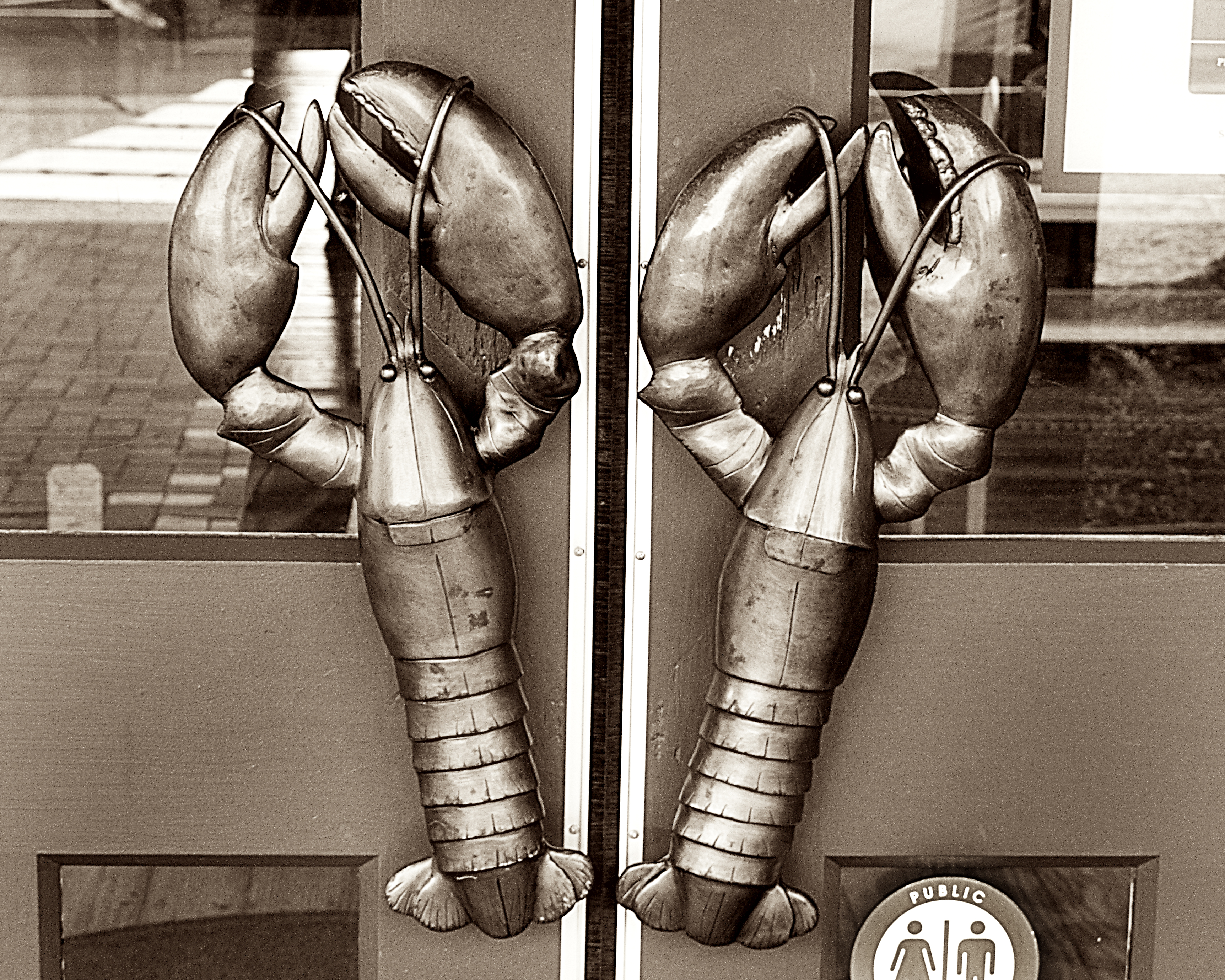
Lobster Door Handles at L. L. Bean

L. L. Bean is itself a kitsch hunter’s playground.  And for the most place this now sprawling facility is mostly indoors.I apologize, but I took no moose pictures, despite several models available both at Bean’s and elsewhere – shades of Teddy Roosevelt to be sure.  But following the wildlife theme, I did photograph the giant lobster door handles of the Home Store.  Even the biggest of Lobstah fan’s would find it difficult to place these gigantic metal crustaceans.  I mean who has a big enough door for startahs?

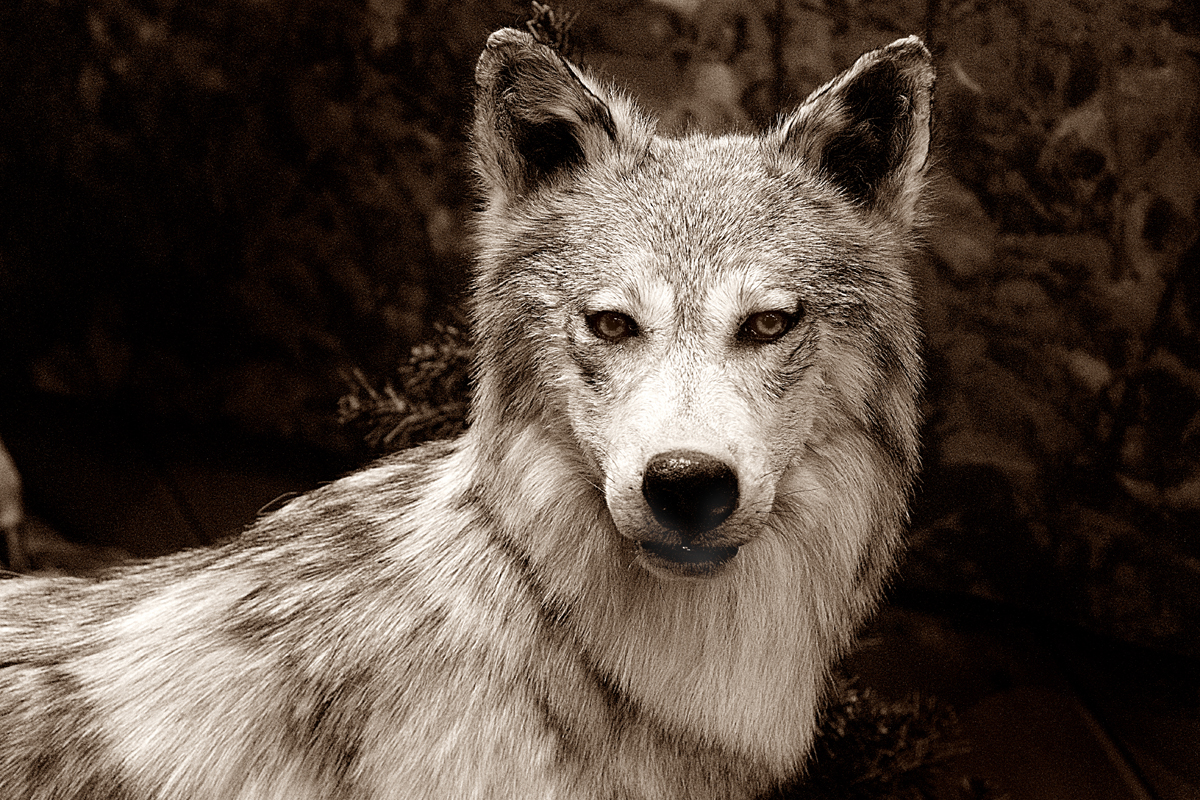
L. L. Bean Wolf Taxidermy Specimen

Then it was over to the Main(e) store to photograph my namesake, in this case stuffed, Wolf.  The store is filled with taxidermy specimens.  Besides my Wolf and the requisite moose, are deer, bobcat, coyote, and mink – indeed, just about all of the Main(e) mammalian species are represented. Again nature lover Teddy Roosevelt’s single handed efforts to eradicate North American wildlife comes to mind – times were different, an important lesson to remember.

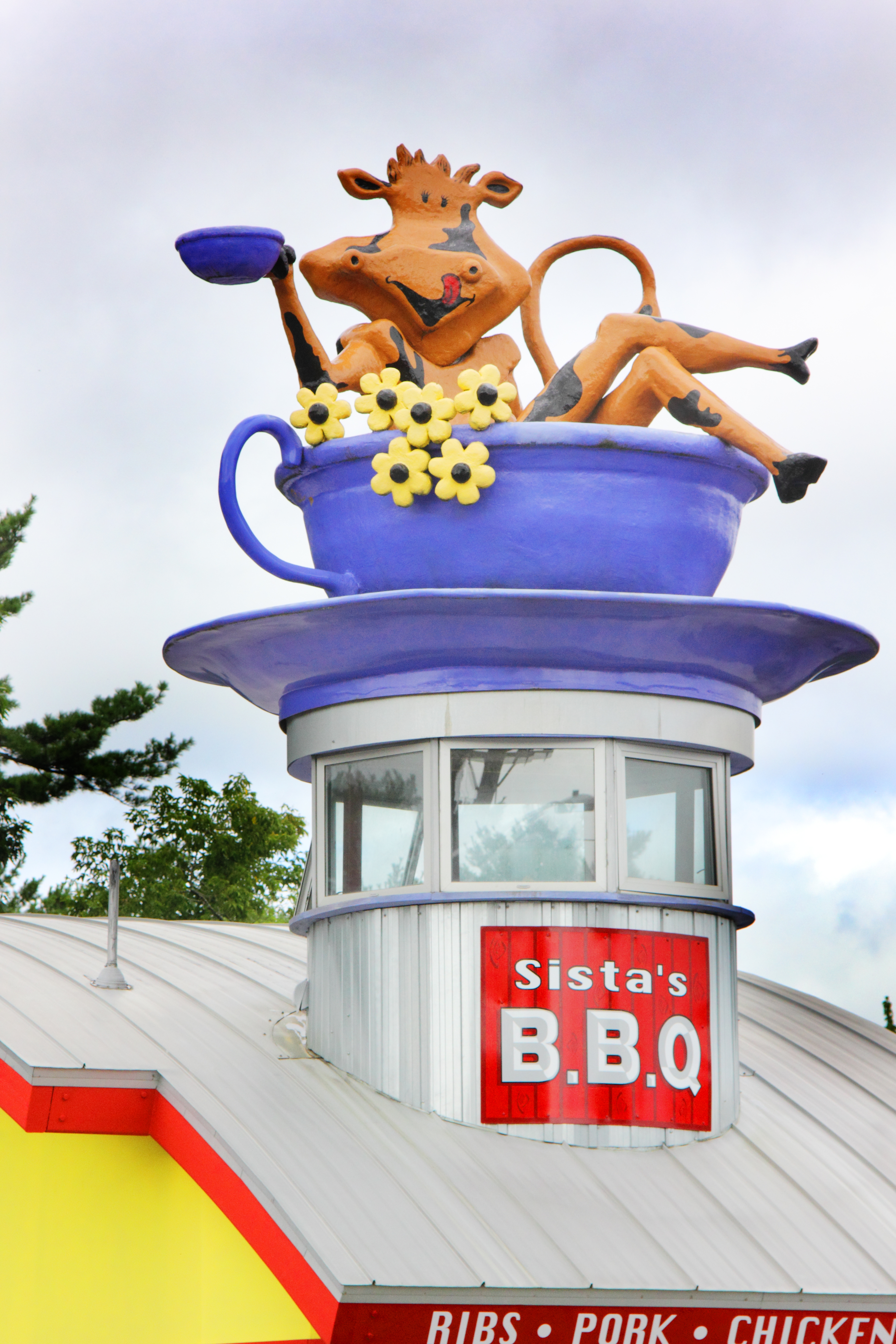
Sista’s BBQ in Brunswick, ME

But for the ultimate of kitsch décor, we journeyed to Brunswick Maine and Sista’s BBQ adorned with its marvelous cow in coffee cup – the whole place in amazing Technicolor.  Sista’s was closed when we were there, except for the photographing.  And in truth, more to our taste, we went to the Scarlet Begonia, where I had the most amazing best in a lifetime shrimp Caesar Salad.  And despite being stuffed, we stopped on the way out of town at The Gelato Fiasco.  The name struck us as odd until, and after a cup of the most wonderful gelato ever, we realized that the fiasco was that The Gelato Fiasco wasn’t close to home.  The good news is that their website contains a list of other New England sites, including our local Whole Foods in Wellesley, MA and Crosby’s Market in Concord, MA where pints are available.  Phew, we dodged one there!

Cell phone photos as a record of a generation

We headed off at 6AM Tuesday morning for a short post-Labor Day vacation in Maine.  This is the way to do it. Crowds are light, save the busloads of tourists from the cruise ships.  Days are warm.  Nights are cool; and there is just a hint of autumn color.

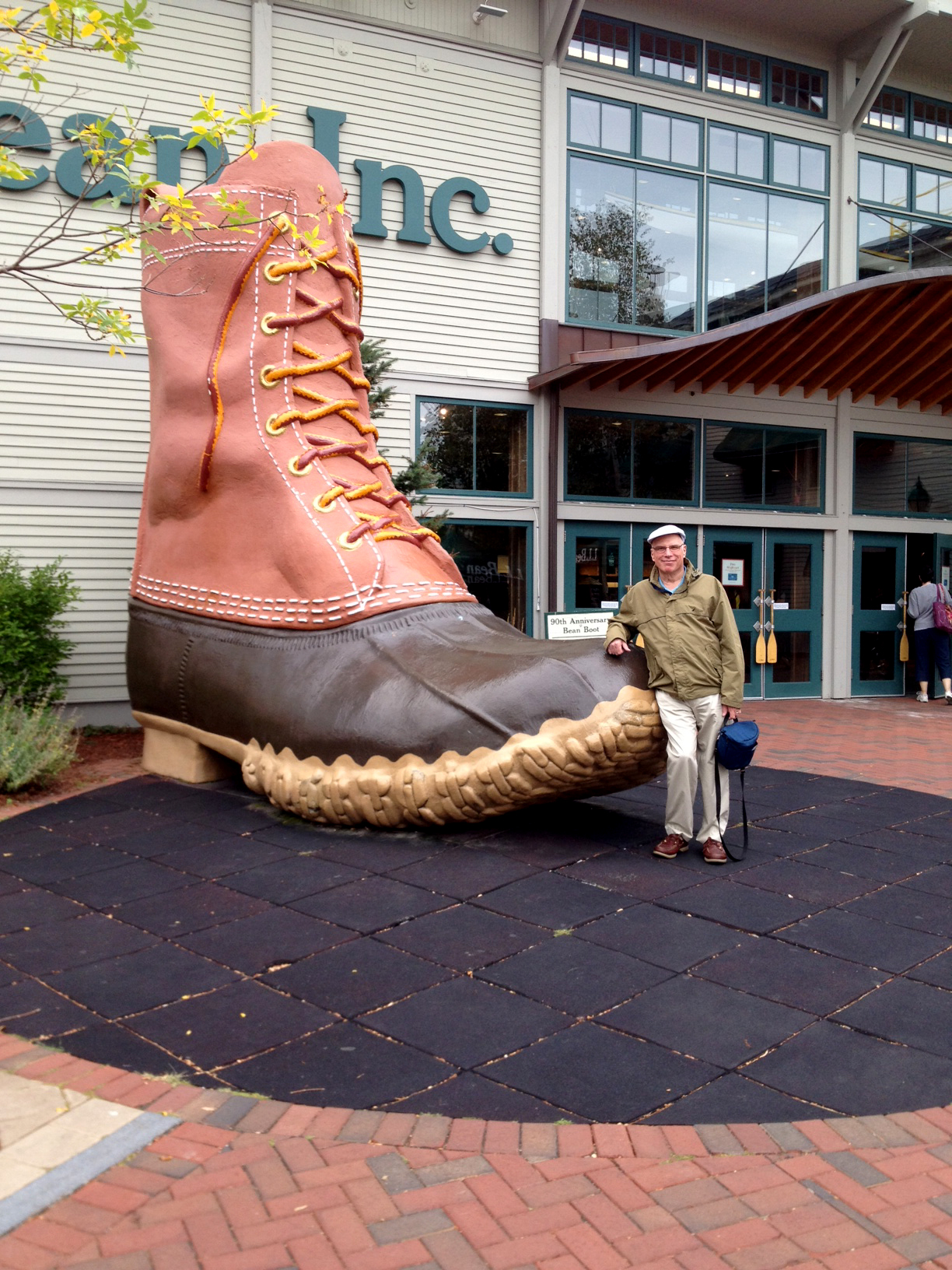
Yours truly with the L. L. Bean Boot

6AM is also the time to do it.  Two and a half hours later we were having coffee at L. L. Bean’s in Freeport, ME, and then I paused to have my picture snapped in front of the giant centennial Bean’s Classic Boot.  It was the epitomizing tourist shot.  In days gone by, these were taken with Kodak Instamatics or Polaroid Instant Cameras.  The cell phone, IPhone, and Android have opened up a whole new world here.  The pictures are of much higher quality, thanks to some very cool and sophisticated technology and can be sent worldwide because of the internet and social media like Facebook and text messaging.

Historically these are going to prove to be the records of a generation and it is ultimately the very real problem for archivists to figure out how to preserve this important record.  This is reminiscent of the collection of Letters of a Century that was all the rage during Y2K. I heard a talk once about imaging technologies from a Smithsonian Archivist, and preserving this record poses no small task.  Technology changes so fast that what is “readable” with ease today will be quaint non interpretable artifact ten or twenty years from now.  In my early scientific career, we made the important transition from paper to digital data storage.  Anybody got an eight inch floppy disk drive that can read my Technico Computer files?

Storm clouds over the Chesapeake

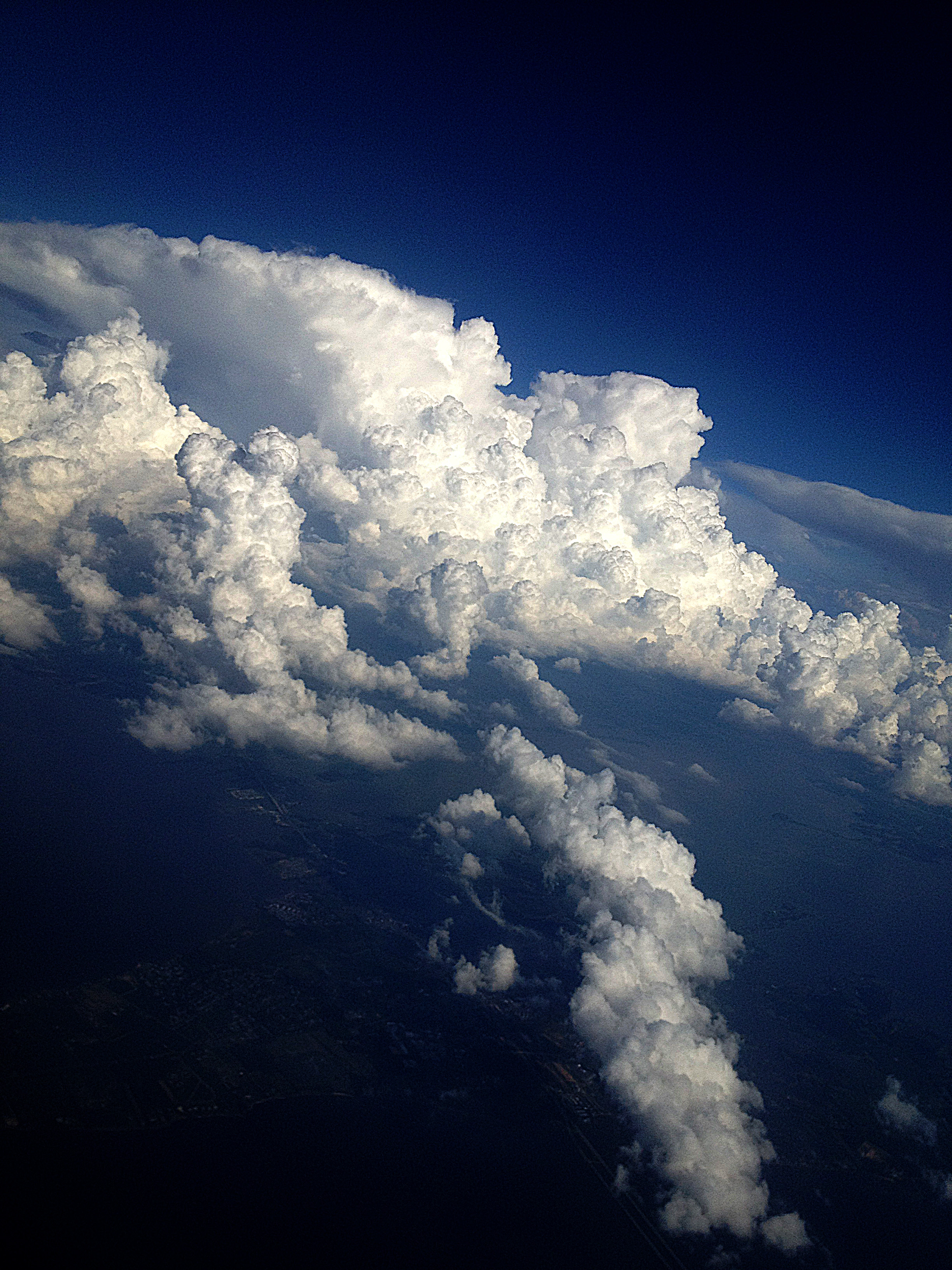
Still I encourage everyone to make a point out of creating a folder on your Facebook or other pages of “Uploads from My Cell Phone.”  It serves the purpose of your camera’s always read for that “Kodak moment.” You can even get some pretty good pictures with these devices.  There is instant review and the pixel densities are now quite reasonable.  Images are just as accessible for post processing with Photoshop or your favorite image processing software.  I offer an image I took from my airplane window of Storm Clouds Gathering Over the Chesapeake. We have reached a high level of technical prowess for these personal life recording devices.  So friends record!

Abelardo Morell, at once whimsical and brilliant

Any discussion of the pinhole camera must lead us to the camera obscura and from there to the truly inspired vision of Boston-based photographer Abelardo Morell and his book Camera Obscura (2004).  If you haven’t yet seen these works, you must.  In general what Morell has done is taken a room, covered the windows except a small pinhole, and then taken an extended image of the walls and surrounding furniture with a view camera.  So we have for instance “Boston’s Old Custom House in Hotel Room, Boston, MA 1999.”  But to me the most inspiring of these works is “Book and Camera: in Memory of Fox Talbot, 1999,” where a hstory of photography book is imaged with a homemade pinhole camera, revealing a dim ethereal image of the inventor of photography.  This is the specter that haunts us all as photographers.  It is an amazing work.

And on a more diminutive, although no less inspiring, level are his photographs to illustrate Alice’s Adventures in Wonderland.  These are made from cutouts of Sir John Tenniel’s original classic illustrations.  For instance, the Rabbit (Down the Rabbit-hole, 1998) now peers down a magical hole or Alice (The Lovliest Garden You Ever Saw, 1998) looks tentatively into an illustration of a garden in a partially opened book – not sure whether to enter.

I leave Morell’s other works for you to discover for yourselves.  He is certainly one of the most creative living photographers.