At the Mall with my IPhone

Mall5

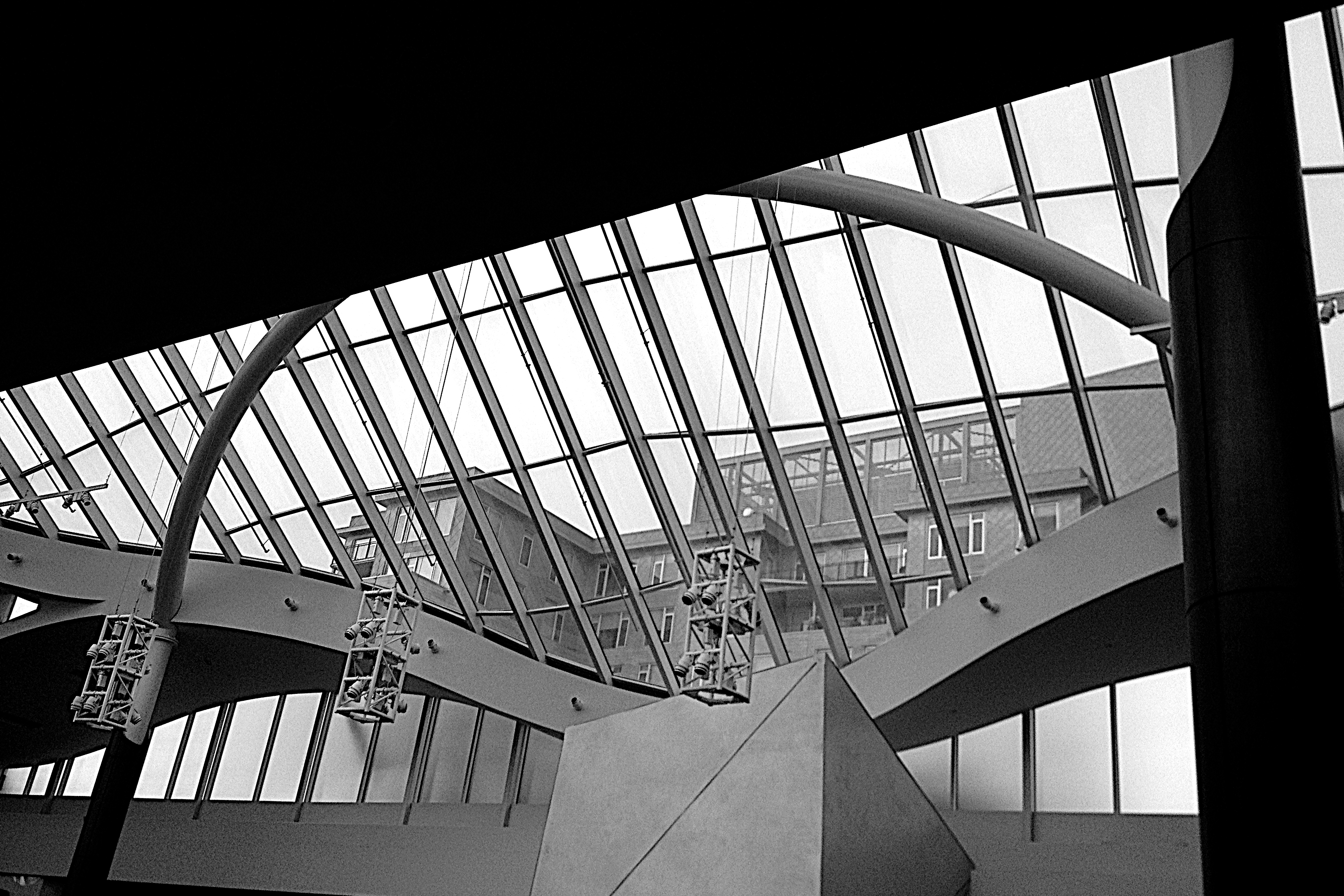
Figure 1 – “Roof of the Natick Collection,” (c) D E Wolf 2013
Mall6

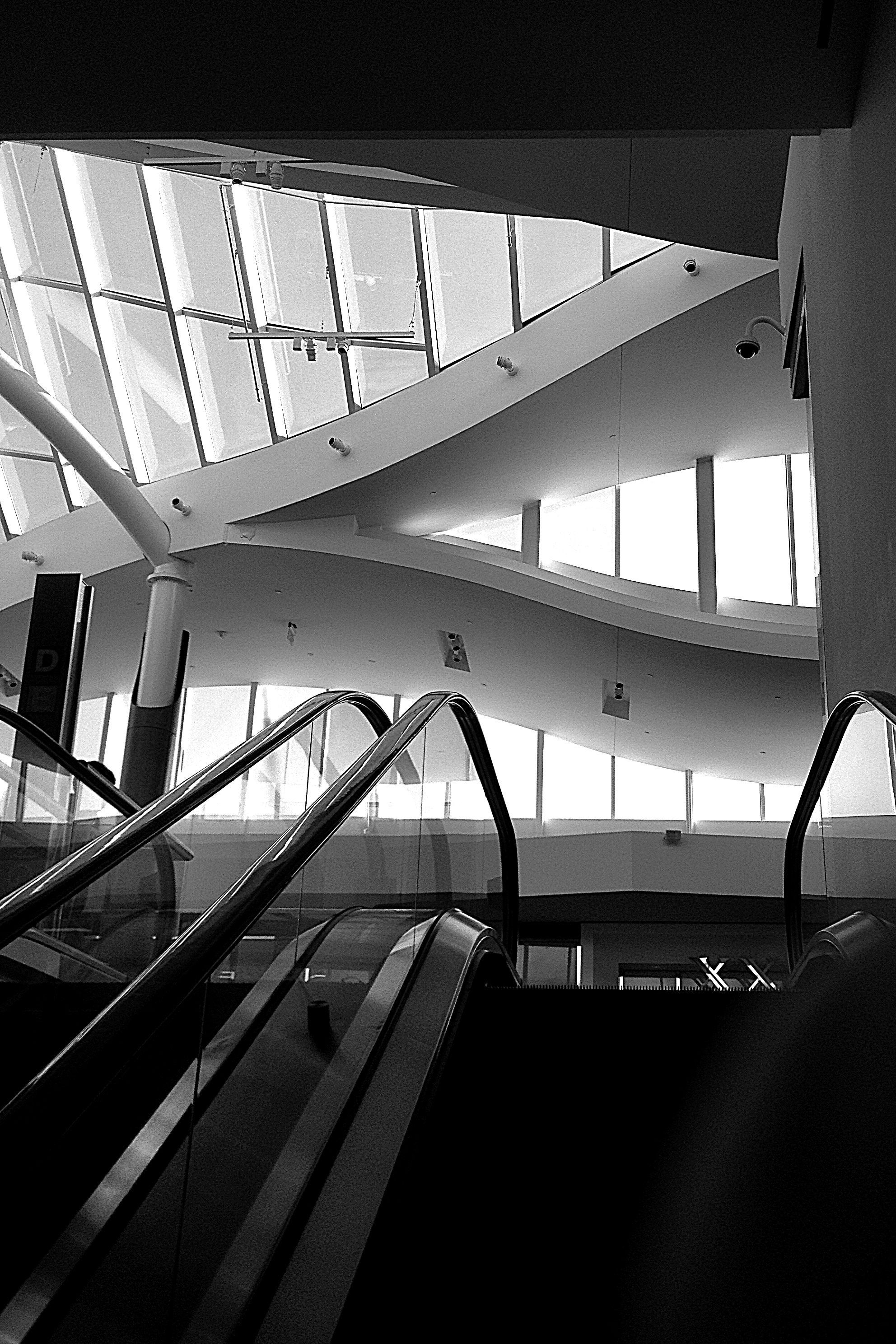
Figure 2 – “Up escalator the Natick Collection,” (c) D E Wolf 2013

OK, so it’s January in New England.  I’m supposed to be out in the snow taking photographs.  But the truth is that it is so much warmer in the Mall – our local Mall, “The Natick Collection.”

So on a lazy January day I decided upon an experiment.  I would take my IPhone 4S with me to the mall and I would take some pictures.  In this case I decided to apply three rules to myself.  First, the goal was geometrics.  Second, only black and whites were allowed. And third, only geometrics would be allow.  That is no people.
Mall2

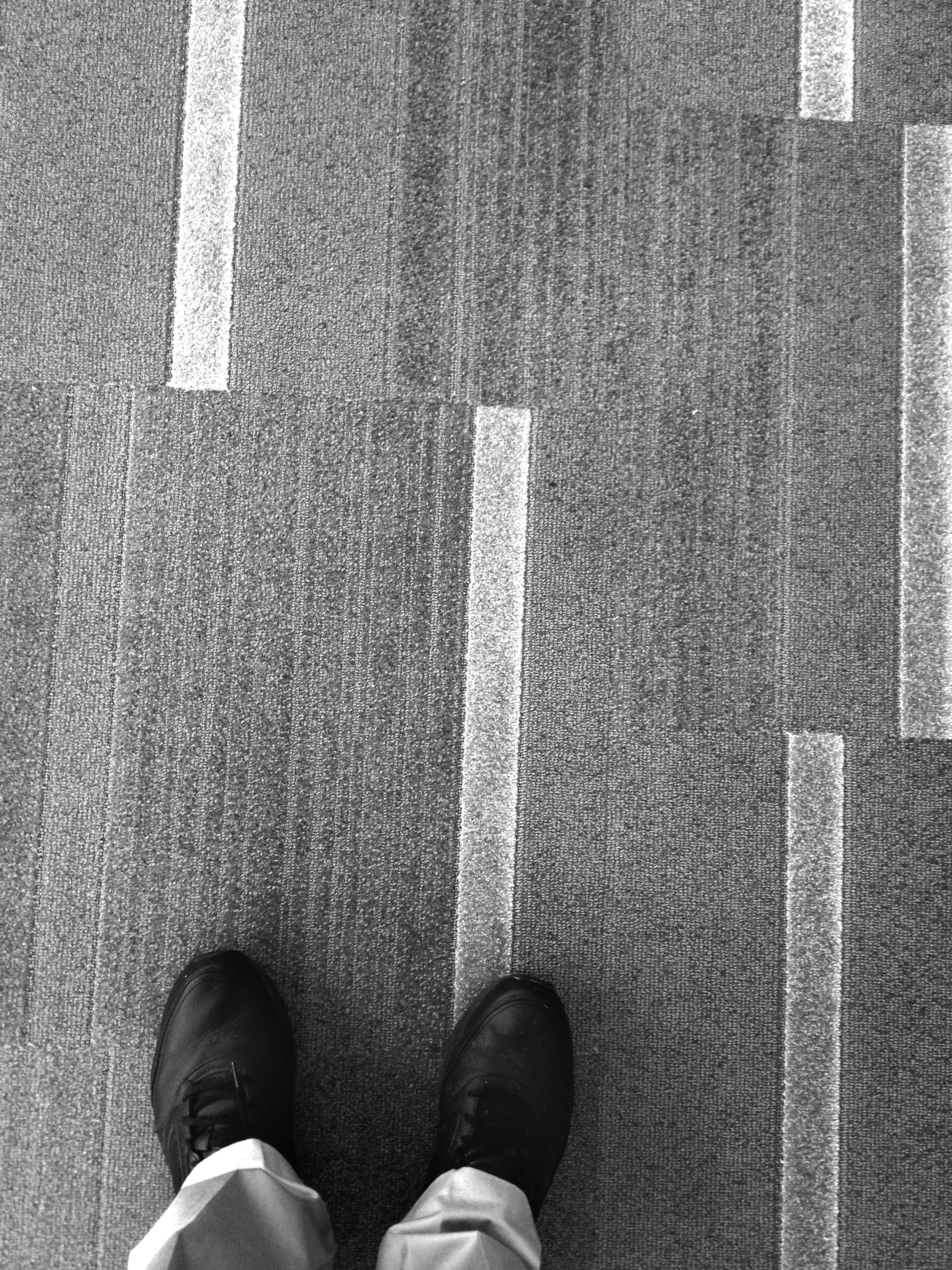
Figure 3 – Feet don’t fail me now! (c) D E Wolf 2013

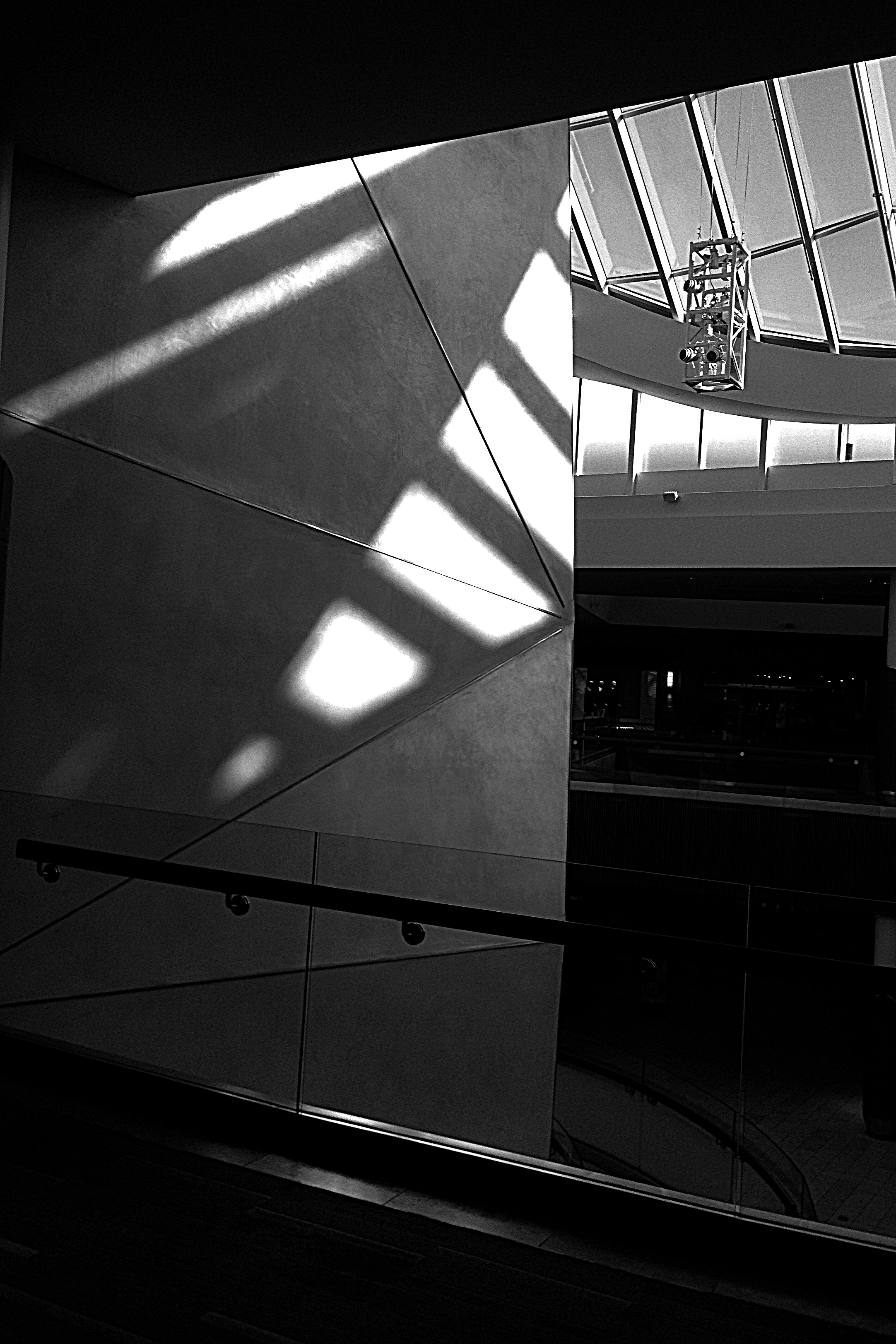
The Natick Collection has this kind of imitation Frank Gehry design.  Outside they cheat and do it with an artificial wavelike facade.  It looks kind of like a boat and there are big sweeping lines inside and out.  As a result, inside the mall there is a cool framework, and this framework in turn casts some very interesting shadows.  These shadows create there own complementary geometric patterns.  The roof is made of glass.  It looks a bit like a greenhouse and on a good day the light streams in spectacularly.

So I headed up the escalator into the light.  I planted my feet on the soft upstairs carpeting and contemplated the path conveniently laid in rectangles before me.  I have a bit of difficulty in framing the image on my IPhone in what is, to me, an awkward position – not to mention that it’s a bit hard to see while you’re framing.
Mall3

Figure 4 – “Shadows the Natick Collection,” (c) D E Wolf 2013

In the end, my trip to the mall fits well to the description of being a “personal photographic wandering.” I think that confining oneself to using a cell phone camera was a very valuable exercise.  It let’s you focus on the photograph.  I was going to add “and not your equipment,” but you always have to know and understand your equipment and what it can do.

But as I walked around the mall contemplating storefronts and sushi bars, I remembered Ansel Adams’ burro named Miseltoe. Misletoe accompanied Adams on his first long trip into Sierras in 1920, when Adams was just eighteen. Mistletoe, carried almost a hundred pounds of gear and food, Adams a thirty-pound pack full of photographic equipment.
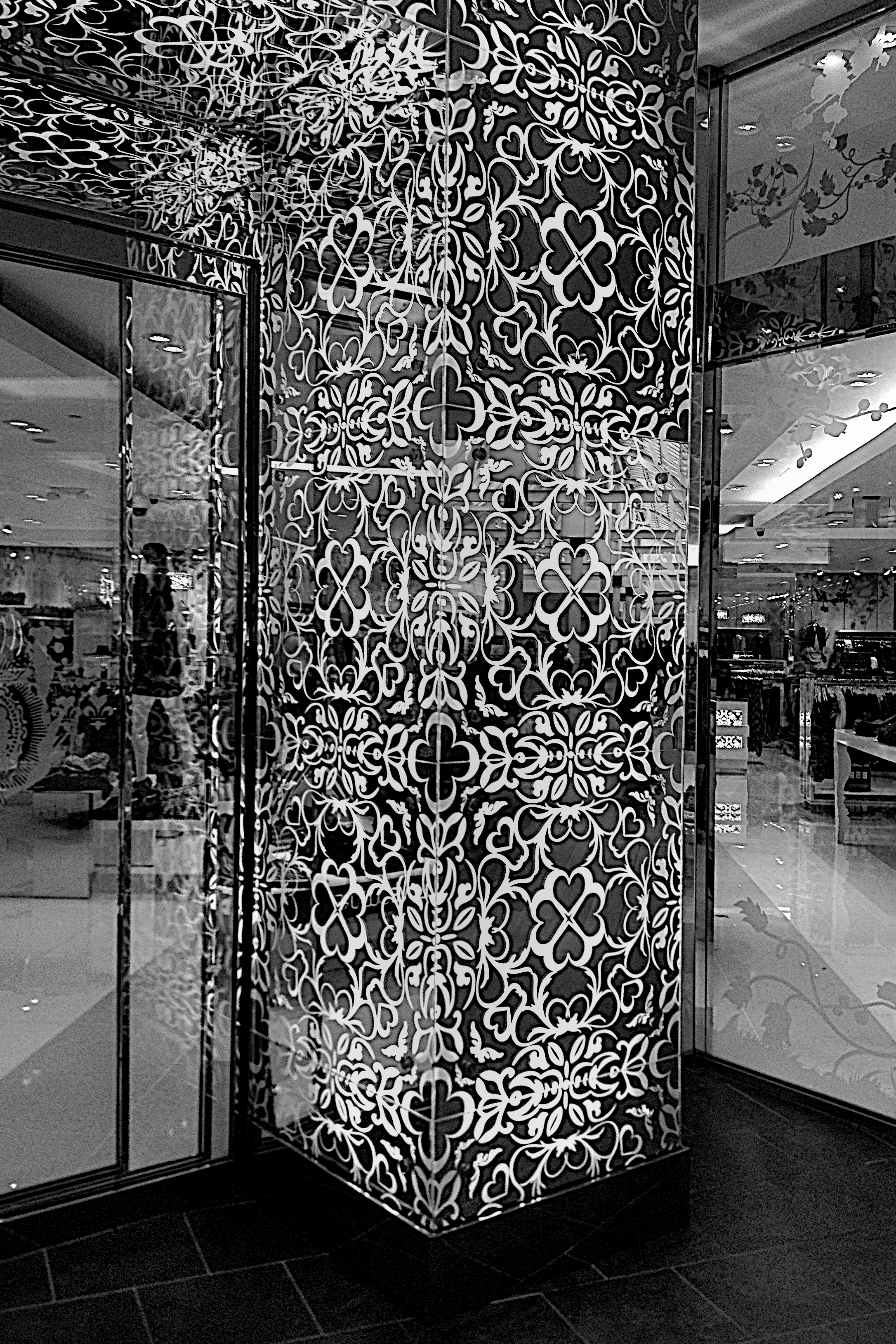
Mall4

Figure 5 – “Glass Column the Natick Collection,” (c) D E Wolf 2013
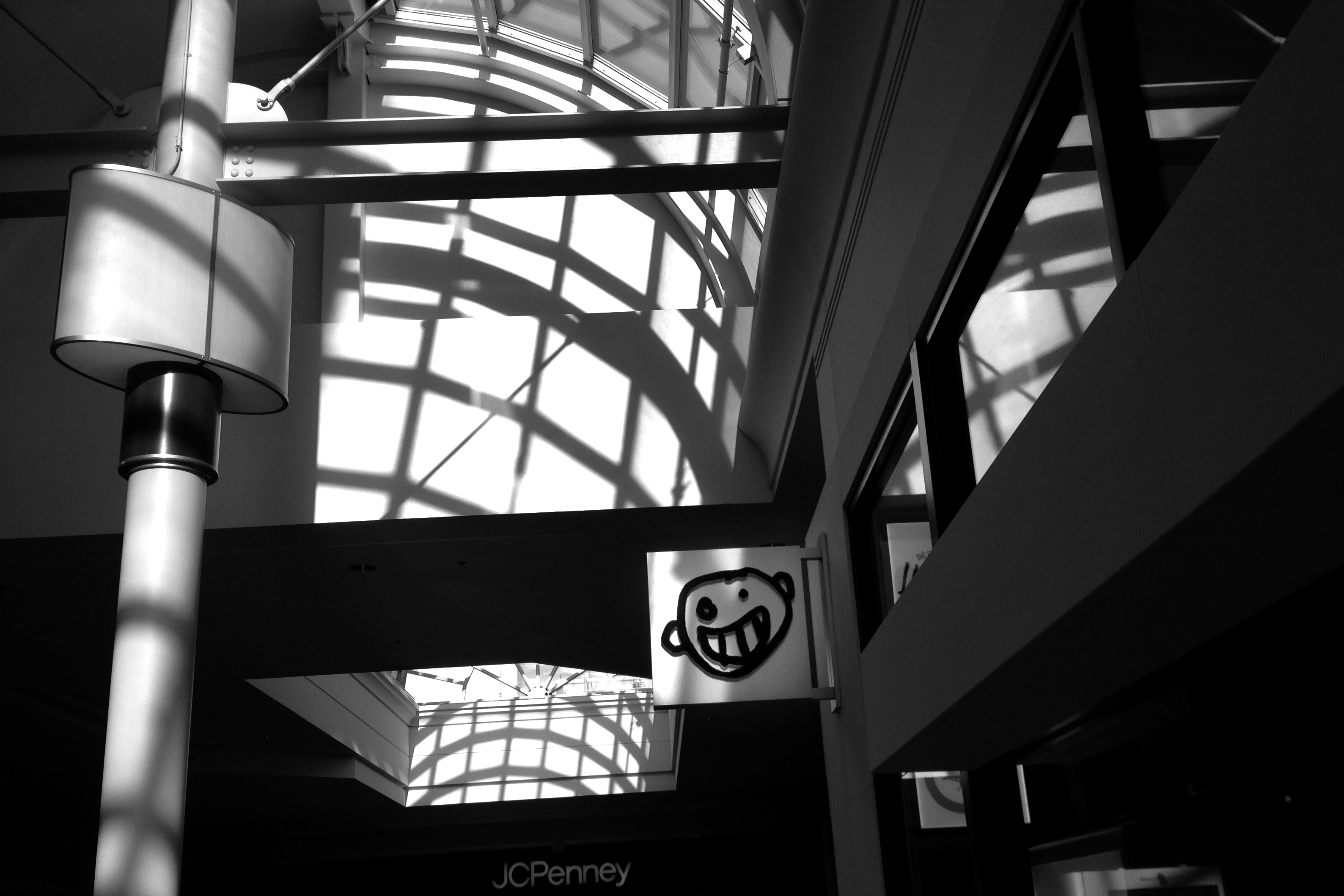


Mall1
Figure 6 – “Newbury Comics the Natick Collection,” (c) D E Wolf 2013
Photographic firsts #6 – the first microphotograph, John Benjamin Dancer and the invention of microfilm

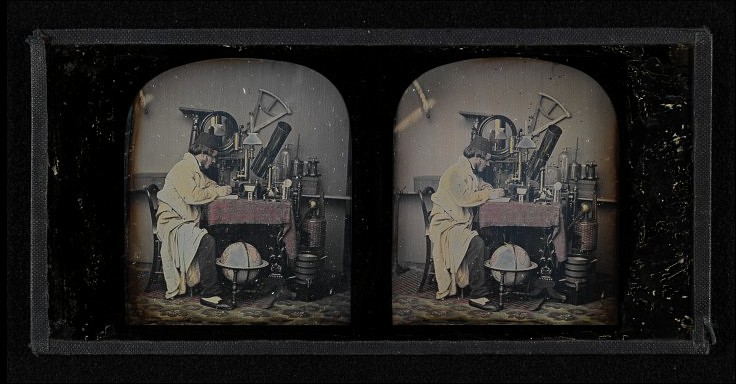
Dancer the Scientist in his Laboratory

Figure 1 – John Benjamin Dancer daguerreotype stereo pair, “The Scientist in his Laboratory, 1851.” The image shows a sitter as “the scientist” creating a daguerreotype and surrounded by Dancer’s instruments and inventions. The image is in the collection of the Victoria and Albert Museum and is in the public domain.

One of the things that you can do with a microscope is project the image of something very tiny onto a wall.  That is, you can blow it up or greatly magnify it.  The only functional limit to this seems to be the amount of light that you have.  How big can you make the image before it gets too faint to see?

If you think about it, you can actually use the same microscope to reverse the process.  You might look at a scene, say a cathedral or a painting, and use the microscope to make a very true but tiny image of the scene.  Physicists have a very cool name for this.  They say that the “laws of physics are reversible in time.”  Wow! Did I say time reversal?

Now suppose I put a photograph film or digital detector in the microscope.  Then if I exposed the film with light from the scene and subsequently developed it, I would have a very tiny image of the scene.  Such was the innovation and popularization of John Benjamin Dancer (1812-1887).  Dancer ran a microscope manufacturing company and also sold microscope slides that contained these wonderful early microfiche.   Several examples can be seen on the web at the site of the Whipple Museum of the History of Science in Cambridge UK.:

Photographic firsts #5 – the first photomicrograph

FoxTalbot-First-Photomicrograph

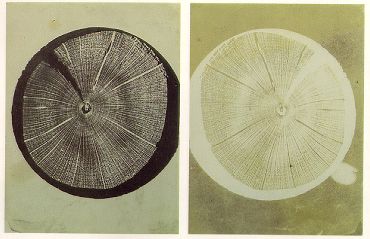
Figure 1 – the first photomicrograph a transverse section of a stem taken by William Henry Fox Talbot in 1839 from the Masters of Photography website ( and in the public domain).

Let’s turn today to the question of who took the first successful photomicrograph.  We need to be precise about definition.  A photomicrograph is a photograph of something small under a microscope.  This is as opposed to a microphotograph, which is a very small photograph that might require a microscope to see it, but could, in fact, be an image of something very large.

William_Henry_Fox_Talbot,_by_John_Moffat,_1864

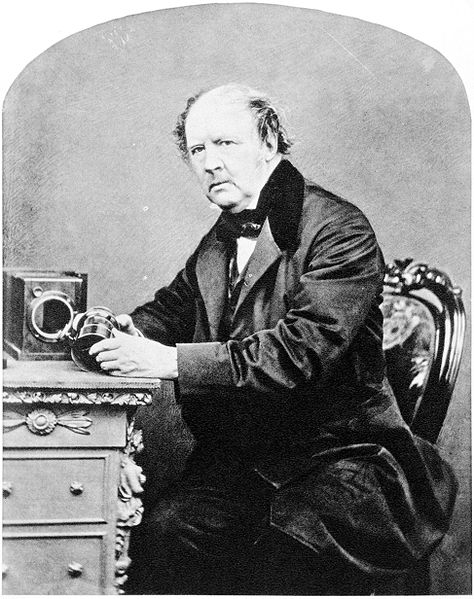
Figure 2 – William Henry Fox Talbot by John Moffat, 1864 from the Wikimedia commons, Michael Maggs source and in the public domain.

It is interesting that this story connects with Charles Darwin.  Charles Darwin and his wife Emma nee Wedgewood were first cousins.  They shared a grandfather, Josiah Wedgewood, I (1730-1795) and an uncle Thomas Wedgewood (1771-1805), who was an early experimenter in photography.  The interrelationships in this very important English scientist and intellectual family are very complex, but you may sort it all out from the Darwin-Wedgewood family tree.  Of course, the name Wedgewood is familiar to us from their very distinctive fine china, and it is indeed the case that Wedgewood Porcelain was founded by Josiah Wedgewood, I and subsequently led by Josiah Wedgewood, II, Emma’s father.

In 1802, uncle Thomas published  “An Account of a method of copying Paintings
upon Glass, and of making Profiles, by the agency of Light upon Nitrate of Silver” in
the Journals of the Royal Institution, it states:
“In following these processes, I have found that the image of small objects, produced by means of the solar microscope, may be copied without difficulty on prepared paper. This will probably be a useful application of the method; that it may be employed successfully, however, it is necessary that he paper be placed at but a small distance from the lens.”

Now, we have no evidence that Thomas Wedgewood ever succeeded in capturing a photomicrograph.  There is however, some evidence that he and Sir Humphry Davy (1778 – 1829) did attempt to do so.

A solar microscope, by the way, is simply a microscope that uses the sun as a source of light.  This is usually accomplished by means of a mirror that reflects the sunlight from outside a window into the microscope.

The first known photomicrograph, and therefore the credit of being the inventor of photomicroscopy goes to the inventor of photography William Henry Fox Talbot (1800-1877).  This is shown in Figure 1 – a photomicrograph of a botanical transverse section of a stem, 1839. A photograph of Fox Talbot taken by John Moffat in 1864 is shown in Figure 2.

As natural history came more and more into intellectual vogue in the nineteenth century the act of looking through a microscope became more and more familiar.  You would expect to see a circular image surrounded by black.  As a result, the framing of Fox Talbot’s photomicrograph by a circular field of view has as much to do with viewer expectation as it does with how the picture was optically taken.

* Here is an excellent link to the history of photomicroscopy.

Genealogical imagery and the quest for the familiar

I’ve gotten a lot of kind and positive response to my post about my grandmother’s portrait, and it got me thinking about the special appeal of old family photographs.  We have discussed the magical quality of nineteenth century photographs of people, about how these people seem to call out and connect with us across the vastness of time.  Their anonymity is part of their appeal.  We are almost voyeurs observing long forgotten lives. In the case of family photographs it is almost as if the opposite is true.  We are looking for something familiar, something of ourselves that creates a special bond of connection.

I remember once going to a good friend’s mother’s house and there on the wall was a nineteenth century picture of what appeared to be his teenage daughter.  To me his daughter looked like her great-great grandmother – so strong was the family resemblance. That is the great power of our genes and therein lies the appeal of family pictures.  They create a sense of personal connection and at the same time flesh out the ancestor almost as if they were remade.

The picture that I posted of my grandmother used to hang in my grandmother’s living room and next to it was a picture of my infant father on a bearskin rug from around 1918.  I remember looking at them, whenever I visited my grandmother’s house. These hang again together in my study now.  They are loaded with memories for me.  Right now I am thinking about how sunny her 12th floor Bronx, NY apartment was, how she had a green thumb, which she was sure was because she spoke and sung to her plants.

And I suppose that there is a distinction between pictures of family that you once knew and family you never knew.  In the latter case you can only imagine.  And what you imagine is that the genes run deeper than any superficial physical likeness.  You imagine that personality traits and feelings were also the same.  Do you laugh like your parents, and they like theirs? Just as you may be like your mother or father, who in turn was like their mother or father, all of these people shared something of personality, with you – each in the context of his or her own time*.

There’s a lot of imagining going on, a lot of projection of self, and quite suddenly we see once more the true magic of photography.  It projects a filtered reality through time and space.  It makes us wonder about what makes us fundamentally human.

* I’d like to remind readers of my post of October 30 about Rafael  Goldchain “I am My Family.

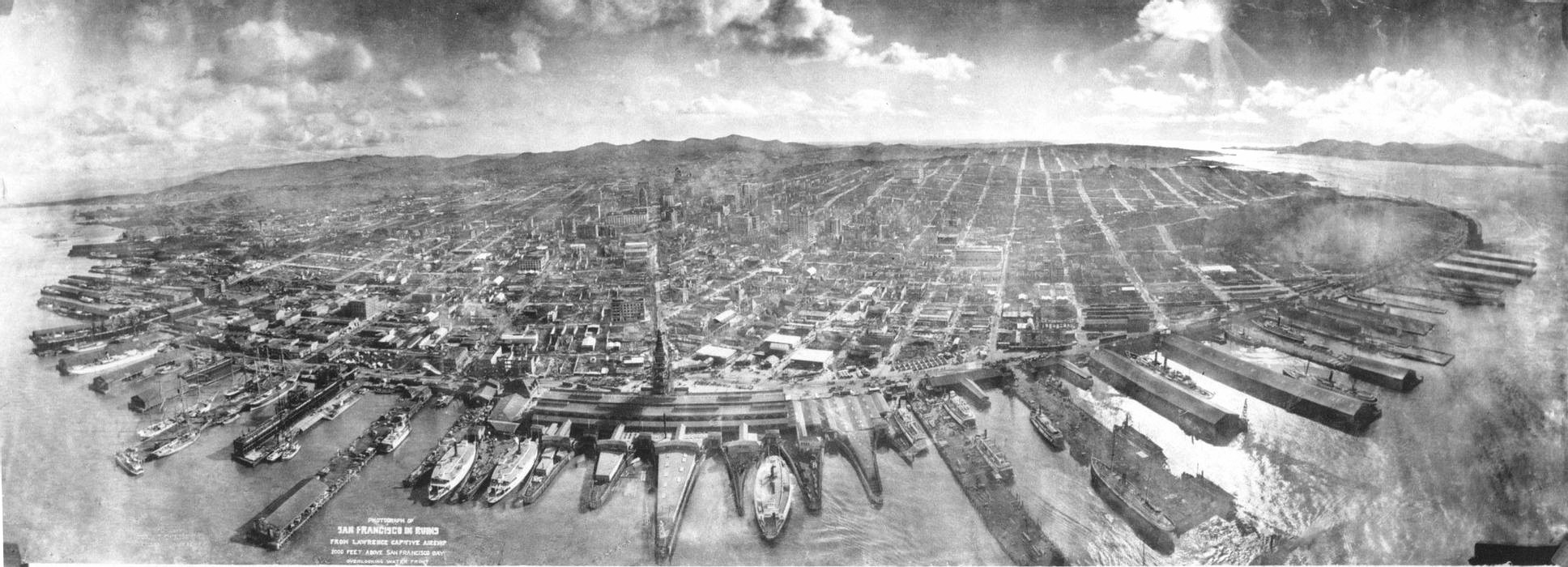
Aerial view of the Great San Francisco earthquake 1906

1906_EarthquakeOn the subject of early aerial photography, we should also take a look and marvel at George Lawrence’s panoramic view of the devastation that followed the great San Francisco earthquake of 1906.  No hot air balloon used here!  Lawrence used a string of Conyne kites to lift his handmade 49-pound camera panoramic camera 1,000 feet .

Today, needless-to-say there’s a website devoted to teaching you how to take aerial digital photographs from a kite.  If you are going to try this I suggest that you remember George Lawrence and his 49 lb camera and also Benjamin Franklin and his kite experiments,

Photographic firsts #4 – the first aerial photograph

Nadar Aerial Photograph from Balloon Paris 1858

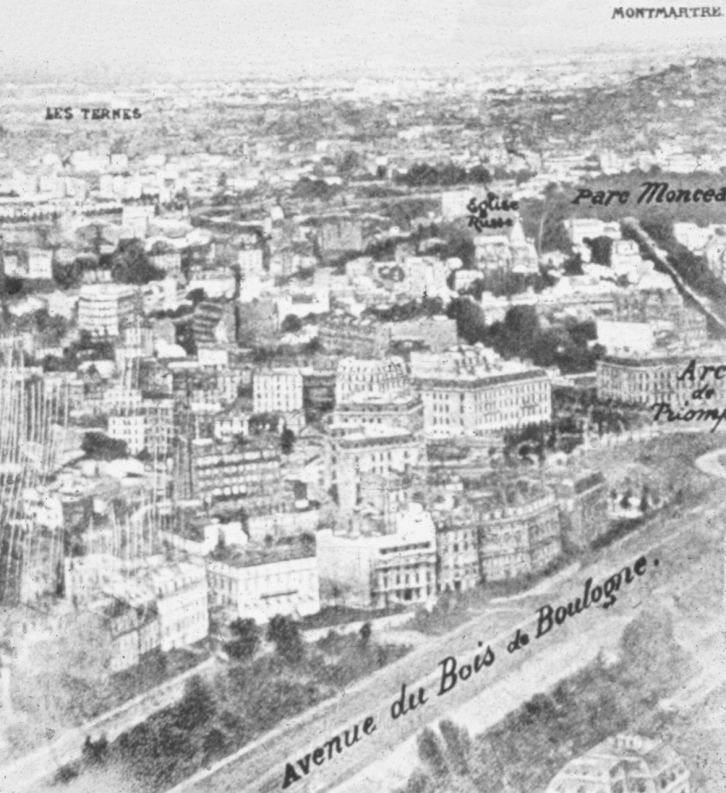
Figure 1 – Earliest remaining aerial photograph by Nadar. Over Paris in 1866 from the Wikicommons and in the public domain

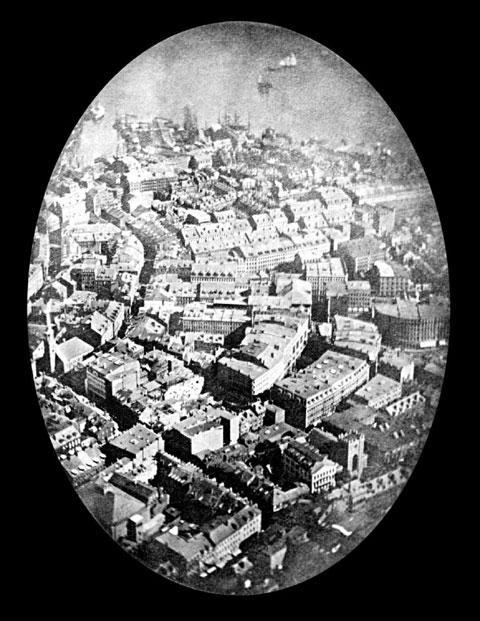
I thought it would be fun today to consider another photographic first, in this case the world’s first aerial photograph.  The first known aerial photograph was taken from a tethered hot air balloon 80 m over the French village of Petit-Becetre in 1858 by French photographer and balloonist, Gaspar Felix Tournachon (aka Nadar).

balloon-Boston

Figure 2 – Earliest known existent aerial photograph. Over Boston in 1858 by John Black from the Boston Public Library and in the public domain

Now the thing is that when we think about such an event, we tend to modernize it and imagine that we climb into a balloon with our digital SLR and snap snap snap.  However, we are talking 1858 and we are talking wet collodion photographic process.  Wet plates must be developed before the plate dries that is within 20 min of exposure.   As a result,  Nadar in addition to having to lug a large view camera into the balloon with him, had to build and use a whole darkroom on the balloon.  Pretty impressive! Unfortunately, the fruits of Nadar’s 1858 efforts no longer exist.  The earliest existent aerial phototograph from Nadar was taken over Paris in 1866 (see Figure 1).  As a result the earliest aerial photograph known to be still in existence is James Wallace Black’s image of Boston, also taken from a hot-air balloon but in 1860 (see Figure 2).  It is also interesting to see a side-by-side comparision with a modern shot with the same perspective taken by S. W. Dunwell on October 13 of 2012, that is to the minute 162 years apart.

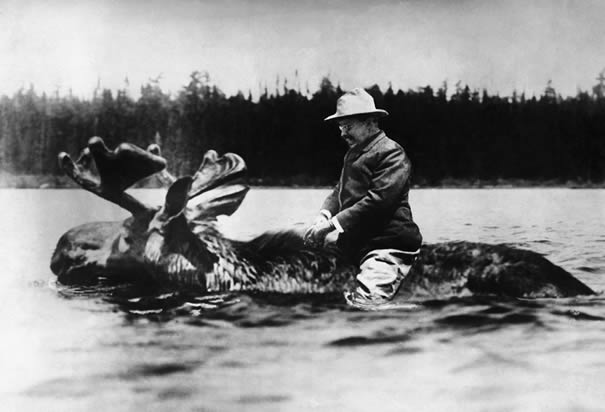
Theodore Roosevelt Riding a Moose

theodore-roosevelt-moose

Figure 1 – Theodore Roosevelt rides a moose supposedly c. 1900 and from the archives of Life Magazine via www.history.com and in the public domain

Well we’ve been talking about and looking at a lot of early twentieth century photographs and I came upon this one and couldn’t resist posting it.  The picture from supposedly c. 1900 shows Theodore Roosevelt riding a swimming moose.  It is said to be from the archives of Life Magazine.  I am a little skeptical.  First, I’ve read a lot of books about Teddy and I’ve never seen this before.  Second, his hands rather than being onto the sides of the moose or holding onto its fur, appear to be holding non-existing reins.  Third, what’s that funkiness in front of Teddy.  Fourth, if you blow the thing up and play with the contrast you start to see a halo of sorts around Teddy but not the moose.  Fifth, there’s a shadow of the moose but not of the president. And finally there’s a strange tonal/texture change behind Teddy’s left pants leg, which by the way isn’t wet.  One way or another “It’s Bully!” ’nuff said.

Sonja Hall – Reflective Silverback, 2009

When I work my way through magazine contest portfolios, I am always looking for the picture that grabs me, the one that makes me say wow.  So I was making my way through the February contest issue of Black and White Magazine #95, when I came across a photograph by painter and photographer Sonja Hall entitled “Reflective Silverback.”  And I said, “Wow, that’s a great photograph!”

Suprisingly, when I visited Ms. Hall’s website I found a color version of the image and I liked that even more.  The shades of gold on the gorillas fur and the shades of green behind the boy really make the image.  What we have here is a gorilla reflective in the sunlight and reflective in demeanour, perhaps dreaming of Africa.  A young boy his hand pressed against the glass of the enclosure is behind the gorilla.  The story is right there, at so many levels.  The  eyes, of both, tell everything and the hand, albeit perhaps unintentionally, is held in a sign of trans-species peace and greeting.

This is one of those pictures where timing was everything.  Usually when you photograph at the zoo, you try to eliminate the zoo aspect from your pictures.  You try to pretend that you took the picture in the wild.  Here however, the zoo is the whole point.  The smudged and scratched glass rather than detracting from the image adds a story to it.

Go and have  look at this picture at Ms. Hall’s website.  While you are there spend the time to look at the other photographs and paintings of this talented young artist. It’s worth the adventure. And don’t forget to watch the slide show on her homepage.

The intelligent camera

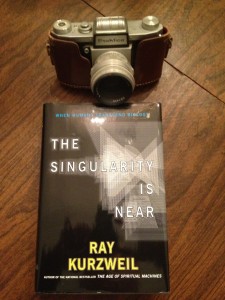
photoIn his book “The Singularity is Near” futurist Ray Kurzweil points out that people are always asking when is artificial intelligence coming, but that it’s already all around us.  It’s just that every time it gets developed, we call it something else.  A real case-in-point is the modern digital SLR.

My father’s camera was a Ciroflex twin lens reflex camera, the “poor man’s Rolleiflex.”  It focused manually with a thumb dial and that was about all it did. There was no flash and no light meter.  For exposure you had to use either the guesstimates that came with the Kodak roll film instructions or an external exposure meter.  My father would mount this camera on an enormous set of external floodlights during birthday parties.  My sister and I still laugh at this since these  slights were so bright that some of our childhood friends may still be seeing after image.s all these years later.

My first SLR was similar in its capabilities, a Praktica from East Germany.  Then I saved up my pennies and bought myself a Leica M3, arguably the best camera ever made.  So let’s say it’s 1968 and I wanted to photograph a flower, but also wanted the building behind it in focus.  The process was 1. consider the scene and decide on an f-number that’s going to give you the needed depth of field, 2. set the f-number, 3. choose the point that you want to use for focusing, 4. move the exposure time dial which was linked mechanically to the exposure meter until the the needle lined up in the center,  5. look at the exposure setting and decide whether it was fast enough to hand hold, 6. focus the lens on the flower using the split screen parallax range finder, 7. note the distance to the flower and then mover the lens focus so that both that distance and the distance to the building were both bracketed by the appropriate f-number lines on the lens barrel.  8. push the shutter.  I used to be pretty good and pretty fast in executing this set of events seamlessly.

Moving on, in 1985 Minolta, with the introduction of the Maxxum 7000, developed “autofocus.”  I remember clearly at the time that many reviewers though this pretty much useless.  I mean, who cannot focus a camera? Today we may be moving towards a crisis on the other side.  With the abandonment of split screen parallax views on the focusing screen, manual focus is becoming harder and harder, even under the many conditions where it might still be preferable.

OK, so today with my Canon T2i, I choose depth of field mode, “A-Dep.” My camera chooses the exposure time for me based on my chosen f-number.  This is based on the placing nine focal points into simultaneous focus.  If this cannot happen, the camera tells me.  Focus is achieved automatically.  Really, if I don’t want to fuss with it,  all I have to do is push the shutter button.  If you think about it, the only thought process required of me was the knowledge that A-Dep was the best way to take this picture.  The little person that lives inside my camera is pretty smart – smart in all sorts of  amazing ways!

This is really a clear example of artificial intelligence, as long as we don’t quibble over the semantic question as to whether an algorithm-based program incapable of learning is true artificial intelligence.  But this definition is pretty satisfactory for most folks, and, perhaps of equal or greater importance,  nonthreatening in that we don’t expect the intelligence in our cameras to declare “cogito ergo sum,” or to emote in response to the subjects they are photographing by, say, crying or laughing.  Most importantly they are unlikely in this stage of development to pass the Turing test.*  But they really do take great pictures!

* The Turing test is a test of a machine‘s ability to exhibit intelligent behavior in such a way that it is indistinguishable from intelligence.  In Turing’s original conception of the test a human asks questions of another human and a machine.  The judge cannot see the participants and they only communicate via a single mode such as a key board and monitor.  That is the test is designed such that the machine does not have to replicate human speech.  If you’ve ever watched the closed captions with the news, you’ll realize that this last point would still be critical.