All forms of photography are equal

I am an avid reader of “View Camera, The Journal of Large Format Photography.”  Practitioners of this form of photography are the keepers of many of the wonderful time-tested forms – from wet colloidon to large format Polaroid –  of the art that might otherwise be lost.  Indeed, they keep these forms new and vibrant, since their goal is not merely to copy but to create.  I was despaired, however, to read in one article recently, the comment that digital printing was merely poster printing, not truly a photographic process.  That is not true and misses a very fundamental point.

I used to believe that if you painted squares or lines and dots on a canvas, but couldn’t paint like Rembrandt, if required to do so, then you weren’t really an artist.  Somehow I believed that being an artist required achieving technical prowess beyond that required for your own art.  It seems silly now and rather convoluted.  It is not true and misses a very fundamental point.

Art is vision and the ability to express that vision.  It encompasses everything from a detail fifteenth century tempura or fresco that might have taken years to complete to minimalist art – a string glued to paper or a paint-laden sponged dabbed selectively on a white board.  You can like it or not, but it expresses vision and is art.

And the marvel in all of this is the individuality of vision.  I have a coworker who showed me marvelous pastel photographs that she had taken in Greece.  They were wonderful, and I remember thinking that if I had been standing right beside her and taken the same pictures they would look completely different.  It’s all about vision.  And it’s all art.

Modern digital cameras, even cell phone cameras, have become progressively easier to use.  They have made the technical part easy and allowed us to concentrate on vision.  Or said differently, they have opened up for us previously unheard of technical capability.   One may argue that the endless droning litany of drunken partiers posted on Facebook, represents a new low in photography.  But I would argue that the real mediocritization of photography came with a vengeance with the introduction of the Kodak Brownie.  Dull meaningless black and whites, or was it gray and grays, and colors automatically set by processing machines to muddy indifference.   They have given more artists a voice.

Let’s embrace photography in all of its forms from the most ancient to the most modern.  They all contribute an important vision or voice to the diversity of the art.


The number of photographs ever taken

I found myself wondering recently how many photographs have ever been taken.  I recognize that this is a little weird.  However, it is what geeks do.  I knew that there would be an answer on the web, that someone besides me had wondered about it before.  So with a little searching I found that everything that I could find written about the subject dates back to a 2011 blog posting by 1000memories.com,  which estimated the number in 2011 to be about 3.4 trillion (3.5 x 10 ^12 for us geeks).  I’ve come up with a slightly different number, but close enough for government work and it’s interesting in that it really demonstrates Kurweil’s concept of the “Singularity.”  The Singularity is the view that technology is growing so rapidly that it’s becoming essentially infinite and  going off the scale.  So let’s have some fun and look at this.

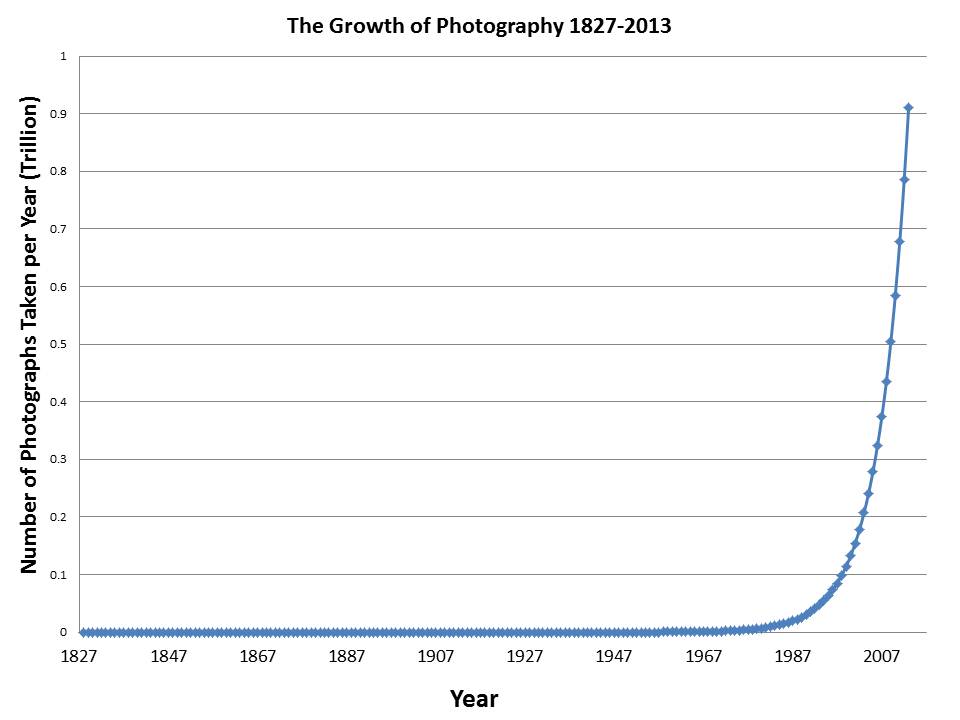
To begin with 100memories.com uses as the number of cameras in the world an estimate by media expert Tomi Ahonen at 2.2 billion in 2011.  In 2012 Ahonen revised this estimate to be 4.2 billion cell-phone base cameras and about a quarter of that, say 1.0 billion non cell-phone based cameras.  So let’s take this number to be a total of 5.2 billion cameras.  The next thing that we have to ask is how many pictures are taken each year per camera.  1000memories.com estimated this in 2011 to be 150 photographs per camera.  As I’ll show you in a bit there is reason to believe that the rate of growth is on the order of 16% a year; so lets go with 175.  So we have something like 910 billion photographs being taken each year at the start of 2013.  Wow!

Alright, so where do we go from here?  So let’s remember that the first photograph was taken by Joseph Nicéphore Niépce in 1827.  That’s 186 years ago.

Figure 1 - The growth of photography 1827-2013

Figure 1 – The growth of photography 1827-2013

The problem is a lot like compound interest.  Suppose that your great-great grandfather had gone into a bank in 1827 and offered to deposit a dollar with the proviso that the money would not be taken out of the account until January 1, 2013 but that he wanted 16% interest.  How much would you have today?  Yes, you guessed it $910 billion. The growth is shown in Figure 1, years 1827 to 2013.  I’ve taken it back to photographs per year.

The Figure doesn’t show the early years very well.  I’d have to expand the scale or make it logarithmic.  But notice how it explodes as we get close to 2013.  That explosion in math is known as a singularity.  Hence “The Singularity.”  Kurzweil generally places the singularity at around 2025, for various reasons.  All sorts of technologies follow this pattern towards blinding almost  inconceivable growth.  Take our calculation out to 2025 and we’ll be talking 5.4 trillion photographs per year!

Getting back to our original question of how many photographs have ever been taken, to calculate this you need to add up the number for each year since 1827.  That is you have to calculate the area under the curve in Figure 1.  This number is 6.62 trillion.* Pretty impressive!


*Last year Facebook estimated that people were uploading 250 million photographs a day.  This is about 91 billion photographs a year or about 10 % of the photographs taken in the world last year.  Facebook current has 220 billion images stored.  That’s 3.5 % of all the pictures ever taken.


Subtractive color films

Today I want to talk about subtractive color films.  Take a deep breath.  For those who want the details I am going to get a bit technical.  Two good sites, consulted here, where you can find additional information are the Wikipedia site on Kodachrome and an excellent site from the Physics Department at the University of Colorado.

I think that after our discussion of Technicolor you can see the appeal of a film where everything is built in – no registration, no bonding, no fuss.  So basically we are talking about a film with three emulsion layers each dyed with one of the primary colors.

HSV-color-Circle

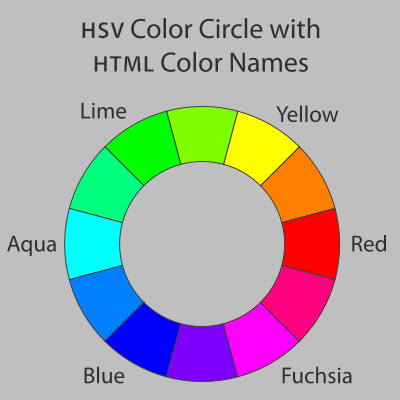
Figure 1 – The RYB or HSV color circle showing color complements. From the Wikicommons by Jacoblus under creative commons license.

Let’s begin with something that I haven’t yet shown you, namely a color wheel.  So-called color spaces are very complicated.  In addition to the mix of the colors you need to worry about hue, saturation, and lightness.  If you work with Adobe Photoshop, you will be familiar with this.  But let’s leave these issues for another day and consider Figure 1, which shows the simple color wheel that describes the Red, Yellow, Blue color system.  The point here is that the complement of yellow is blue, of red is aqua (aka cyan), and of (lime) green is magenta, etc.  Each of these colors will remove its complement, when light is passed through or reflected off it.  So to get yellow remove blue and vice versa.OK so again, in a subtractive film like Kodachrome we have three layers of emulsion one for each of the primary colors.  Each emulsion layer consists of a silver halide with a chemical called a “coupler.”  The coupler will undergo a reaction during the development and form a dye wherever there is free silver. Coupler can be added either during manufacture (eg. Ektachrome, where little oil droplets in the emulsion contained the coupler) or during development (eg. Kodachrome).  The first is called a substantive film and the latter is called a non-substantive film – because the coupler is or is not a substantive part of the emulsion.  Non-substantive films tend to be sharper, or finer grained, because the emulsion is thinner

Needless-to-say development was complicated, and as I’ve said before required very precise temperature control.  For Kodachrome this was out of the reach of amateurs.  Ektachrome could be developed at home by the brave of heart.

Obviously, there’s a lot more to it and the Devil is in the details.  For instance, silver halides are intrinsically blue sensitive.  By chemical modification red or yellow sensitivity could be added.  However, these red and yellow sensitive layers were still blue sensitive.  So to complicate matters the blue layer was placed on top of the stack and it was separated from the other layers with a blue absorbing that is a yellow filter layer.  However, the basic concept and fundamental point to remember is that of three separate emulsions each with a coupler that enabled them to be dyed for a particular set of complementary colors.

Kodachrome was introduced in 1935.  It served as a very fine and special color movie and still film.  There is a film clip circulating on the web and claiming to be a 1922 Kodachrome film test.  It is worth watching for its wonderful soft and beautiful color.  It was taken by Eastman Kodak as it tried to develop viable color processe.  However, the film was taken by an early Kodachrome process similar to the two color Technicolor process and not the commercial Kodachrome process ultimately released.

Richard III revealed

I am a great lover of Shakespeare.  So I was delighted last Monday to learn that University of Leicester archaeologists had announced definitive DNA evidence that a skeleton found under a parking lot several months ago was  that of the last Plantagenet King of England Richard III. This was a wonderful tour de force based on DNA analysis of the skeleton’s mitochrondial DNA with that of both Michael Ibsen and an anonymous individual, modern-day maternal descendents of Richard III. Richard IIII is, of course,  Mitochronial DNA is inherited solely from one’s mother and passed on unchanged through the maternal line

Richard III is Shakepeare’s great villain in a play by that name.  He was evil incarnate, according to Shakespeare.  Some revisionist thinkers however, question this and point out that the Tudor claim to the throne depended upon the legitimacy of the reign of King Henry VII, who defeated Richard at the Battle of Bosworth Field in 1485.  So it was, perhaps, a spin job.

But there I was studying a photograph of Richard’s skeleton, complete with scoliosis of the spine and lethal hole in his skull.  Who would ever expect to see such a photograph?  And if that wasn’t enough, on Tuesday I was greeted by a facial reconstruction, which truly brought the five hundred year old king to life.

These two photographs have returned us for a brief instance to the fifteenth century.  So, as I contemplated Richard’s face and the painful deformity of his back, the words of Shakespeare came back to me:

But I, that am not shaped for sportive tricks,
Nor made to court an amorous looking-glass;
I, that am rudely stamp’d, and want love’s majesty
To strut before a wanton ambling nymph;
I, that am curtail’d of this fair proportion,
Cheated of feature by dissembling nature,
Deformed, unfinish’d, sent before my time
Into this breathing world, scarce half made up,
And that so lamely and unfashionable
That dogs bark at me as I halt by them*;

 * to hear Sir Laurence Olivier perform (in 1955) this marvelous soliloquy click on this link.


.

Early color movies – and the story of Technicolor

Figure 1 - Lon Chaney, Sr. from The Phantom of the Opera, 1925. Image from the Wikicommons and in the public domain.

Figure 1 – Lon Chaney, Sr. from The Phantom of the Opera, 1925. Image from the Wikicommons and in the public domain.

Some time around 1925, my mother who was a young girl then, went with her friend Becky to the Loew’s Delancy in New York City to see Lon Chaney, Sr. (1883-1930), Mary Philbin (1902-1993), and Norman Kerry (1894-1956) in the silent film classic, “The Phantom of the Opera.”  They screamed so loudly that they were almost thrown out of the theater.  Watch the famous unmasking scene or even the entire movie and judge the terror for yourself.  It is, of course, pretty thin by modern standards.  Also take a look at Figure 1, a still shot from this movie, showing the horrific phantom.  So the question I have to ask is this the movie that terrified my mother and her friend?

But first, let’s talk about the history of color in movies.  In 2012 the National Media Museum in the UK announced an exciting discovery.  The first color film was created by british inventor Edward Raymond Turner in 1902.  Figure 2 is a still from the movie.  This film was made with a special camera that took three successive black and white images through a red, green, and blue filters and then projected them back through the same filters.  So fifty years after Maxwell’s tartan ribbon, we have the same technique applied to moving pictures.  It is plain and simple pure additive color.
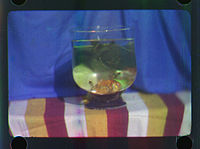
Turner Still 1902

Figure 2 – A still from Edward R. Turner’s first color movie, 1902. From the British Media Museum and graciously in the public domain.

The first feature film taken and shown with an additive red green additive two color process called Kinemacolor was “A Visit to the Seaside,1908.”  Of course, the use of just two colors was a bit limiting.  In 1917 an additive technique that used four filters on a rotating filter wheel (red, yellow, green, and blue) was used to produce a film called “Our Navy.”

The dominant early color process was Technicolor.  And it is with Technicolor that the subjects gets complicated and interesting.  Technicolor came in three chronological stages.

Process 1 (1917) – the first Technicolor Process was additive and involved first taking the red an green images simultaneously onto sequential film frames using a beam splitter arrangement.  The projector had two projection lenses.  As anyone familiar with optics will recognize, this kind of projection will lead to a subtle parallax shift and the colors will not be in perfect registration.  To overcome this, a wedgeprism was added to enable registration of the two color planes.  There is an excellent photograph of one of these early Technicolor cameras and schematics of both the beam splitter camera system and the two lens projection system at the Wide Screen website.   The first film produced by this process was “The Gulf Between, 1917.”  Additive color was effective, but, as noted, required special cameras and projectors.  The process  also necessitated projection at double speed.

.
Phantomtechnicolor

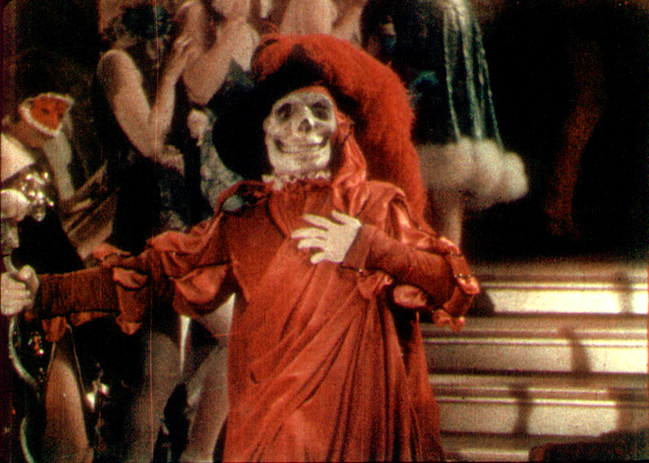
Figure 3 – A still from the masqued ball scene from the Technicolor Process 2 film, “The Phantom of the Opera, 1925.” From Wikicommons and in the public domain.

Process 2 (1922) –  As a result, it soon became clear, necessity being the mother of invention, that subtractive color was the way to go.  This led to adoption of the second Technicolor process.  Again, as in Technicolor Process 1, images were taken red and green simultaneously on film.  The red and green sets were then photographed onto two separate strips and dyed in the complementary color.  They were then cemented together.  The first film produced by this method was “The Toll of the Sea, 1922.”  “Phantom of the Opera was made by the Technicolor Process 2 in 1925.  Wait a minute!  Phantom of the Opera was a color movie.  Yes indeed it was.  Only a small segment of this remains of the masqued ball scene (see Figure 3) .  So why is it now only seen in black and white?  We’ll get to that part of the story later.

Some of you are old enough to remember films melting from the heat of the projector, or even worse, for nitrocellulose based films, exploding or bursting into flames.  Projector heat was a real problem for films produced by the Technicolor 2 process.  They warped and buckled and the two layers would separate.

Process 3 (1928) – To overcome this heat problem the third Technicolor process was developed.  Once again red and green planes were recorded simultaneously but sequentially on the film.  However, in the developing laboratory the reds were copied to one strip of film and the greens to another, just like in the Technicolor 2.  However, the film contained a special gelatin.  The gelatin required exposure to UV light to copy the films.  The UV hardened the emulsions.  Unhardened emulsion, that is unexposed emulsion, was removed chemically.  This is very reminiscent of Nicéphore Niépce’s (1765 – 1833) method of creating the world’s first photograph, which we have discussed previously.  The emulsions were then dyed with complementary colors and chemically transferred to a “blank” strip of film.  A so-called “mordant” was then applied to prevent further migration of the emulsion.  The first film produced by the Technicolor 3 process was “The Viking, 1928” (video of the entire film).”  This was also the first feature-length Technicolor film to also feature a soundtrack.

Wikipedia has a list of early color movies and the processes used to make them.  The list covers the period from 1903 to 1935.  Take a look at this list.  It is astounding how many there were and how strong audience demand for the latest technology must have been.  We have Autochromes and Three Color stills.  We have brilliant and magnificent color movies by a variety of additive and subtractive processes, most dominantly Technicolor.  These all are a tribute to the inventiveness and color of the age.   I for one can never think of this period as being a black and white one.

OK.  So why do most of these films now exist only in black and white?  First, of all in the 1940’s the company Technicolor destroyed many film originals, when they were unclaimed by the studios during a space clearing act.  Most of those that survived were made into black and white for television copies in the 1950’s and the colored masters were subsequently destroyed.  So the real black and white era was not the 1900’s to 1920’s but the 1950’s to 1960’s – the era of black and white television.

For further reading on Technicolor see the Wikipedia and the Wide Screen website.  Both of these were consulted extensive in researching this blog.
Why can we see movies?

Zoetrope

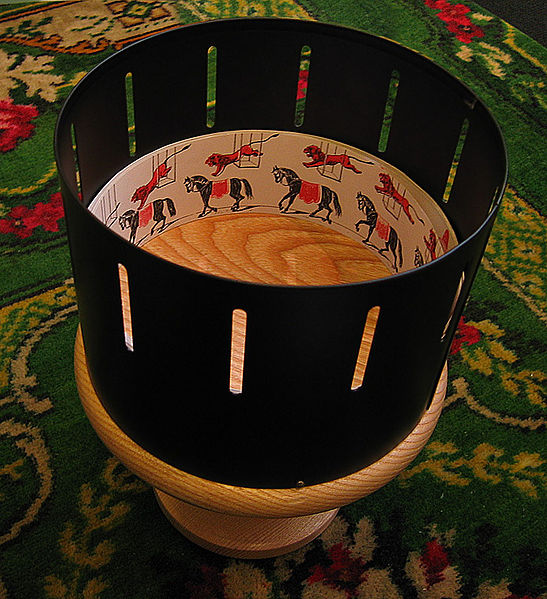
Figure 1 – a modern replica of a Victorian Zoetrope
Photograph © Andrew Dunn, 5 November 2004.
Website: http://www.andrewdunnphoto.com/ published under Creative Commons attribution license.

The question for today is: “why can we see movies,” or more accurately put: “why can we perceive movies?” You will often see this answered by the phrase “persistence of vision.”  Persistence of vision refers to the fact that an afterimage of what you see persists for approximately 1/25th of a second after you see it.  This is a purely physical answer akin to saying that every instrument has a measureable response time.  It’s been clear, however, for a century, from neurophysiological and neuropsychological studies that persistence of vision is not the cause of motion perception.  The bottom line, before we go any further is that the human eye, for many many reasons, some of which we have previously discussed, is not a camera. Perception of image and perception of motion are brain phenomena.

In a sense, this is really all that we need to know. But it is fun to explore this a bit further.  The perception of motion appears to be more closely related to what is called the “phi phenomenon” first defined in 1912 by Max Werthheimer (1880-1943), one of the founders of Gestalt psychology.

Figure 2 - The Lilac Chaser an example of the phi phenomenon.  From the Wikicommons and in the public domain.

Figure 2 – The Lilac Chaser an example of the phi phenomenon. From the Wikicommons and in the public domain.

The phi phenomenon is often demonstrated to a viewer by projecting two images in succession. The first image might be a ball on the left hand side of the screen.  The second image may be a ball on the right hand side of the screen.  If you project the two images with sufficient time in between and hold the images for sufficient duration, the viewer sees first a ball on the left and then a ball on the right.  However, with certain times in between and certain durations of holding the images steady, the viewer perceives a sensation of motion of the ball between the two sides.The same is true of music.  If you play the notes too closely they will blur into a squeal.  If you play them too far apart, they become separate and disembodied from the music.  I mention this because the music that we launched into space on Voyager may or not be interpretable by some alien civilization that discovers it.  That will depend on the way that the alien’s brain operates.

Of course, a great example of this phenomen is that of the zoetrope (see Figure 1), where a rotating drum with a set of images, of for instance a horse running and a lion jumping,  is viewed through a slit.  Actually, the slits are also rotating.  The brain interprets the set of images as the horse running and the lion jumping.  This is, needless-to-say just like the successive frames in a movie.

A  cool example of the phi phenomenon is shown in Figure 2.  It is an optical illusion called the “lilac chaser” and really illustrates the dominance of brain function in image interpretation.  In the lilac chaser we observe twelve blurred lilac (aka magenta) disks forming a ring.  One of the disks is made to disappear for about 0.1 seconds, then the next about 0.125 seconds later, and so on in a clockwise direction.   Now the trick is to stare at the cross in the center, and you may want to click on the image so as to maximize its size..  Don’t cheat keep starring at the cross. When one stares at the cross for about 20 seconds or so, one sees successively three different phenomena.  First, a gap appears to run around the ring of magenta disks.  This is the so-called beta movement.  Second, the gap becomes replaced with a green disk.  This is  an adaptation of the rods and cones of the retina.  The brain is working and interpreting.  There is no green disk.  Finally, again the brain interpreting, the magenta disks disappear and you have a green disk running around against the grey background.

So the bottom line, or lines, is that:

  • the eye is not a camera but part of the eye-brain system
  • once the between image timing and the duration of images become fast enough the brain no longer interprets the images as separate
  • because of the phi phenomenon there is a sweet spot of image duration and between image timing that the brain will interpret as motion

It is the second of these points that, we will next consider as a further mode of creating additive color from multipile images.  And, as I promised yesterday our view of the early twentieth century will no longer be one of subdued black and white, but rather of vivid Technicolor.  That will be discussed in tomorrow’s blog.


The Blizzard of 2013

WatchinSnowflakes

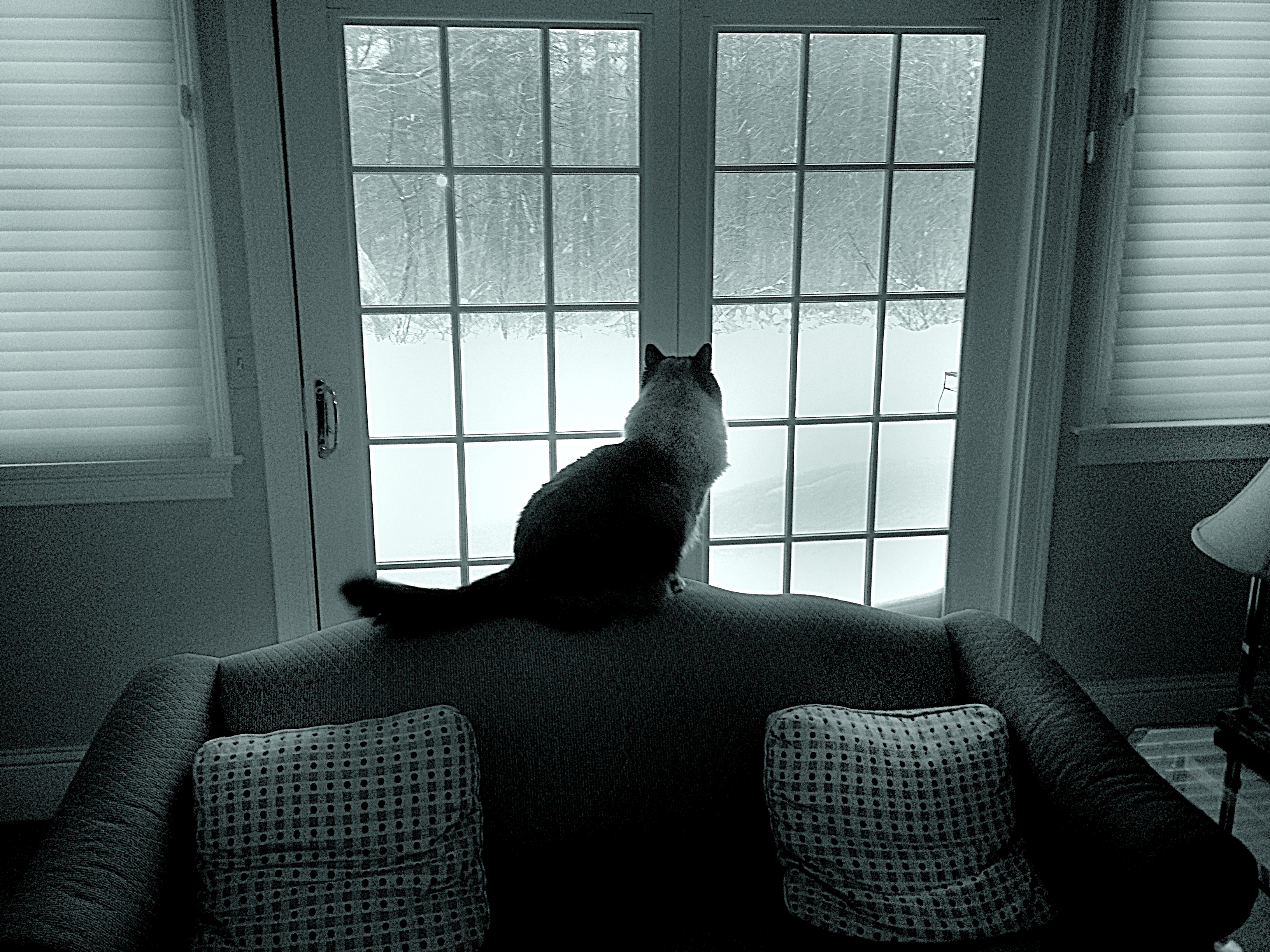
Blizzard of 2013 – Watchin’ the snowflakes
(c) DEWolf 2013

As you may have heard, the Boston area has been hit by an official blizzard.  We’ve had 24 inches of snow and it is continuing to pile up.  Driving is banned throughout the state and Boston’s MBTA, made famous by “Will he Ever Return, Charlie,” is shut down.  Basically there’s nothing to do but watch the snowflakes – which for some is very exciting!

Methods of additive color photography

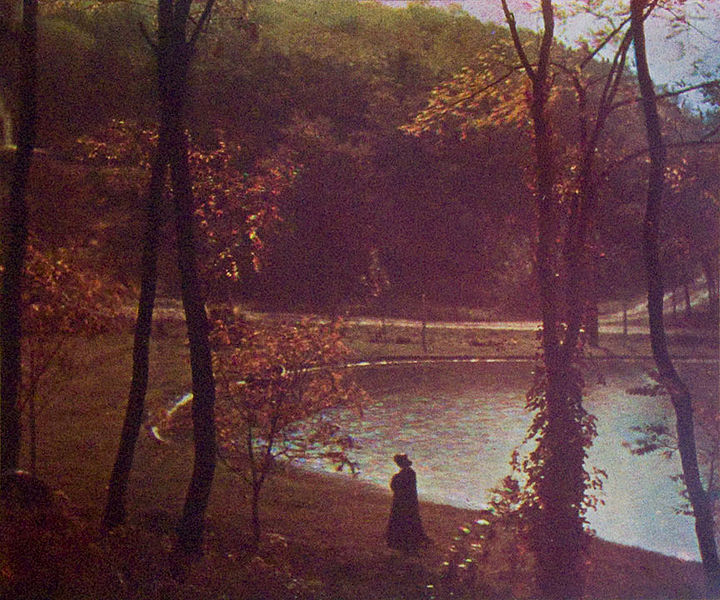
Edward_Steichen-Three Color Experiment

Figure 1 – Edward Steichen, “Experiment in Three Color Photography, 1906<” originally published in Camera Work #15, 1906, from the Wikicommons and in the public domain.

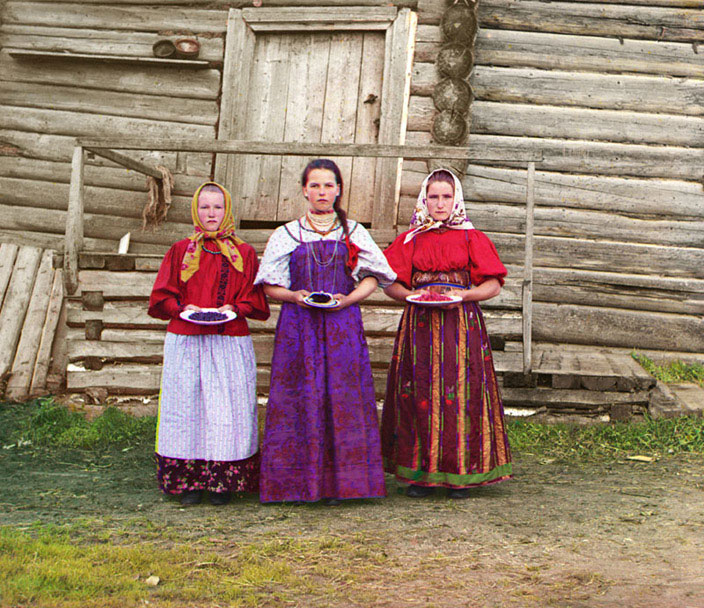
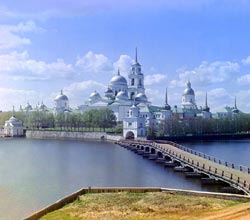
We began our exploration of early color photography from a discussion of Edward Steichen’s (1879-1973) “false color” image of the Flat Iron building in NYC.  So it is fitting to include Figure 1 an image from Camera Work # 15, 1906, which shows an early experiment by Edward Steichen in color photography by the three-color method.  I just cannot resist also including two more of Prodkudin-Gorsky’s three color images from the Library of Congress.  These are “Peasant Girls, 1909” and “Nilova Monastery, 1910.”

Prokudin-Gorsky's "Peasant Girls, 1909," from the Library of Congress and in the public domain.

Prokudin-Gorsky’s “Peasant Girls, 1909,” from the Library of Congress and in the public domain.

It is surprising to discover that with these additive methods coupled with photo-lithographic techniques not only was color photography possible in the first decade of the twentieth century, but it was magnificent.  Both the Autochrome and the three color techniques were appealing in that they did not require any more, from a chemical standpoint, than standard silver halide development.  This meant that any amateur could develop them.

Figure 3 - Prokudin-Gorsky, Nilova Monastery, 1910," from the Library of Congress and in the public domain.

Figure 3 – Prokudin-Gorsky, Nilova Monastery, 1910,” from the Library of Congress and in the public domain.

Such was not the case with ultimate subtractive processes such as: Kodachrome, Kodacolor, and Ektachrome.  These required not only a complex slew of nasty chemicals to develop, not to mention complex tweaking of color filters on your enlarger, but also very precise temperature control.  This made these processes largely inaccessible to most home darkrooms.

Autochrome and three-color are interesting variants in methodology.  They both involve geometric separation of the different primaries.  In the Autochrome process this is microscope and local, much like the modern computer LED or LCD monitor.  In three-color three separate images are projected separately into registration.

You can see the fundamental problem with this additive color approach, at least to analogue photography.  Both methods are awkward and require special equipment and methods to visualize.  They were stunning, but inventors, at the time, soon realized that subtractive color was the way to go.

However, before we go on to discuss subtractive color, we need to realize that there is one more approach to additive color that we have not considered.  We’ve spoken about local separation and projection (Autochrome) and global separation and projection (Three-color).  But we have yet to consider the very significant method of temporal separation, the rapid project of serial images.  However, first we need to consider the phenomenon of visual persistence, or what it really is.  We need to consider why we can see movies.  And by the time we are done with that, we will have to abandon our misconception that the first two decades of the twentieth century were black and white.  In the immortal words of Jacques Brel

“It was the time when Brussels could sing 
It was the time of the silent movies 
It was the time when Brussels was king 
It was the time when Brussels brustled 
Pick out a hat so dashing and gay 
Go take a walk, it’s a beautiful day 
Put on your spats and your high-buttoned shoes 
Get on the tram, get the gossip and news”

Updates and Changes to Hati and Skoll Gallery Website

Over the last week I have been updating the Hati and Skoll website for 2013.  You will find many new photographs in the galleries.  I have also added a New Gallery of photographs taken with my IPhone.

I’d also like to take a moment and thank all of you for your continued interest in the gallery, the blog, and photography.  Readership is growing rapidly via subscription, Facebook, RSS feed and people who just regularly stop by.  I love everyone’s comments and value your thoughts; so please keep commenting.

I hope that you enjoy the new pictures and continue to read and like the blog.

David