Burned out

Figure 1 - Burned out meters at 88 Galen Street, Watertown, MA, IPhone photograph. (c) DE Wolf 2014.

Figure 1 – Burned out meters at 88 Galen Street, Watertown, MA, IPhone photograph. (c) DE Wolf 2014.

Shortly before Christmas there was a major fire on Galen Street that totally gutted an old wooden house*.  I don’t know the facts but it wouldn’t surprise me if the structure has stood there for more than a century, and it makes me feel very sad for the people who lived there,  Their homes are totally gone.  The house is a burned out shell, that I am sure is doomed for demolition.  It was lucky that it didn’t spread to neighboring homes or offices.  Still the scene there is one of major devastation, burned wood, peeled paint, and melted plastic.

It has been cold and snowy; so I have had little opportunity to venture out and investigate.  This week there has been a January thaw and I have been able to resume customary walks along the river.  On the way back to the office today I was drawn to the burned out “electrical?” meters in the front of the building.  I wished I had my good camera with me.  But I had to be content with my IPhone, which did a surprisingly good job.  Still, and as always, I want greater sharpness.  So I guess that I will have to go back and explore the site with my Canon.  For now I offer the IPhone image of Figure 1 showing the devastation to the meters.  There are two meters.  This suggests that two families have lost their homes.

* I have found the newspaper report on this fire.  It occurred on November 14, 2013 at 88 Galen Street in Watertown, MA.

Whither the Tralfamadorians?

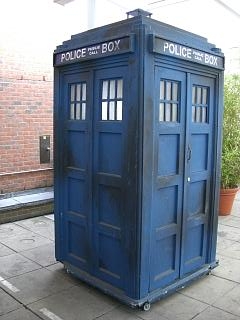
Figure 1 - Tardis time machine from the English television series "Dr. Who."  From the Wikimediacommons, upload by Zir, and put in the public domain.

Figure 1 – Tardis time machine from the English television series “Dr. Who.” From the Wikimediacommons, uploaded by Zir, and put in the public domain.

Well, I regret to inform everyone that no one sent me an email response to yesterday’s post before it was posted: no Dr.Who, no Petula Clark or Billy Pilgrim, no Tralfamadorian.  Not even the Time Traveler’s Wife bothered to respond ahead of time.  It was a bust and rather disappointing.

I am not ready, however, to rule out time travel based on this little experiment.  There are three possible reasons why no time traveler responded: 1. there are no time travelers, 2 no time traveler saw my post, and 3. no time traveler reads hatiandskoll.com or cares to communicate with us.

Do not discount the last of these.  Time travelers, in literature at least, are a rather apathetic group.  If you think about it, a major component of human endeavor is to change things to “build a life for oneself,” or “to make a better life for one’s children,” as examples.Your goal is to change or make the future. When you are “unstuck in time” as for instance Kurt Vonnegut‘s Billy Pilgrim, you kinda lose that motivation.  Nothing matters; because you always know what is going to happen – you become truly indifferent.

In our world religions the question of knowing and not knowing the future is akin to the question of preordination.  You do not want to become complacent and indifferent.  We have, for instance, Matthew 24.2 “Watch therefore: for ye know not what hour your Lord doth come.” And in religions were predeterminism is dominant, little “catch twenty-twos” tend to evolve.

You may have heard the arguments that when a supposed time traveler travels through time, (s)he is really traveling between alternative universes.  Such a concept solves a lot of the paradoxes of time travel.  For instance, if you go back and kill your grandfather you essentially limit the number of these universes that you can be in.  Although like Hilbert’s “Grand Infinite Hotel” there are still an infinite number of universes available to you. Albeit, fewer than the infinite possibilities that there were before.  I hope that’s clear! Then, of course, there is the question of what happens when two of these rooms are home to Dr. Spock, one young one old.

That concept seems to work quite well on a quantum level.  For bulkier sentient beings, such as ourselves, the argument of parallel universes seems a bit lame.  But who knows?

I remain a bit saddened that I received no comments about yesterday’s post until it appeared, which was after all the expected result.  I did breathe just a bit harder the moments before the deadline.  Such a message would truly have been rather unsettling.  And there is something reassuring about not knowing what is going to happen next.

Then there is the quote from Canadian mycologist Arthur Henry Reginald Buller (1874-1944) in Punch (December 19, 1923).

“There was a young lady named Bright,
Whose speed was far faster than light;
She started one day
In a relative way,
And returned on the previous night.”


Photographs and messages from the future

We’ve spoken a lot here about how photograph transcends time, how it enables us to see the faces and private lives of people of the past and how there is just a hint of them realizing that we are looking at them.  I know, I know, this is starting to get just a bit mystical.  But today, I read about scientists physicists Robert Nemiroff and Teresa Wilson at Michigan Technological University asking whether people of the future might be using the internet to send information back to us. Wouldn’t it be great to get a message from the future or better still to get a photograph?  Ok maybe not!

And it all sounds bizarre, I know.  So let’s begin with the rudiments of time travel.  We move in four dimensions: the three dimensions of space: forward/back, left/right, and up and down; and we move forward in time.  The equations of physics, in general do not offer a prohibition to traveling backwards in time.  So that has been a controversial point.  Is there some constraint.  Significantly, we also know if we have people on the Earth and people in a fast moving rocket ship they both do not advance in time at the same rate.  This is not mysticism but experimental proven fact.

I should point out that some people believe that the prohibition of time reversal lies in the second law of thermodynamics, which is the tendency of physical systems (Psst, you and I are physical systems) to chaos.  Sadly, every time we move information around, like in a computer or over the internet, we push the universe that much closer to chaos and absolute zero.  Gulp!

Well anyway, what Nemiroff and Wilson did was examine whether there was any prior knowledge of two major recent events. The two events they chose were the discovery of Comet ISON in September 2012, and the selection of Pope Francis in March 2013. Because time stamps on most of the internet can be either ambiguous or tampered with they chose to study Twitter tweets.  No signs of ‘Comet ISON,’ ‘#cometison,’ ‘Pope Francis’ or “#popefrancis’ were found. Too bad!

They also issued, last September, a request for time travelers to send tweets using either the hashtag “#ICanChangeThePast2” or “#ICannotChangeThePast2” by the end of August 2013. Again nada! At least there were no tweets which predated the deadline. Of course, some have been received since.

This second “experiment” is reminiscent of one performed by famed British physicist Stephen Hawkings in 2009.  Hawkings sent out a post-dated invitation to a predated party. I’m so confused.  But you can watch the movie of Hawkings waiting patiently for his guests from the future. Unfortunately, nobody came!

Still, I like the concept of someone sending us photographs from the future – giving us a bit more than a hint that they are looking at us.  So let me set this challenge. I am writing this post on Friday, January 3, 2014.  It will post at 6:30 UT on Wednesday January 8, 2014.  So you futurians have until then to send me a message, or better yet send me a selfie from the future.


Daniel Chester French and winter’s long shadows

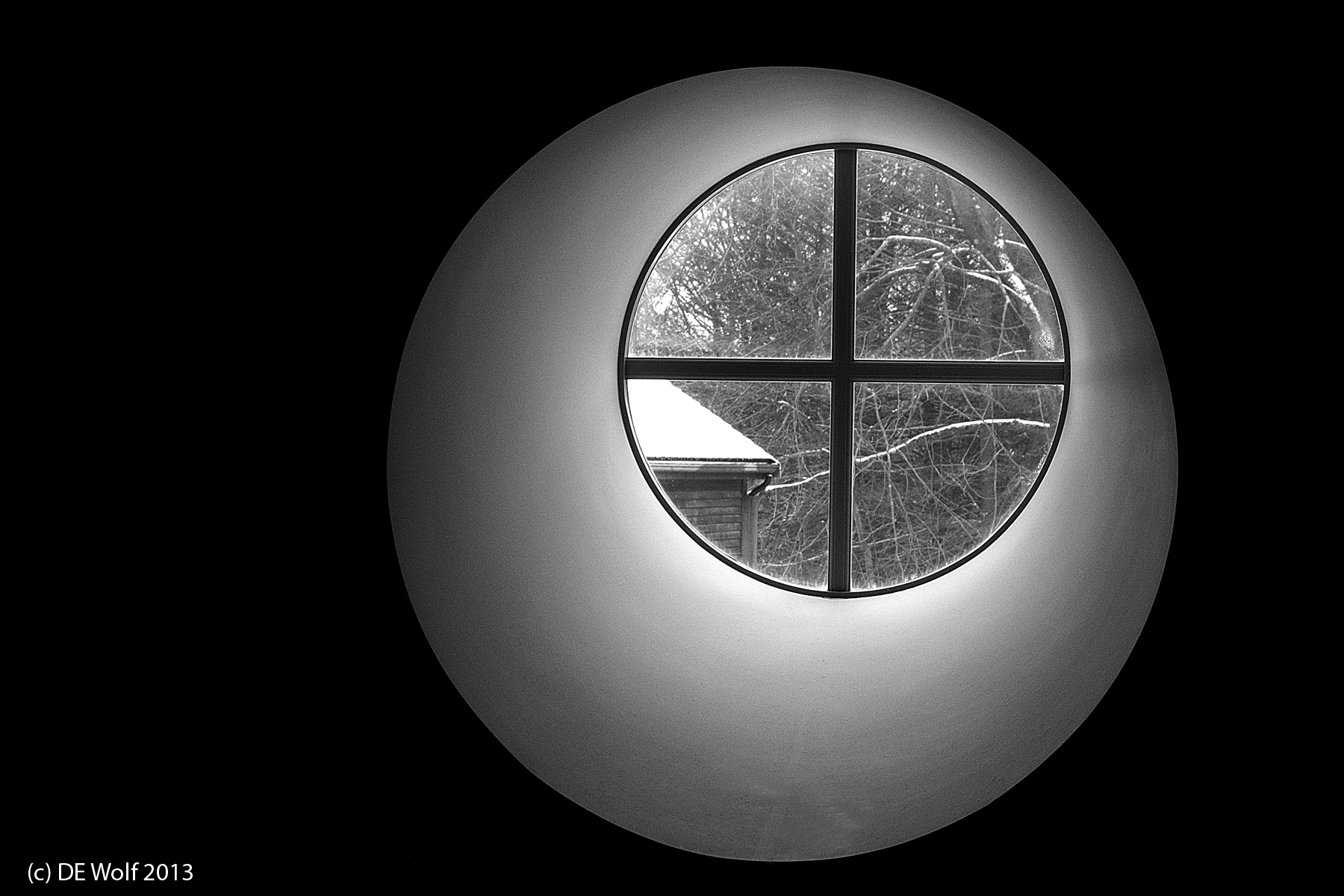
Figure 1 - Winter window, Concord, MA, (c) DE Wolf 2014

Figure 1 – Winter window, Concord, MA, (c) DE Wolf 2013

End of December and the beginning of January are the time of long shadows in the Northeast.  Also, and not atypically, the skies are grey and cloudy and they share precious little light.  I took along vacation and felt little inspiration in the dreariness and the lack luster snow.

To break this trend my wife and I after Christmas went up to the Concord Museum in Concord, Massachusetts.  This is a gem of a museum that covers the rich history of the town.  At Christmas they set up Christmas trees, in the various rooms each decorated around a story book theme.  Parents come and read the books to their children and gaze at the trees.  The children are given sheets of paper and told to find various ornaments somewhere on a tree in the museum.  The place becomes one great scavenger hunt, with children laughing and scurrying about.

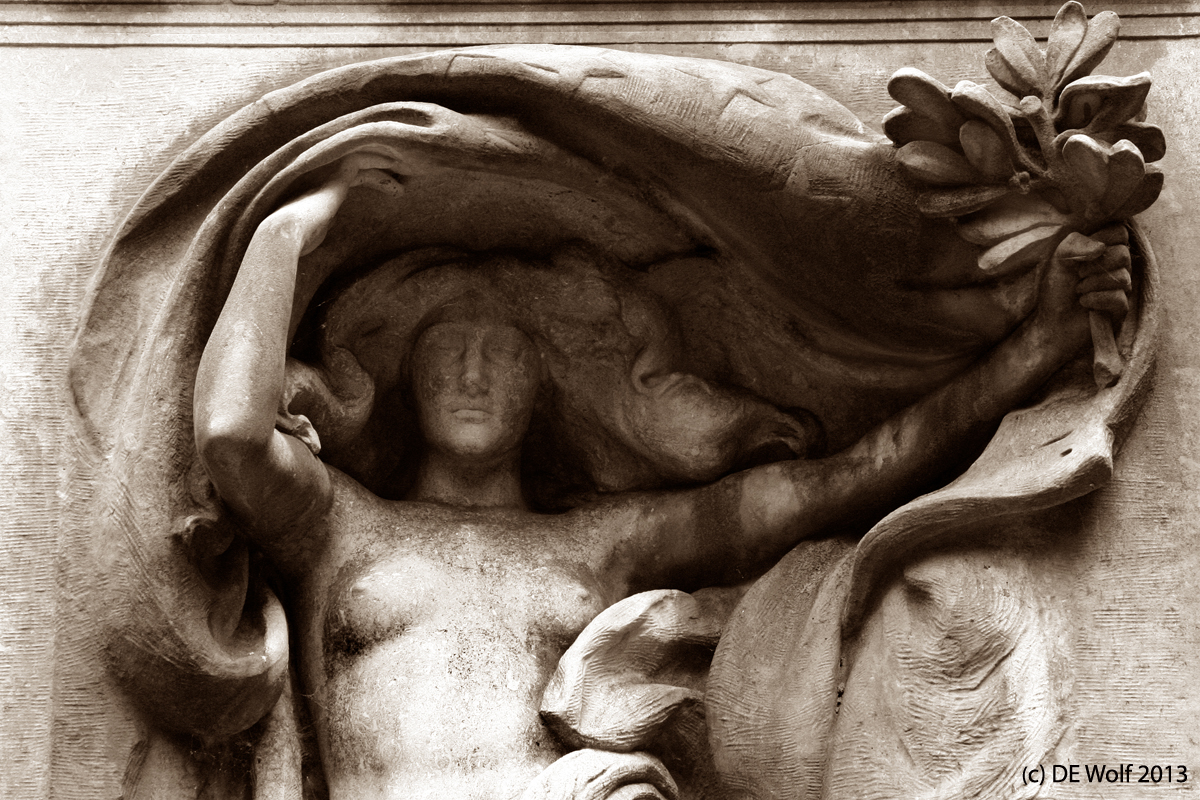
Amidst all of this, this year there was an exhibit about the great American sculptor Daniel Chester French (1850-1931), who was born in Concord.  The two bookends of French’s career are the “Minuteman Monument” by Concord’s “Old North Bridge,” and the “Lincoln Memorial” in Washington, DC.  To my taste however the great sensitivity and quality of his work is nowhere more brilliantly displayed than in the “Melvin Memorial” in Concord’s “Sleepy Hollow Cemetery.“In 1897 French was commissioned by James C. Melvin, a Boston businessman, to design a war monument honoring his three brothers who had died in the Civil War. The memorial was erected in 1908.  Figure 2 shows a detail from the actual monument, showing a mourning victory.  To me Victory seems to be emerging from the Earth.  Perhaps she is meant to symbolize not just the victory in battle in the American Civil War, but the final victory over death.

As I wandered between the various exhibits I was struck by a dramatic circular window and the dimly lit snowy scene outside.  I couldn’t help but take the photograph of Figure 1. The light in the window and the darkly lit walls around it seemed to accurately depict the long low light of winter, the coming New Year, and the slight but waxing expectation of spring.

Figure 1 - Daniel Chester French, The Melvin Memorial, Concord, MA, (c) DE Wolf 2013

Figure 1 – Daniel Chester French, The Melvin Memorial, Concord, MA, (c) DE Wolf 2013

Some photographic resolutions for 2014

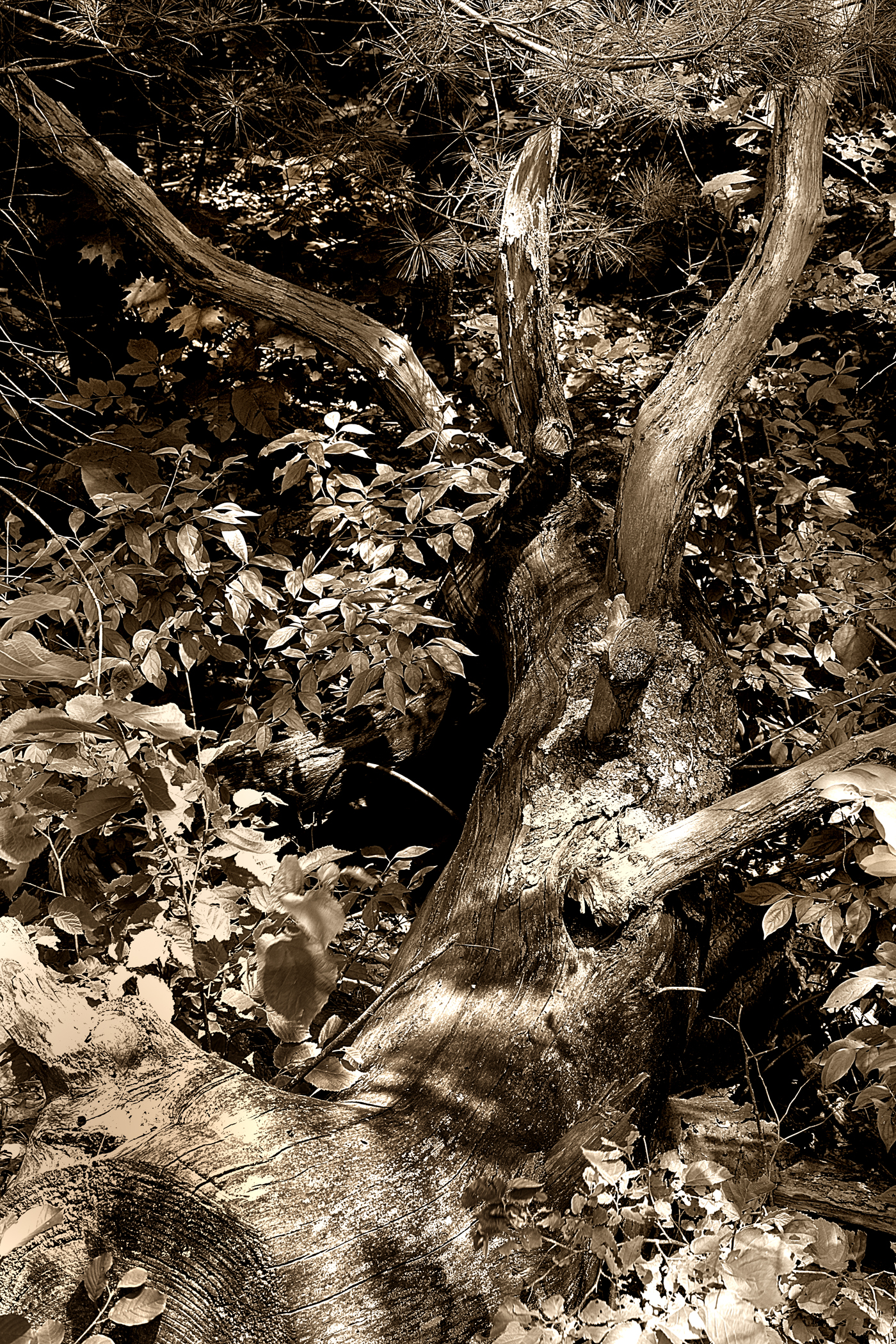
Figure 1 - Fallen Tree, Sudbury, MA, (c) DE Wolf 2013

Figure 1 – Fallen Tree, Sudbury, MA, (c) DE Wolf 2013

Last year on January 2, I posted some photographic resolutions for 2013.  These were:

  1. Focus on seeing.  Isn’t this what it’s all about?
  2. Spend more time taking photographs.  If you love doing it, you should do more of it.
  3. Slow down, concentrate on composing the image, on setting and checking the light.
  4. Learn to photograph trees.  They are worthy subjects, but can be difficult to compose, difficult to get the light right, difficult to isolate, and difficult to disentangle from power and telephone lines.

So now the question is how did I do.  Lets see:

  1. As for seeing, I try very hard to do this all the time.  Whether I have my camera with me or not, I’m always evaluating a scene for its photographic opportunities.  How would I take the picture, where would I fail?  And, of course, when all else fails I have my cell phone with me ever ready to fill in as a miniature 8 x 10 large format camera. And also I spend a lot more time looking at other people’s pictures, evaluating what I like and what I don’t like, trying to incorporate the good into my own work.
  2. I have spent more time taking pictures, more time processing them, and more time writing about them.  Indeed, I think that the fact that I keep this blog actively moving encourages me to take more pictures and hopefully to improve my pictures.
  3. Slowing down, this is very important.  It begins with having my camera ready to take a picture in some kind of average light for a given day and place.  Then there is the thought process, what is the light level, what do I need to do.  Or I take the picture and then I ask myself was that right, did I get what I wanted.  Recompose, rethink, check the image sharpness by using the on “zoom in on the image” feature of the camera.  I’m still a bit sloppy but getting more thoughtful and careful and also I’m expanding my repertoire of picture taking techniques.
  4. I photographed a lot of trees this year and was happy in many cases with the results.  Taking pictures is the best way to learn some I am gaining technique and experience.

OK, so what about 2014.  My photographic resolutions for 2014 are:

  1. Focus on seeing.  This has to be a continuing lifetime lesson.
  2. Spend more time taking photographs and have my camera with me more often.
  3. Slow down, concentrate on composing the image, on setting and checking the light. This remains the key and is a lifelong lesson.
  4. Continue to learn to photograph trees.  They remain the most worthy of subjects.
  5. Spend more time photographing people, learn to take better portraits and to develop a personal portrait style.

This point about developing a personal style is very important.  Whether you’re photographing landscapes, trees, or people, indeed whatever the subject, what you need to develop is your own unique photographic signature.  Then it becomes fun to watch it evolve.


Solstice Sunset at Malibu

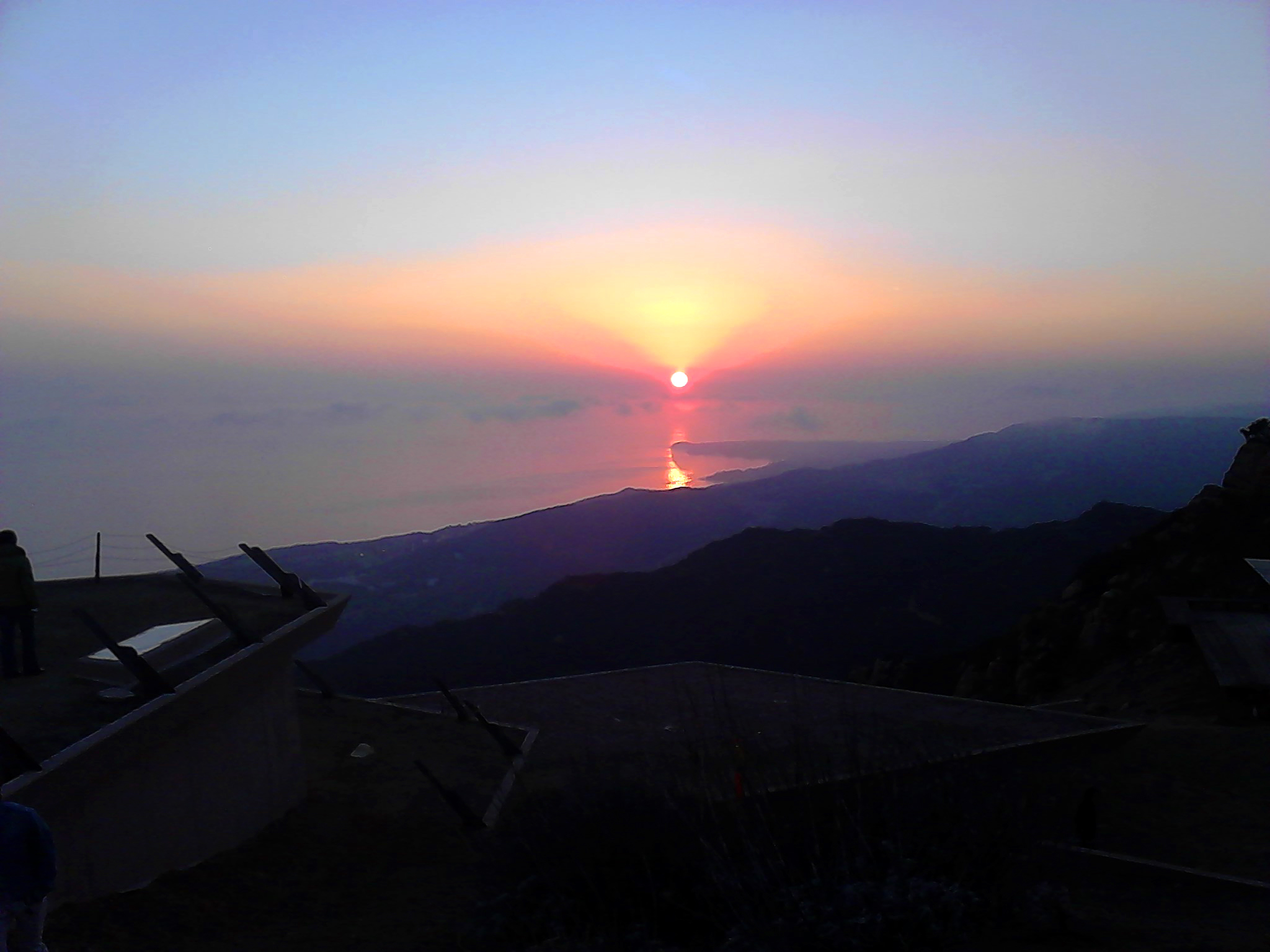
Figure 1 -

Figure 1 – Solstice Sunset at Malibu, (c) John Unfried 2013, and used with permission.

Reader Marilyn has been kind enough to send in this beautiful sunset  image taken on the night of the Winter Solstice.  The photograph was taken at the Malibu property of Eric Wright, who is the grandson of Frank Loyd Wright.  The picture was taken by Jim Unfried with his cell phone and he has granted permission for its use here.

I think that it complements the photograph that I took of the winter sunrise in Tampa last week and has the same sense of pensive foreboding and of precious winter light.  I am grateful to Marilyn for sending this in.  But I am grateful to her as well for taking me to Berkeley, CA forty years ago, to watch the sunset over the Pacific.  These are brilliant special moments, when the sun seems for an instant to hover suspended above the ocean and then is sucked into the sea.  You can almost hear it. Ever since that moment I have held that beautiful sight in my mind’s eye and today’s picture reminds me so gloriously of sunset.

Nemo on Wheaties

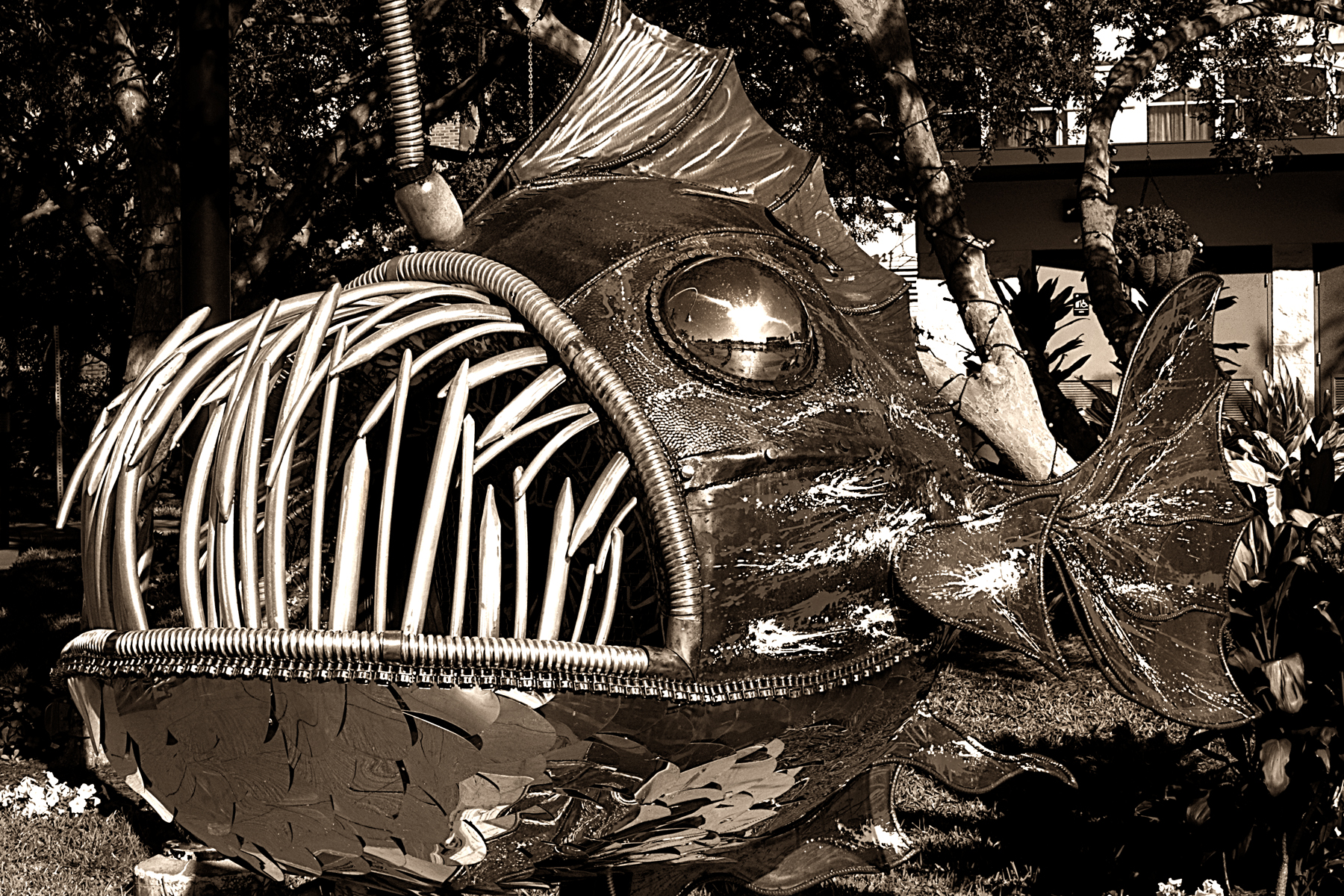
Figure 1 - Domique Martinez's Nemo on Wheaties, Tampa, FL, (c) DE Wolf 2013.

Figure 1 – Domique Martinez’s Nemo on Wheaties, Tampa, FL, (c) DE Wolf 2013.

I wanted to share one more photograph from my recent trip to Tampa, Florida. This (see Figure 1) is a photograph of Dominique Martinez’s marvelous sculpture “Nemo on Wheaties.”  Nemo in this case is an angler fish – in fact a rather scary looking angler fish.  He captures the sunlight in many ways, but most particularly in his shiney convex eyes that invariably place a diminutive photographer in the picture.

What is probably most appealing to me about Nemo on Wheaties is that he reminds me of a book that I used to read to my son when he was small entitled Big Al.  Big Al was the ugliest fish in the sea, and as a result none of the other fish wanted to associate with him.  But in the end Big Al saved the day by rescuing all the other fish from become dinner. I loved Big Al.

A hotel mirror

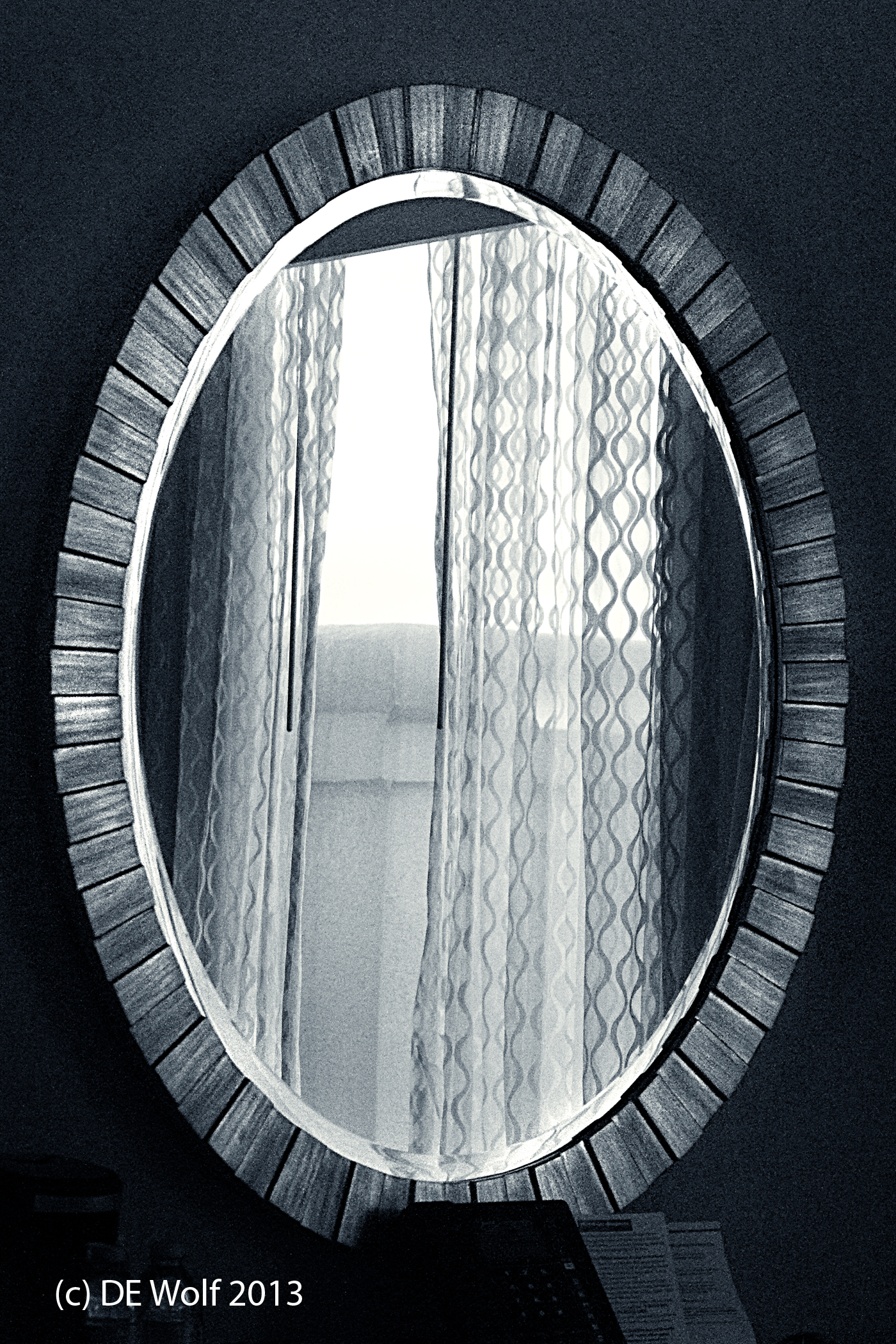
Figure 1 - Dusk in my hotel mirror, Tampa Bay, FL. (c) DE Wolf 2013

Figure 1 – Dusk in my hotel mirror, Tampa Bay, FL. (c) DE Wolf 2013

At dusk today I was working on my laptop in my hotel bedroom.  The lights were turned off since I had been enjoying the pastels of the waning day. When I looked up the last light was shining in the huge silver framed mirror above the desk.  It acted as a perfect frame of the sheer curtains and the sky outside the window.

It seemed the perfect opportunity for a photograph; so I grabbed my camera and was dismayed to see just how low the light was.  I set the camera for ISO 6400 and aperture priority.  Even so  the exposure with my EF-S18-55mm f/3.5-5.6 IS STM was 1/13th of a second at f/5.0 working at 44 mm.  I had heard that you can do this handheld with an IS lens, but I had never tried it before.  So it represented a real test of the IS system.  The result, which I deem a success,  is shown in Figure 1.

In my mind it was a black and white from the start.  You can see the graininess from the ISO 6400.  But for an old Tri X Pan guy like me this is actually pleasing. I gave it a slight cold tone to the mid range and warm yellow to the highlights.  It is rare that I cold tone, but in this case I like the results.

Tampa Bay winter sunrise

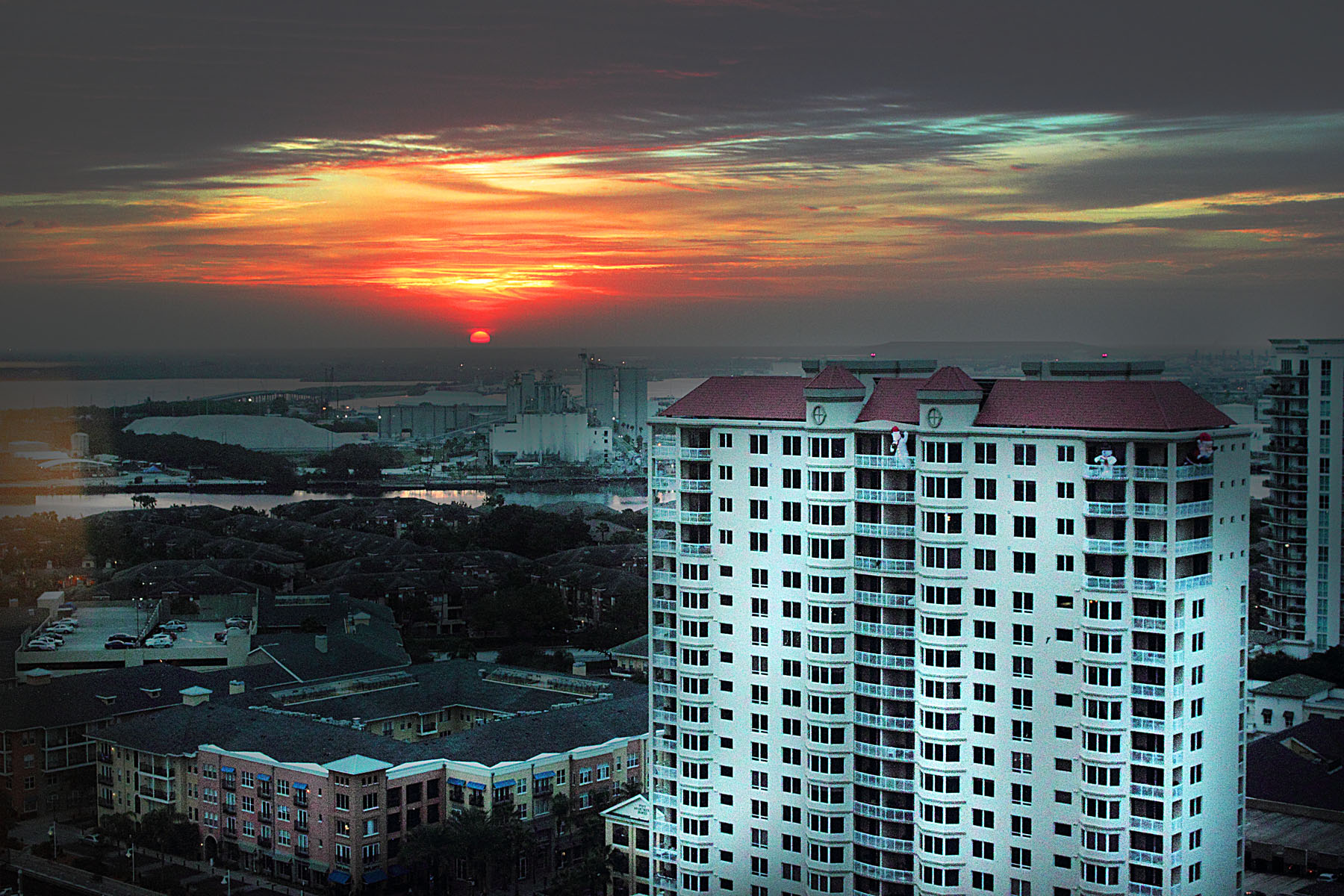
Figure 1 - Tampa Bay Sunrise. December 14, 2013,. (c) DE Wolf 2013.

Figure 1 – Tampa Bay Sunrise. December 14, 2013,. (c) DE Wolf 2013.

As a New Englander I always find it strange to travel to some warm place in winter.  Provided that you stay in the Northern hemisphere there seems to be something peculiar going on.  It’s a lot warmer, but just as dark.  The sun still hangs relatively low in the sky and there is still a foreboding sense of winter.

This week I found myself… Wait that’s a silly way to put it, I got on an airplane and arrived in Tampa.  While my wife dealt with the first big snow of winter 2013/14, I was in sunshine.  This btw did not make me popular with my wife.  Also the city of Tampa found it necessary to spray some kind of artificial snow all over the place.  Whatever it was didn’t fool me and burned my eyes.

Still these are the shortest days of the year – even in Florida.  I offer up Figure 1 we shows the winter sun trying to rise over Tampa Bay shrouded in clouds.  This was a tough picture to work up and, I think, not totally successful.  Still Ibelieve that it conveys the feeling of the morning.  The sun cracks both the horizon and the clouds.  Look closely an you will see a blow-up Santa leaning over the balcony on the building in the foreground.