Tone-on-tone 3 – Bunched indigo


Figure 1 - Tone-on-tone 3 - Bunched Indigo, (c) DE Wolf 2014.

Figure 1 – Tone-on-tone 3 – Bunched Indigo, (c) DE Wolf 2014.

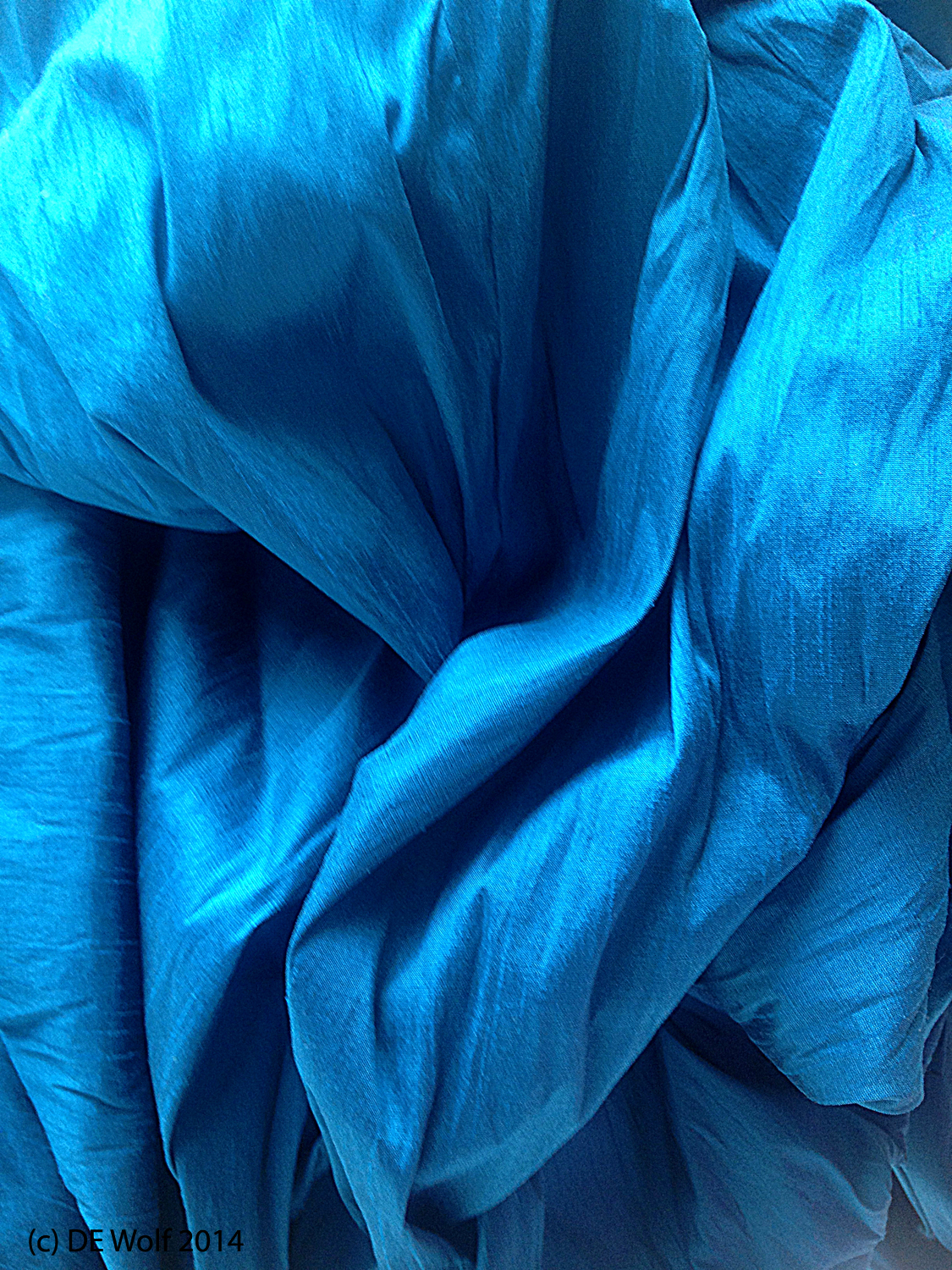
Last April I posted an IPhone image of folds or bunching in a wedding gown that I found during one of my mall walks.  Every spring our local mall features dress and fashion designs by local students that attend regional fashion programs.  It’s done as a contest where the public judges the “best in show.” This morning I was delighted to find that this year’s show had begun.  It is a sure sign of spring, and the colors are truly like spring flowers.

What caught my eye this morning was a puffy indigo skirt by a very talented young lady named Eboni Bell from Mount Ida College.  I just loved the folds and took a close-up of them.  Folding and bunching so as to create drama and a sense of spontaneity is no small feat – and requires an excellent eye.

As for the tone-on-tone of my photograph, taken again with my IPhone 4S, I love the challenge that monochromicity poses.  It is so too easy to over do the dynamic range, to plunge to total blackness, and soar to pure white.  It is a mistake that kills the whole effect of the tone-on-tone.

Your f-numbers don’t make no never mind to me!

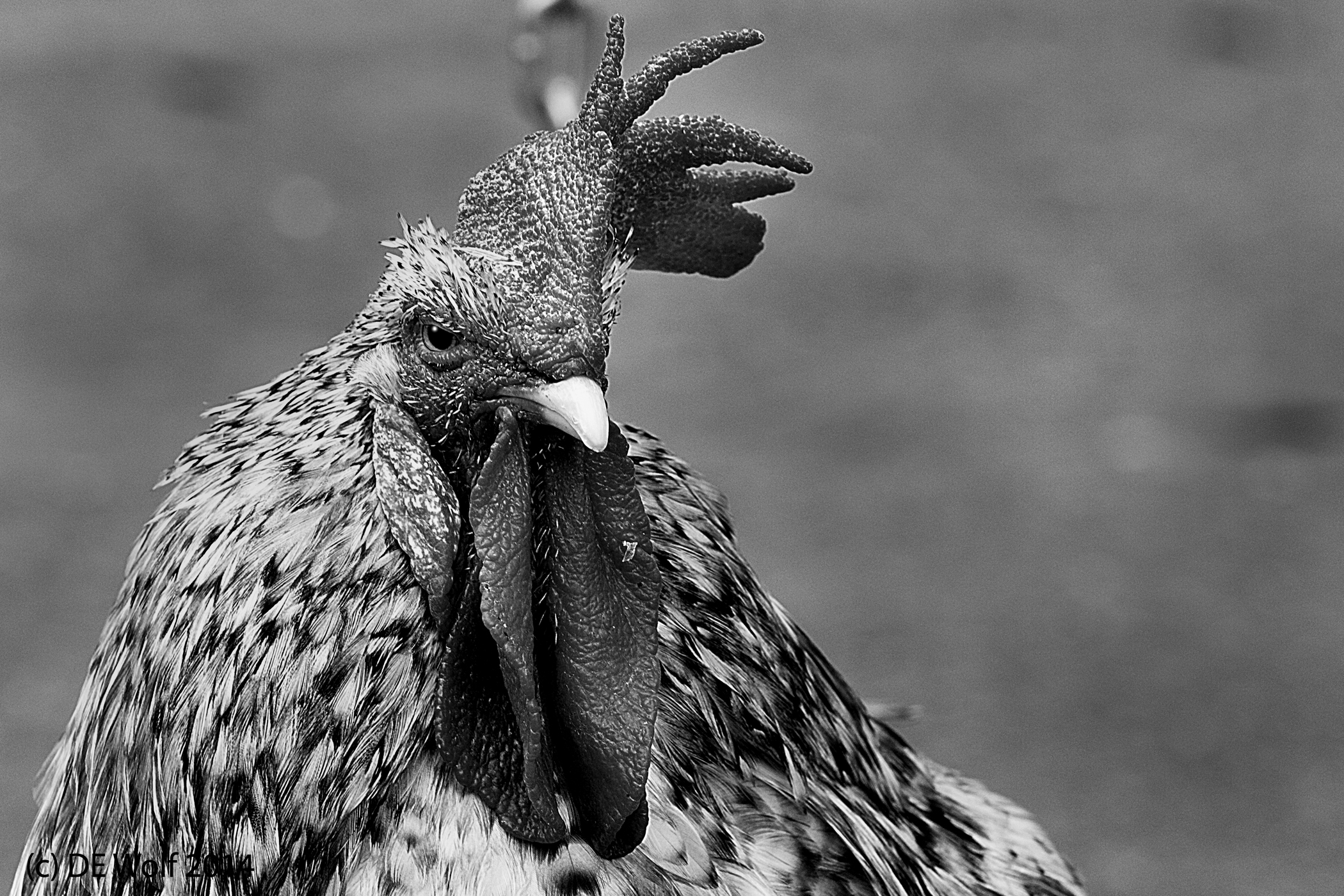
Figure 1 - Charleston Cock, Charleston, SC, (c) DE Wolf 2014.

Figure 1 – Charleston Cock, Charleston, SC, (c) DE Wolf 2014.

I was delighted to learn today that the expression, “it don’t make no never mind to me,” is South Carolinian in origin. That makes it a perfect complement to the cock of Figure1.  In encountered this fellow and an avian friend by Charleston Old Market, where the horse-drawn carriages depart.  I am not sure why he was there, although I suspect that it had something to do with what the horses leave behind.  And I hasten to add that the City of Charleston has these sanitary trucks that follow the horse paths, clean up, and disinfect.  Perhaps the chickens are municipal employees.

So now the litany.  This picture was taken with my Canon T2i camera using    EF70-200mm f/4L USM, exposure compensation +1, at a focal length of 131 mm, 1/100th of a second at F/9.0. WHO CARES! And frankly your f-numbers don’t make no never mind to me either, or perhaps neither. 8<)

It’s kind of like a scientific notebook.  Scientists are religious about taking notes, recording all the facts and details, and usually it turns out in retrospect that they wish that they had recorded some salient point.  Still too much is too much!  When I was a postdoctoral fellow in Michael Edidin’s laboratory at the Johns Hopkins University, several of the graduate students would spend hours producing multicolored, neatly written, masterpiece, notes.  They would then proudly sit down with Michael and become infuriated, when Michael would scribble all over their notebooks with his fountain pen.  (Allow me to assist those of you who are strictly of a digital age.  A fountain pen is a writing implement that leaves little annoying pools of ink on paper, fingertips, and shirt pockets).  Michael was teaching an important lessen, that the purpose of a scientific notebook was to be a free flowing, on the spot record of an experiment, and not an impediment to getting work done.  Indeed, I have learned over the years that in science the amount of good work accomplished is inversely proportional to the beauty of a lab notebook!

Returning to exposure details, the point is that rarely is all of this information of any value to anyone but you.  Ansel Adam has it right, when his picture taking began with absolute and relative measurement of the light and its dynamic range.  The important point is that he was developing a critical system of photography, “the zone system.” It was a system that starting with the key element “light measurement” and systematically provided a modus operandi for producing “the best” print using the exquisitely annoying nonlinear media of film and photographic paper. .  Note that “best image” is in quotes because that too had to be defined within the zone system.  It was brilliantly designed to overcome uncontrollable variables, like how exhausted your developer was, and produce the same high quality print again and again from a given negative.

And arguable you could develop such a system for your digital images.  But the starting point would need to be a measurement of the intensity and dynamic range of the light and a scrupulously consistent workflow with standardized (your own) curves or look-up tables.  That being the digital equivalent of film type.  Without that it all starts to unravel and become pretty meaningless.

I do not argue that in surveying your own work that the exposure data is useless.  It teaches you how your camera and lenses perform under certain circumstances, albeit qualitative circumstances.  Is a given lens sharp enough at a given f-number and focal length?  How does lens type affect depth of field?  How far with your camera can you push the ISO?

What about other people’s exposure data.  While I would never say that it is useless, I do have to say that without a lot more information it’s of little value.  There are just too many unknowns to make meaningful assessments.  So I have to return to the statement that “your f-numbers make no never mind to me.”

You have to love the expression.  It is a quadruple negative, easily driven driven to quintupleness with the addition of the word neither at the end- “your f-numbers don’t make no never mind to me neither.”  And can even be made a sextuple negative in the subjunctive- “your f-numbers wouldn’t make no never mind to me neither.”  It all flies in the face of those bratty English teachers, who insisted that it was improper to use a double negative (despite the fact that most other romance languages do), to blatantly split an infinitive.  The concept of ending a sentence with a preposition I shall not bring up.

Picasso’s Minotaur at Charleston’s Mellow Mushroom

Picasso's Minotaur, Charleston, SC, (c) DE Wolf 2014.

Picasso’s Minotaur, Charleston, SC, (c) DE Wolf 2014.

So the usual – get up at three thirty in the morning, drive to the airport bus, take the bus to Logan Airport, fly two hours to Charleston, hassle at the car rental (the old bait and switch), drive to hotel (kinda bait and switch again).  But I am not a bitter person.  OK, well maybe just a little.  I have been accused of having a glass empty view of the world.  So finally around two in the afternoon we arrive at the King Street Mellow Mushroom for well a pretty good lunch.

I am itching to get out and take some pictures, when the chandeliers above the two front tables catch my eye – my favorite abstractions white tone on tones.  So now there’s this weird guy at the front of the restaurant taking pictures of the lighting.  People are tolerant in the American South! Taken with my Canon T2i with my EF70-200mm f/4L USM using IS 1/60th second at f/13.0 ISO=800.This was not my expected first photograph in Charleston.  But, the result is Figure 1, which I entitle Picasso’s Minotaur – hopefully for obvious reasons.

A soggy vacation in Charleston, SC

Figure 1 - On the Ashley River at Middleton Plantation, SC, (c) DE Wolf 2014.

Figure 1 – On the Ashley River at Middleton Plantation, SC, (c) DE Wolf 2014.

We have just returned from vacation in Charleston, SC.  We sent there to seek relief from what has seemed an endless winter of snowstorms and bad weather.  We went there in search of sunlight.  There was two hours of that in five days.  We went there in search of warn. Ixnay on that.  It was cold, rainy, and dreary. And yes it was rather challenging photographically.  The light was continuously dark, flat, and uninteresting.  I guess that it may be said to have been a challenge.  And from such challenges you can learn a lot about how to take pictures.

Did I mention that it is a beautiful city. And the food…  Well the food is wonderful, and I find myself to be so much in grit withdrawal that today I had to have polenta with my lunch.

Over the next few days, I shall post some of the pictures that I took in Charleston.  They are what I would call quirky because of the weather.  I want today to start with Figure 1, which shows a venerable oak at Middleton Plantation on the Ashley River gloriously adorned in Spanish Moss – what can be more quintessentially South Carolina. And I have to say that I could spend years learning to take such pictures.

This was taken with my Canon T2i at ISO 3200 f/9.0 at 1/320 s with my EF-S18-55mm f/3.5-5.6 IS STM lens, IS on.  Because of the dull lighting the image took quite a bit of work and it is not as sharp as I like.  But I will say that the subject matter seems to demand a painterly style; so I will not begrudge it being a bit fuzzy to match the light and over dramatic in effect.  It captures not only what I saw but what I felt, the mood of the moment.

Abandoned store

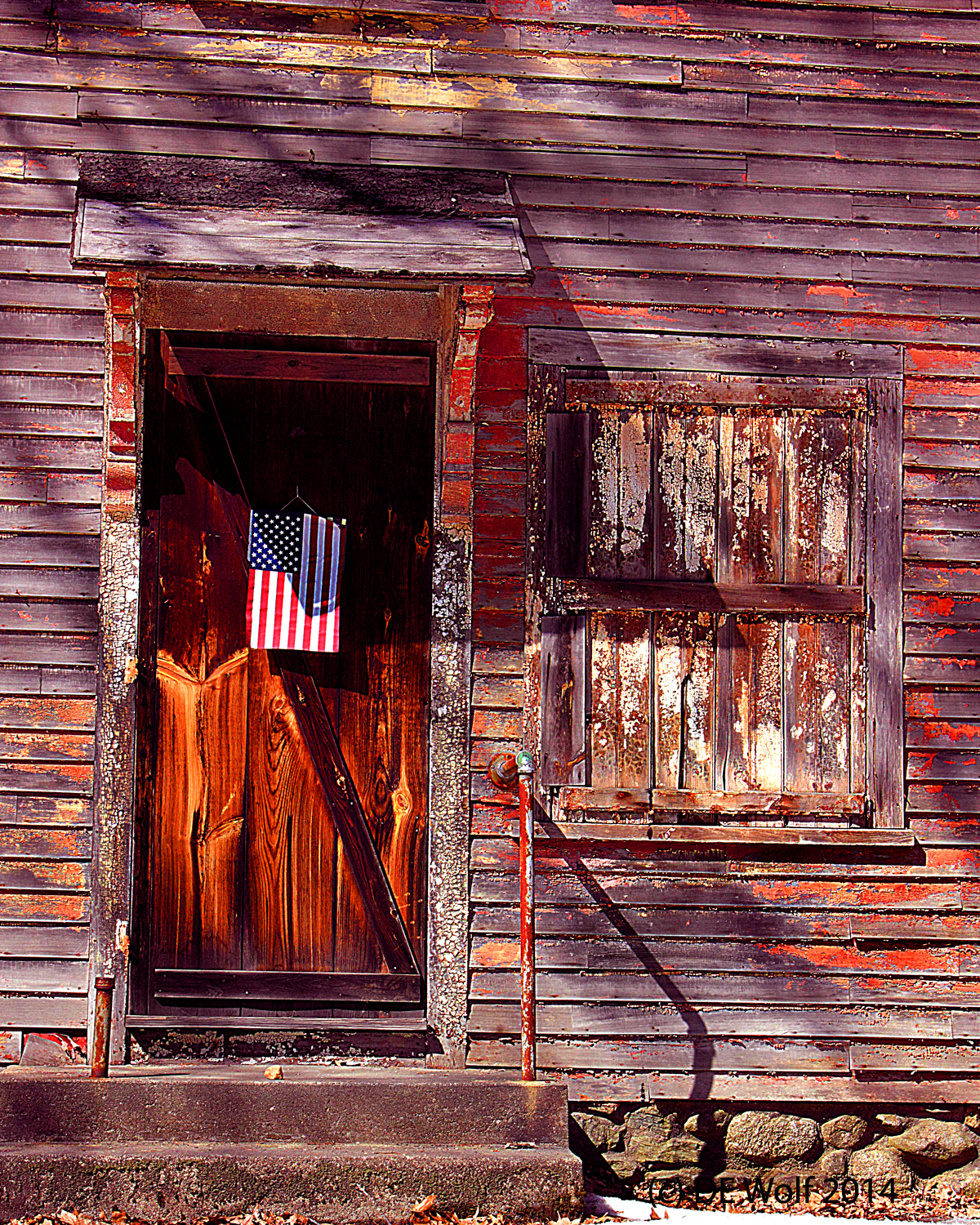
Figure 1 - Abandoned store Sudbury, MA, (c) DE Wolf 2014.

Figure 1 – Abandoned store Sudbury, MA, (c) DE Wolf 2014.

There is what I assume to be an old store at the intersection of Haynes Road and Pantry Lane in Sudbury, Massachusetts.  It’s on my alternate road to work; so I pass it often and keep cataloging it as a building to be photographed.  I’ve gone there camera-ready several times, but the light was never quite right.  Recently, I’ve noticed that the early morning light is good this time of year, but stopping on the way to work has been impossible with the traffic.  By this time of year most of the snow has solidified into walls of ice on the sides of the road side.  You feel like you are driving in some kind of tunnel.  So there is never a way to safely pull over during rush hour.

In any event. on Sunday I took advantage of the shift in time (spring ahead) to stop and take a picture of this building.  The result is shown in Figure1.  I moved progressively into the scene and in the end I settled upon this door and window shot.  I love the peeling paint and the little flag that is always there.  I surprised myself by deciding that I favored color for the photograph.  It was not my original intent.  However, I realized that the colors of the building are part of what really appeals to me about the little structure, particularly the red, white, and blue of the tiny flag against the warm brown wood.  I am pretty happy with the end result.

Whoo gives a hoot?

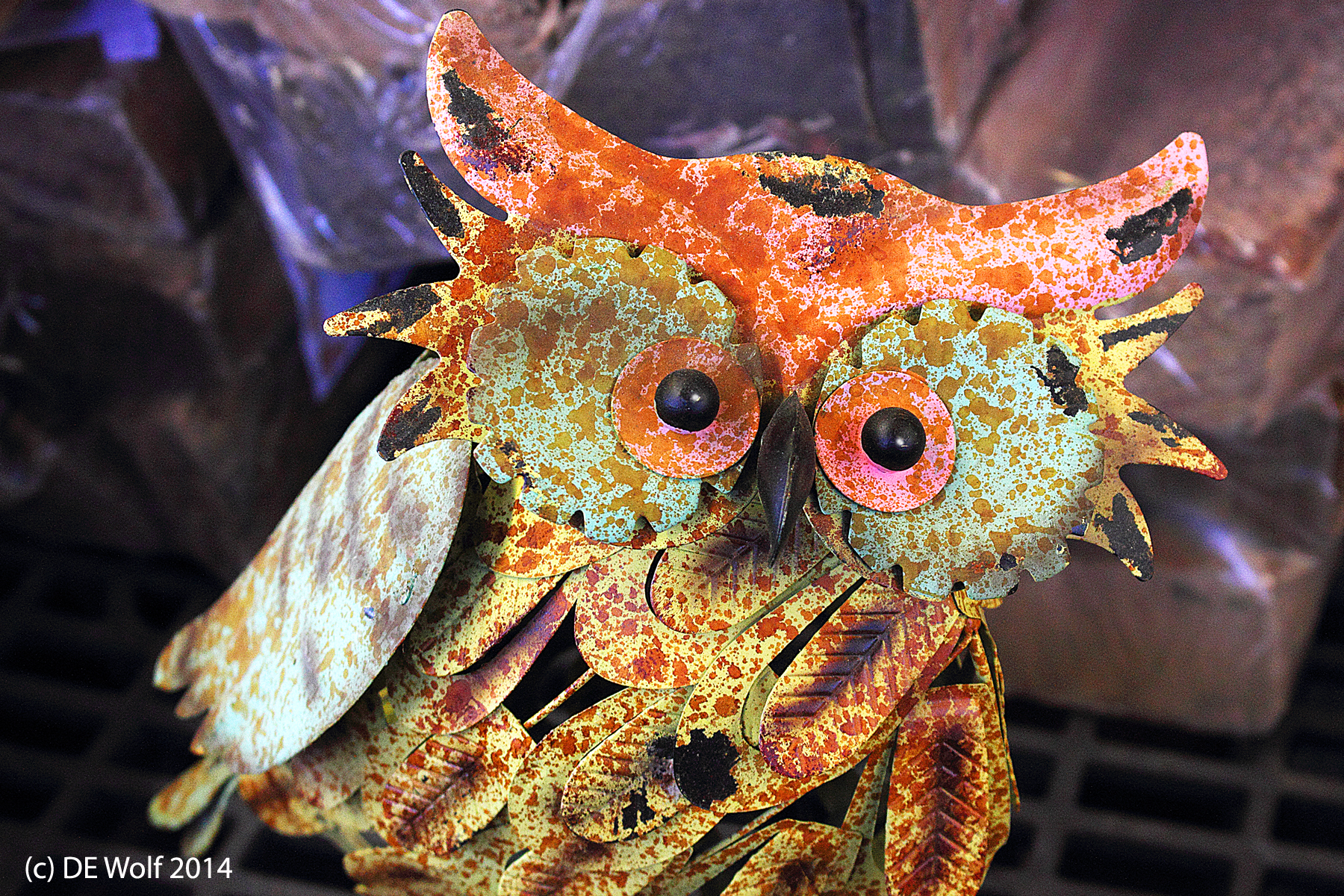
Figure 1 - What a hoot! (c) DE Wolf, 2014.

Figure 1 – What a hoot! (c) DE Wolf, 2014.

There is a popular television commercial here in the States for GEICO insurance.  The commercial starts with a husband and wife in a car.  The husband is being a bit of a know-it-all until his wife ask him whether he knows that not all owls are wise, and then the scene shifts to the forest, where the lady owl says to her husband owl: “Don’t forget that I’m having lunch with Megan tomorrow.”  The husband owl responds “Whoo.” And as the conversation continues, it becomes clear that he is not paying a feather’s worth of attention and keeps responding: “Whoo.”

I had this poor fellow in mind this past Sunday when I was visiting our local farm-stand and came across the fine fellow of Figure 1.  What a hoot!


Long shadows, simple gifts, and tomatoes

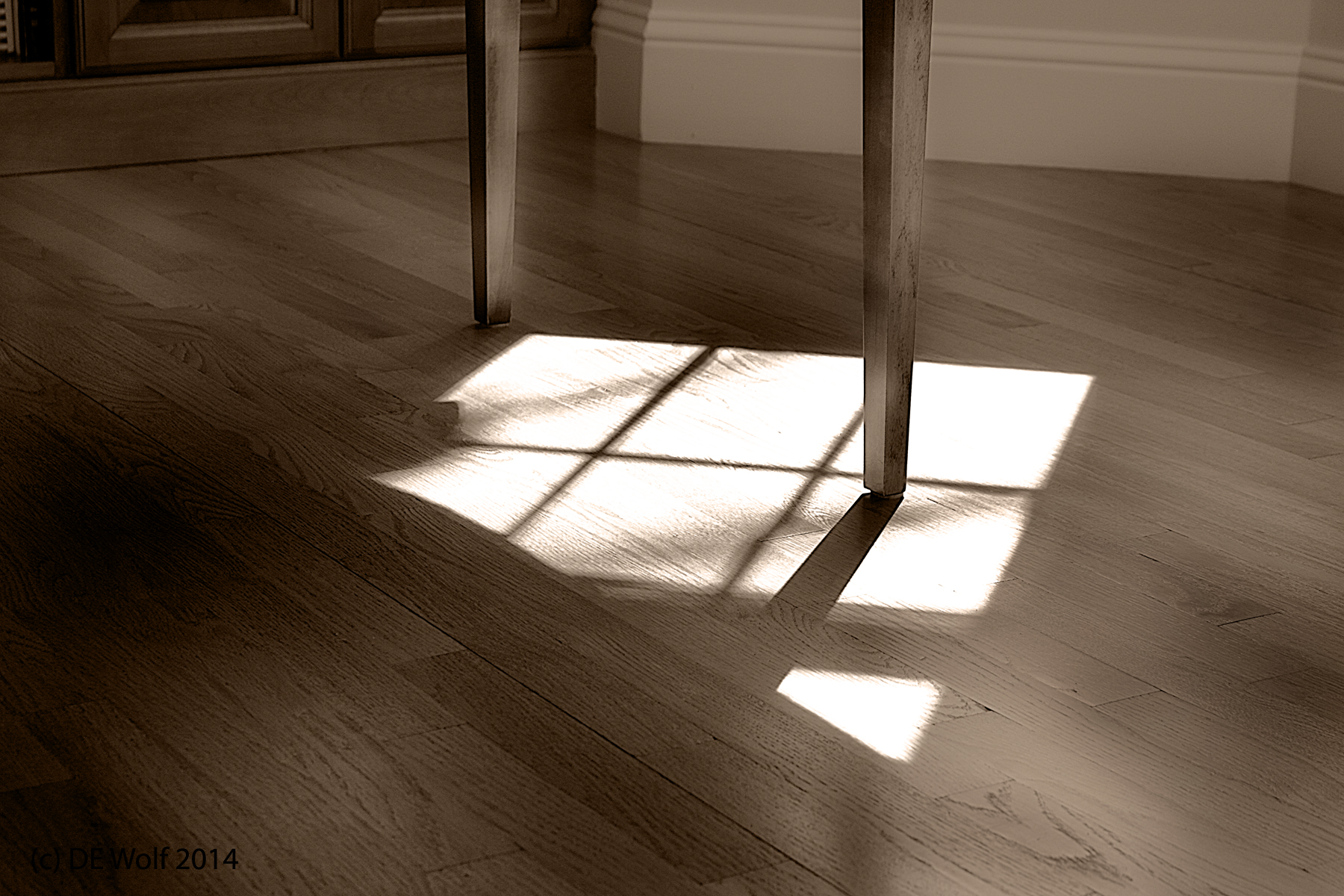
Long Shadows with Simple Gifts, (c) DE Wolf 2014.

Figure 1 – Long Shadows with Simple Gifts, (c) DE Wolf 2014.

I have spoken about the long shadows of a New England winter.  It is now March and near the equinox.  The sun is higher and in its own way casts long shadows bathed in a warming light.  It is a special time of year.  It is important to remember that all times of year are a simple gift to us.  One unique feature of a March light in northern climates is that when the sun is low it is unimpeded by trees, which have yet to put on summers leaves.

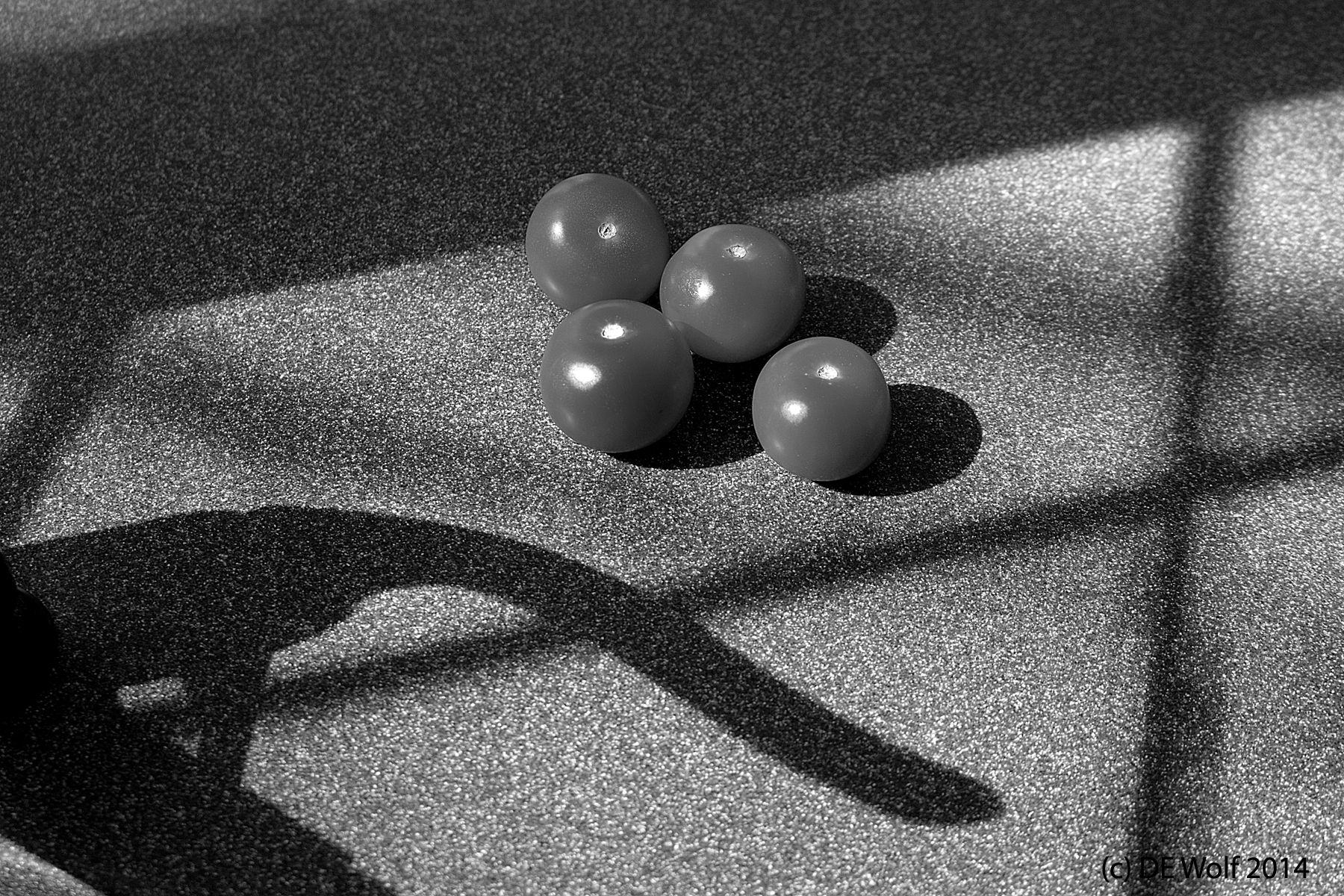
I was struck on Saturday morning by the bright rays of light entering my kitchen and the long shadows cast.  So I experimented with a few photographs that my mind created.  First is Figure 1, which I call “Long shadows with simple gifts” in honor of the Shaker like forms of the table legs on hardwood floors.  It seemed to call for a slight warm tone to emphasize the warmth of the light and to recall the original color of the wood. Figure 2, I entitle “Long shadows with tomatoes.”  I was really struck with the curious shadow cast by the handle of the kitchen faucet. I left it strictly in black and white.

I would rate these as almost successful.  With Figure 1, I did not quite achieve the effect that I wanted.  But every photograph is a learning experience.  And I guess that it is important to recognize that tomatoes can be glorious even in black and white.

Figure 2 - Long Shadows with Tomatoes, (c) DE Wolf 2014.

Figure 2 – Long Shadows with Tomatoes, (c) DE Wolf 2014.

The meme of Schrödinger’s cat

Figure 1 - Schrodinger's cat, (c) DE Wolf 2014.

Figure 1 – Schrodinger’s cat, (c) DE Wolf 2014.

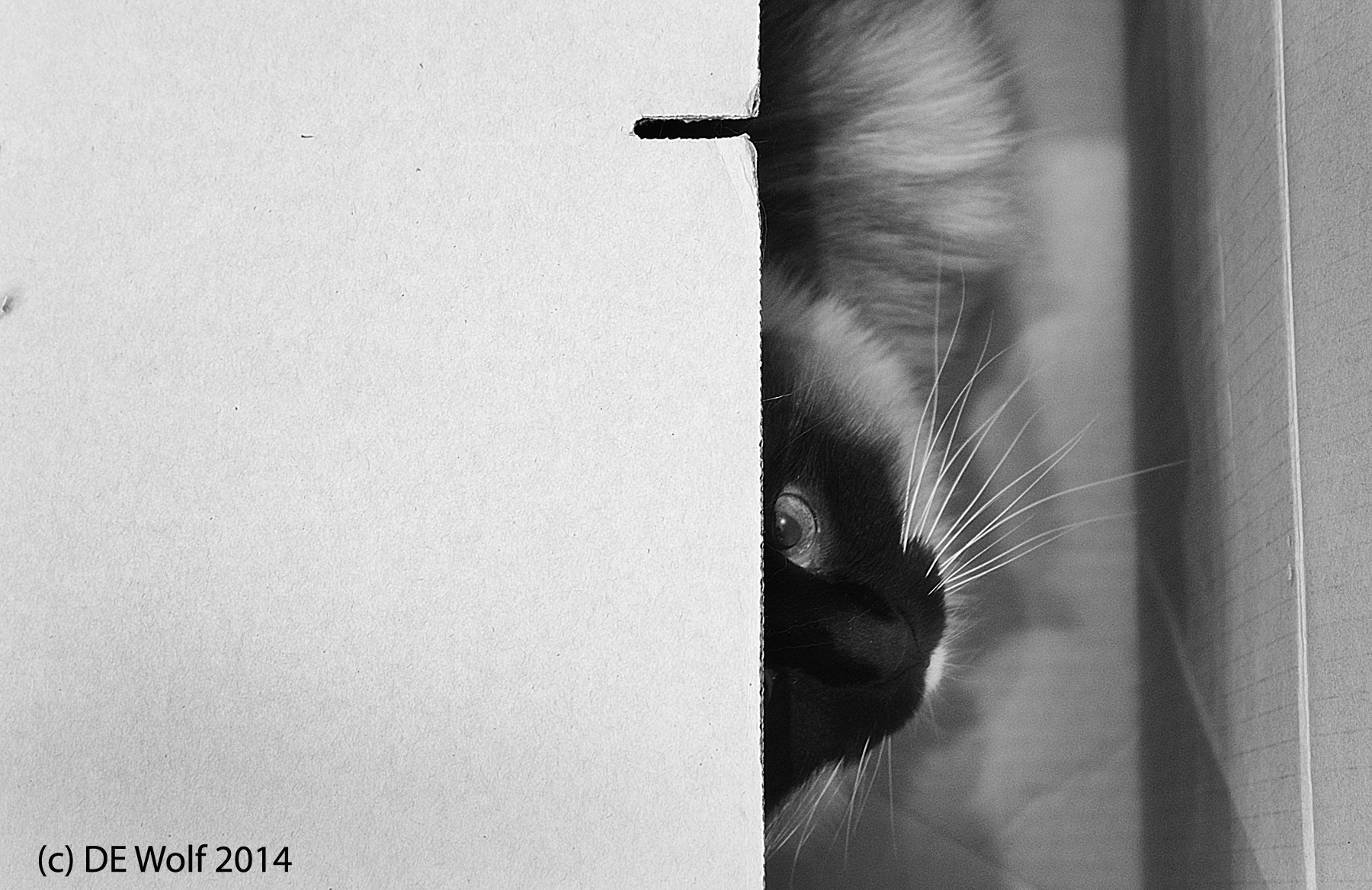
Figure 1 is a photograph of a cat in a cardboard box.  It is meant to evoke the meme of Schrödinger’s cat. Schrödinger’s cat is a curious kind of meme that is illustrative of an important fact, namely, that knowing the meme is not necessarily to know what it means, or at least what it refers to.  Most people have little understanding (this is not a value judgement) of what the Schrödinger’s cat paradox is all about.  Indeed, they have little reason or need to understand it.  They know that it has something to do with a cat and a bottle of cyanide inside a box and perhaps that the paradox implies that physicists are stupid.  Such is the life of the meme.  It has very little to do with the science behind Schrödinger’s original description.  It is a lot like E = mc^2.  Very few people know what that means either.

Inevitably, and I apologize, I have to tell you just a little bit about what Schrödinger’s cat is all about.  Quantum mechanics is the set of physical laws that small systems (like atoms) obey.  They’re slightly different than the physical laws that big objects like you and I or the planet Saturn obey.  This isn’t so difficult to understand.  One is the extrapolation of the other when things get big.  It’s a lot like the planet Earth being round but for the most part, as we move about it, we can treat it as if it were flat.  I mean it doesn’t look round.

But since our common experience doesn’t deal with objects that are really small, we tend to get confused when we have to think about them  Artificial paradoxes arise. The most commonly held interpretation of quantum mechanics is the so called Copenhagen interpretation.   Guess where the meeting that the Copenhagen interpretation was developed occurred.  Brilliant! In the Copenhagen interpretation, we suppose that we have say an atom, which can be in one of two states: a ground state or an excited state.  We covered this about a year ago.Throw that atom in the box and close it.  Which state is the atom in?  You don’t really know until you open the box and look.  Quantum mechanically you can consider the atom to be in a combination of the two states until you look and measure it.  Then the system of states collapses and there is only one or the other.  The key to quantum mechanics is the inseparability of the observer and the observed.  It’s totally counter intuitive, and totally bizarre, and we know from certain experiments where the states interfere like the waves they are with one another that it is absolutely true.

But how do you make the measurement?  Suppose you use an electronic circuit inside the box that lights up when the atomic gets excited.  The Copenhagen interpretation makes apparent the fact that the nature of measurement, or observation, is not well-defined if you think about it in this way. The experiment can be interpreted to mean that while the box is closed, the system simultaneously exists in a superposition of the states.  The light is both on and off, until you look.  The whole thing becomes ludicrous when you add a living element to the measurement, namely a cat.  Let’s consider Schrödinger’s own description and please ignore what he says about the  Psi function.  It’s not important to get the gist.

“One can even set up quite ridiculous cases. A cat is penned up in a steel chamber, along with the following device (which must be secured against direct interference by the cat): in a Geiger counter, there is a tiny bit of radioactive substance, so small, that perhaps in the course of the hour one of the atoms decays, but also, with equal probability, perhaps none; if it happens, the counter tube discharges and through a relay releases a hammer that shatters a small flask of hydrocyanic acid. If one has left this entire system to itself for an hour, one would say that the cat still lives if meanwhile no atom has decayed. The psi-function of the entire system would express this by having in it the living and dead cat (pardon the expression) mixed or smeared out in equal parts.”*

Hmm!  It goes very much against thee commonly held view that the cat is either (A) alive or (B) dead, not both at the same time.  You might well ask, what this has to do with photography?  And I sheepishly must admit very little, except for the recurrent theme of memes in our discussion and the luscious point that they do not necessarily require true understanding of the underlying phenomenon.  They acquire a life of their own in the common culture and that after  all is really the point of both words and images as memes.  They metamorphose and evolve.  I will, however, point out that in his discussion Schrödinger does go on to describe the paradox in photographic terms.

“It is typical of these cases that an indeterminacy originally restricted to the atomic domain becomes transformed into macroscopic indeterminacy, which can then be resolved by direct observation. That prevents us from so naively accepting as valid a “blurred model” for representing reality. In itself, it would not embody anything unclear or contradictory. There is a difference between a shaky or out-of-focus photograph and a snapshot of clouds and fog banks.”*

There is, of course, also the cat’s view in all of this.  You will note that Schrödinger apologizes for his hypothetical cat murder.  This is because physicist’s tend to love cats, because cats, like physicist’s, are patiently seeking truth and understanding.  The cat is much more patient than the physicist.  Cats love boxes and may be termed claustrophiles. (S)He knows that she is alive, even though the physicist has, for the moment, disappeared.  The cat will wait endlessly, if necessary, for the physicist to return to the box.  But all that the ailurophile physicist really needs to do is stick his finger inside the box to find out if kitty is still alive.

*Erwin Schrödinger, Die gegenwärtige Situation in der Quantenmechanik (The present situation in quantum mechanics), Naturwissenschaften
(translated by John D. Trimmer in Proceedings of the American Philosophical Society)
Northern Woods at Sunset

Figure 1 - Northern Woods at Sunset, Winter, (c) DE Wolf 2014.

Figure 1 – Northern Woods at Sunset, Winter, (c) DE Wolf 2014.

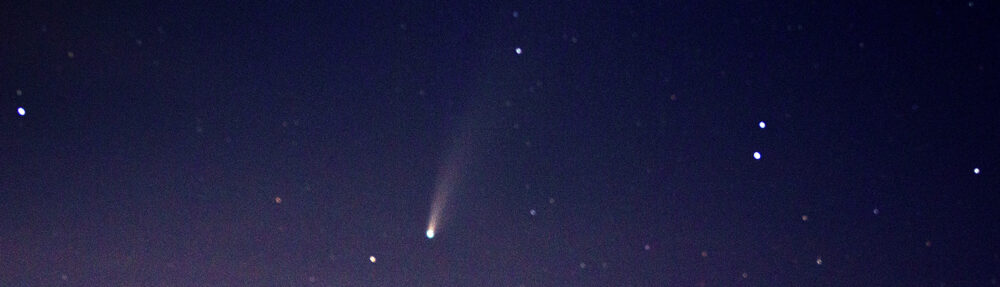
We can complain all that we want about the snow and cold of winter in the Northeast.  But in its own way it is a photographer’s paradise.  There is a very special pastel quality to the sky, when it is crisp and cold.  This past weekend we have had temperatures in the 50’s F on both days.  I made it my task to clear my driveway of the ice block that forms in front of the garage because of the snow melting off the roof.  Miraculously, I succeeded and just at sunset I went out to admire my own handiwork – thinking of Shackleton’s men trying to free the endeavour.  The cloudiness of the afternoon was just beginning to break up, and there were wonderful petite billowing red and magenta clouds in a blue-violet sky that silhouetted the bare trees.  It was a short lived moment, but I grabbed my camera and took one image, before the light darkened and changed.