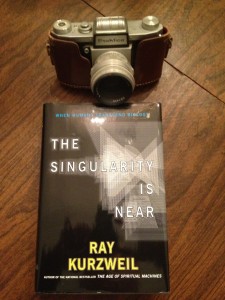
The intelligent camera

photoIn his book “The Singularity is Near” futurist Ray Kurzweil points out that people are always asking when is artificial intelligence coming, but that it’s already all around us.  It’s just that every time it gets developed, we call it something else.  A real case-in-point is the modern digital SLR.

My father’s camera was a Ciroflex twin lens reflex camera, the “poor man’s Rolleiflex.”  It focused manually with a thumb dial and that was about all it did. There was no flash and no light meter.  For exposure you had to use either the guesstimates that came with the Kodak roll film instructions or an external exposure meter.  My father would mount this camera on an enormous set of external floodlights during birthday parties.  My sister and I still laugh at this since these  slights were so bright that some of our childhood friends may still be seeing after image.s all these years later.

My first SLR was similar in its capabilities, a Praktica from East Germany.  Then I saved up my pennies and bought myself a Leica M3, arguably the best camera ever made.  So let’s say it’s 1968 and I wanted to photograph a flower, but also wanted the building behind it in focus.  The process was 1. consider the scene and decide on an f-number that’s going to give you the needed depth of field, 2. set the f-number, 3. choose the point that you want to use for focusing, 4. move the exposure time dial which was linked mechanically to the exposure meter until the the needle lined up in the center,  5. look at the exposure setting and decide whether it was fast enough to hand hold, 6. focus the lens on the flower using the split screen parallax range finder, 7. note the distance to the flower and then mover the lens focus so that both that distance and the distance to the building were both bracketed by the appropriate f-number lines on the lens barrel.  8. push the shutter.  I used to be pretty good and pretty fast in executing this set of events seamlessly.

Moving on, in 1985 Minolta, with the introduction of the Maxxum 7000, developed “autofocus.”  I remember clearly at the time that many reviewers though this pretty much useless.  I mean, who cannot focus a camera? Today we may be moving towards a crisis on the other side.  With the abandonment of split screen parallax views on the focusing screen, manual focus is becoming harder and harder, even under the many conditions where it might still be preferable.

OK, so today with my Canon T2i, I choose depth of field mode, “A-Dep.” My camera chooses the exposure time for me based on my chosen f-number.  This is based on the placing nine focal points into simultaneous focus.  If this cannot happen, the camera tells me.  Focus is achieved automatically.  Really, if I don’t want to fuss with it,  all I have to do is push the shutter button.  If you think about it, the only thought process required of me was the knowledge that A-Dep was the best way to take this picture.  The little person that lives inside my camera is pretty smart – smart in all sorts of  amazing ways!

This is really a clear example of artificial intelligence, as long as we don’t quibble over the semantic question as to whether an algorithm-based program incapable of learning is true artificial intelligence.  But this definition is pretty satisfactory for most folks, and, perhaps of equal or greater importance,  nonthreatening in that we don’t expect the intelligence in our cameras to declare “cogito ergo sum,” or to emote in response to the subjects they are photographing by, say, crying or laughing.  Most importantly they are unlikely in this stage of development to pass the Turing test.*  But they really do take great pictures!

* The Turing test is a test of a machine‘s ability to exhibit intelligent behavior in such a way that it is indistinguishable from intelligence.  In Turing’s original conception of the test a human asks questions of another human and a machine.  The judge cannot see the participants and they only communicate via a single mode such as a key board and monitor.  That is the test is designed such that the machine does not have to replicate human speech.  If you’ve ever watched the closed captions with the news, you’ll realize that this last point would still be critical.
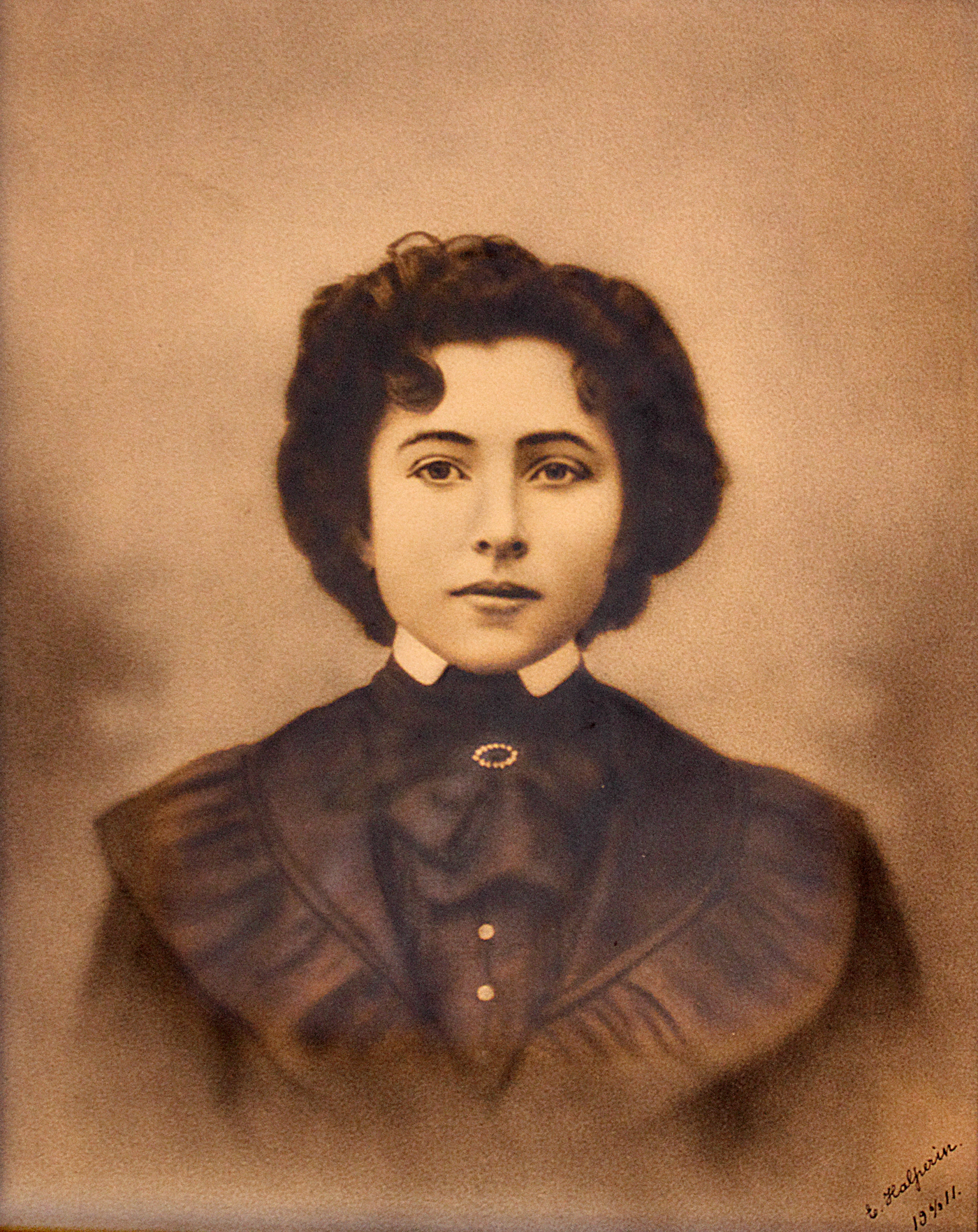
Maryam Freyda Figa (Wolf) 1886-1972

Maryam

Maryam Freyda Figa Wolf, 1911 silver gelatin print by Elias Halperin

A reader has asked that I post the picture of my paternal grandmother that I described in yesterday’s post.  It is contemporary with Andre Hachette’s portrait of Sarah Lievine and is a silver gelatin portrait taken and hand tinted by Elias Halperin, who was the husband of my grandfather’s sister Menuka Wolfowitz Halperin.  The image is dated June 9, 1911.

The date is significant, because my grandmother, Mary as they called her, had quit her job at the Triangle Waist Coat factory a few months earlier.  On March 25, 1911 in a sad and gruesome tragedy the Triangle Waist Factory, now the NYU Brown building on Washington Square, went up in flames.  The owners had locked the rear doors, so that the girls, who worked there, were forced to exit by the elevator in the front of the building so that they could be checked for stolen cloth.  Within eighteen minutes the entire factory was engulfed in smoke and flames killing everyone left inside.  Fortunately, for me, my grandmother was not one of them.

Mary married my Grandfather Louis Wolf five months after this picture was taken.  The wedding was held at “The Brides Residence at 54 Ludlow Street” in Manhattan.

I have blogged before at how wonderful it is to have silent faces look back at us over a century.  The have a message for us.  When the face is unknown, we catch a glimpse of their lives and create a story for ourselves.  When we know the person and know the rest of their lives, those eyes are filled with the wonder of expectation.

My grandmother was born in 1886 in Lomza, Poland.  She came to America in 1910 at age 24 full of hope and expectation.  My grandmother always seemed a timid person to my sister and me.  But she must have been an incredibly brave person to make that journey alone.

My cousin Ken Figa told me a story that has always haunted me.  When his grandfather, Jack Figa, my grandmother’s youngest brother, was asked what it was like to leave his family behind, he said tearfully, “I kissed my mother goodbye on the dock and I never looked back.”

I hope that Ken doesn’t mind my telling that story, because it’s very important.  Millions of stories like that define the great immigrations that are America.  I always love to look at that picture.  It always makes me think that (to paraphrase Edward R. Murrow), we are not descended from fearful men and women.  They were doers and they did what they did for us.  They had great expectations and they expected nothing less from us.  Anyway, that’s what Mary’s photograph means to me.


Winter break 2012

BrusselsSprouts

Brussels Sprouts, (c) DEWolf 2013

I took a pretty extended winter break last month and I did manage a few photographs that were successful at some level.  So I thought that I would share them with you.

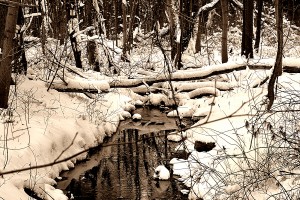
StreamSM

Winter Stream (c) DEWolf 2013

The first were of some Brussels Sprouts that were still fresh on the stalk.  I got a reasonable  tonality, and also got a nice effect by spraying them with water before photographing them.  I was impressed with the spiral form of the stalks and I tried to capture this.  Unfortunately, I wasn’t too successful,  and unlike Edward Weston, who just took his time and photographed until the vegetables were on the verge of spoiling, here the cooks were demanding and I had to take what I got.  They did taste good, however.

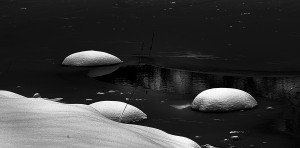
snowandice2

Snow and ice (c)DEWolf 2013

We had a snow storm the Saturday night before New Years, and Sunday morning dawned beautiful though overcast.  It seemed a perfect time to try out my new Canon 70 – 200 mm f/4.0 USM zoom lens.  Snow is always a tough task master, as it tends to bleach out and drive everything else into darkness.  Still I got a reasonably satisfying image of a brook near my house that I’ve been targeting for photographing for some time.  For some reason the image seemed to beg for sepia toning.  Since I’ve shifted to the Canon T2i, I’ve found that I generally like my black and whites straight-up and sans toning.

I also took an acceptable image of a frozen pond with snow.  It was a real lesson in dealing with snow.  It took a lot of processing including a very nonlinear LUT on the grey scale.  This can be tricky and turn the image into a solarization, if your not careful.  But the important point here is that I learned a lot.  Handling your equipment can be a bit of a pain, when you are wading in snow, carrying a monopod, and trying to keep your fingers warm.

Still more on robotic eyes – the seeing mannequin comes to a mall near you

OK, I’m going a bit off topic again today. We’ve talked about robotic eyes and now according to Bloomberg News and NBC News, it’s gone a step further.  Italian mannequin manufacturer Almax SpA is now selling the EyeSee mannequin.  Units go for just over $5000 and have digital cameras built into one of their eyes.  That is their eyes have eyes.

As you might imagine, a significant purpose of this is to augment store security.  OK, so maybe not the Mars Rover, but it does serve a purpose.  But then we learn that the mannequins are analyzing us and profiling us, collecting data, determining gender and race.  People report that it’s more than a bit spooky, being watched at eye level, by something anthropomorphic but not quite human.

I am reminded of a “Sunday Showcase, November 8, 1959 entitled “Murder and the Android,” where the android sheds tears.  OK, so maybe I’m the only one that remembers this Hugo award winning story.  And then coincidentally a week later, November 13, 1959 we have, or rather had, the famous “Twilight Zone” episode, “The Lonely,” where a man is imprisoned on an asteroid and out of compassion the police give him a female android companion, whom he falls in love with – has the usual Rod Serling twist ending.  And, as an aside, Android Alicia is played by Jean Marsh of “Upstairs Downstairs,” fame.

A hundred years from now the EyeSee will be judged primitive.  So where is all this taking us?  Is it just another example of an invasion of our ever waning privacy?  Or is it the dawn of new ways of seeing, connecting, and interacting?  Is it bad that a robotic eye can take data and analyze us as shoppers, but good if it observes our gate to determine if we have suffered brain trauma?  One point is certain.  We are going to have to deal with these issues as we enter a Kurzwelian age.

Some Photographic Resolutions for the New Year

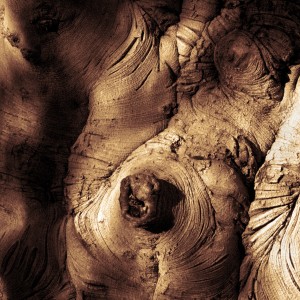
Gnarl2

Figure 2 – “Gnarl” (c) DEWolf 2013

It seems a good time to make some photographic resolutions for the New Year.  So here goes:

  1. Focus on seeing.  Isn’t this what it’s all about?
  2. Spend more time taking photographs.  If you love doing it, you should do more of it.
  3. Slow down, concentrate on composing the image, on setting and checking the light.
  4. Learn to photograph trees.  They are worthy subjects, but can be difficult to compose, difficult to get the light right, difficult to isolate, and difficult to disentangle from power and telephone lines.


Favorite Photographs for 2012 – What I learned about photography and “awe”

I found the exercise of coming up with my ten favorite photographs for 2012 curious for what it tells me I personally like in a photograph.  And also for what it teaches me about the meaning of photography.

Let’s start with some statistics.

There were four nudes:

  1. Edward Weston, Nude in the Dunes, 1930
  2. Annie Leibovitz, Portrait of Keith Haring, 1987
  3. Judy Dater, Imogen and Twinka, Yosemite, 1974
  4. Anne Brigman, The Bubble, 1909

There were four portraits:

  1. Annie Leibovitz, Portrait of Keith Haring, 1987
  2. Judy Dater, Imogen and Twinka, Yosemite, 1974
  3. Julia Margaret Cameron Portrait of Sir John Herschel with Cap, 1867
  4. Yousuf Karsh, Audrey Hepburn,1956

And four landscapes:

  1. Ansel Adams, Moonrise, Hernandez, NM, 1941
  2. Abelardo Morell, Umbrian Landscape Over Bed, Umbertide, Italy, 2000
  3. Edward Steichen, The Flatiron Building at Night, 1904
  4. Beth Moon, Kapok

Also, all of the images chosen were in black and white except, arguably, “The Flatiron Building at Night, 1904,” which is really only toned in color, albeit quite effectively.  I truly prefer black and whit photography both in the seeing and in the taking.  I find that color can easily take over, even to the point that the whole exercise becomes trivial.  Although, I will freely admit that in certain photographs the color demands itself.

I do not know, indeed I would like to understand whether this is merely photographic tradition or whether there is a aesthetic psychology that defines the power of black and white.  But for me, it is always about good light, good contrast, good composition, and good dynamic range

As for landscape photography, its appeal is two fold.  First, it is part of an artistic tradition and through the greats, like Adams, a photographic tradition.  Second, and more profoundly, we stand in awe of nature and things man-made that emulate nature, such as the beauty of the Flatiron building at night, colored with the amazing artistry of the master’s hand.  The meaning of the word “awe” was expressed so wonderfully by the great theologian and philosopher Abraham Joshua Heschel in his book “Who is Man?”

Awe is more than an emotion; it is a way of understanding, insight into a meaning greater than ourselves. The beginning of awe is wonder, and the beginning of wisdom is awe.
Awe is an intuition for the dignity of all things, a realization that things not only are what they are but also stand, however remotely, for something supreme. Awe is a sense for transcendence, for the reference everywhere to mystery beyond all things. It enables us to perceive in the world intimations of the divine, to sense in small things the beginning of infinite significance, to sense the ultimate in the common and the simple: to feel in the rush of the passing the stillness of the eternal. What we cannot comprehend by analysis, we become aware of in awe.

As for nudes, as we have discussed there is certainly a wonder of abstraction as well as a beauty in the sensuous.  But ultimately they connect so directly with “awe” in landscape, so much so that they define the same sense.  I was reading an article in the September/October 2012 issue of View Camera by Ian Leake who specializes in photographing nudes.  He expressed the connection so wonderfully and concisely:

I work primarily with female nudes because the human body is a universal language of life – and arguably, anything that is worth saying about life can be said with the human body.”

And finally, we have to recognize that portraiture attempts to capture the meaning of a person’s life.  Keith Haring becomes his art.  We look into John Herschel’s eyes and in the classic sense are given admission to his soul.

The awe is in all three of these photographic forms.  Therin, lies their wonderful connection!


Happy New Year from Hati and Skoll Gallery

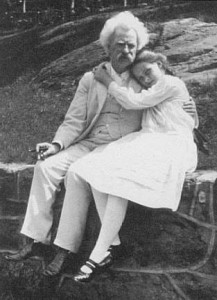
Mark_Twain_and_Dorothy_Quick

Figure 1 – Mark Twain with Dorothy Quick c. 1907. From the Wikicommons in the public domain.

Call me crazy, but I am optimistic about 2013.  We all need to be optimistic.  Despite all the terrible events that are happening, we all need to imagine and to dream of a better world.  We all need to work together to make it better.

I have been looking for an excuse to insert a photograph of Mark Twain (1835-1910) into my blog.  So here it is.  I have chosen an image of Twain taken around 1907, with eleven year old Dorothy Quick (1896-1962) – an unlikely friendship?  Dorothy spotted and recognized Twain on a transatlantic crossing.  She slowly circled his chair multiple times, until he introduced himself.  They went on to be great friends until Twain’s death in 1910.  Ms. Quick went on to become a writer herself.

In his darkest moments, Mark Twain wrote one of his finest works, “The Mysterious Stranger.”  Here he revealed his worst pessimism, his most dreaded thoughts.  It is an awesome existential work, which ends in the vision that everything in the world is nothing but a dream.  We are the dreamers.  We have chosen to have bad dreams and nightmares. Twain challenges us to “Dream other dreams, and better!”  It is an admonition worth restating on January 1, 2013. Let’s work together to dream better dreams.

Holiday Greetings from Hati and Skoll Gallery

Poinsettia3

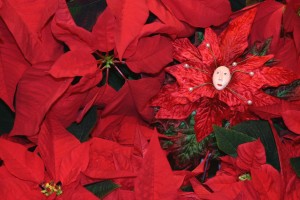
Tiger Lily’s Christmas Vacation, copyright DEWolf 2012

Today is December 21, 2012, the time of the Winter Solstice, the darkest day of the year.  So I thought it an appropriate moment to wish you all very happy holidays.  These seem particularly dark times.  But let us think of spring and the coming sunshine.  Let us work together, so that we may achieve mutual respect, peace, and love in our little world.  May we follow in the footsteps of Dante to share the beauty of the stars. David


“My guide and I did enter, to return

To the fair world: and heedless of repose

We climb’d, he first, I following his steps.

Till on our view the beautiful lights of heaven

Dawn’d through a circular opening in the cave;

Thence issuing we again beheld the stars.” *


*“Lo duca e io per quel cammino ascoso
intrammo a ritornar nel chiaro mondo;
e sanza cura aver d’alcun riposo,
salimmo sù, el primo e io secondo,
tanto ch’i’ vidi de le cose belle
che porta ‘l ciel, per un pertugio tondo.
E quindi uscimmo a riveder le stelle.”

Robotic eyes, yes, but is it art?

hs-2009-25-e-large_web

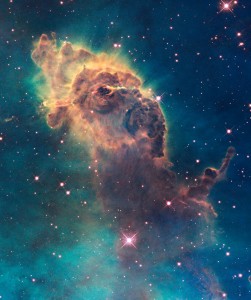
Figure 1 – NASA image of the “Jet in Carina” taken by the Hubble Space Telescope from the NASA Hubble Gallery Site.

The subject of robotic eyes and surveillance cameras seems very far from the subject of photography as art.  But is that really so?  I’m not going to give you the cliche’ argument that “art is in the eye of the beholder.”  I’m going to answer very directly and say that yes it can be – and that in the end this fact may prove to be very profound.

You have to look no further than the Hubble images of deep space and the pictures coming back from the Mars Rover.   Arguably, there is a human being choosing the object to be photographed and at some level editing the final image.  Still the point is that these are clearly objects of beauty, which by virtue of robotic eyes, extend the limits of our own vision.

garvitationallensing

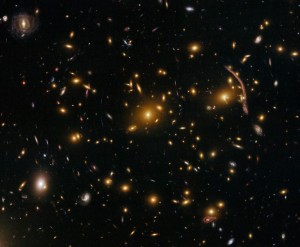
Figure 2 – This important image taken by the Hubble Space Telescope is a picture of the Galaxy Cluster Abell 370. The warped and distorted lines are galaxies the image of which are distorted by “gravitational lensing” of light by a black hole. This is direct proof of Einstein’s theory of General Relativity. Image from the NASA Hubble Gallery Site.

Take this a step further, and consider Ray Kurzweil‘s view, articulated in his book “The Singularity is Near,” that humans are becoming more and more bionic, that is machine-like.  According to Kurzweil we are evolving towards an immortality as machines.  It is, of course, a controversial opinion.  Less controversial, however, is the view that as machine become more and more “artificially” intelligent, that is as they become more and more capable of intelligent decision, it becomes less and less justifiable to go to the expense of sending human beings into hostile environments like deep space.

Right now, we can marvel at the ability of human beings to control the eyes on the Hubble Telescope and reveal both the secrets of the universe and its beauty, or to move the Mars Rover to a new location and take both images and analyze soil samples on the red planet.  It is sobering how far we have come in the hundred and seventy years since Daguerre and Draper took the first photographs of the moon.  So, perhaps we should be a bit cautious about rejecting Kurweil’s view of our, not so distant, future.