Full dome in winter

Figure 1 - Full Dome in Winter. IPhone self-portrait. (c) DE Wolf 2013 .

Figure 1 – Full Dome in Winter. IPhone self-portrait. (c) DE Wolf 2013 .

Last weekend, Bostonians were treated to the third weekend storm in as many weeks.  We were homebound Saturday and Sunday and I reached the point of “Enough already!  How many snow pictures can one person take?  Still I concluded that as one last bow to winter a self portrait homeage to Ansel Adams’ great “Half Dome in Winter, 1938” was in order.  Or perhaps it should be a homage to Jerry Ueslmann’s “Full Dome, 1973.”

In any event the IPhone serves wonderfully in this kind of self portrait situation.  First, because it is reasonably easy to keep it dry.  And second, because you can easily switch into a face the screen camera mode, so that you can see the image as you take it.

This was meant to connote the angry and disgruntled New Englander, fed-up with snow and nasty weather.  Why do I live here? But then came Monday morning and the commute to work through a breath taking fairy land where every tree was covered in pristine snow and the dawn light struggled to make its way through minute breaks in the overcast.  I found myself asking myself two things.  One, why did you leave your camera at home?  And two, why would anyone want to live anywhere else?  So I guess that I will again soon take camera with me into the throngs of another Massachusetts winter storm and I will be loving it!

Figure 2 - The Charles after the Storm, IPhone photograph (c) DE Wolf 2013.

Figure 2 – The Charles after the Storm, IPhone photograph (c) DE Wolf 2013.

The blizzard of 2013 – Part 2 Old Burial Ground Sudbury, Massachusetts

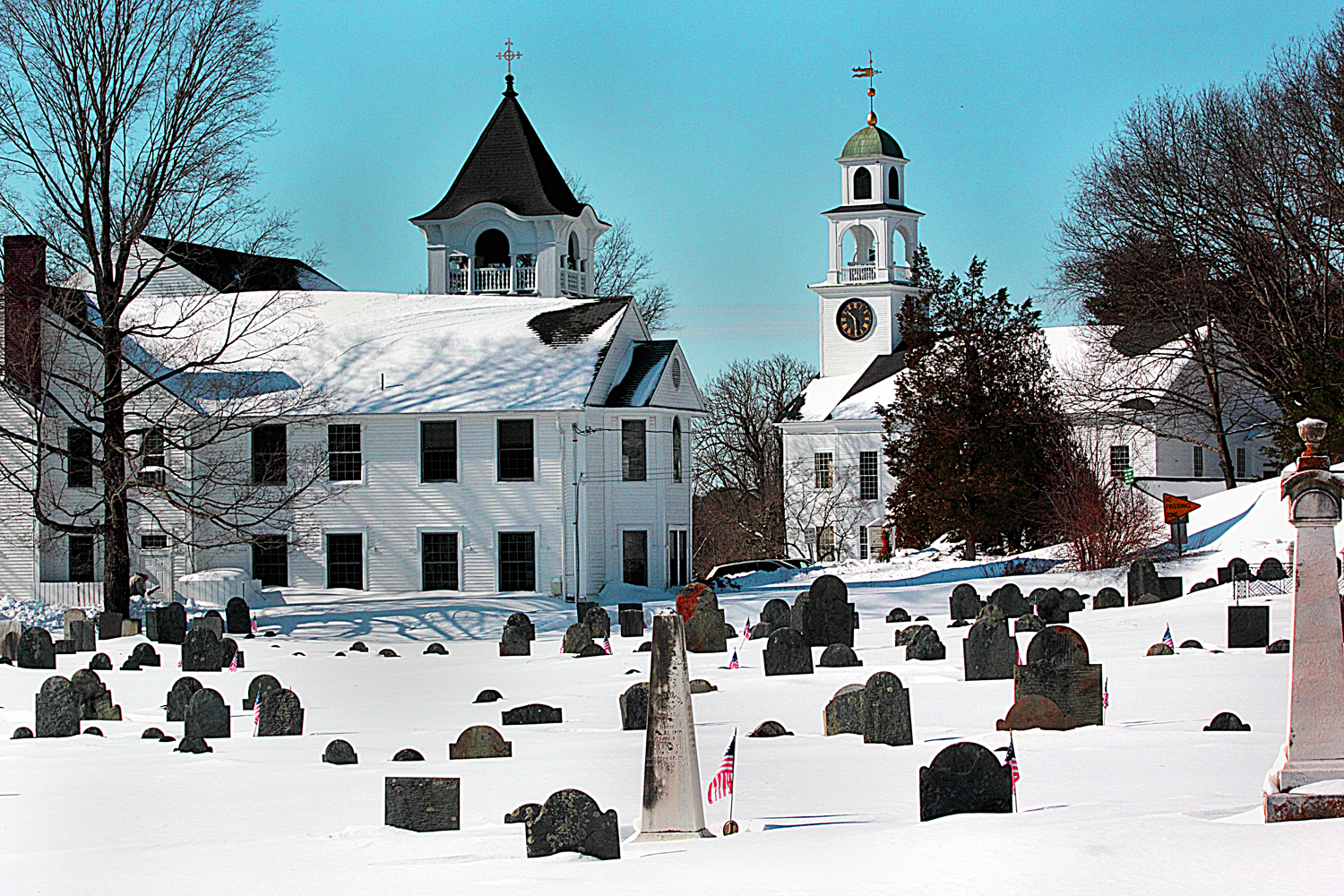
Figure 1 - The Old Burial Ground, Sudbury, MA (c) DEWolf 2013

Figure 1 – The Old Burial Ground, Sudbury, MA (c) DEWolf 2013

Sudbury, Massachusetts is one of the great historic Revolutionary War villages in Middlesex County, Massachusetts.  It’s Town Center is marked by the Old Burial Ground and the Congregational and Unitarian Churches.  The blizzard of 2013 dropped over two feet of snow in Sudbury and left the historic town center “picture perfect.

On the 19th of April in 1775 the church bells rang to summon the Sudbury Minutemen to march to neighboring Concord, Massachusetts to defend the gunpowder stores.  This commemorated evry year on the anniversary, when the church bells still ring out to summon the Sudbury Minutemen reenactors.   It is an eight mile march to Concord and on that day in 1775 Sudbury’s militia arrived too late for the initial engagement with British troops on the Old North Bridge.

Figure 2 - Grave markers in the snow, Old Burial Ground, Sudbury, MA (c) DEWolf 2013

Figure 2 – Grave markers in the snow, Old Burial Ground, Sudbury, MA
(c) DEWolf 2013

The old graveyards of New England seem to accentuate our connection with the past.  They remind us of the building of America and our obligation to the ideals of these early Americans.  The denizens of Sudbury’s Old Burial Ground are mostly from the eighteenth and early nineteenth centuries.  Across Concord road from the Old Burial Ground is a newer cemetery and the side of the road is marked by crypts containing the remains of prominent Sudbury citizens of the nineteenth century.  A second nineteenth century graveyard is to be found about a mile South of the town center.
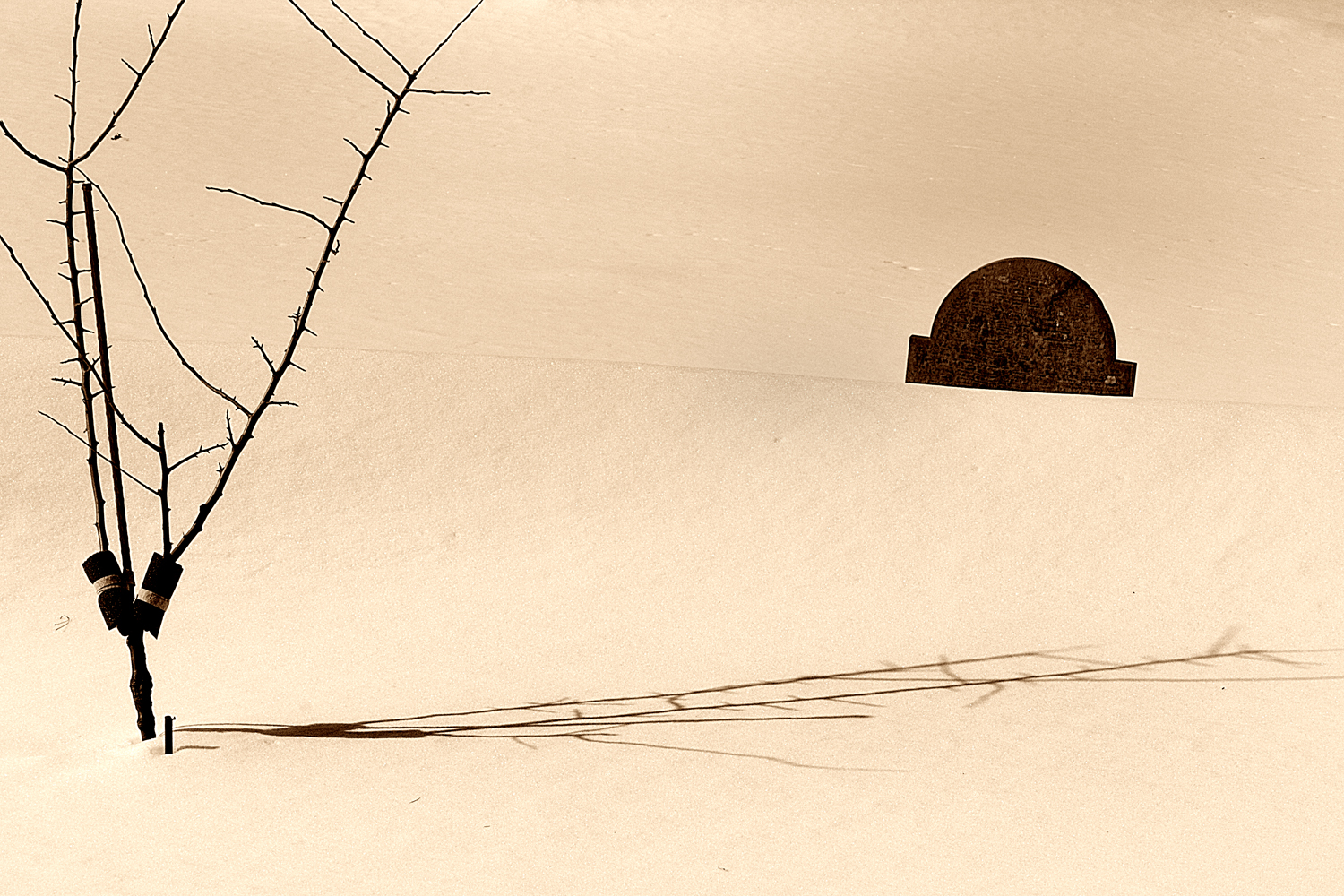
GraveMarkerinSnowSm

Figure 3 – Gravemarker in the Snow, Old Burial Ground, Sudbury, MA (c) DEWolf 2013

A problem in the early days, and up until the nineteenth century, was that the ground became too hard in winter for burials.  The deceased were stored in undertakers’ sheds until spring when the ground softened. In many Massachusetts towns, such as Concord, here The  Burial Ground overlooks Monument Street, may be found built on glacial drumlins because this was the ground first caught the sun and melted first in spring.  Such drumlins are a key geological feature of eastern Massachusetts, Sudbury has recently moved the old undertaker’s storage shed to the burial ground and restored it.
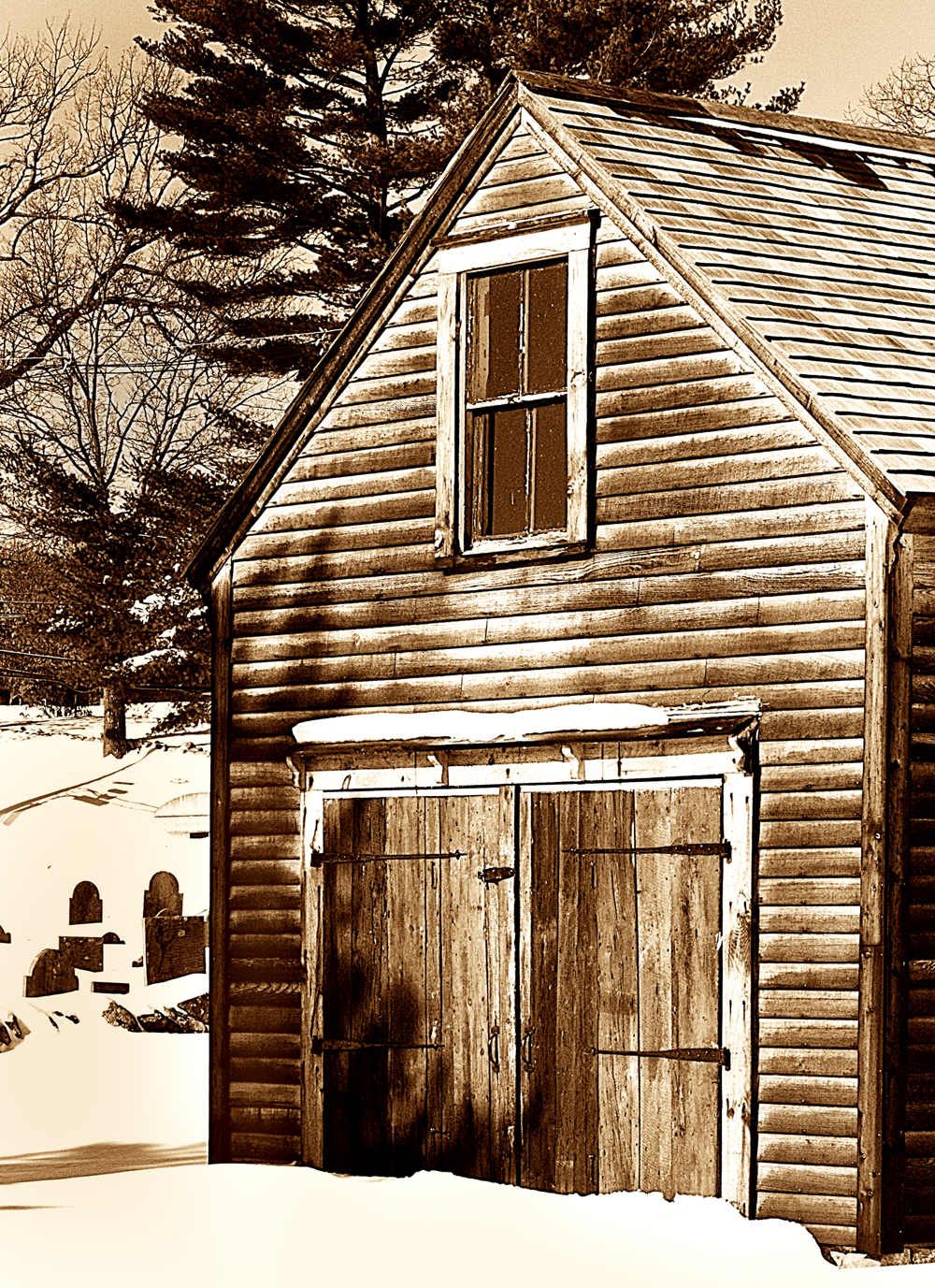
Figure 4 - Undertaker's Shed, Old Burial Ground, Sudbury, MA (c) DEWolf 2013

Figure 4 – Undertaker’s Shed, Old Burial Ground, Sudbury, MA (c) DEWolf 2013

Next to Sudbury’s Old Burial Ground may be found the stonework town pound, where escaped domestic animals were placed until they could be reclaimed by their owners.  The town has rebuilt the gate to this pen, and its authentic coloration provided a marvelous contrast to the stark, pristine whiteness of the snow.
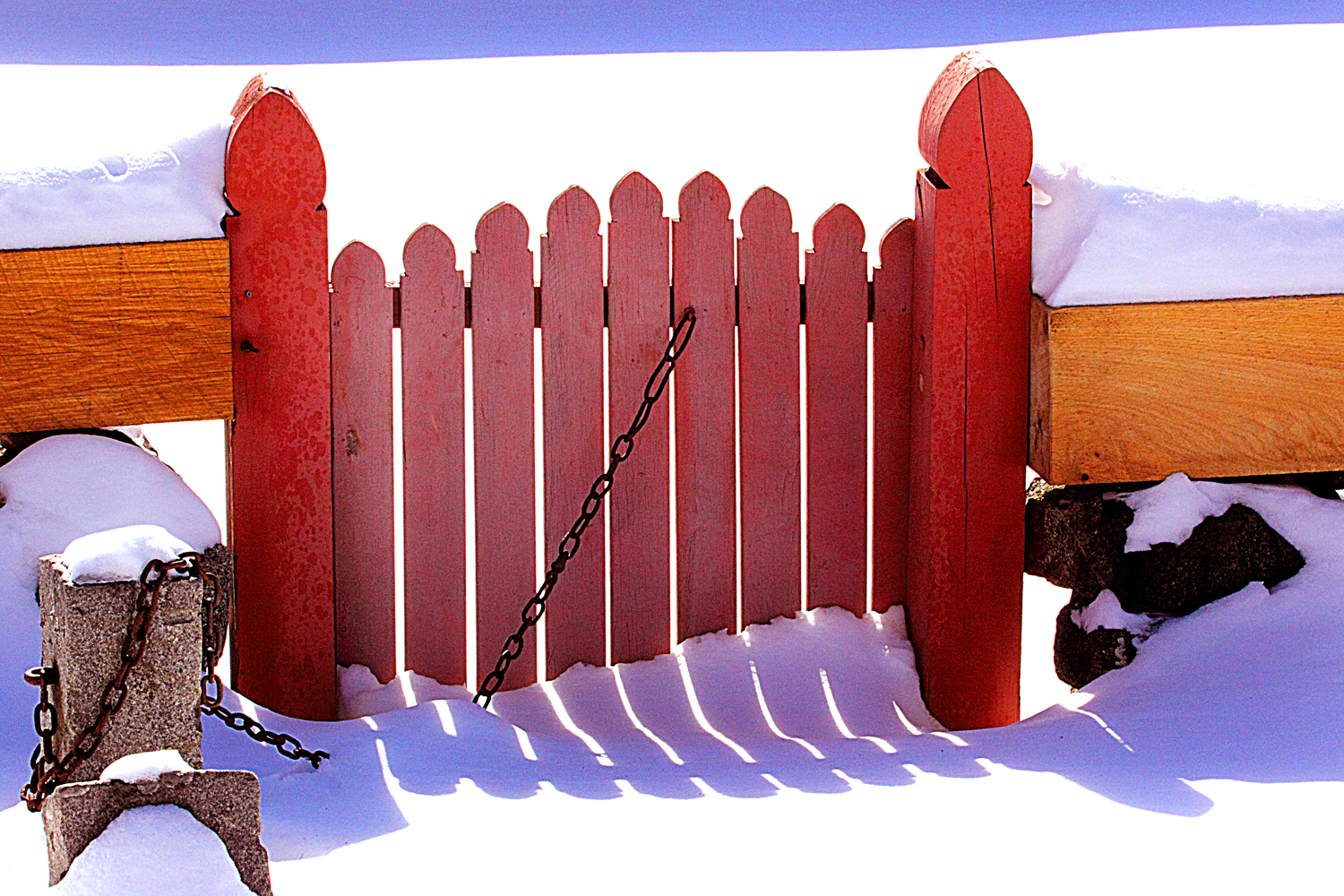
Figure 5 - The gate to the Old Town Pound, Sudbury, Massachusetts, (c) DEWolf 2013.

Figure 5 – The gate to the Old Town Pound, Sudbury, Massachusetts, (c) DEWolf 2013.

When one thinks of New England one thinks of snow.  So there was something right about the blizzard of 2013 in the way that it set off the countryside.  Still there was something quite reassuring to retreating from the cold to a warm cup of coffee.


The blizzard of 2013 – Part 1 Geometrics

Figure 1 - Slats and Snow, 2013 (c) DEWolf

Figure 1 – Slats and Snow, 2013 (c) DEWolf

The great blizzard of 2013 is fading into memory now.  Within 48 hrs the pristine snow, in Boston at least, had acquired that yucky, sloppy, urban blackness.  Fortunately, I got out early on the first two days and did some photography.  Hopefully, you will find some of it interesting.

Snow is curious and nontrivial to photograph.  I still have a lot to learn and have yet to truly achieve tone on tone.  Rather I wind up defaulting to high contrast in the image, that is letting it range from black to white.  I experimented with plus and minus on the exposure.  In general you wind up with double peaked histograms.  If you photograph the snow alone the dynamic range is tight and the images can become very high contrasty and abstract, if you equalize the histogram.

Today I’d like to focus on what I call geometrics.  The first (Figure 1) is an image of hand-railing slats projecting deep shadows on a pristine alabaster and flat snow bed, whicj is the deck of a front porch.  You tend to think of snow as cold, which would suggest blue/green toning as preferred, but here I chose a deep sepia tone and like the effect.

Figure 2 - Windblown peak on a field of snow, 2013 (c) DEWolf

Figure 2 – Windblown peaks on a field of snow, 2013 (c) DEWolf

The second (Figure 2) is an image of wind blown peaks on a field of snow.  Strong wind defines a blizzard and the effects can be abstract and very pleasing.  I’m really drawn to this kind of subject matter – nature’s abstractions.  Here a subtle and colder blue/green toning seemed best.

Figure 3 - Windblown ripples in the snow, 2013 (c) DEWolf

Figure 3 – Windblown ripples in the snow, 2013 (c) DEWolf

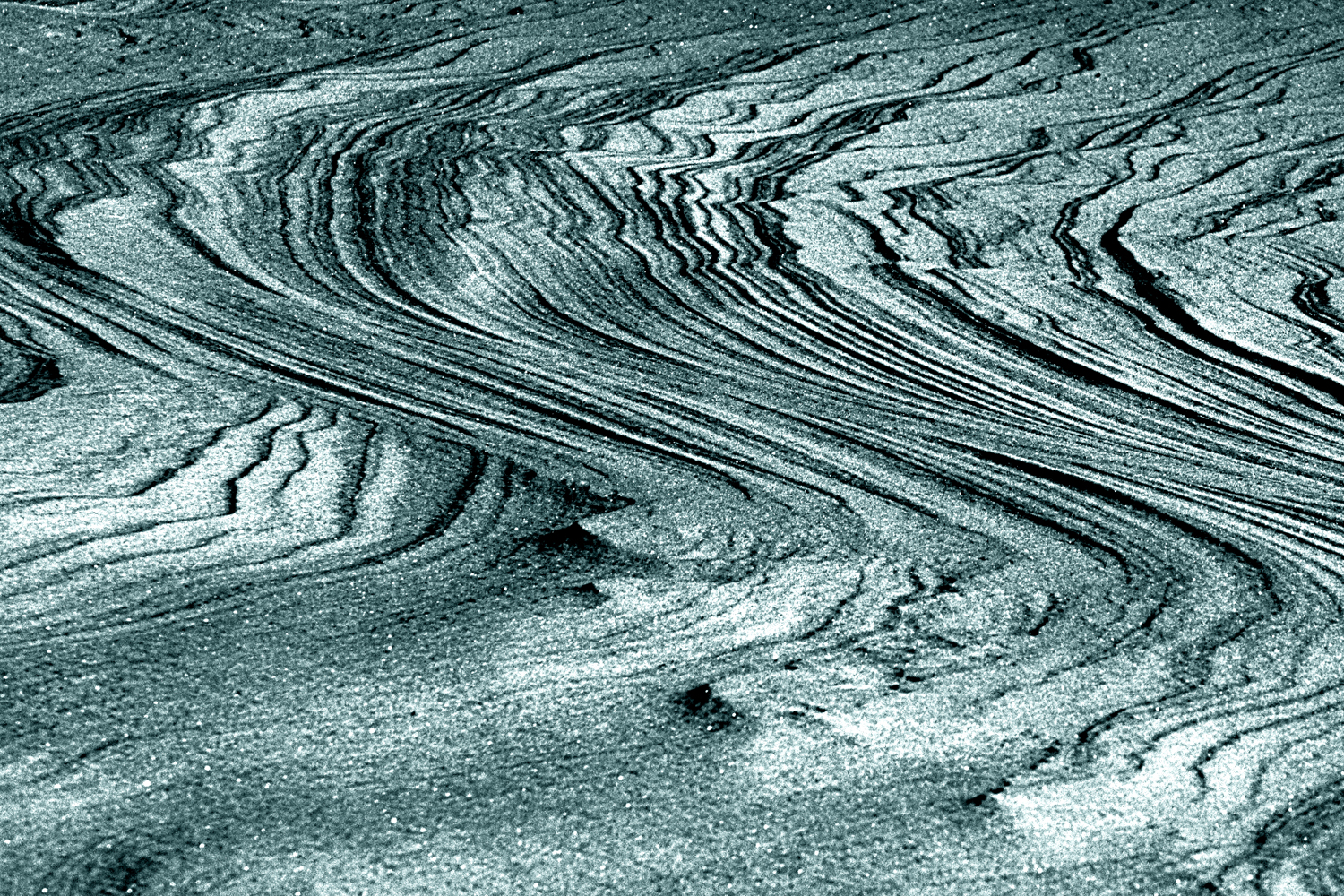
Another, wind effect are the beautiful undulating waves seen in Figure 3.  Again a cold blue/green tone seemed most appropriate.  The image required a lot of cropping.  The effect seems to me very abstract and mysterious.  Snow would not be what first comes to my mind if asked what I am looking at.  It might as easily be sand or even the surface of a quart of iced cream.

A serious case of Ansel Adams envy

Our discussion of large format analogue photography vs. digital photography had led me to muse about the clinical pathology that may be referred to as “Ansel Adams envy.”  All photographers suffer from this to some extent.  And I suspect that this includes practitioners of large format photography.

When I first encountered the photographs of Adams, I was amazed, envied, their wonderful sharpness – the fineness of the detail.  This, of course, was the unobtainable ideal, unless I was prepared to purchase and lug an 8″ x 10″ or larger view camera around the Sierras.  The Sierras part is required and, as I was a New Yorker then and didn’t drive, seriously outside my reach.  What to do about that?

Well the answer is not much.  The sharpness of film is on the order of 50 to 10 lp/mm and the best lenses 100 to 200 lp/mm.  But an 8″ x 10″ contact print is going to be five or six times sharper than an enlargement from a 35 mm camera.  It’s simple physics and geometry.

Then I started to realize that while sharpness was one factor, the other was dynamic range as well as the artistry that Adams used as a master print maker.  So I studied all of Adams’ books on photography, learning as much as I could about the zone system  The problem then was two fold.  First, 35 mm photography does not easily lend itself to the kind of one off negative development that the zone system requires.  Second, it was all very costly.  Photographic chemicals and paper were quite expensive and the arduous, albeit quite worthwhile, experimenting that is required of fine analogue printing burned through a lot of photographic paper and chemicals.  Some of my best work in this analogue world still hang on my walls, and I continue to love them.

Being environmentally aware, and who isn’t who secretively believes that he should be wandering around the Sierra’s in quest of natures beauty, I was starting to get concerned about the ill effects of my darkroom materials.  I was toning with selenium, leaving me with both that and nasty silver waste to deal with and I was using massive amounts of water to achieve the ideal “archival quality.”

It is in this regard that digital photography has been liberating for me.  Using raw 14 to 16 bit file format and good metering the zone system can be applied frame by frame.   ISO can also be changed frame by frame.  You can even switch between color and black and white frame by frame.  You start off with a linear look up table and then can mimic the response of any film, real or imagined that you like.  You can dodge and burn at a level of detail that would be maddening in analogue photography.

So I am free at last to be Ansel Adams.  One problem remains.  Only Ansel Adams was Ansel Adams and he was a photographic genius!


Richard III revealed

I am a great lover of Shakespeare.  So I was delighted last Monday to learn that University of Leicester archaeologists had announced definitive DNA evidence that a skeleton found under a parking lot several months ago was  that of the last Plantagenet King of England Richard III. This was a wonderful tour de force based on DNA analysis of the skeleton’s mitochrondial DNA with that of both Michael Ibsen and an anonymous individual, modern-day maternal descendents of Richard III. Richard IIII is, of course,  Mitochronial DNA is inherited solely from one’s mother and passed on unchanged through the maternal line

Richard III is Shakepeare’s great villain in a play by that name.  He was evil incarnate, according to Shakespeare.  Some revisionist thinkers however, question this and point out that the Tudor claim to the throne depended upon the legitimacy of the reign of King Henry VII, who defeated Richard at the Battle of Bosworth Field in 1485.  So it was, perhaps, a spin job.

But there I was studying a photograph of Richard’s skeleton, complete with scoliosis of the spine and lethal hole in his skull.  Who would ever expect to see such a photograph?  And if that wasn’t enough, on Tuesday I was greeted by a facial reconstruction, which truly brought the five hundred year old king to life.

These two photographs have returned us for a brief instance to the fifteenth century.  So, as I contemplated Richard’s face and the painful deformity of his back, the words of Shakespeare came back to me:

But I, that am not shaped for sportive tricks,
Nor made to court an amorous looking-glass;
I, that am rudely stamp’d, and want love’s majesty
To strut before a wanton ambling nymph;
I, that am curtail’d of this fair proportion,
Cheated of feature by dissembling nature,
Deformed, unfinish’d, sent before my time
Into this breathing world, scarce half made up,
And that so lamely and unfashionable
That dogs bark at me as I halt by them*;

 * to hear Sir Laurence Olivier perform (in 1955) this marvelous soliloquy click on this link.


.

The Blizzard of 2013

WatchinSnowflakes

Blizzard of 2013 – Watchin’ the snowflakes
(c) DEWolf 2013

As you may have heard, the Boston area has been hit by an official blizzard.  We’ve had 24 inches of snow and it is continuing to pile up.  Driving is banned throughout the state and Boston’s MBTA, made famous by “Will he Ever Return, Charlie,” is shut down.  Basically there’s nothing to do but watch the snowflakes – which for some is very exciting!

Updates and Changes to Hati and Skoll Gallery Website

Over the last week I have been updating the Hati and Skoll website for 2013.  You will find many new photographs in the galleries.  I have also added a New Gallery of photographs taken with my IPhone.

I’d also like to take a moment and thank all of you for your continued interest in the gallery, the blog, and photography.  Readership is growing rapidly via subscription, Facebook, RSS feed and people who just regularly stop by.  I love everyone’s comments and value your thoughts; so please keep commenting.

I hope that you enjoy the new pictures and continue to read and like the blog.

David

At the Mall with my IPhone

Mall5

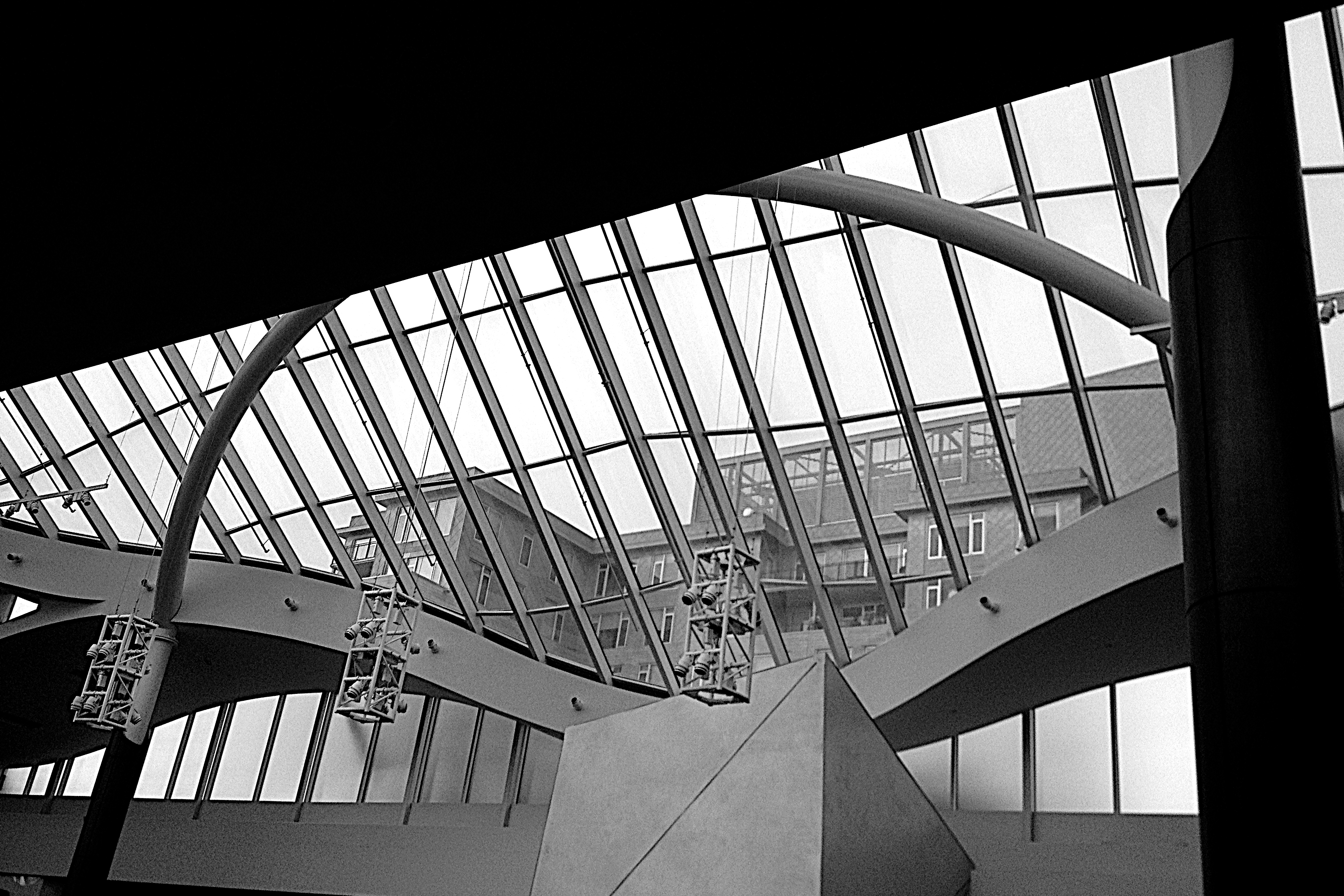
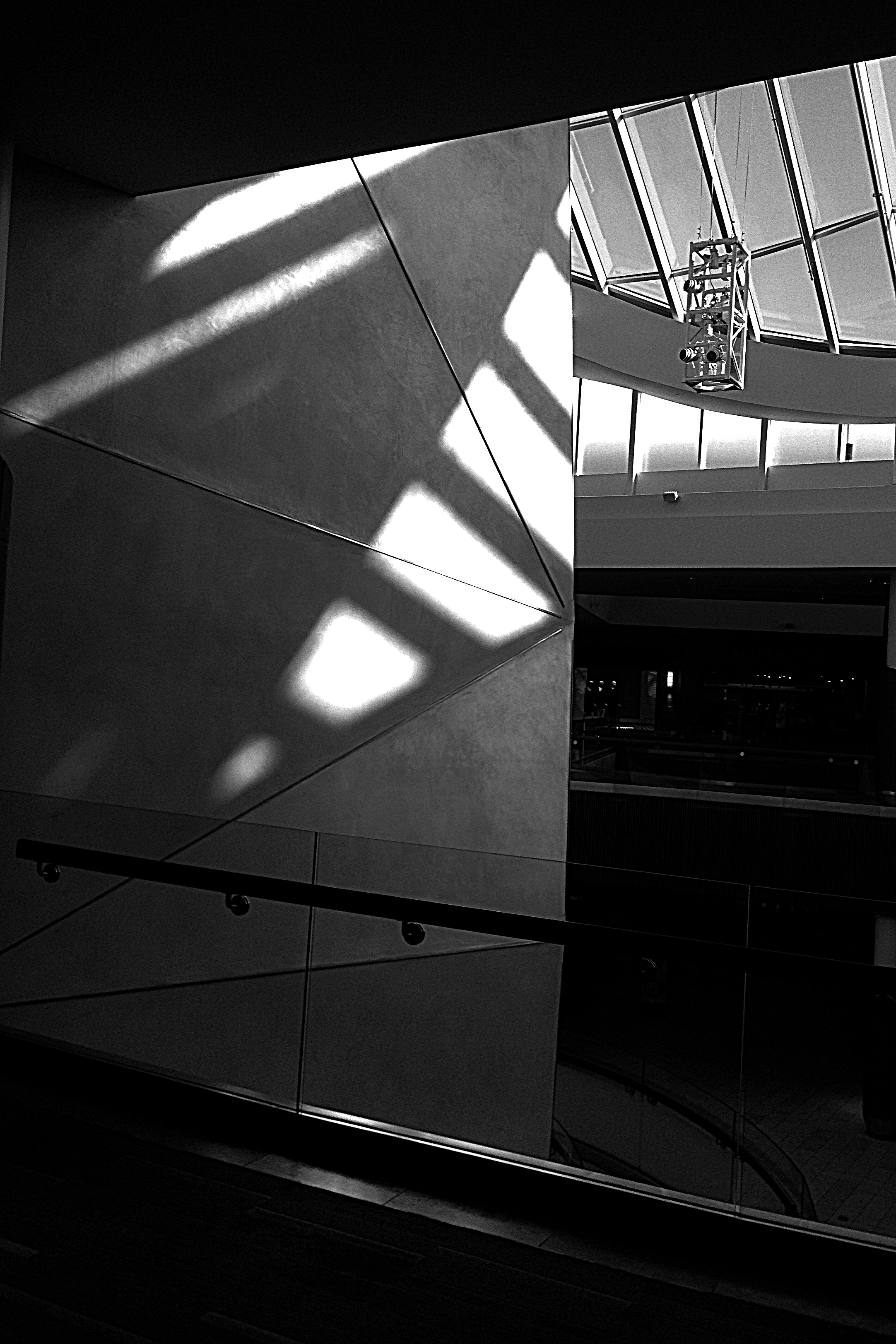
Figure 1 – “Roof of the Natick Collection,” (c) D E Wolf 2013

Mall6

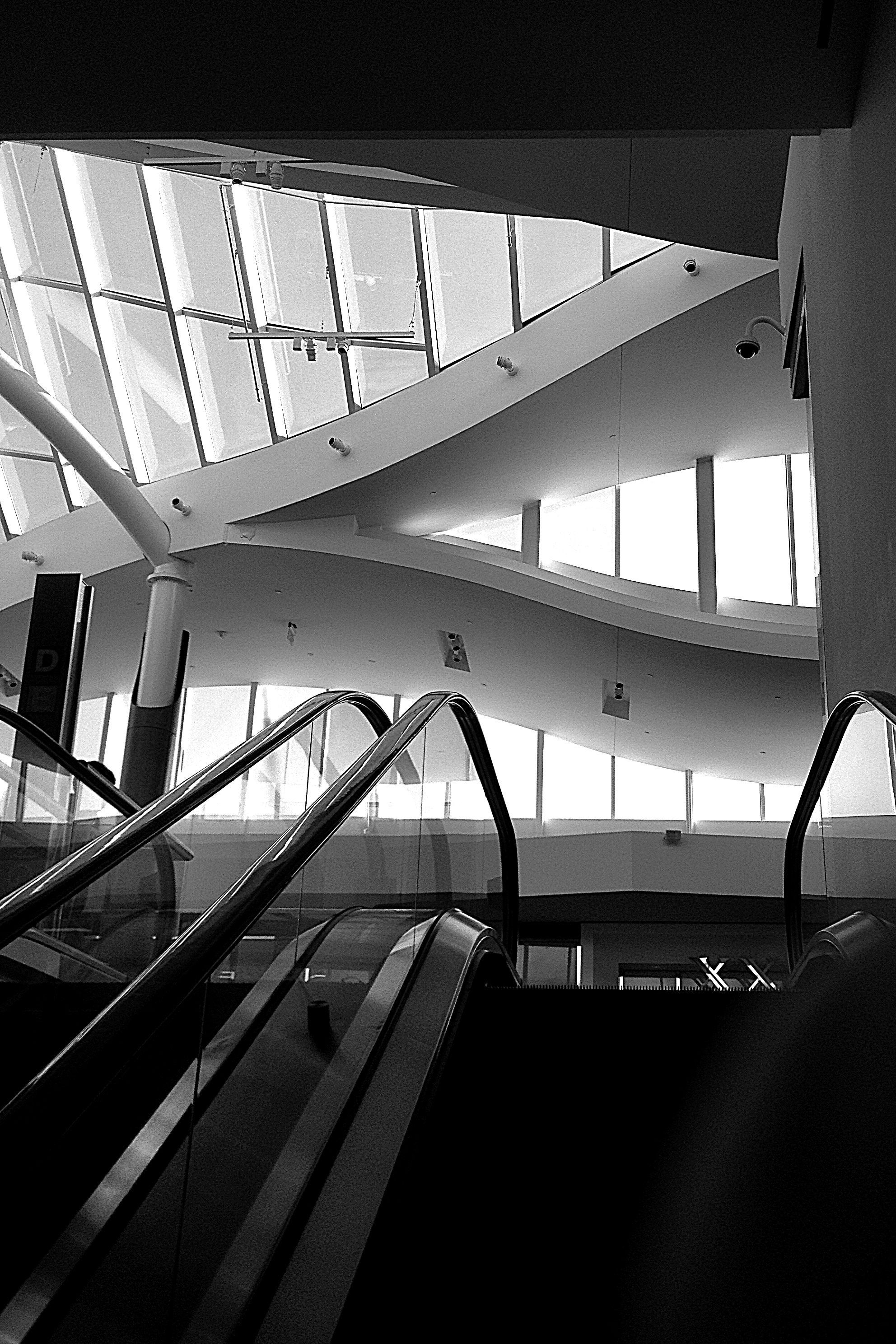
Figure 2 – “Up escalator the Natick Collection,” (c) D E Wolf 2013

OK, so it’s January in New England.  I’m supposed to be out in the snow taking photographs.  But the truth is that it is so much warmer in the Mall – our local Mall, “The Natick Collection.”

So on a lazy January day I decided upon an experiment.  I would take my IPhone 4S with me to the mall and I would take some pictures.  In this case I decided to apply three rules to myself.  First, the goal was geometrics.  Second, only black and whites were allowed. And third, only geometrics would be allow.  That is no people.

Mall2

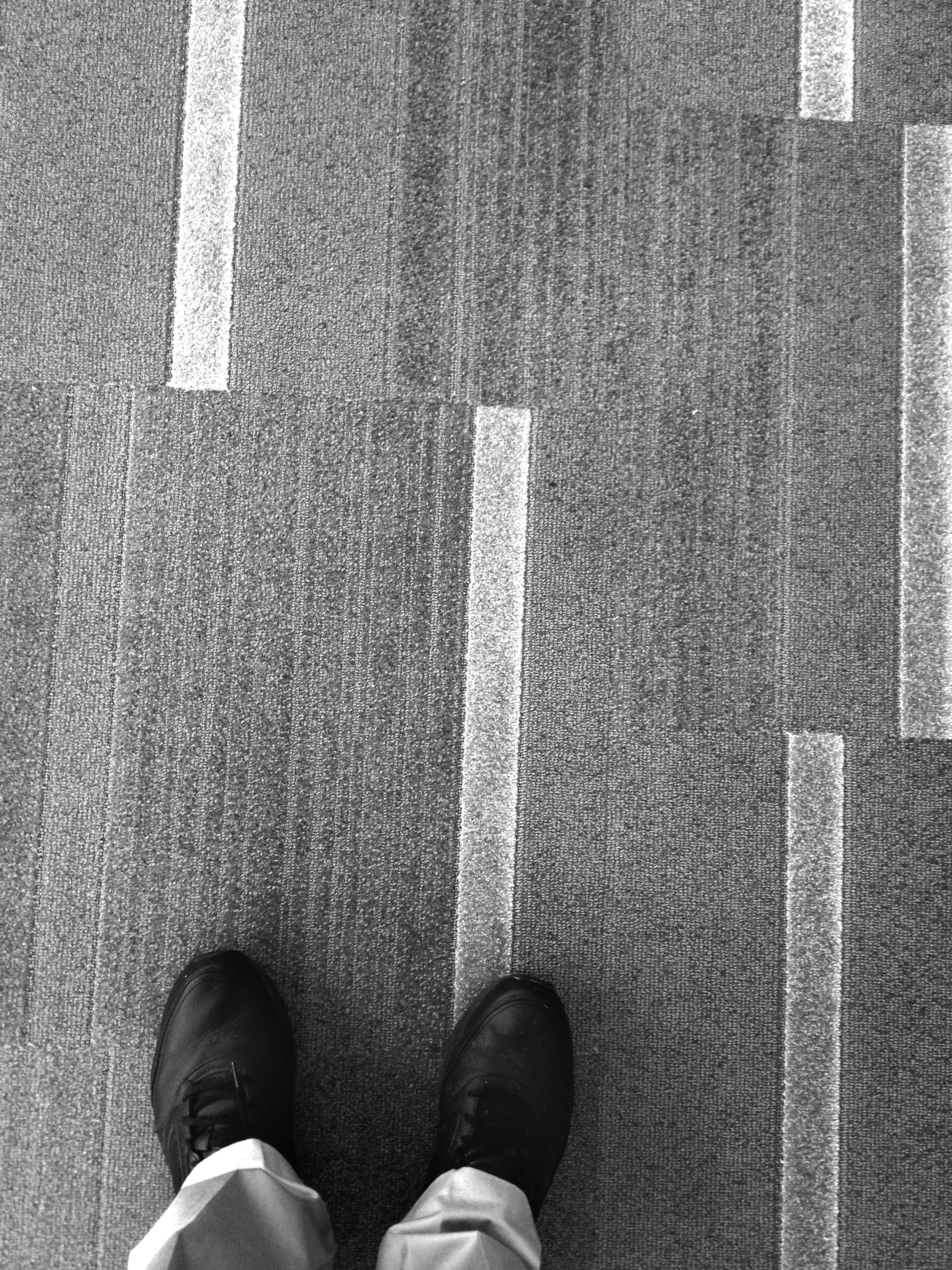
Figure 3 – Feet don’t fail me now! (c) D E Wolf 2013

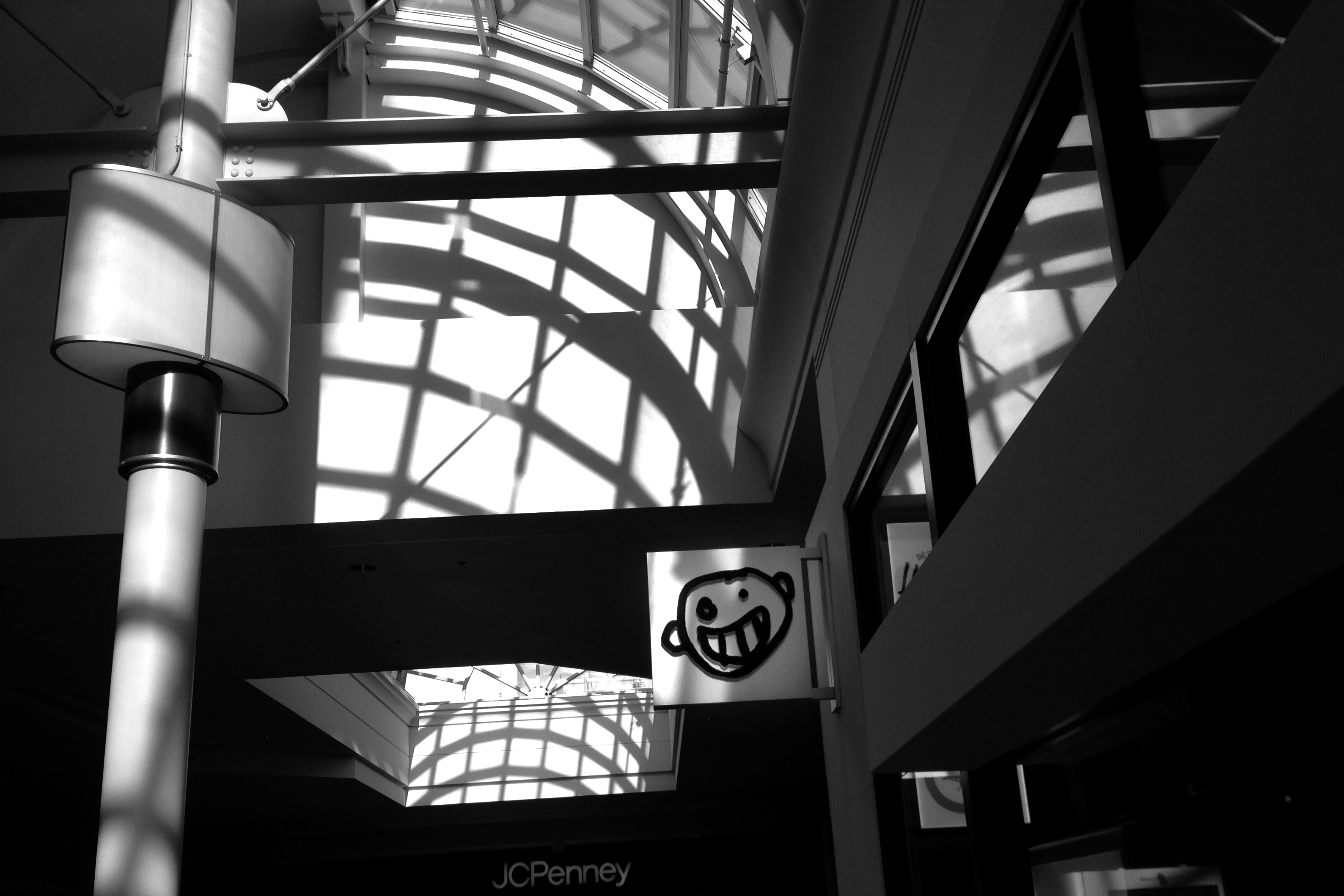
The Natick Collection has this kind of imitation Frank Gehry design.  Outside they cheat and do it with an artificial wavelike facade.  It looks kind of like a boat and there are big sweeping lines inside and out.  As a result, inside the mall there is a cool framework, and this framework in turn casts some very interesting shadows.  These shadows create there own complementary geometric patterns.  The roof is made of glass.  It looks a bit like a greenhouse and on a good day the light streams in spectacularly.

So I headed up the escalator into the light.  I planted my feet on the soft upstairs carpeting and contemplated the path conveniently laid in rectangles before me.  I have a bit of difficulty in framing the image on my IPhone in what is, to me, an awkward position – not to mention that it’s a bit hard to see while you’re framing.

Mall3

Figure 4 – “Shadows the Natick Collection,” (c) D E Wolf 2013

In the end, my trip to the mall fits well to the description of being a “personal photographic wandering.” I think that confining oneself to using a cell phone camera was a very valuable exercise.  It let’s you focus on the photograph.  I was going to add “and not your equipment,” but you always have to know and understand your equipment and what it can do.

But as I walked around the mall contemplating storefronts and sushi bars, I remembered Ansel Adams’ burro named Miseltoe. Misletoe accompanied Adams on his first long trip into Sierras in 1920, when Adams was just eighteen. Mistletoe, carried almost a hundred pounds of gear and food, Adams a thirty-pound pack full of photographic equipment.

Mall4

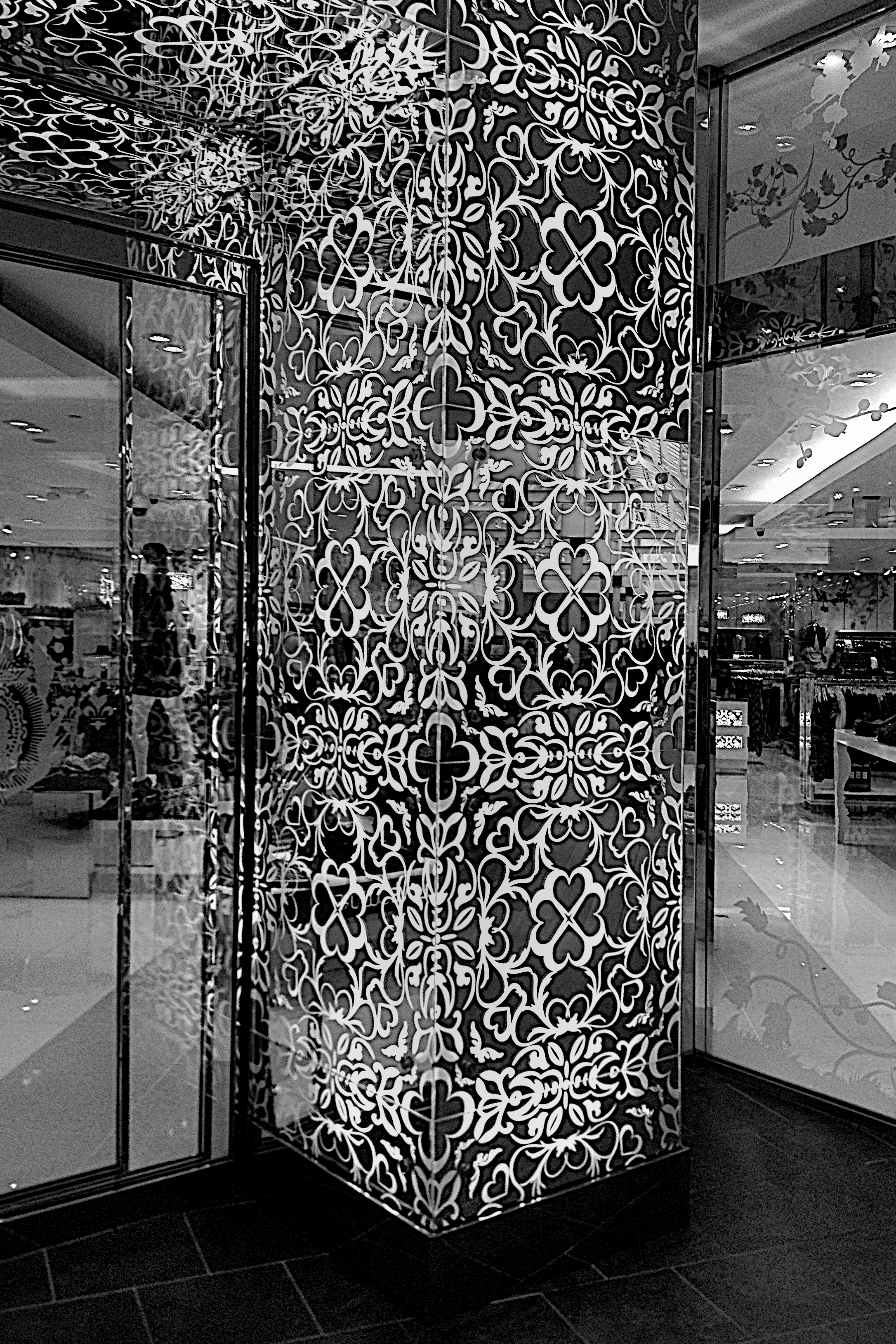
Figure 5 – “Glass Column the Natick Collection,” (c) D E Wolf 2013


Mall1
Figure 6 – “Newbury Comics the Natick Collection,” (c) D E Wolf 2013

Genealogical imagery and the quest for the familiar

I’ve gotten a lot of kind and positive response to my post about my grandmother’s portrait, and it got me thinking about the special appeal of old family photographs.  We have discussed the magical quality of nineteenth century photographs of people, about how these people seem to call out and connect with us across the vastness of time.  Their anonymity is part of their appeal.  We are almost voyeurs observing long forgotten lives. In the case of family photographs it is almost as if the opposite is true.  We are looking for something familiar, something of ourselves that creates a special bond of connection.

I remember once going to a good friend’s mother’s house and there on the wall was a nineteenth century picture of what appeared to be his teenage daughter.  To me his daughter looked like her great-great grandmother – so strong was the family resemblance. That is the great power of our genes and therein lies the appeal of family pictures.  They create a sense of personal connection and at the same time flesh out the ancestor almost as if they were remade.

The picture that I posted of my grandmother used to hang in my grandmother’s living room and next to it was a picture of my infant father on a bearskin rug from around 1918.  I remember looking at them, whenever I visited my grandmother’s house. These hang again together in my study now.  They are loaded with memories for me.  Right now I am thinking about how sunny her 12th floor Bronx, NY apartment was, how she had a green thumb, which she was sure was because she spoke and sung to her plants.

And I suppose that there is a distinction between pictures of family that you once knew and family you never knew.  In the latter case you can only imagine.  And what you imagine is that the genes run deeper than any superficial physical likeness.  You imagine that personality traits and feelings were also the same.  Do you laugh like your parents, and they like theirs? Just as you may be like your mother or father, who in turn was like their mother or father, all of these people shared something of personality, with you – each in the context of his or her own time*.

There’s a lot of imagining going on, a lot of projection of self, and quite suddenly we see once more the true magic of photography.  It projects a filtered reality through time and space.  It makes us wonder about what makes us fundamentally human.

* I’d like to remind readers of my post of October 30 about Rafael  Goldchain “I am My Family.