Snowflake Bentley

Snowflake_Bentley

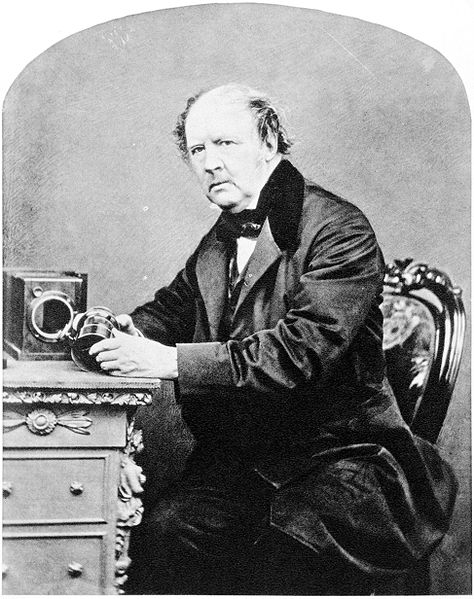
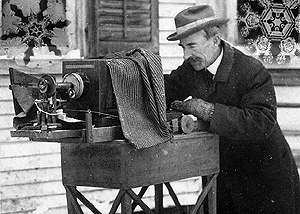
William A. Bentley with his snowflake camera from the Wikicommons original source http://www.flickr.com
/photos/mobyd
/2908371931/
and in the public domain.

We cannot discuss the origins of photomicroscopy without mentioning the work of William A. Bentley (aka the Snowflake man)(1865-1831). Bentley was a self-taught Vermont farmer.  At age fifteen Bentley developed an interest in snowflakes. He learned to capture them beneath the lens of a microscope and tried to draw them in all their beautiful and unique detail. But he found that they melted before he could complete a drawing. If you think about it these are the most ephemeral of objects. Photomicrosopy was the obvious solution, but it still took Bentley two years to develop a camera and methodology.
Bentley_Snowflake5

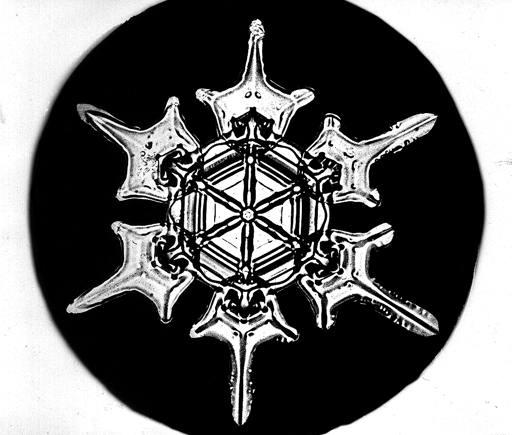
Figure 2 – one of William A. Bentley’s snowflake photographs from http://snowflakebentley
.com/
snowflakes.htm and in the public domain

Today, of course, we recognize that this is an example of macrophotography.  With a 35 mm camera we would want to “blow up” the snowflake two or three times.  For a view camera this is more extreme, and that makes the required exposure somewhat demanding.  But for Bentley, it was all worth the effort.

Today, we learn as children that no two snowflakes are alike.  It was William A. Bentley, who made that discovery.  Today, as physicists, we are taught that this random uniqueness is characteristic of what we call fractal processes.  We should never dismiss the fundamental beauty of nature – even in its most fleeting processes.  Bentley recognized this important point.  He wrote profoundly in 1925:

“Under the microscope, I found that snowflakes were miracles of beauty; and it  seemed a shame that this beauty should not be seen and appreciated by others.  Every crystal was a masterpiece of design and no one design was ever repeated.  When a snowflake melted, that design was forever lost. Just that much beauty was gone, without leaving any record behind.”

Bentley died in 1931 after contracting pneumonia in a blizzard.  But this was not before he left us a very rich legacy of some of the finest and most emotion filled photomicrographs ever created see Figure 2).
 

Photographic firsts #6 – the first microphotograph, John Benjamin Dancer and the invention of microfilm

Dancer the Scientist in his Laboratory

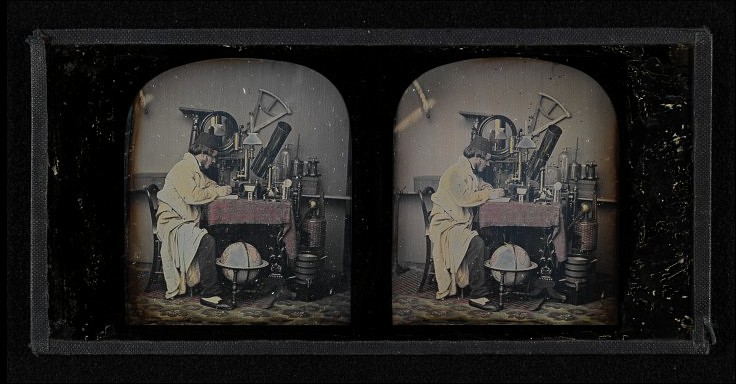
Figure 1 – John Benjamin Dancer daguerreotype stereo pair, “The Scientist in his Laboratory, 1851.” The image shows a sitter as “the scientist” creating a daguerreotype and surrounded by Dancer’s instruments and inventions. The image is in the collection of the Victoria and Albert Museum and is in the public domain.

One of the things that you can do with a microscope is project the image of something very tiny onto a wall.  That is, you can blow it up or greatly magnify it.  The only functional limit to this seems to be the amount of light that you have.  How big can you make the image before it gets too faint to see?

If you think about it, you can actually use the same microscope to reverse the process.  You might look at a scene, say a cathedral or a painting, and use the microscope to make a very true but tiny image of the scene.  Physicists have a very cool name for this.  They say that the “laws of physics are reversible in time.”  Wow! Did I say time reversal?

Now suppose I put a photograph film or digital detector in the microscope.  Then if I exposed the film with light from the scene and subsequently developed it, I would have a very tiny image of the scene.  Such was the innovation and popularization of John Benjamin Dancer (1812-1887).  Dancer ran a microscope manufacturing company and also sold microscope slides that contained these wonderful early microfiche.   Several examples can be seen on the web at the site of the Whipple Museum of the History of Science in Cambridge UK.:

Photographic firsts #5 – the first photomicrograph

FoxTalbot-First-Photomicrograph

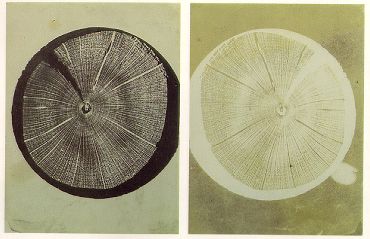
Figure 1 – the first photomicrograph a transverse section of a stem taken by William Henry Fox Talbot in 1839 from the Masters of Photography website ( and in the public domain).

Let’s turn today to the question of who took the first successful photomicrograph.  We need to be precise about definition.  A photomicrograph is a photograph of something small under a microscope.  This is as opposed to a microphotograph, which is a very small photograph that might require a microscope to see it, but could, in fact, be an image of something very large.

William_Henry_Fox_Talbot,_by_John_Moffat,_1864

Figure 2 – William Henry Fox Talbot by John Moffat, 1864 from the Wikimedia commons, Michael Maggs source and in the public domain.

It is interesting that this story connects with Charles Darwin.  Charles Darwin and his wife Emma nee Wedgewood were first cousins.  They shared a grandfather, Josiah Wedgewood, I (1730-1795) and an uncle Thomas Wedgewood (1771-1805), who was an early experimenter in photography.  The interrelationships in this very important English scientist and intellectual family are very complex, but you may sort it all out from the Darwin-Wedgewood family tree.  Of course, the name Wedgewood is familiar to us from their very distinctive fine china, and it is indeed the case that Wedgewood Porcelain was founded by Josiah Wedgewood, I and subsequently led by Josiah Wedgewood, II, Emma’s father.

In 1802, uncle Thomas published  “An Account of a method of copying Paintings
upon Glass, and of making Profiles, by the agency of Light upon Nitrate of Silver” in
the Journals of the Royal Institution, it states:
“In following these processes, I have found that the image of small objects, produced by means of the solar microscope, may be copied without difficulty on prepared paper. This will probably be a useful application of the method; that it may be employed successfully, however, it is necessary that he paper be placed at but a small distance from the lens.”

Now, we have no evidence that Thomas Wedgewood ever succeeded in capturing a photomicrograph.  There is however, some evidence that he and Sir Humphry Davy (1778 – 1829) did attempt to do so.

A solar microscope, by the way, is simply a microscope that uses the sun as a source of light.  This is usually accomplished by means of a mirror that reflects the sunlight from outside a window into the microscope.

The first known photomicrograph, and therefore the credit of being the inventor of photomicroscopy goes to the inventor of photography William Henry Fox Talbot (1800-1877).  This is shown in Figure 1 – a photomicrograph of a botanical transverse section of a stem, 1839. A photograph of Fox Talbot taken by John Moffat in 1864 is shown in Figure 2.

As natural history came more and more into intellectual vogue in the nineteenth century the act of looking through a microscope became more and more familiar.  You would expect to see a circular image surrounded by black.  As a result, the framing of Fox Talbot’s photomicrograph by a circular field of view has as much to do with viewer expectation as it does with how the picture was optically taken.

* Here is an excellent link to the history of photomicroscopy.

Aerial view of the Great San Francisco earthquake 1906

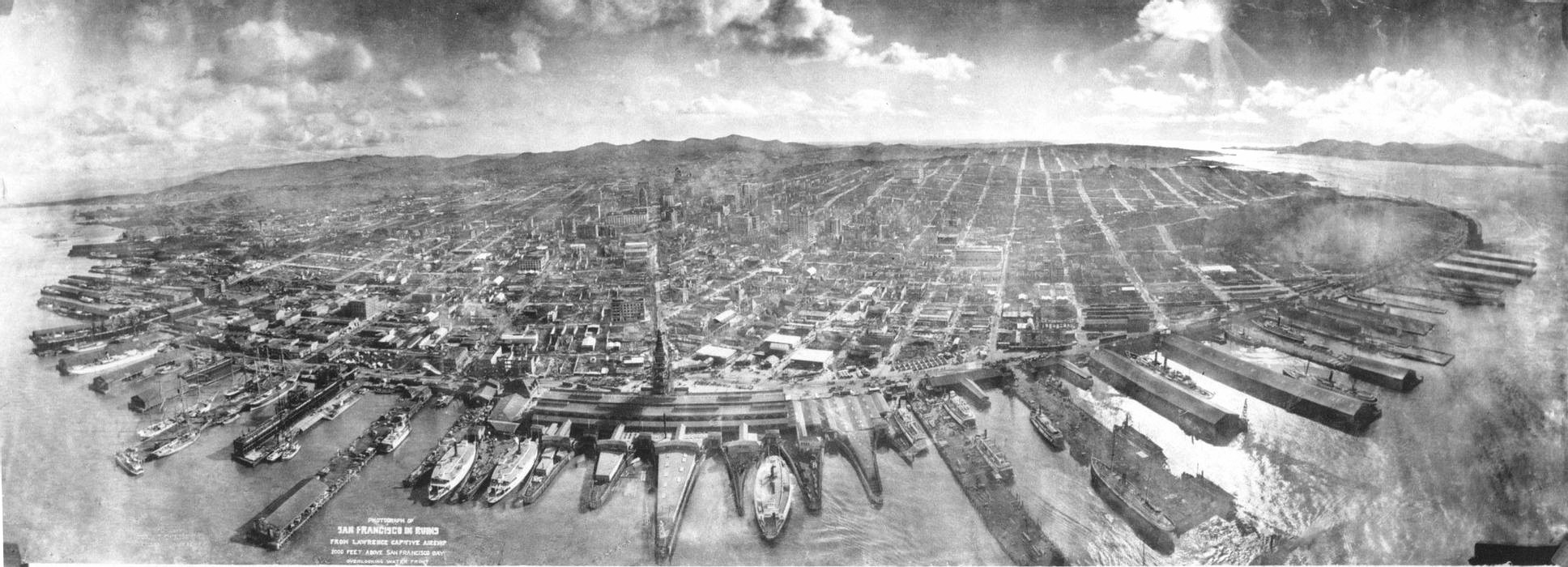
1906_EarthquakeOn the subject of early aerial photography, we should also take a look and marvel at George Lawrence’s panoramic view of the devastation that followed the great San Francisco earthquake of 1906.  No hot air balloon used here!  Lawrence used a string of Conyne kites to lift his handmade 49-pound camera panoramic camera 1,000 feet .

Today, needless-to-say there’s a website devoted to teaching you how to take aerial digital photographs from a kite.  If you are going to try this I suggest that you remember George Lawrence and his 49 lb camera and also Benjamin Franklin and his kite experiments,

Oscar Gustave Rejlander (1813-1875) – Darwin’s Photographer

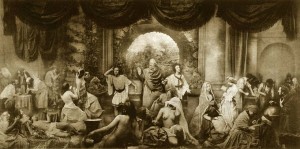
The Two Ways of Life

Figure 1 – Oscar Gustave Rejlander, “The Two Ways of Life, 1857” from the Royal Photographic Societ, Bath, UK, and in the public domain.

Oscar Gustave Rejlander (1813-1875) was born in Sweden and first made his name as a painter, lithographer, and copiest (of classical paintings).  Therein lie his roots in classical pictoralism.  There are conflicting accounts of what caused him to turn towards photography.  One story has it that it resulted from a visit to the great Crystal Exhibition of 1851 in London, another that he was converted when he saw how well a photograph captured the fold of a sleeve, and a final account has him inspired by one of Fox Talbot‘s assistants.

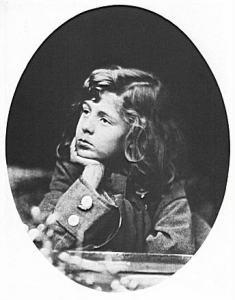
YoungHallamTennyson

Figure 2 – Oscar Gustave Rejlander, “Portrait of Hallam Tennyson, the son of Alfred Lord Tennyson,1863,” in the public domain.

Around 1846 he set himself up as a portraitist in the industrial Midlands town of Wolverhampton, and in 1850 he learned the wet-collodion and waxed-paper processes from Nicholas Henneman in London.  He set up a photostudio and supported himself with genre work and commissioned portraiture (see Figure 2).

JohntheBaptistsHead

Figure 3 – Oscar Rejlander, “The head of Saint John the Baptist, 1850.” in the public domain.

It was while experimenting with the issue of depth of field in portraiture that Rjlander developed combination printing – the use of multiple negatives to create a photomontage.  Today in Adobe Photoshop this is straight forward. A hundred and fifty years ago in the days of analogue photography, this was difficult and pioneering.  An example of this work is shown in Figure 1 above from his allegorical study “The Two Ways of Life.”  The same figures are shown on the two sides of the image, depicting right the way of virtue and left the way of sin.  The work was view as scandalous by many of his contemporaries.  But the perceived ‘indecency’ faded when Queen Victoria bought a copy for 10-guineas as a gift for Prince Albert.

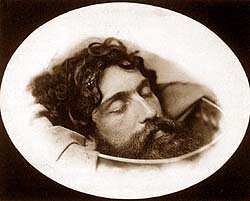
To our century the portraits, particularly those of children still bring a smile and retain a special loveliness.  The religious allegories are no longer in vogue.  However, we can still very much appreciate the creativity in producing something as convincing as his work, “The Head of Saint John the Baptist, 1850.”  This image is so reminiscent of classic works by Titian and Caravaggio.

The was a controversial and darker side to Rejlander.   He also created erotic work using circus girls, street children and child prostitutes.  He created images referred to as “The Charlotte Baker series.”  The most notable of these is “Mother’s Clothes,” which depicts a nude teenage girl trying on her mothers clothing.  It tests even our modern sensibilities and reminds us of sinister images of children taken by Charles Dodgson (aka Lewis Carroll), a colleague and friend of Rejlander’s.

As previously discussed, near the end of Rejlander’s life he was approached by Charles Darwin to do the photographs for “The Expression of Emotions in Man and Animals, 1872.”  He added a special humor and artistic quality to this early example of photographic illustration of scientific books.

* In addition to the sites hyperlinked, background for this blog was obtained from the ever useful and magnificently produced “The Golden Age of British Photography, 1839-1900.”


The Expression of Emotions in Man and Animals – a photographic and scientific milestone

Title-Page

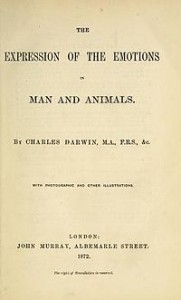
Figure 1 – The title page of Charles Darwin’s “The Expression of Emotions in Man and Animals.” From the Open Library and in the public domain.

Today I’d like to talk about a book – Charles Darwin’s “The Expression of Emotions in Man and Animals.”  Paul Johnson has suggested, and I believe rightly so, that Darwin’s magnum opus on the Theory of Evolution really consists of three major works: “The Origin of Species (1859),” “The Descent of Man (1871),” and “The Expression… (1872).”  In “The Expression…,” Darwin seeks to trace the animal origins of human facial expressions such as: the pursing of the lips in concentration and the tightening of the muscles around the eyes in anger and efforts of memory.

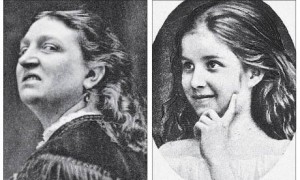
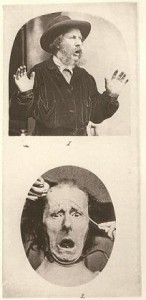
In composing the book, Darwin circulated a questionnaire to scientist around the world so as to gather data to test the universality of emotional expression in different ethnic groups.  Other sources (see Figure 2) were photographs of babies, children, and actors, and also descriptions of the behaviour of  psychiatric patients at the West Riding Lunatic Asylum at Wakefield in West Yorkshire. This kind of thorough attention to detail was characteristic of Charles Darwin, characteristic in fact, of much of Victorian Science, and is one of the reasons that, even today, he is so compelling in his arguments. Darwin also performed experiments involving electrical stimulation of the facial muscles to induce expression and elicit emotions (other than fear of electrocution) from his subjects (see Figure 3).

Hatred-and-love

Figure 2 – Images of hatred and love from Charles Darwin’s “The Expression of Emotions in Man and Animals,” in the public domain.

This book was published in 1872   and represents a cornerstone in the history of science (most particularly the then fledgling science of psychology) and photographic book illustration.  It was one of the first scientific books to use photographic illustrations.  Darwin saw this as imperative saying: “Several of the figures in these seven Heliotype Plates have been reproduced from photographs, instead of from the original negatives ; and they are in consequence somewhat indistinct. Nevertheless they are faithful copies, and are much superior for my purpose to any drawing, however carefully executed.

Facial-expressions

Figure 3 – Plate 2 from Charles Darwin’s “The Expression of Emotions in Man and Animals.” In the top image the photogrpher, Oscar Rejlander, using himself as subject. The bottom image shows and example of Darwin’s experiments on electrical stimulation of expression and emotion. In the public domain.

What exactly is a heliotype and why was Darwin concerned about its loss of sharpness?  A heliotype was a photomechanically produced plate for pictures in a book that was  made by exposing a gelatin film under a negative.  The film was then hardened with chrome alum, and the pages of the book printed directly from it.  What Darwin was interested in was a faithful and scientific rendering of the faces in the pictures and he was willing to suffer a little loss of sharpness to get the realism.

Darwin saw photography as a means to convey scientific observation, both accurately  and in detail.  Indeed, in a sense, the reader gets to observe for his/herself.  He set a new course and was followed by other luminaries, such as Eadweard James Muybridge (1830-1904) and his work on animal and human locomotion.

But beyond science, there is something wonderful and often humorous about the photographic illustrations of “The Expression…”  This immediately raises an important question.  Who was Darwin’s photographer.  The answer is Oscar Gustave Rejlander (1813-1875).  He is the man with the muttonchops in Figure 3.  Rejlander used himself as subject for many of the heliotypes in Darwin’s book.

Although a somewhat controversial figure in his day, he was one of the great British photographers and a master experimentalist with the new medium.  As in science, the Victorian era was a golden and innovative time in English photography.  Who was Oscar Gustave Rejlander?  That is the story I will tell in tomorrow’s blog.

André Kertész – La Fourchette, 1928

I was looking at a website today that was doing a series similar to my “Ten Favorite Photographs for 2012,” and I came across André Kertész , “La Fourchette, 1928” or in English, “The Fork.”  Please click on the hyperlink and have a look.  It was interesting to me because I had actually considered this for my 2012 list.  It is certainly, one of Kertész’s most famous works and as an abstraction pretty perfect and wonderful.  It defines all the right elements of a well composed and well executed black and white image.  There’s black and there’s white and there’s beautifully everything in between.  Then we see a well and interesting use of the “Golden Rule of Thirds.”  The objects are contrasted with their shadows, which in the case of the bowl forms a concentric circle.  The fork creates a marvelously strong diagonal line and presents a fantastically well done metallic sparkle.  The image is well designed and cries out “simplicity.”  And in a high resolution copy you can read the letter on the back of the fork.  The sharpness is intriguing.

I have read a bit of a “tongue and cheek” discussion of what it all means.  And I respect the expression, indeed I practice, the exploration of why the piece personally moves one.  But here ultimately it is like the old adage about over Freudian interpretation.  Sometimes a pencil is just a pencil, or in the present case a fork is a fork.

But something does bother me.  Something is incongruous.  And the problem is that the viewer, or a least this viewer, feels a bit like the chess master, who sees a board set up as a display and realizes viscerally and immediately that the position of the pieces could never have evolved.  What exactly is going on here?  Why is the fork teetering on the edge of the bowl?  Generally forks are associated with plates and spoons with bowls.  My mother would have insisted that the fork be placed tines up on the left hand side in anticipation of dinner.  And if dinner has already taken place then it would be rude to tangle one’s fork at the edge of the bowl, or so my mother taught me.  And finally, if dinner has already taken place, then why are both the fork and the bowl pristine and shining?  Puzzle me all of this!
So we are left, I believe, with two options either reject these incongruities and reject the picture, or accept them and conclude that they give the picture a sense of the dynamic a sense of motion.


The Lumière brothers – a bit more

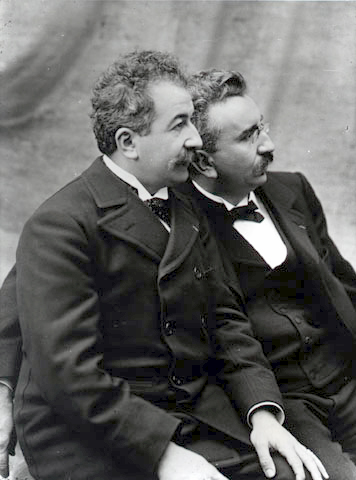
Fratelli_Lumiere

Figure 1 – the Lumiere brothers image form the Wikicommons and in the public domain

In my blog of January 10, I discussed the invention, in 1903, by Auguste Marie Louis Nicholas and Louis Jean Lumière  of the Autochrome process.  There is a bit more of significance to say about the Lumière brothers.  They were, in fact, the earliest film makers.  

Their father, Claude Antoine Lumière (1840-1911) ran a photography firm, producing principally the then dominant dry plates.  The two brothers entered the firm, Louis as a physicist, Auguste as a manager.  To give you an idea of the scale, the Lumière Factory was producing 15 million dry plates by 1894.

Antoine was invited to a demonstration of Edison’s Peephole Kinetoscope in Paris. He returned excited and presented Louis with  a piece of Kinetoscope film and the challenge to make it cheaper.

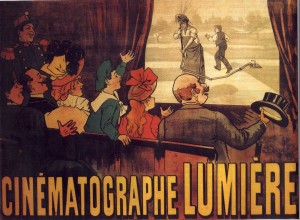
This led to several major patents including: the patent for the use of perforations in the film and the patent for the Cinématographe.  The Cinématographe was smaller than Edison’s Kinetoscope and was capable of recording, developing, and projecting the film – an all-in-one device.  Significantly, Louis’ device operated like a sewing machine on the principle of intermittent motion.

Cinématographe_Lumière

Figure 2 – advertisement for Cinematographie Lumiere by Marcellin Auzolle (1862-1942) Image from the Wikicommons and in the public domain in the United States


The first public screening of La Sortie de usines Lumière (Workers leaving the Lumière Factory) (click on link to see the movie and other of their short films for yourself) was presented on 22nd March 1895 at 44 Rue de Rennes in Paris.  This and their other short films were standardized to 17 m of film and was ~46 seconds long.

There are several individuals who have been credited with the invention of cinema.  Without a doubt however, the Lumière brothers played a very significant role both in the invention and popularization of both color photography and the movies.

* Two principal sources were consulted in writing this and I recommend them for further reading: the Early Cinema Website and Wikipedia.

The appeal of Autochromes

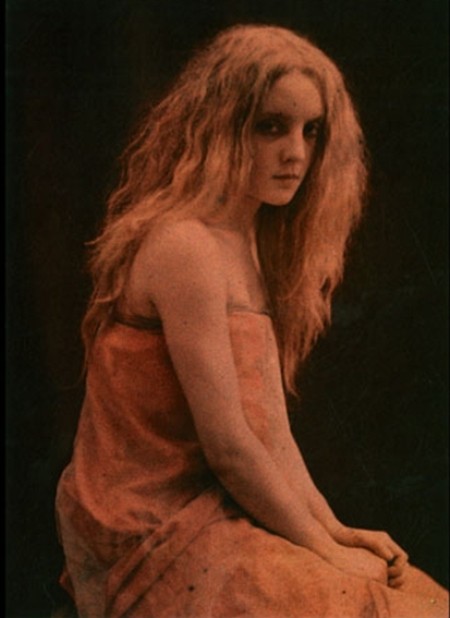
Andre Hachette 1907

Figure 1 – Sarah Lievine by Andre Hachette, Autochrome c1907, from http://blessedwildapplegirl.tumblr.com/post/18202226926/maudelynn-sarah-lievintese-by-andre-hachette and in the public domain in the United States

In researching yesterday’s blog about Autochromes, I found myself exploring many of these wonderful images and trying to understand their artistic appeal.  I think that the image above by French collector and photographer Andre Hachette, an Autochrome of Sarah Lievine, taken around 1907 pretty much says it all.

I think that we subconsciously feel that pictures from the early twentieth century should be in black and white – that those three decades 1900 – 1930 were black and white.  I have a large photographic portrait of my paternal grandmother.  It is black and white and fits the mold.  She is every bit as beautiful as young Sarah, but she remains temporally distant from us because of the  black and white.

Sarah seems alive – as if we could reach out and touch her.  Because of the color, Sarah seems our contemporary, and we wonder if we aren’t looking at cast photographs from Downton Abbey, as opposed to actual inhabitants of the Edwardian age.

It is again the magic of photography that brings these ghosts of the past back to life.  You will remember how in the movie “The Wizard of Oz,” the black and white film suddenly becomes color when the scene opens in Oz, and Dorothy remarks to her dog, “I don’t think we’re in Kansas anymore, Toto!”  The Autochrome Process ushered in something very new and magical, something now commonplace – namely color photography with its magical spectral dimension.  I don’t think we’re in the nineteenth century anymore.