Judy Dater, “Imogen and Twinka, Yosemite,1974,” Favorite Photographs for 2012, #5

Judy Dater, Imogen and Twinka, Yosemite, 1974

We have already explored several concepts or uses of the nude in photography and here is yet another one.  It is a study in contrasts, indeed a very touching one, taken by photographer, feminist, and biographer Judy Dater (1941-).  American photography pioneer Imogen Cunnigham (1883-1976) was teaching a workshop in how to work with the nude in Yosemite Valley in 1974, when Ms. Dater captured this beautiful image of an aged Cunningham and model Twinka Thiebaud (1945-).  Cunnnigham assumes an abstracted pedagogical pose observing the model, while Twinka stares back coyly.  The image is a study in contrasts as the two women, diametrically opposed look at each other across the tree:

  • young vs. old
  • dressed vs. undressed
  • working vs. playful

Interestingly both women are beautiful in their own ways: Twinka in her youth and Cunningham in her age.  We must recall Cunningham’s wonderful book and portfolio “After Ninety,” which highlights the beauty that comes with age.  I highly recommend this portfolio as well as Dater’s Cunningham photo-biography “Imogen Cunningham, a Portrait.”


Annie Leibovitz, “Portrait of Keith Haring, 1987,” Favorite photographs for 2012 #4

Annie Leibovitz, “Portrait of Keith Haring, 1987

We Have already spoken about Annie Liebovitz in the context of her Pilgrimage, now on  national tour, where she touches on our collective past, .  Also of note is her touching book and portfolio, A Photographer’s Life 1990-2005.  She is, of course, famous for her elaborate work for Vanity Fair and for her portraits.  Where to begin: Bette Midler in a Bathtub Filled with Roses or Meryl Streep Covered with White Makeup?

My personal favorite is “Portrait of Keith Haring, 1987.”  Haring (1958-1990) was a graffiti artist.  Leibovitz photographed him in his Greenwich Village studio: “The Pop Shop.”  He is depicted nude, but blending in, seemingly camouflaged, with his own art. I say seemingly, because, while he is physically camouflaged, Haring is, in fact, totally revealed artistically.  The man becomes his own art.  It is the ultimate paradox.  Artists are always their own art.  And, as always Leibovitz, is brilliant in both conception and execution.


Yousuf Karsh, “Audrey Hepburn, 1956” Favorite photographs for 2012, #3

Yousuf Karsh, Audrey Hepburn,1956

Today’s favorite photograph is by legendary Armenian-Canadian portrait photographer, Yousef Karsh (1908-2002).  Karsh’s output was monumental and he photographed many of the greats of the twentieth century.  More often than not, and without knowing it, these are the portraits that we remember.  Perhaps his most famous portrait was that of a scowling “Winston Church, 1941”  As Karsh himself related the story:

“My portrait of Winston Churchill changed my life. I knew after I had taken it that it was an important picture, but I could hardly have dreamed that it would become one of the most widely reproduced images in the history of photography. In 1941, Churchill visited first Washington and then Ottawa. The Prime Minister, Mackenzie King, invited me to be present. After the electrifying speech, I waited in the Speaker’s Chamber where, the evening before, I had set up my lights and camera. The Prime Minister, arm-in-arm with Churchill and followed by his entourage, started to lead him into the room. I switched on my floodlights; a surprised Churchill growled, “What’s this, what’s this?” No one had the courage to explain. I timorously stepped forward and said, “Sir, I hope I will be fortunate enough to make a portrait worthy of this historic occasion.” He glanced at me and demanded, “Why was I not told?” When his entourage began to laugh, this hardly helped matters for me. Churchill lit a fresh cigar, puffed at it with a mischievous air, and then magnanimously relented. “You may take one.” Churchill’s cigar was ever present. I held out an ashtray, but he would not dispose of it. I went back to my camera and made sure that everything was all right technically. I waited; he continued to chomp vigorously at his cigar. I waited. Then I stepped toward him and, without premeditation, but ever so respectfully, I said, “Forgive me, sir,” and plucked the cigar out of his mouth. By the time I got back to my camera, he looked so belligerent he could have devoured me. It was at that instant that I took the photograph.”

I was, needless-to-say, tempted to choose the Churchill portrait from among Karsh’s prodigious output, but then I came upon (really came upon once more) his beautiful image of actress “Audrey Hepburn (1929-1993).”  What more is there to say about the choice, she was, after all, breathtaking, as is the photograph.

Karsh was of Armenian descent, and those of you in the Boston area should take advantage of the fact that he donated his vast collection of his work to the Armenian Library and museum in Watertown.  It is definitely on my To-Do list!

Julia Margaret Cameron, “Portrait of Sir John Herschel with Cap,” Favorite Photographs for 2012, #2

Julia Margaret Cameron Portrait of Sir John Herschel with Cap, 1867

I absolutely love the photographs of Julia Margaret Cameron (1815-1879). So this was a tough call for me.  I kept going back and forth between this photograph and her “Annie, my first success, 1864.”  But in the end, the physicist in me won out.  Sir John Herschel ((1792-1871)) was a great British astronomer.   Here he is depicted as an old man.  He seems a wild man with his hair out of control beneath his cap.  It is the expression in the eyes that makes the image.  You know that those eyes have peered for many hours through telescopes discovering the wonders of the universe. The three quarter view is always an interesting one.  Sir Herschel looks to the side, not at the photographer, as if abstracted, his mind on something else.  Perhaps he ponders some problem in celestial mechanics.  We will never know.  I find it wonderful.

Cameron was one of the founders of photography.  There is a excellent book entitled “The Golden Age of British Photography 1839 – 1900,” in which she is described as a “Christian Pictoralist.”  This is very accurate, as illustrated both in her choice of subject matter: mother and child, little girls with pasted on angel wings, and posed allegory: and in the value she attached to her own works: “My mortal, yet divine! Art of photography.”

While many of these themes might not appeal to our twenty-first century sensibilities.  They accurately depict the religiosity of the nineteenth.  Julia Margaret Cameron was a photographic innovator, and the pensive, dreamy poses of her subjects still move us nearly a century and a half after she took them.


Edward Weston, “Nude in the dunes, 1930” Favorite Photographs for 2012 #1

Edward Weston, Nude in the Dunes, 1930

So to begin my list of favorite photographs for the end of 2012, I’d like to start with Edward Weston’s, “Nude in the Dunes, 1930.”  Please click the hyperlink above to see the image.  Weston was a master at photographing the nude.  So there are a number of wonderful nudes to consider when looking for a favorite.  In particular we have to consider the marvelous folded “Nude, 1936,” “Nude, 1936” is a classic example of beautiful and peaceful static abstraction.  What I like about “Nude in the dunes, 1930,” is that the nude is placed in the lower third of the image, following the very traditional “Golden Rule of Thirds.”  However, this placement and the sand dune above it gives the image a dynamic sense of motion.  You feel that the nude is slowly slipping out of the picture and you feel the need to push her back up towards the center.  This kind of “trick of the eye” is classic and is here used marvelously.

Weston’s goal in his nudes was to create a perfect sense of the abstract. For me there is always a sense of the sensuous in Weston’s imagery.  This flows from the nudes into his abstract images of shells and vegetables, see for instance “Two Shells, 1927” and, of course, “Pepper No. 30., 1930.” In writing about “Pepper No. 30., 1930” Weston said:

“It is classic, completely satisfying, – a pepper – but more than a pepper: an abstract, in that it is completely outside subject matter.  It has no psychological attributes, no human emotions are aroused: this new pepper takes me beyond the world we know in the conscious mind.”

I was surprised, when I first read that, because for me the appeal of his vegetables and shell images lies in their sensuosity.  They strike our eye because they take on a human character.  They move us for the very reason that they elicit human emotion.


Ten favorite photographs for 2012

Starting today and then each day until the end of the year, I am going to present ten of my favorite photographs, one each day.  It is my holiday gift to you, or maybe to myself, because each time I revisit a crowning work by one of the great photographers it is a special and inspiring moment.  It is a moment to relearn the power of image.

So just a few rules of the game.

  1. I am only allowed one image per photographer.  I have to choose.
  2. I have to respect copyrights.  This means that most of the time you are going to have to click on the title to see the image.
  3. I’m allowed to talk about photographers that I have previously discussed in this blog.
  4. I’m not going to try to order the images on a scale of one to ten, except perhaps the last.  They’re pretty much in random order.

I very much hope that you enjoy these photographs and I invite you to send a link to your favorites for possible inclusion on the blog.


Holiday Greetings from Hati and Skoll Gallery

Poinsettia3

Tiger Lily’s Christmas Vacation, copyright DEWolf 2012

Today is December 21, 2012, the time of the Winter Solstice, the darkest day of the year.  So I thought it an appropriate moment to wish you all very happy holidays.  These seem particularly dark times.  But let us think of spring and the coming sunshine.  Let us work together, so that we may achieve mutual respect, peace, and love in our little world.  May we follow in the footsteps of Dante to share the beauty of the stars. David


“My guide and I did enter, to return

To the fair world: and heedless of repose

We climb’d, he first, I following his steps.

Till on our view the beautiful lights of heaven

Dawn’d through a circular opening in the cave;

Thence issuing we again beheld the stars.” *


*“Lo duca e io per quel cammino ascoso
intrammo a ritornar nel chiaro mondo;
e sanza cura aver d’alcun riposo,
salimmo sù, el primo e io secondo,
tanto ch’i’ vidi de le cose belle
che porta ‘l ciel, per un pertugio tondo.
E quindi uscimmo a riveder le stelle.”

Infrared photography on digital cameras

solarspec

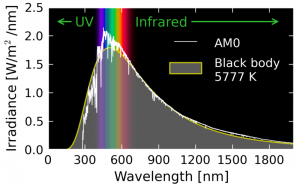
Figure 1 – The solar spectrum, By Danmichaelo (Own work) [Public domain], via Wikimedia Commons

In researching my last blog on the Infrared Photography of Davide D’Angelo, I discovered that there was a bit of a controversy about whether infrared photography should be possible with digital cameras that are “infrared filtered.”  So I thought that I would explore  that here, for those of you who want to try it for youselves.

OK, so for starters, let’s look at the spectrum of sunlight (see Figure1). The bottom line from this is that there is a lot of light in the near infrared (700 – 950 nm).

Next, the bar is set by classical, i.e. film-based, infrared photography.  What is, or was the response of such films?  Let’s look at the spectral response of Kodak High-speed HIE Infrared Film.  This pretty clearly tells us that we are, or were, looking at the spectral region between 700 and 950 nm.

So what we need to do is filter out the visible, maybe allowing a little deep red, using what’s referred to as a long-pass filter.  Let’s look at the spectra of some of these filters.  We see that a Wratten number 87 or 88 will do the job for us.  Note the Wratten number 89B, which is the Hoya 72 filter.  It allows a bit more red to pass, but as we shall see may be the compromise you need to get this to work on your digital camera.
standard_camera

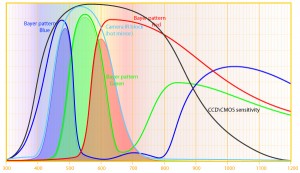
Figure 2 – Spectral response of a standard digital camera CCD/CMOS by  http://www,ir-photo.net under creative commons license.

Finally, we need to consider the spectral response of digital cameras.  What we call a pixel on the sensor of digital cameras is actually a small pattern or array of pixels divided into three groups: those with a micro-blue filter over them, those with a micro-green filter over them, and those with a micro-red filter over them.  The sensor is then filtered in two more ways.  There is a filter to remove UV light and there is a filter to remove infrared light.
unmodifiedcamera_plus720filter

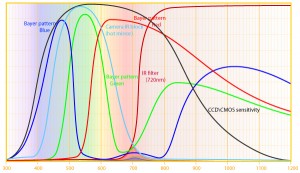
Figure 3 – Spectral response of a standard CCD/CMOS digital camera with a a Hoya 72, Wratten 89B, filter by http”//www.ir-photo.net under creative commons license.

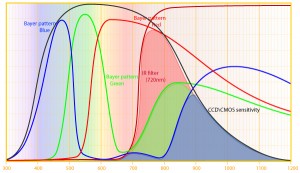
The net effect of all of this is shown in Figure 2.  The shaded blue, green, and red areas, referred to as Bayer patterns, are the individual color sensor elements.  The blue, green, and red solid lines show how the responses of these elements would be in the absence of the “extra” filtration.
moddedcamera_720filter

Figure 4 – Spectral sensitivity of IR converted digital camera (CCD/CMOS) camera used in conjunction with a Hoya 72, Wratten 89B, filter by http://www.ir-photo.net under creative commons license.

Next (Figure 3) let’s add a Hoya 72 filter.  Note the little shaded area that ranges from about 650 to 775 nm. That is the IR sensitivity of such a camera.  It looks pathetic, but it will give you images provided you put your camera on a tripod and accept the necessary long exposures that you will need.

You can, however, have your camera modified (typical cost $200 to $300 depending on camera, in 2012), which entails removal of the IR cut-off filter.   Some examples of these services are LifePixel, and  Digital Silver Imaging, and This is shown in Figure 4 and gives you back all of the beautiful infrared sensitivity that is intrinsic to the CCD and CMOS detectors.  Indeed, this sensitivity extend well beyond 1200 nm, greatly exceeding that of Kodak HIE film.

One important word of additional caution is that the focus changes.  Some lens have specially marked lines on the lens barrel to indicate where the IR will be in focus.  In the absence of this, you are going to have to experiment to locate this line.