Still more on robotic eyes – the seeing mannequin comes to a mall near you

OK, I’m going a bit off topic again today. We’ve talked about robotic eyes and now according to Bloomberg News and NBC News, it’s gone a step further.  Italian mannequin manufacturer Almax SpA is now selling the EyeSee mannequin.  Units go for just over $5000 and have digital cameras built into one of their eyes.  That is their eyes have eyes.

As you might imagine, a significant purpose of this is to augment store security.  OK, so maybe not the Mars Rover, but it does serve a purpose.  But then we learn that the mannequins are analyzing us and profiling us, collecting data, determining gender and race.  People report that it’s more than a bit spooky, being watched at eye level, by something anthropomorphic but not quite human.

I am reminded of a “Sunday Showcase, November 8, 1959 entitled “Murder and the Android,” where the android sheds tears.  OK, so maybe I’m the only one that remembers this Hugo award winning story.  And then coincidentally a week later, November 13, 1959 we have, or rather had, the famous “Twilight Zone” episode, “The Lonely,” where a man is imprisoned on an asteroid and out of compassion the police give him a female android companion, whom he falls in love with – has the usual Rod Serling twist ending.  And, as an aside, Android Alicia is played by Jean Marsh of “Upstairs Downstairs,” fame.

A hundred years from now the EyeSee will be judged primitive.  So where is all this taking us?  Is it just another example of an invasion of our ever waning privacy?  Or is it the dawn of new ways of seeing, connecting, and interacting?  Is it bad that a robotic eye can take data and analyze us as shoppers, but good if it observes our gate to determine if we have suffered brain trauma?  One point is certain.  We are going to have to deal with these issues as we enter a Kurzwelian age.

Some Photographic Resolutions for the New Year

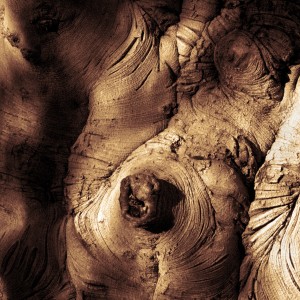
Gnarl2

Figure 2 – “Gnarl” (c) DEWolf 2013

It seems a good time to make some photographic resolutions for the New Year.  So here goes:

  1. Focus on seeing.  Isn’t this what it’s all about?
  2. Spend more time taking photographs.  If you love doing it, you should do more of it.
  3. Slow down, concentrate on composing the image, on setting and checking the light.
  4. Learn to photograph trees.  They are worthy subjects, but can be difficult to compose, difficult to get the light right, difficult to isolate, and difficult to disentangle from power and telephone lines.


Favorite Photographs for 2012 – What I learned about photography and “awe”

I found the exercise of coming up with my ten favorite photographs for 2012 curious for what it tells me I personally like in a photograph.  And also for what it teaches me about the meaning of photography.

Let’s start with some statistics.

There were four nudes:

  1. Edward Weston, Nude in the Dunes, 1930
  2. Annie Leibovitz, Portrait of Keith Haring, 1987
  3. Judy Dater, Imogen and Twinka, Yosemite, 1974
  4. Anne Brigman, The Bubble, 1909

There were four portraits:

  1. Annie Leibovitz, Portrait of Keith Haring, 1987
  2. Judy Dater, Imogen and Twinka, Yosemite, 1974
  3. Julia Margaret Cameron Portrait of Sir John Herschel with Cap, 1867
  4. Yousuf Karsh, Audrey Hepburn,1956

And four landscapes:

  1. Ansel Adams, Moonrise, Hernandez, NM, 1941
  2. Abelardo Morell, Umbrian Landscape Over Bed, Umbertide, Italy, 2000
  3. Edward Steichen, The Flatiron Building at Night, 1904
  4. Beth Moon, Kapok

Also, all of the images chosen were in black and white except, arguably, “The Flatiron Building at Night, 1904,” which is really only toned in color, albeit quite effectively.  I truly prefer black and whit photography both in the seeing and in the taking.  I find that color can easily take over, even to the point that the whole exercise becomes trivial.  Although, I will freely admit that in certain photographs the color demands itself.

I do not know, indeed I would like to understand whether this is merely photographic tradition or whether there is a aesthetic psychology that defines the power of black and white.  But for me, it is always about good light, good contrast, good composition, and good dynamic range

As for landscape photography, its appeal is two fold.  First, it is part of an artistic tradition and through the greats, like Adams, a photographic tradition.  Second, and more profoundly, we stand in awe of nature and things man-made that emulate nature, such as the beauty of the Flatiron building at night, colored with the amazing artistry of the master’s hand.  The meaning of the word “awe” was expressed so wonderfully by the great theologian and philosopher Abraham Joshua Heschel in his book “Who is Man?”

Awe is more than an emotion; it is a way of understanding, insight into a meaning greater than ourselves. The beginning of awe is wonder, and the beginning of wisdom is awe.
Awe is an intuition for the dignity of all things, a realization that things not only are what they are but also stand, however remotely, for something supreme. Awe is a sense for transcendence, for the reference everywhere to mystery beyond all things. It enables us to perceive in the world intimations of the divine, to sense in small things the beginning of infinite significance, to sense the ultimate in the common and the simple: to feel in the rush of the passing the stillness of the eternal. What we cannot comprehend by analysis, we become aware of in awe.

As for nudes, as we have discussed there is certainly a wonder of abstraction as well as a beauty in the sensuous.  But ultimately they connect so directly with “awe” in landscape, so much so that they define the same sense.  I was reading an article in the September/October 2012 issue of View Camera by Ian Leake who specializes in photographing nudes.  He expressed the connection so wonderfully and concisely:

I work primarily with female nudes because the human body is a universal language of life – and arguably, anything that is worth saying about life can be said with the human body.”

And finally, we have to recognize that portraiture attempts to capture the meaning of a person’s life.  Keith Haring becomes his art.  We look into John Herschel’s eyes and in the classic sense are given admission to his soul.

The awe is in all three of these photographic forms.  Therin, lies their wonderful connection!


Happy New Year from Hati and Skoll Gallery

Mark_Twain_and_Dorothy_Quick

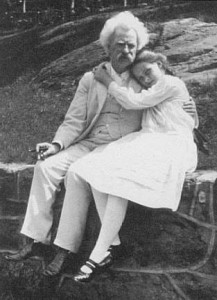
Figure 1 – Mark Twain with Dorothy Quick c. 1907. From the Wikicommons in the public domain.

Call me crazy, but I am optimistic about 2013.  We all need to be optimistic.  Despite all the terrible events that are happening, we all need to imagine and to dream of a better world.  We all need to work together to make it better.

I have been looking for an excuse to insert a photograph of Mark Twain (1835-1910) into my blog.  So here it is.  I have chosen an image of Twain taken around 1907, with eleven year old Dorothy Quick (1896-1962) – an unlikely friendship?  Dorothy spotted and recognized Twain on a transatlantic crossing.  She slowly circled his chair multiple times, until he introduced himself.  They went on to be great friends until Twain’s death in 1910.  Ms. Quick went on to become a writer herself.

In his darkest moments, Mark Twain wrote one of his finest works, “The Mysterious Stranger.”  Here he revealed his worst pessimism, his most dreaded thoughts.  It is an awesome existential work, which ends in the vision that everything in the world is nothing but a dream.  We are the dreamers.  We have chosen to have bad dreams and nightmares. Twain challenges us to “Dream other dreams, and better!”  It is an admonition worth restating on January 1, 2013. Let’s work together to dream better dreams.

Ansel Adams, “Moonrise, Hernandez, NM, 1941,” Favorite Photographs for 2012, #10

Ansel Adams, “Moonrise, Hernandez, NM, 1941

OK everyone, it is the last day of the year, December 31, 2012, and time for the last of my Favorite Photographs for 2012 Series.   For my generation of photographers, could there ever be any doubt, it is ” Moonrise, Hernandez, NM by Ansel Adams (1902-1984).   The folklore about this image, taken late in the afternoon on November 1, 1941, from a shoulder of U.S. Route 84. is, well, legendary.

Secretary of the Interior Harold Ickes had hired Adams to photograph federal lands. As Adams recounted:

“I could not find my Weston exposure meter! The situation was desperate: the low sun was trailing the edge of clouds in the west, and shadow would soon dim the white crosses. . . . I suddenly realized that I knew the luminance of the moon—250 cd/ft2. Using the Exposure Formula, I placed this value on Zone VII. . . . Realizing as I released the shutter that I had an unusual photograph which deserved a duplicate negative, I quickly reversed the film holder, but as I pulled the darkslide, the sunlight passed from the white crosses; I was a few seconds too late! The lone negative suddenly became precious.”

And why is it so precious, why do we relate to it so strongly?  Well for me, there is first of all the light, the patch of setting sun, the dark sky.  Then there is the detail in the moon, the fact that we can make out the features.  And finally, yes it is the glow of the grave marlers, the white crosses.  Adams is quite correct about the crosses.  They are the essential element.  For me it is not only one of Adams’ greatest images, it is one of the world’s greatest images.

I wish you all a Happy New Year!


Abelardo Morell, “Umbrian Landscape Over Bed, Umbertide, Italy, 2000” Favorite Photographs for 2012, #9

Abelardo Morell, Umbrian Landscape Over Bed, Umbertide, Italy, 2000

Abelardo Morell (1948- ) is one of the most creative photographers alive today.  If you visit his website you will find remarkable, novel, often whimsical series of photographs. The creative mind of the artist is always present. I had no doubt that I would choose for the 2012 favorites list one of his camera obscura series.  But then I had to pick which one, which gave me the fun of visiting all of them again..

In my post about pinhole cameras, I described the basic function of a camera obscura – the us of a pinhole of light to project onto the walls of an otherwise dark room what is outside.  Morell chooses dramatic sites for his camera obscura images, often a hotel room with a view of a historic or otherwise scenic site.  He darkens the windows save a pinhole and projects the scene on the opposite wall, sets up his camera to photograph the image and then exposes,often for as long as eight hours.

These pictures are inspiring, not only for the dramatic scenes chosen, but also because of the placement by the artist of the mundane, or every trappings, of the room.  It is the play between these two aspects that ultimately make the image.  Therein lies the artistry!

Recently, Morell has taken camera obscura images in color.  Also he has created an optical device that reverses the upside down images of a pinhole camera, thus rendering them right-side-up.  You can read about this at the “On Location” link on his website.

When you create these lists of fite photographs, the cliche’ often arises: “If you were on a desert island and could take only one image with you, which would it be.”  I think that, for me, it would be “Umbrian Landscape Over Bed, Umbertide, Italy, 2000.”  It would always remind me of the simple beauties of the world.  Composed by the artist above an old time bed, the whole scene is reminiscent of a childhood story like “Peter Pan,” and I would be constantly reminded that there is magic in the world

Anne Brigman, “The Bubble, 1909,” Favorite Photographs for 2012, #8


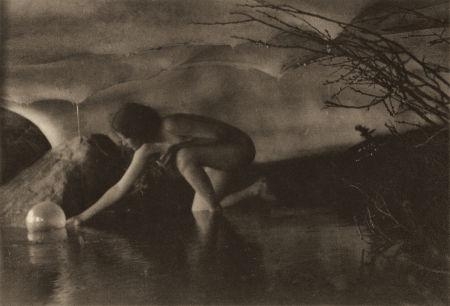
Figure 1 – Anne Brigman’s “The Bubble, 1909,” from Wikicommons and in the public domain.

I have spoken before about Anne Brigman’s,“The Bubble” a mysterious image of a female nude, in a cave, creating and launching a bubble on a mythic stream.  Interestingly, the light comes enigmatically from the left as if there were some hidden and unseen illuminating power.

Anne Brigman (1869-1950), was a member and practioner of the  photo-secession, is famous for heavily reworked negatives and a pictoralist sense of our allegorical tradition.  There are references to myths that are deeply engrained in our psyches, such as that of the mother goddess.  The bubble, which appears in several of Brigman’s works, evokes the ovum from which we are all born.  The river is not only the birth canal but the river of life on which we must all journey.

Then too there is the classical imagery of the renaissance.  We are reminded of Leonardo’s (or presumptively Leonardo’s) Salvator Mundi (Savior of the World), where the Christ holds in his hand a crystal orb, representative of the cosmos or the universe.

I find that there is a very special and profound sense of solitude that I achieved when I encounter Brigman’s work in a quiet gallery.  It is the best way to see them.  I find myself studying the forms and allusions reflectively.  It is for that reason that I count “The Bubble” among my favorite images.


Edward Steichen, “The Flatiron Building at Night, 1904,” Favorite Photographs for 2012, #7

Steichen_flatiron

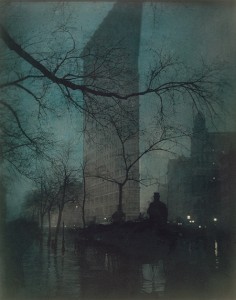
Figure 1 – Edward Steichen, “The Flatiron Building at Night, 1904,”By Ghirlandajo at ru.wikipedia (Transferred from ru.wikipedia) [Public domain], from Wikimedia Commons

Edward Steichen, The Flatiron Building at Night, 1904

This wonderful image, of dark and foggy Madison Square and the legendary Flat Iron building, then one of the tallest buildings in New York City, captures forever the mood, spirit, even the smell of NYC at the dawn of the twentieth century. It was taken by Edward Steichen (1879 – 1973) and is an early example of night photography.

Notice the subtle coloration.  Steichen manually and laboriously applied layers of light-sensitive gums to create the one-of-a-kind sense of color.

Steichen was heavily featured by Alfred Stieglitz in Camera Work between 1903 and 1917.He went on to become Director of the Department of Photography at New York’s Museum of Modern Art, where he curated the famous The Family of Man exhibit.

Even today, the triangular Flat Iron building still seems a bit magical. And, speaking of witchcraft, who can forget James Stewart tossing his hat from the roof onto a snow filled Madison Square as he romances Kim Novak in “Bell Book and Candle?


Beth Moon, “Kapok,” Favorite Photographs for 2012, #6

Beth Moon, Kapok

I spoke about California Photographer Beth Moon on November 1 in the context of magical realism.  She is one of my all time favorite artists, and as I said then, “her work is not just worth seeing, it is worth seeing again and again.”

Kapok comes from Beth’s portfolio of tree pictures, “Portraits of Time.” Trees are silent witnesses to time and history.  And, the trees that she photographs are among the most ancient and most magical.  Trees, I think, carry a sense of faith for us, a faith in the eternal continuity of life.  There are two great acts of faith that we, as human beings,  partake in: having children and planting trees.  I planted a Norway Spruce once in my back yard.  It will eventually grow a hundred feet or more tall.  I will not live to see that.  But it will grow without me, and every time  I look at it I think of the great continuum that goes beyond me.  Such is the sense of wonder that Beth Moon’s tree photographs raise in me.   And Kapok is one of her best.

The is a wonderful movement in the image.  The placement of the limbs, roots, leaves, and clouds create a spectacular dynamicism.  The tree appears to be dancing, to be spinning on axis.

The one thing that remains to be said is that this is a platinum palladium. Seeing them in digital doesn’t quite do them justice.Each print is an individual.  If you get the opportunity to see Beth Moon’s work in person you should do so.