Images of the Challenger disaster – becoming sacred

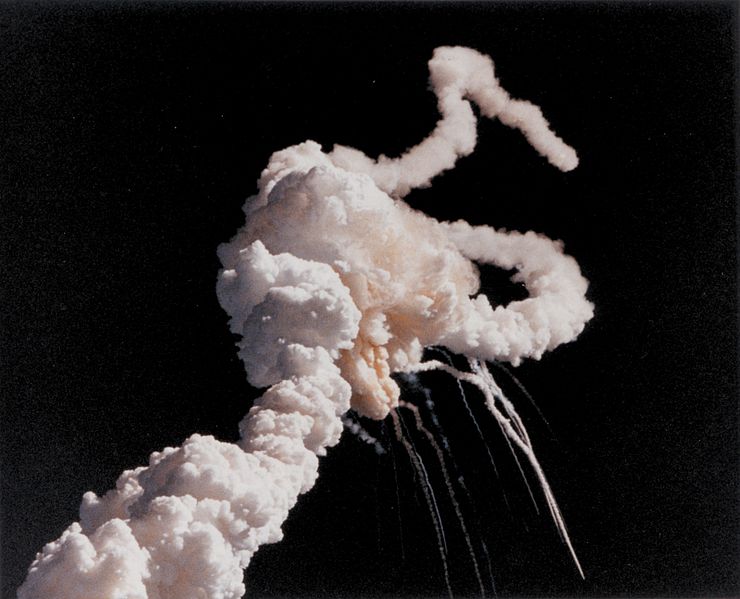
Figure 1 - The Challenger Disaster. Photograph from the Wikicommons and NASA in the public domain.

Figure 1 – The Challenger Disaster. Photograph from the Wikicommons and NASA in the public domain.

On January 28, 1986, I had gone with a friend and colleague to lunch.  We had gone a bit early because we wanted to watch the space shuttle take off.  What we saw, what we will never forget, it is the image shown in Figure 1.  Seventy-three seconds into the flight the Space Shuttle Challenger blew up, killing all on board.  If ever an image was a meme,  this is it.  Whenever you mention the disaster by name, this is the image that comes to mind.  I think of those people and the terrible experiences they went through.  It is one of those shared gruesome and terrible moments that haunt the collective memory of our culture.

That night, President Regan went on television to speak to the nation and he said something truly remarkable:

“The crew of the space shuttle Challenger honored us by the manner in which they lived their lives. We will never forget them, nor the last time we saw them, this morning, as they prepared for their journey and waved good-bye and ‘slipped the surly bonds of earth’ to ‘touch the face of God.”

Regan associated the image of the disaster with our image of God.  He associated the image, associated the meme, with the sacred.  He elevated the ordeal of those lost souls to an epic plane. And now whenever the subject of the disaster is mentioned not only do I see that image and think about the astronauts and their suffering, but I hear those words, and I try to imagine the image or meme that those words create in my mind, in our collective minds.

We have a set of memes in our culture that define the sacred.  And whenever an image, a photograph, touches upon the sacred, it is elevated.  It resonates with what is most deeply human.

Image and memetic evolution

In yesterday’s blog, I discussed the parallels between memes and genes.  I spoke about how memes are shared and spread.  I also spoke about the role of photographs both in the acceleration of the memes they represent and in the maintenance of their fidelity.  So wait, memes are shared, they spread,and they mutate!  This is to say that memes are self-replicating and that they evolve.  The evolution of human culture is driven by memes, just like the evolution of species is driven by genes.

The important point is that human beings have evolved a whole new form of evolution.  They are no longer strictly held captive by genetic evolution.  Primitive man developed a simple tool, say a sharpened rock.  Each individual from each generation didn’t have to come upon this meme himself.  It could be past on, replicated, between individuals and across the generations.  The meme “tool” evolved until we find ourselves no longer banging rocks together, but rather banging away at the keyboards of our computers.

Some have argued that it is not speech, nor language, nor the size of our brains that separates us from other animal species, but rather our development of a whole new form of evolution that frees us completely from the slavery of genetic evolution.  This has always struck me as a bit self serving and arrogant.  Are we truly different from other species in a way that truly sets us apart? As we pollute our planet and slowly raise its temperature, as we approach that point when the ocean currents that control our climate will shut down, I think that the jury remains out as to whether we will, as all other species, eventually go extinct.  However, the powerful role that memes, and images, as a dominant form of meme, play in our lives and culture still ring true.  They have given us the ability to develop technology at breakneck speed.

So we start to see why human connectedness in a digital age, where images can and are shared at blinding velocity, is such a force in our lives and cultures.  Images as memes are unifying.  They connect us with what is our common perception.  Herein, I believe, lies the meaning of image and photography.

Image and the concept of the meme

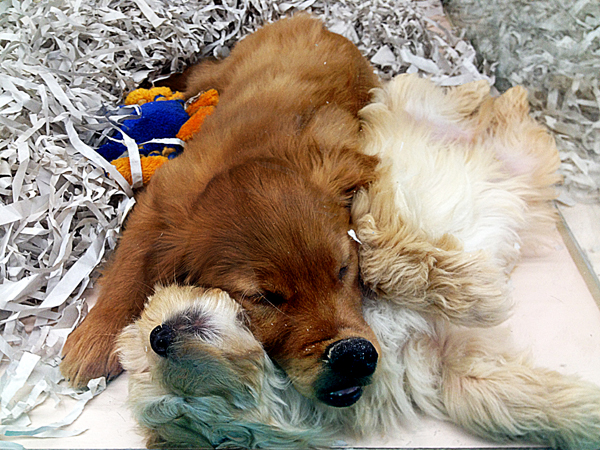
Figure 1 - Cute cuddley (yummy?) puppies. (c) DE Wolf 2013.

Figure 1 – Cute cuddley (yummy?) puppies. (c) DE Wolf 2013.

Today, I want to speak about images as memes.  The subject is a little abstract, but actually kind of fun, not to mention revealing.  The term meme was introduced by Richard Dawkins in his book “The Selfish Gene.”  When we look at an individual: a person, animal, or plant, what makes them an individual is their particular make-up of genes.  Biologists call this defining make-up a phenotype.  A meme is meant to parallel the gene, but to refer to human culture.  Just as genes define an individual’s biological make-up, memes  define an individual’s cultural make-up.  They are the elements of culture.

If you haven’t come across this concept before, it can sound a little strange; but let’s consider a meme in relation to photographs.  If I show you a picture of some puppies then you might say; “Aw, how cute!  Show the same picture to someone in a different culture, they might say: “Yummy!” (Sorry dog lovers.)  And if I show the picture to an alien from another planet they might not have anything to say at first.  They just don’t know how to relate to puppies.  The concept has no cultural context or meaning to them.
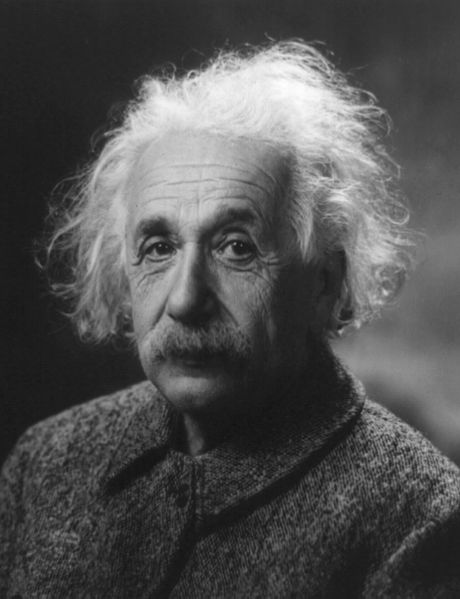
Figure 1 - Albert Einstein, 1947, From the Wikicomons and in the public domain because copyright not renewed. Photograph by Oren Jack Turner, Princeton, N.J. - Modified with Photoshop by en:User:PM_Poon and later by User:Dantadd.

Figure 1 – Albert Einstein, 1947, From the Wikicomons and in the public domain because copyright not renewed. Photograph by Oren Jack Turner, Princeton, N.J. – Modified with Photoshop by en:User:PM_Poon and later by User:Dantadd.

To the alien, the puppy picture is something new.  As a meme it starts out as a question mark.  However, it quickly evolves and changes in the alien’s mind.  How, depends upon whether the puppies try to befriend him, or bite his finger (if he has fingers), or even if the alien tries to eat the puppies.  He communicates to all his alien friends (ET phone home!) that this is something sweet, or something scary, or something yummy.  And all the alien’s friends associate these qualities first with the picture and then with the real puppies that they encounter during their sojourn on Planet Earth.  The important point is that the meme is shared.  One person or alien has the experience and he passes it on to everyone else.  It, the meme of puppiness, becomes an element of the alien culture.

If I say the words “Albert Einstein”, they have an immediate meaning to us, and we conjure up in our minds a picture like that of Figure 2.  Your brain starts firing away all of the things that it associates with Albert Einstein.  Funny looking genius physicist with wild white hair.  You might reflexively think “theory of relativity” or “E=mc2 ” even if you don’t really know what they are or mean.  It’s culturally memetic.  The man is long gone.  His meme lives on in our minds.

Of course, photographs and images are not the only form that memes take on.  If I say to you cinnamon, what does that conjure up?  An image of a brown powder, or a rolled reddish brown bark? More likely it conjures up the smell of cinnamon and the reassuring sense of cuddling up on a chilly fall day with hot mulled cider or apple pie. 8<)

Indeed, the photograph itself is not the meme.  The meme is what is stored in your head and in the head of the other members of your culture.  But the photograph is very important to the meme.  It serves to accelerate the spread of the meme and it serves as a filter to keep the meme to a certain extent pure.

We’ve talked about the fact that the human eye is not a camera, and that the human brain is not storing JPEG files.  Cover up the picture of Einstein for a moment.  Now tell me whether his top button is buttoned.  Tell me about the nature of the fabric.  Is he looking left or right? There is a furrow that runs up his forehead.  Is it centered?  You might not  notice any of these details.  Adrian Monk would.  Sherlock Holmes would.  But you might not.  These details are not culturally significant. They do not contribute to the meme that is Albert Einstein.

OK, so look at the picture closely again.   Is there something disconcerting – something that Mr. Monk or old Sherlock would certainly pick up on?  The picture violates another mime.  Albert’s coat buttons right to left.  This mime, in western culture, tells us that he is wearing a woman’s coat.
The meaning of photography – are we more or less connected?

On Sunday, I spoke about the bombing of the Boston Marathon and of the capture of its perpetrators in the context of shared and collective image.  This touches on the profound question of what is the fundamental meaning of photography and imagery.  And perhaps not surprisingly, this takes us, in turn, to the profounder still question of what it means to be human.  This seems like a good jumping off point to take on these deeper questions; so I will attempt to address them over the course of several posts.

For me, these questions relate to an ongoing discourse (argument) that I have been having with a dear and brilliant friend about whether people (the word young is silently implied as a modifier to the word people – those whipper snappers!) of today are more or less connected than in the past.  If you see someone in a store not interacting with the people immediately around him or her, but instead texting and exchanging images with a cadre of distant friends has (s)he become abstract and disconnected or is (s)he more connected by virtue of his or her cyber network?

To ask the question differently, is the cell phone ruining the young people of today?  My immediate response is reflexive.  Well, we’ve heard that question before.  Before the cell phone it was the internet, before the internet it was the video game, before the video game it was television, before television it was radio, before radio it was the bicycle.  Yes, you heard me right – the bicycle ruining the moral fiber of society, corrupting young people to a life of decadent intellectual stagnation and decay.  Somewhere between accusing my friend of being a Miniver Cheevy* and pointing out that science and technology do what they have always done – namely present expanded options, I suddenly realize that this is really a pretty profound question, deeply engrained in our biology, and touching on our very meaning.

So, let’s consider this question of greater or lesser connectivity in the context of photography and the meaning of image, and image as the meaning of mankind.  We have previously discussed the very important point that the human eye is not a camera and the human brain is not storing a RAW, TIFF, or JPEG image.  Photographs and images in general must be considered in the context of human neurobiology. To proceed further with these questions of meaning, over the course of several postings I need (want?) to consider.

  • Image and the concept of the meme
  • Image and memetic evolution
  • Image and the meaning of the sacred

Dangerously, this all sounds complicated.  However, like all elegant knowledge, we in the end recognize it as pretty straight forward.  Oh, and please remember that this is my opinion and perspective.

* Miniver Cheevy

BY EDWIN ARLINGTON ROBINSON

Miniver Cheevy, child of scorn,
   Grew lean while he assailed the seasons;
He wept that he was ever born,
   And he had reasons.
Miniver loved the days of old
   When swords were bright and steeds were prancing;
The vision of a warrior bold
   Would set him dancing.
Miniver sighed for what was not,
   And dreamed, and rested from his labors;
He dreamed of Thebes and Camelot,
   And Priam’s neighbors.
Miniver mourned the ripe renown
   That made so many a name so fragrant;
He mourned Romance, now on the town,
   And Art, a vagrant.
Miniver loved the Medici,
   Albeit he had never seen one;
He would have sinned incessantly
   Could he have been one.
Miniver cursed the commonplace
   And eyed a khaki suit with loathing;
He missed the mediæval grace
   Of iron clothing.
Miniver scorned the gold he sought,
   But sore annoyed was he without it;
Miniver thought, and thought, and thought,
   And thought about it.
Miniver Cheevy, born too late,
   Scratched his head and kept on thinking;
Miniver coughed, and called it fate,
   And kept on drinking.


The Marathon Bombings: Images of terror, heroism, and resilience

I am adamant that I keep the focus of this blog on photography and image and not venture into public events or politics.  Still I cannot help but comment on the images of the Marathon Bombings and their aftermath that have literally bombarded us for the last week.

I woke yesterday at five AM to learn that Watertown, Massachusetts, the town where I work was under police siege; that Boston and all surrounding towns had been ordered into lock-down.  These are bizarre and incredible events.

People know that the Boston Marathon occurs on the holiday Patriots Day – conveniently scheduled on a Monday.  The actual events that started the American Revolution in Lexington and Concord Massachusetts, occurred on April 19, 1775.   So as I staggered downstairs into my kitchen in search of my morning coffee, contemplating the unfolding events of this April 19, I was greeted by musket fire as the Sudbury Minutemen reenacted the events of that April 19th.  The effect was surreal and thought provoking.

For the past week images of horror, of mayhem, of heroism have been played over and over again, seeming endlessly.  For those fortunate enough not to be directly involved, such events are a parade of images that will stay with us throughout our lives.  I can recite a list of mine: the Kennedy assassinations, the King assassination  the War in Vietnam, Kent State… The list plays on inescapable.  You may recall my discussion of Howard G. Davis’ collection of the photographs that haunted him and defined his life. I emphasize that these nightmares are for those fortunate enough not to be directly involved.  Their horror is firsthand; ours shared and collective.  None of the platitudes or aphorisms help the murdered, wounded, or maimed.

In the terrible events of this past week we have seen the power of image unfold in two ways: first in the creation of a common social consciousness and second in the way that peoples mementos, such as photos on an IPhone and photos from robotic eyes all around the city ultimately led to the identification of these terrorists.

I return to the contrast between April 19, 2013 and April 19, 1775.  The President was correct when he said that as, clearly seen in the videos and still images of the events of last Monday, terrorism failed in the first instance as law enforcement, medical personnel, and ordinary citizens rushed to the aid of the wounded, oblivious to personal danger.  I have gone many times to Concord Bridge to watch the reenactments.  It’s usually cold and windy, sometimes wet. And I have wondered what special kind of person could stand on that bridge, armed with a flint lock rifle, and be ready to take on the greatest army in world, oblivious to personal danger and even iminent death.  I understand that a little better now.

Scientists in the laboratory

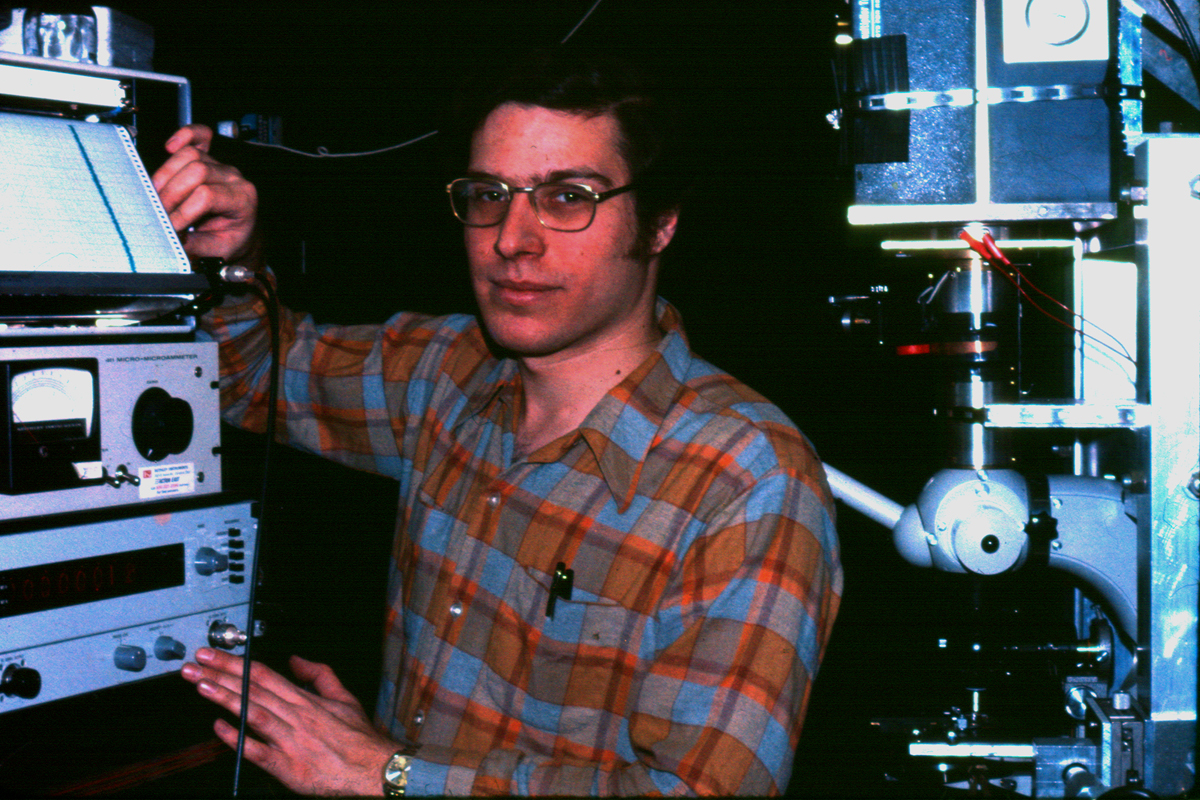
Figure 1 - the author in the laboratory of Dr. Watt Webb in the Department of Applied Physics at Cornell University in 1975. (c) DE Wolf, 2013

Figure 1 – the author in the laboratory of Dr. Watt Webb in the Department of Applied Physics at Cornell University in 1975. (c) DE Wolf, 2013

While I was writing and researching my recent blog on Robert G. Edwards, I was struck by the importance of capturing images of people in their places of work and in their places of living.  My father had a friend who in the 1960’s and 1970’s set out to take photographs of everyday things that he was pretty sure would no longer exist in, say twenty-five years.  What images that show the way people live or lived gives us a momentary glimpse into another time.  It is for this quality that we value nineteenth century photographs that aren’t just portraits but images of what it meant to live in the nineteenth century.  And we may even forlonly wish that we had similar images of still earlier times.

So over the next few weeks one of my topics is going to be photographs of that chronicle people at work and street life, images that capture the Zeitgeist, the spirit of the times.  I have a particular liking for images of famous scientists in their laboratories so there will be some of that as well.

And as a start, I’d like to post a picture of myself (Figure 1), in all my youthful geekiness, albeit sans pocket protector.  The picture is from 1975 and shows me in the physics laboratory of my mentor Professor Watt W. Webb.  I am shown standing next to the worlds first microscope-based fluorescence correlation spectroscopy instrument, which had a screaming 128 bit hardware correlator built by Dr. Dennis Koppel.  What’s was it for?  In those days we were establishing the fundamental ways in which biological membranes work, specifically how molecules move in these membranes.

Louis Vuitton – Moiré adventures with my IPhone

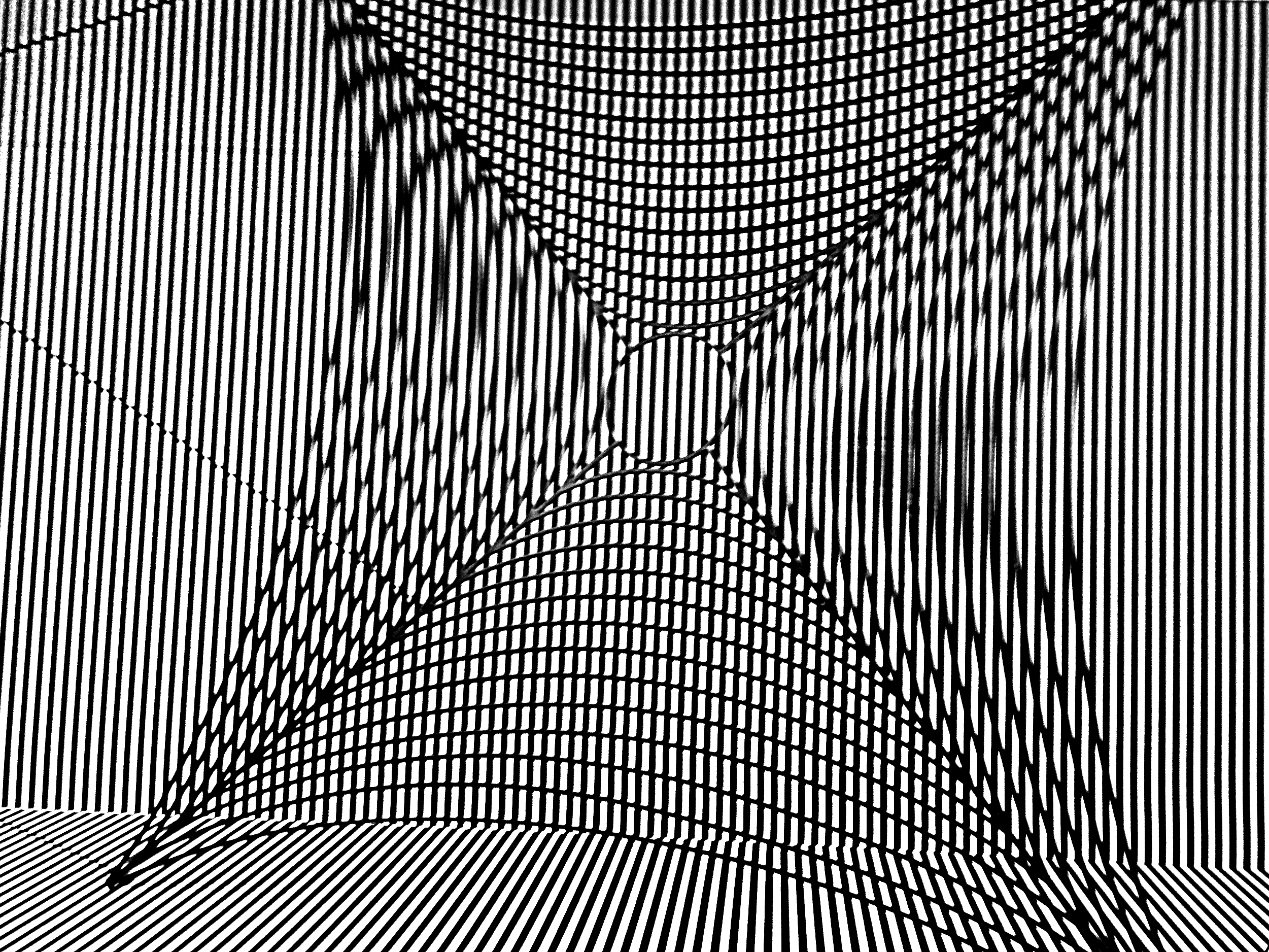
Figure 1 - Louis Vittoun Moiré Pattern (c) DE Wolf, 2013.

Figure 1 – Louis Vuitton Moiré Pattern (c) DE Wolf, 2013.

Yes, I will admit it, I have been walking the mall again, IPhone in pocket and ever on the prowl for interesting geometrics.  Today’s IPhone image is a detail from a Louis Vitton window – how much more geometric can you get.  And here I was struck my the wonderful Moiré pattern that I found.

The Moiré pattern is related to the problem of aliasing, where someone makes the mistake of wearing either a striped shirt or striped tie on television, and you see strobing as the stripes cross the pixel pattern on the TV.  Another related phenomenon is when two musical instruments are tuned just slightly off frequency from one another, and you hear  beats with a frequency that is the difference of the two instruments.

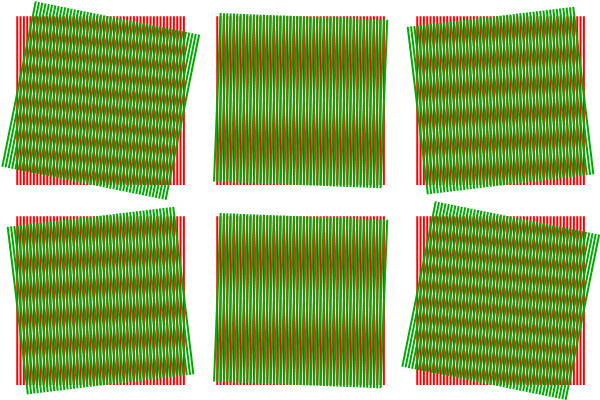
Figure 2 - Animation of the Moiré pattern that forms as a set of green lines is rotated in front of a set of red lines.  The spatial frequencies in the horizontal direction change because of the rotation creating the Moiré pattern From the Wikicommons by P. Fraundorf under creative commons license.

Figure 2 – Animation of the Moiré pattern that forms as a set of green lines is rotated in front of a set of red lines. The spatial frequencies in the horizontal direction change because of the rotation creating the Moiré pattern From the Wikicommons by P. Fraundorf under creative commons license.

Basically if you have a set of lines superimposed on one another, where the lines per inch (referred to in optics as the spatial frequency) of the sets are slightly different from one another, you will see a regular beat pattern, at the difference of the two patterns in lines per inch.  You can see the same thing if you rotate two sets of lines even with the same pattern with respect to one another because rotation effectively creates a situation where one set of lines is no separated in the horizontal direction by a shorter distance.  You can see this in the little animation of Figure 2.

I have here introduced the very useful optical concept of the spatial frequency.  Sound is a wave; so two sound waves can interfere with one another.  Light is a wave; so two light ways can interfere with one another.  And equivalently any regular line pattern is geometrically equivalent to a wave, a so-called spatial wave; so two regular line patterns can interfere with one another and create Moiré patterns.

Of course, if the line patterns are two dimensional, say a regular mesh like a window screen or a sheer curtain, the beat or interference pattern is also two dimensional.  Make the lines curved or three dimensional and very wonderful patterns can occur, like in my photograph.

Sometimes also the pattern can be quite unexpected if the lines or meshes at just discernible.  In that case,  the Moiré pattern can suddenly appear seemingly out of no where.  For instance, when the wind blows a sheer curtain in front of a window screen.

Tone-on-Tone 1

ToneonTone1

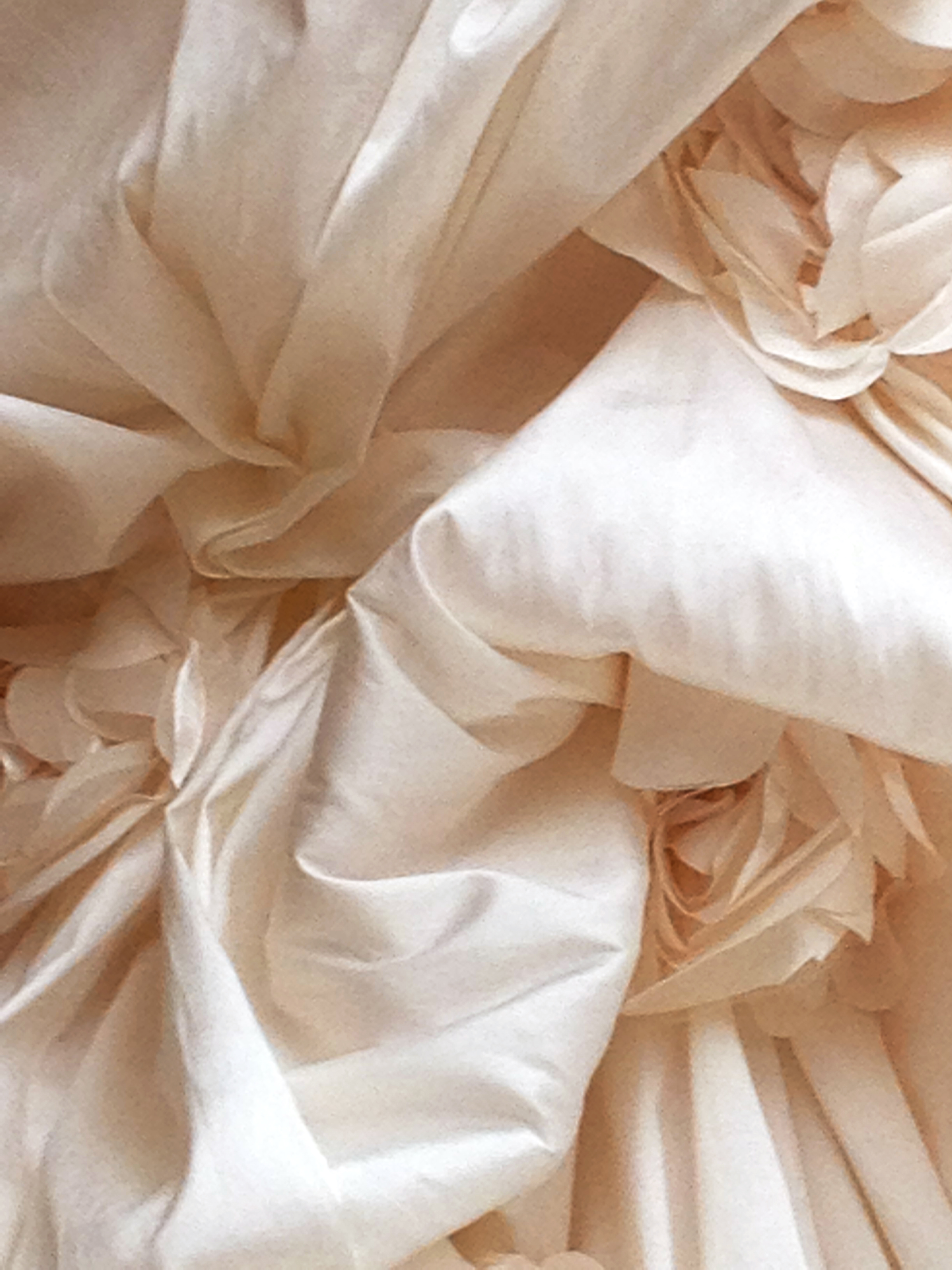
Figure 1 – “Tone-on-tone 1, Bridal Gown.” (c) DE Wolf 2013.

Mall walking again on a Sunday morning.  Our local mall has a spring fashion show where they feature the dress designs of local students.  This morning I was struck by two fantastically stunning bridal dresses by Lasell College student, Amelia LoBrutto.  So while I’m talking about photography here and tone-on-tone photography in particular, while I’m talking about what is commonly called “derivative art,”  I think that it is important to give credit to this very talented young artist.

Tone-on-tone intrigues me.  It intrigues me because it violates the first rule of my photographic work flow, which is to adjust the levels so as to set the lowest level black and the highest level white.  If you do that with tone-on-tone you wind up with something way too contrasty.  And in the case with whites, in particular, you wind up with something totally the opposite of the  beautifully soft gradations that attracted you to the subject in the first place.

So I think that there is a lot to be learned from doing and experiencing tone-on-tone photography.  As a result, I’ve labelled today’s blog “Tone-on-tone 1,” since it is my intent to revisit the subject. And it is my intent also to study it a bit in terms of what dynamic range creates a pleasing tone-on-tone.

This morning however, all I had with me was my IPhone 4S.  I have this running dialog in my head that the IPhone is the modern “view camera,” and that I am carrying it high into the Sierras or into the steamier sections of New Orleans  Of course, it is the antithesis of that.  I find it very difficult to hold the camera steady and I have to concentrate really hard to successfully frame the subject.  Still I got two pictures this morning that I found acceptable examples of the tone-on-tone genre.

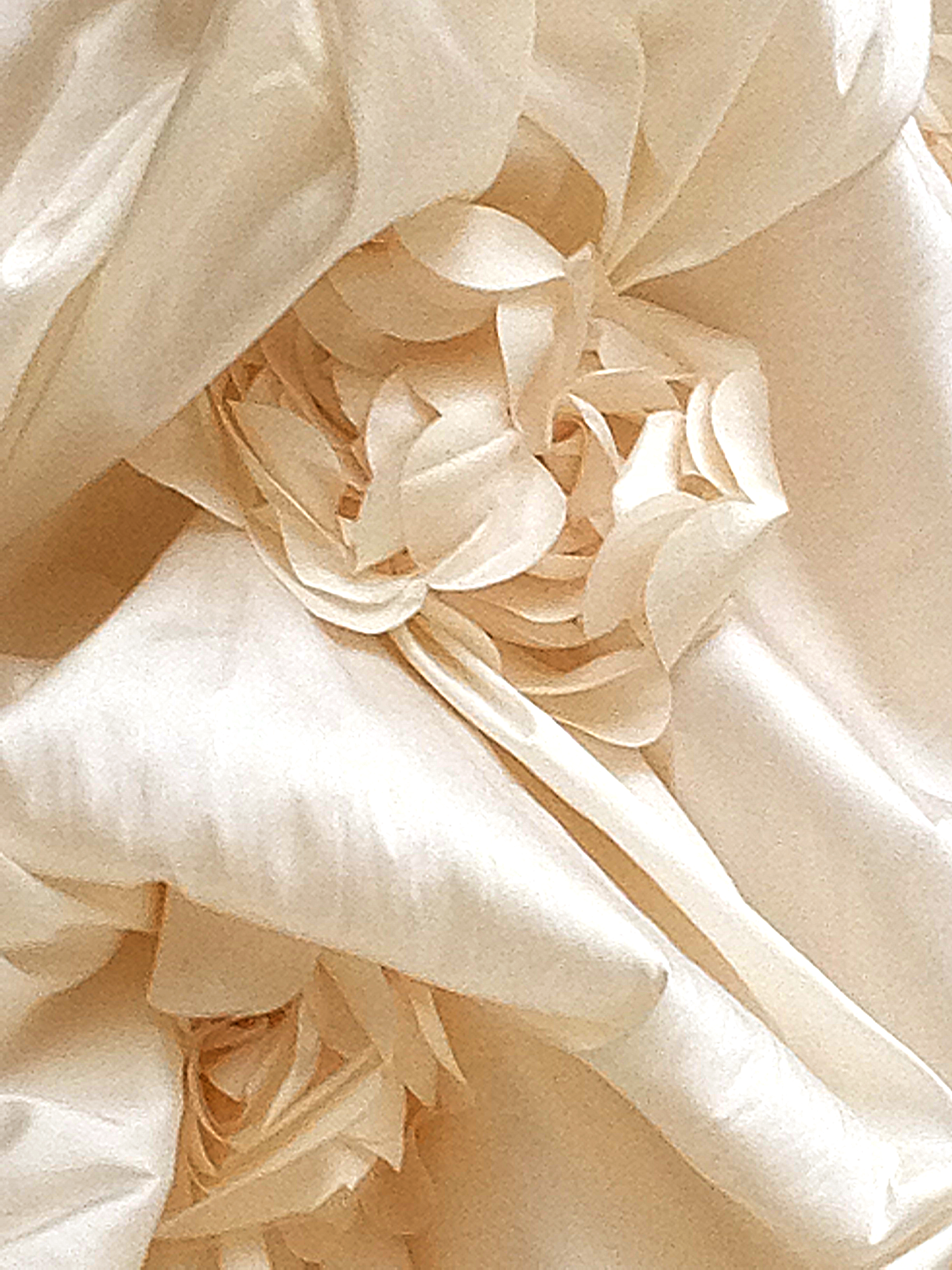
The signal is all in the upper half of the camera’s dynamic range.  I debated a long time, trying out various approaches, and finally settled on the original color, adjusting both the color balance and the gamma subtlety to create what I hope is a beautiful ivory color.  The camera will intrinsically set the whole image to a washed out neutral grey.  I also did just a  bit of dodging to enhance some of the highlights.  The results are shown in Figures 1 & 2.

Figure 2 - "Tone-on-tone 2, Bridal Gown." (c) DE Wolf 2013

Figure 2 – “Tone-on-tone 2, Bridal Gown.” (c) DE Wolf 2013

Cultural Democratization – The George Eastman House joins Google Art Project

We learn from PetaPixel that the world’s oldest photography museum, The George Eastman House in Rochester, New York has joined the Google Art Project.  Pictures from the Eastman House on the Google Art Project may be found at this link.

Google Art Project is an online platform which gives the visitor access to high-resolution images of artworks from the projects partner museums.  Google launched the project in February of 2011.  Beyond high resolution images the project offers Google Earth style walk-throughs of the physical museums and a single image chosen to be captured as a gigapixel image.  The Art Project promotes Google’s view that we are in a period of cultural democratization.  The control of knowledge and its dissemination is no longer controlled by a small elite.

At this point it is, perhaps, interesting to consider the works initially chosen by the Eastman House as representative of the history of photography.  We see many of the same faces that we have discussed previously in this blog.  This includes: Julia Margaret Cameron, Oscar Reijlander, Edward S. Curtis, and, Dorothea Lange.  Visiting the Eastman House in this way is exciting and I look forward to other major photography collections coming online in this way