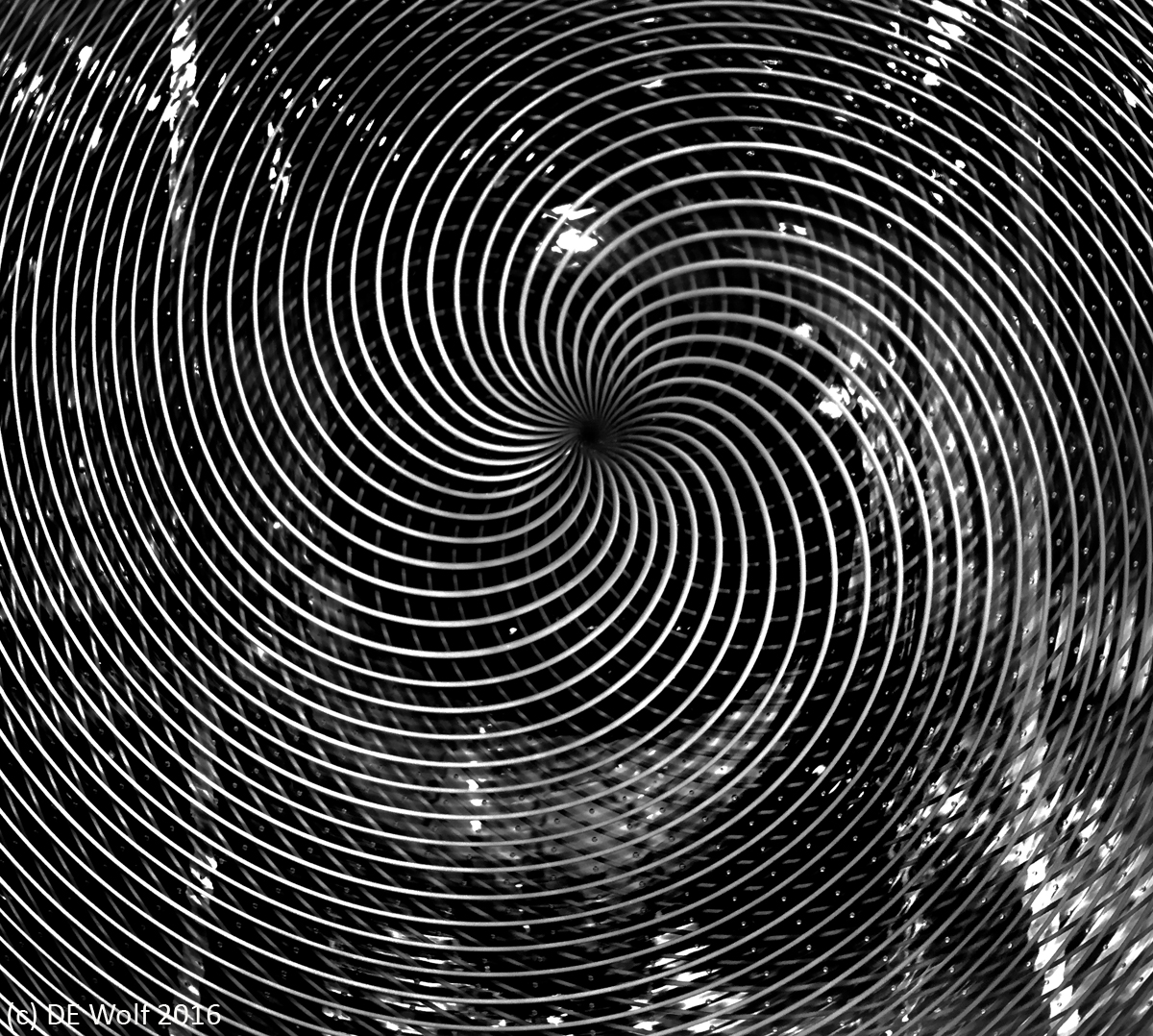
The black hole

Figure 1 - The Black Hole. (cv) DE Wolf 2016.

Figure 1 – The Black Hole. (c) DE Wolf 2016.

I have always loved and related to Hamlet’s statement:

“I could be bounded in a nutshell, and count myself a king of infinite space, were it not that I have bad dreams.”

It is, of course, a statement of Hamlet’s contemplative nature. But I think also that it points out the infinite in the miniature, the view that the structures of the universe are everywhere repeated. This is, of course, the whole concept or definition of a fractal, a random process creating order out of apparent disorder, but the same on all scales. The other geometry that seems ubiquitous is the spiral. We have the golden spiral ( a so-called logarithmic spiral) and the Archimedes spiral (a linear spiral): the spiral of the ram’s horn, the spiral of cream in a cup of coffee, and the spiral of the galaxies.

Yesterday was a gloomy day here in Massachusetts as we awaited the big snow, I had sought warmth, shelter, and amusement in the local indoor mall and while walking came across the spirals of Figure 1 – a spiral in a glass vase. My first thoughts were of the Twilight Zone hypnotic spiral, and the wonderful ambiguity of whether it features an inward or an outward spiral. Then my mind wandered to the the warp in space-time around a black hole, where everything is inexorably drawn in, even light, and where nothing escapes.  I don’t apologize for obscure associations.  All of our minds are set by random, that is fractal, associations. More accurately this is the path that you would see of an object trying to move perpendicular to the radius. This is the path of a planet circling a star – a decaying orbit drawn in the end to its doom. You may have seen shot marbles spiraling down a hemisphere at you local science center.

I took the image with my Iphone, and it proved exceedingly difficult to work-up to what I had visualized. In the end, I liked the distracting reflections mimicking galaxies and faint alternate spiral reflections. These seemed to add to the sense that I was looking at some giant scale astronomical phenomenon.
Teacher teacher shining bright

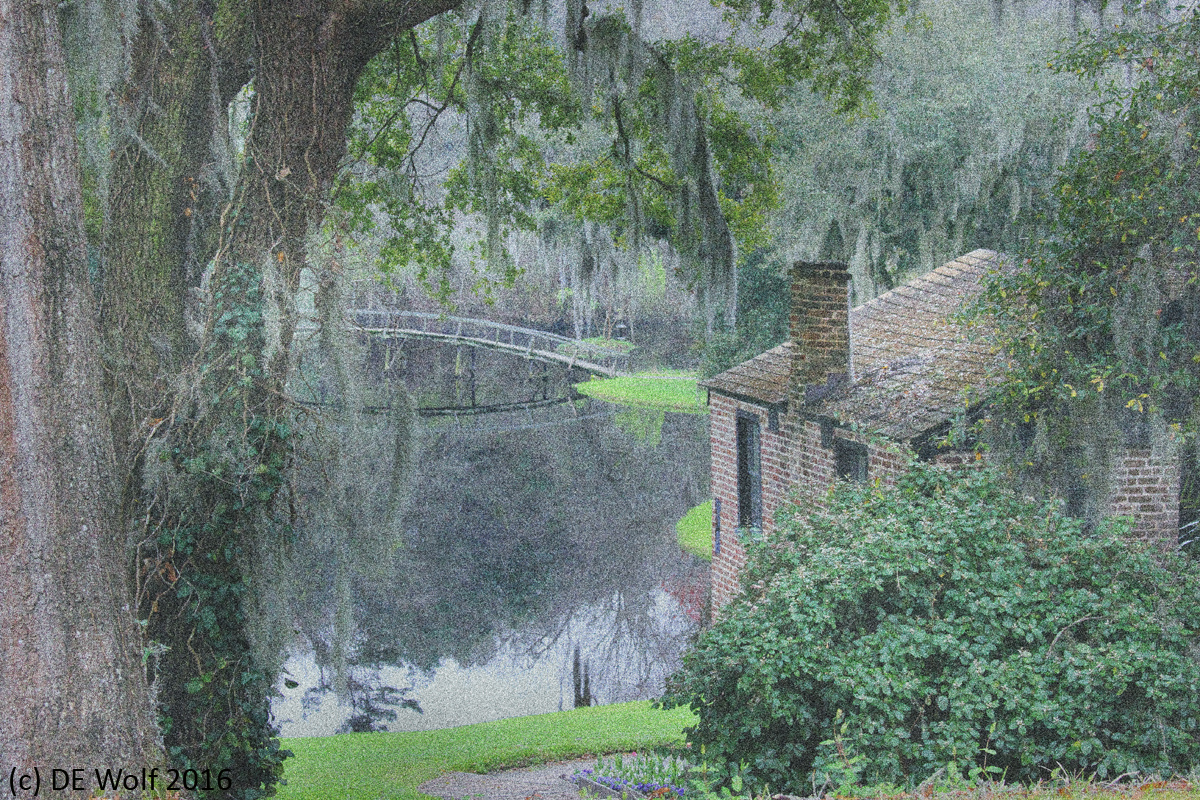
Figure 1 - Photopictorialist study # 6 - Middleton Plantation, Charlston, SC. (c) DE Wolf 2016.

Figure 1 – Photopictorialist study # 6 – Middleton Plantation, Charlston, SC. (c) DE Wolf 2016.

Last Thursday, I happened upon one of those witty posts from “Purple Clover:”

Question – If someone from the 1950’s suddenly reappeared today what would be the most difficult thing to explain to them about life today?

Answer – I possess in my pocket a device capable of accessing to entirety of information known to man. I use it to look at pictures of cats and get in arguments with strangers.”

It struck me that there was a lot of truth to this point, even though I am myself a great admirer of cute, cuddly, cat pictures. The cat after all is the symbol of greater knowledge and many of us have wondered whether they truly have a terrestrial origin and genesis.

On Friday I found myself on the MBTA Boston’s subway, the Red Line to be precise, and I mention that because therein rides the nation’s intelligentsia. The Red Line passes Harvard University, the Massachusetts Institute of Technology, and then the Massachusetts General Hospital. Anyway I was hanging from a strap – trying, of course, to minimize my contact with the pathogenic, microbial world inhabiting that strap, when I noticed that the people in front of me were all looking at their cell phones, reading emails, and looking at baby pictures. I turned around to realize that it was only I and the fellow a few seats away who was muttering to himself that weren’t looking at their cell phones.

So we have once more the profound question of whether all these people escaping to the internet are more connected or less connected. Certainly, if you project back into the world that was the domicile of the 1950’s fellow mentioned above, all of these people would be staring at books, newspapers, or otherwise blankly through everyone else, and especially through the poor fellow who was muttering to himself. Today’s rider of the Red Line while not connected to each other are, at least, connected to someone else – someone with babies. So I am not so quick to criticize!

And then there is another important point. I was recently out with friends for dinner and we were talking about a variety of topics. I was talking about my photography and immediately pulled my photographs up on my cell phone illustratively from the web. The subject turned to pictorialist photography, and snap I was able again to illustrate. So it is far from true really that we do not access the collective knowledge of mankind. This is only a small initial step towards extending and augmenting our brain-stored knowledge with machine-stored knowledge. The possibilities are limitless – ask the folks at Harvard, MIT, and MGH.

Hanging from that germy subway strap I began musing. You may recall in the play “Peter Pan” that every time a child says that they do not believe in fairies a fairy dies. We love you and believe in you Tinker Bell! Imagine that every teacher of English, history, science, or math who has inspired us, is like some Greek hero transformed into a star upon dying, and that every time someone makes the effort to look up a fact on their cell phone, recognizes the value of facts, that some not forgotten teacher’s star shines just a little more brightly. Imagine what it takes to create a supernova! Porter Square. It was my stop and I had to get off the train.

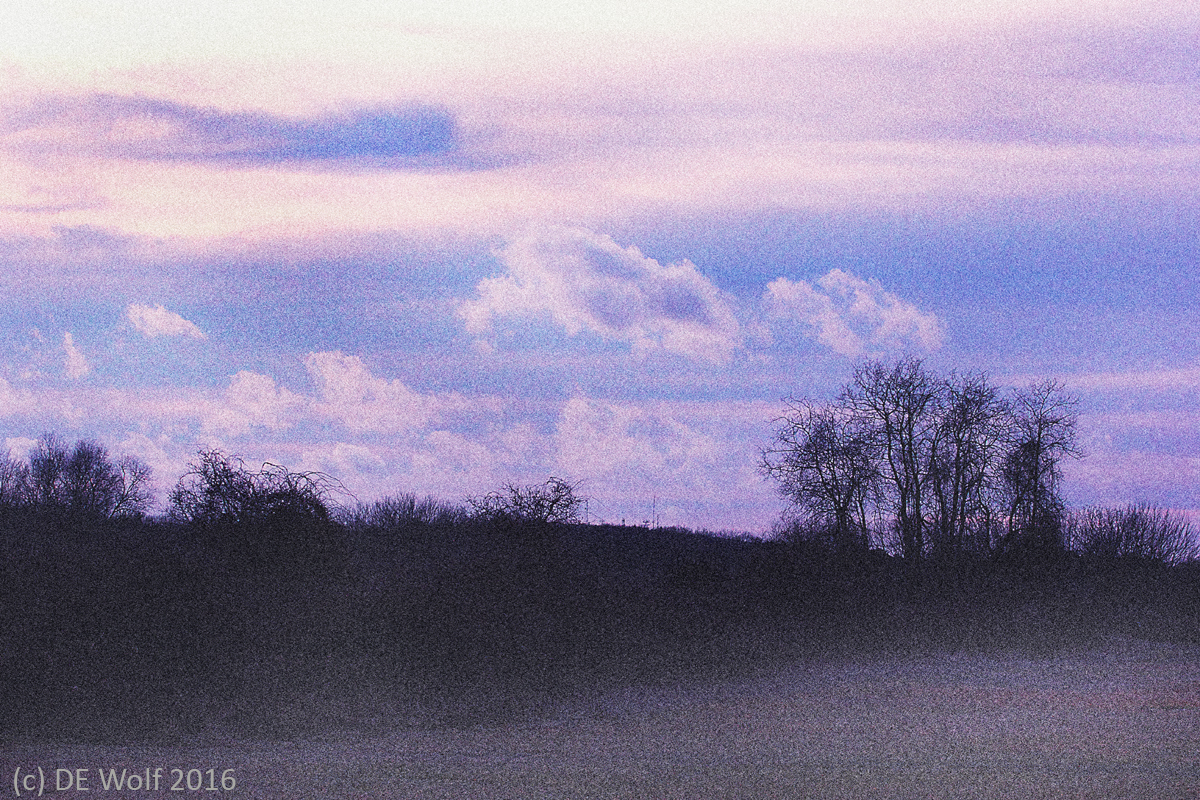
Photo-pictorialism study #3 – Tree line


Figure 1 - Photo-pictorialism study # 4 - Tree line. Heard Farm, Wayland, MA. (c) DE Wolf 2016.

Figure 1 – Photo-pictorialism study # 3 – Tree line. Heard Farm, Wayland, MA. (c) DE Wolf 2016.

As I have indicated this year’s winter-break was a successful one for me photographically, and I wanted to share today my most recent photo-pictorialist study. This one I took back in December and only this week rediscovered it and “worked it up.” The scene itself was much crisper, but it is the addition of atmosphere that creates the mystery and ambiguity of the image. The scene was taken at dusk but the fogginess evokes a sense of dawn instead.

There is an excellent and succinct description of this style and the role played by atmosphere in an image from Alfred Stieglitz. “Atmosphere is the medium through which we see all things. In order, therefore, to see them in their true value on a photograph, as we do in Nature, atmosphere must be there. Atmosphere softens all lines; it graduates the transition from light to shade; it is essential to the reproduction of the sense of distance. That dimness of outline which is characteristic for distant objects is due to atmosphere. Now, what atmosphere is to Nature, tone is to a picture.”

Photograph or watercolor?

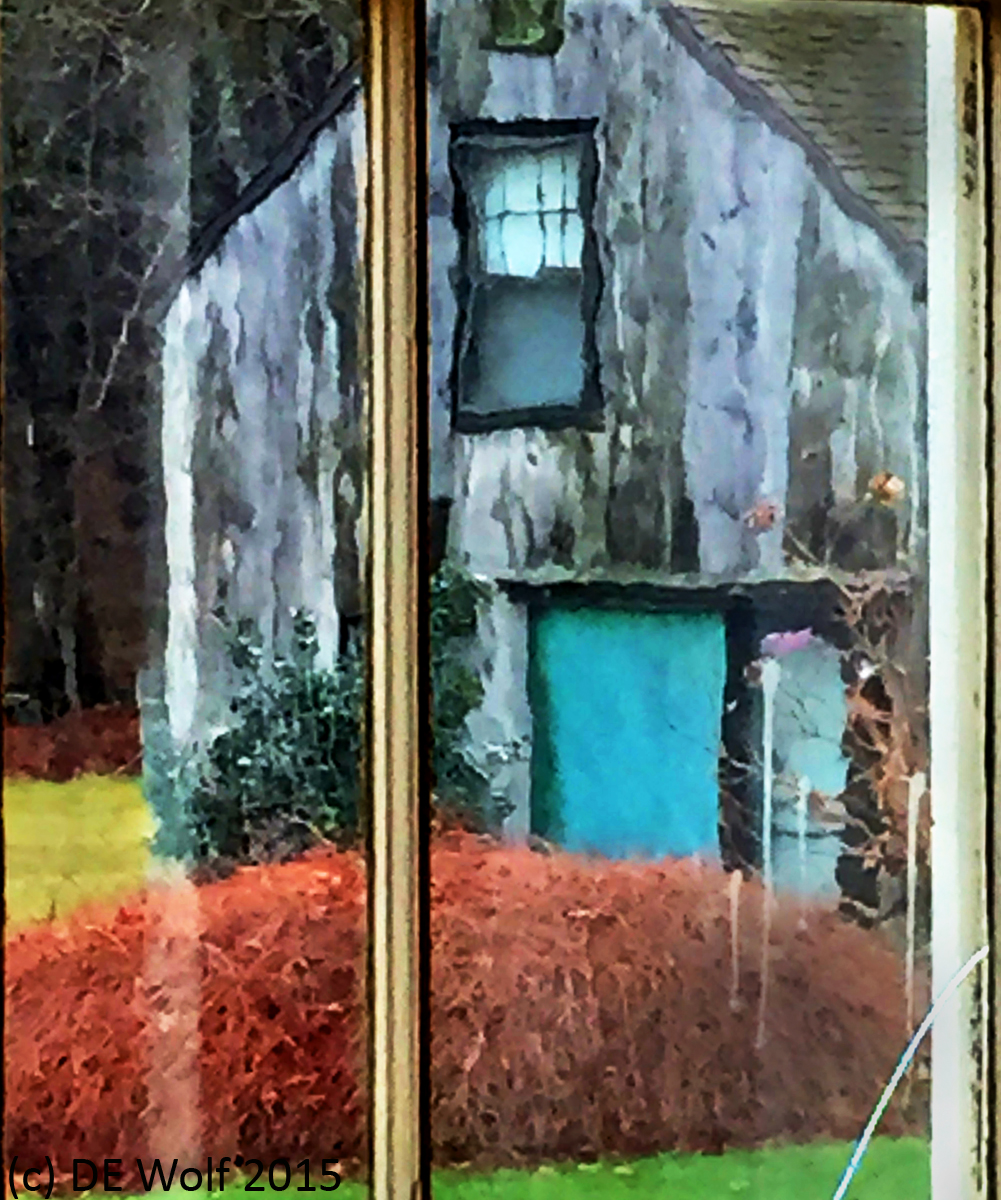
Figure 1 - Pictorialist study #4 - distorted refraction, Sudbury, MA. (c) DE Wolf 2015

Figure 1 – Pictorialist study #4 – distorted refraction, Sudbury, MA. (c) DE Wolf 2015

As it turned out I had a lot of fun taking pictures over the break. You may remember my resolution of having my camera with me more. Well the picture of Figure 1 was, in fact, taken with my IPhone, even though I did have my Canon T2i with me.

I was speaking to a friend when I noticed that the glass in the window, especially when viewed at an oblique angle, distorted the image in a very pleasant fashion. I am told that this particular pane of glass is original and dates back to around 1886 – no jokes here about the distorted world-view of the nineteenth century. They had their illusions and delusion, we ours. The effect makes the photograph look very much like a watercolor. In that regard it may be viewed as a pictorial image, one that imitates or emulates painting. Here of course, the atmospherics that Steiglitz spoke of are created not with atmosphere or fuzzy noise but with distortion by refraction. This point seems significant. There is a dichotomy, that is often two ways of creating a visual effect: one by digital manipulate; the other by optical modification.

The trick to taking the photograph lay in paying close attention to the window frame. It was essential to be both perpendicular to the floor and parallel to the sides. This is why I feel that using my IPhone is not that different from using a large format or view camera.The intensity of the color comes from a bit of additional saturation. I feel that it is often essential to reproduce what the mind rather than the eye sees. I am actually both happy and enchanted by the results.

The details amaze me. There is the crack in glass and the smudges. And then there is the dried flowers of last summer just visible on the right hand side. All of these I think subtly make the composition. As for the question whether the image is a photograph or a watercolor then I have succeeded.

Trying the sunset in black and white

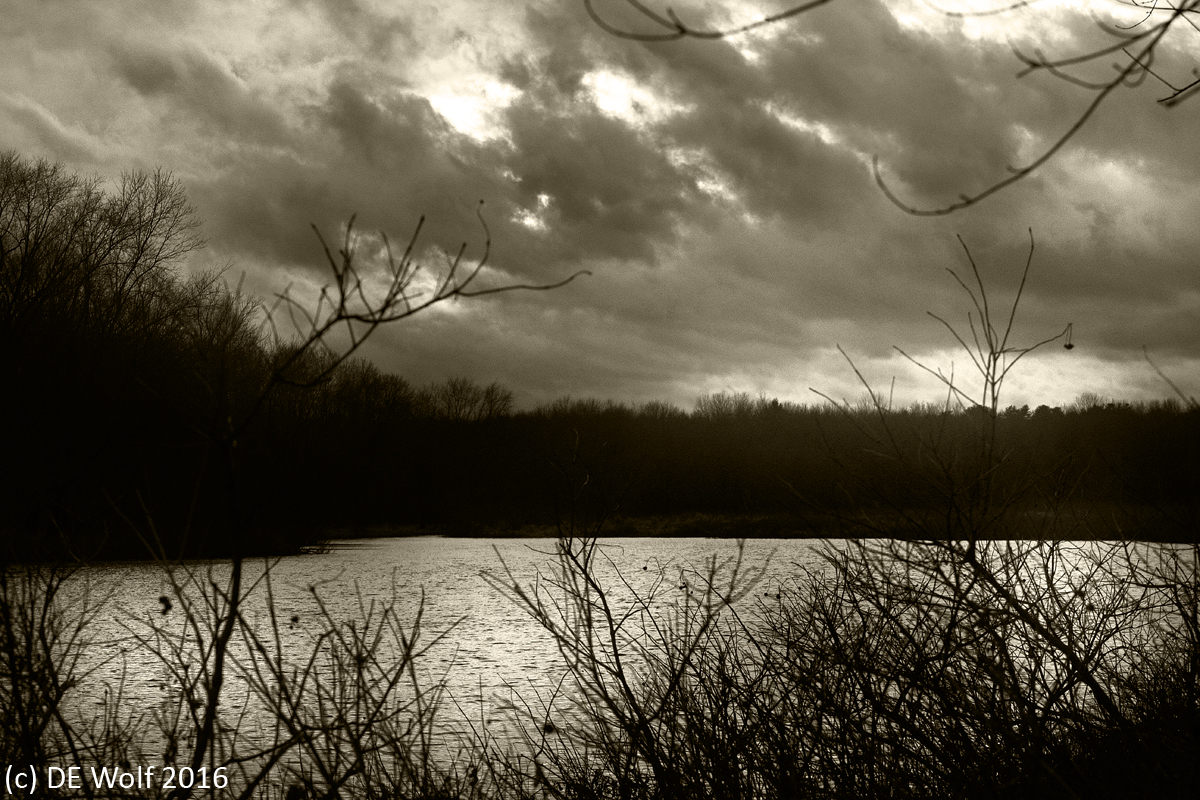
Christmas Eve 2015, Sunset along the Sudbury River, Heard Farm, Wayland, MA. (c) DE Wolf 2016.

Christmas Eve 2015, Sunset along the Sudbury River, Heard Farm, Wayland, MA. (c) DE Wolf 2016.

I absolutely promise that I will not spend the entire year posting sunset photographs that I took on a very warm Christmas Eve along the Sudbury River. I was, in fact, all set to stop when I was looking over my proofs from the event and decided that I had to try one in black and white.

What had originally drawn me to the scene were some striated patterns in the clouds where the sun was leaking through, and it seemed that this would develop better in black and white. I loved the dynamic range of the original images immediately – the power of 14 bit dynamic range – and I went to work.

A truism of sunset photography is that you need to anticipate the scene. The actual image appears as the sky will look perhaps 30 to 60 min later. So here the “world” is a lot darker. And I have to say I love it. The final image is lusciously velvet in its blacks, sparing but brilliant in its whites. I used just a bit of sepia toning.

Canon T2i with EF70-200mm f/4L USM lens at 70 mm, ISO 1600, Aperture Priority AE Mode, 1/2500th sec at f/7.1 with -1 exposure compensation.

Reliving my youth and catching the light

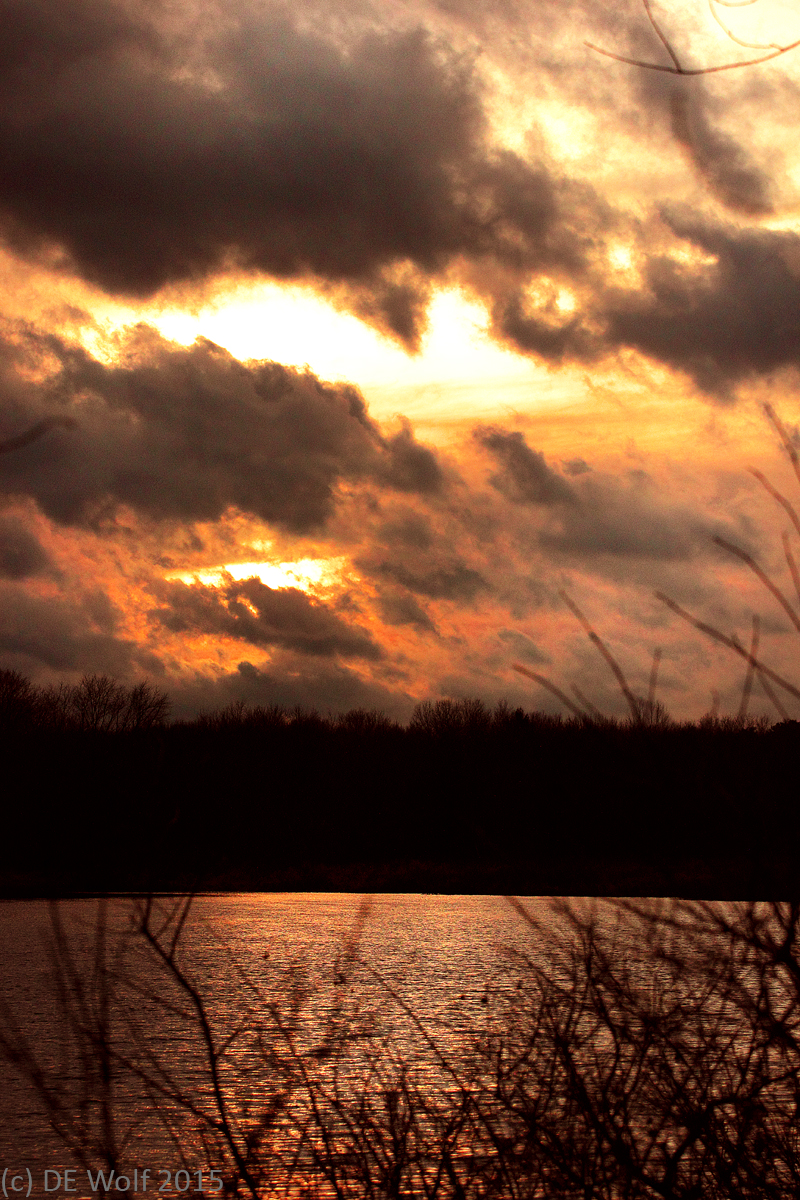
Figure 1 - Christmas Eve sunset # 3, Heard Farm, Wayland, MA. (c) DE Wolf 2015.

Figure 1 – Christmas Eve sunset # 3, Heard Farm, Wayland, MA. (c) DE Wolf 2015.

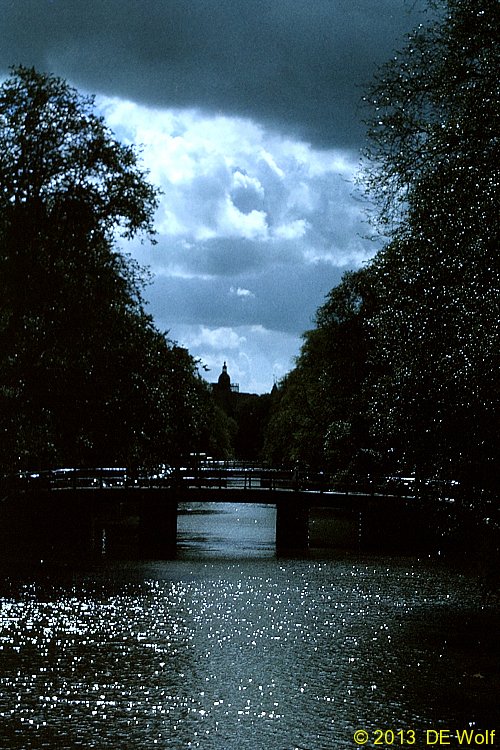
I have always felt that the best analogue photograph of my “youth” was a picture that I took from a bridge over a canal in Amsterdam, NL. The light was truly there in its luminous glory for an instant and I went into automatic mode and well was lucky, I guess. In a sense every photograph that I have taken since, I am trying to recapture that moment.

Yesterday, I posted a photograph of our Christmas Eve 2015 in New England and there are two more images of that sunset that I would like to share.  The first is Figure 1. Taken at Hear Farm in Wayland, Massachusetts from down along the Sudbury River, it shows the sun breaking through the clouds and reflecting off the water. As I was looking through the viewfinder I was thinking of that wonderful moment in Amsterdam 45 years ago with my Leica.

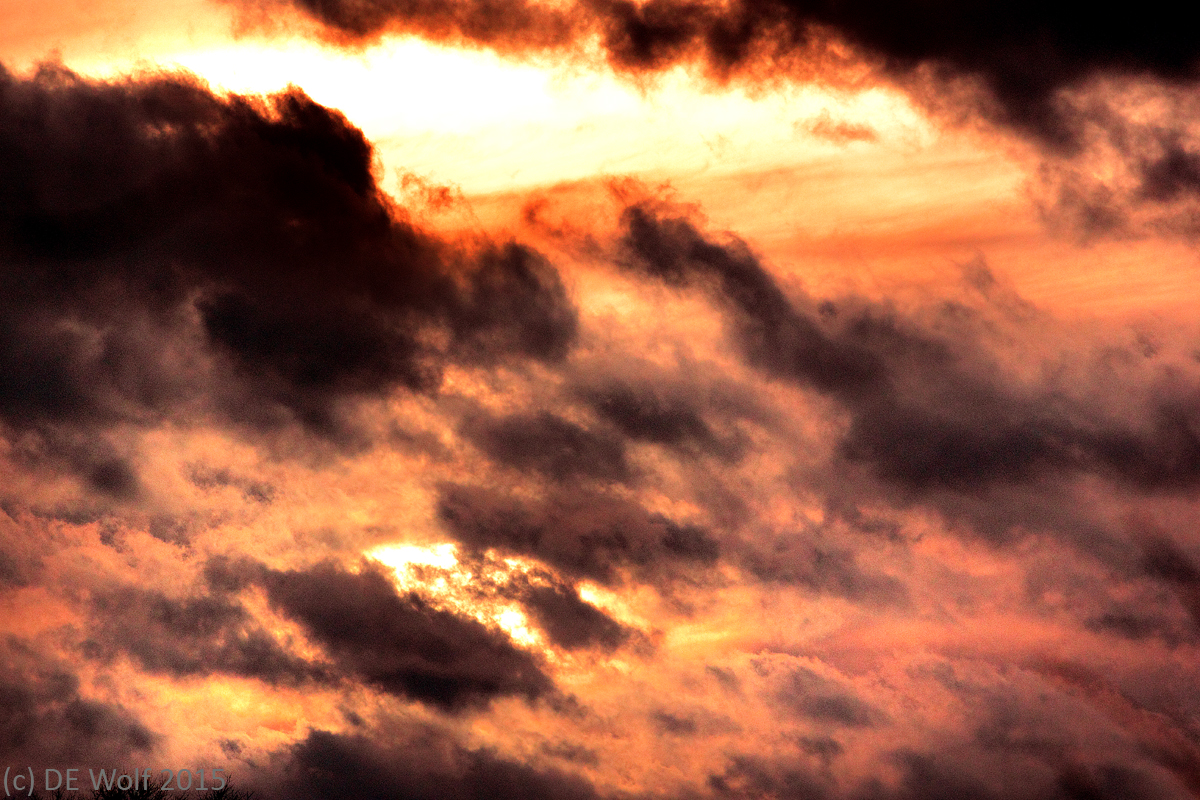
This image is meant to evoke the primordial mix of water and sky. It is also meant to capture the peculiar sense of a world meant to be cold and dark instead being warm and if not dark then illuminated. The sun appears as if it is boiling away the clouds. And this is stated more strongly in a telephoto zoom of the same clouds a few moments later when the sun’s disk becomes visible.

Figure 1 - Christmas Eve sunset # 2, Heard Farm, Wayland, MA. (c) DE Wolf 2015.

Figure 2 – Christmas Eve sunset # 2, Heard Farm, Wayland, MA. (c) DE Wolf 2015.

Figure 1 – Canon T2i with EF70-200mm f/4L USM lens at 70 mm, ISO 1600, Aperture Priority AE Mode, 1/3200 at f/7.1 with -1 exposure compensation.

Figure 2 – Canon T2i with EF70-200mm f/4L USM lens at 200 mm, ISO 1600, Aperture Priority AE Mode, 1/4000 at f/7.1 with -1 exposure compensation.

Photographic resolutions for 2016

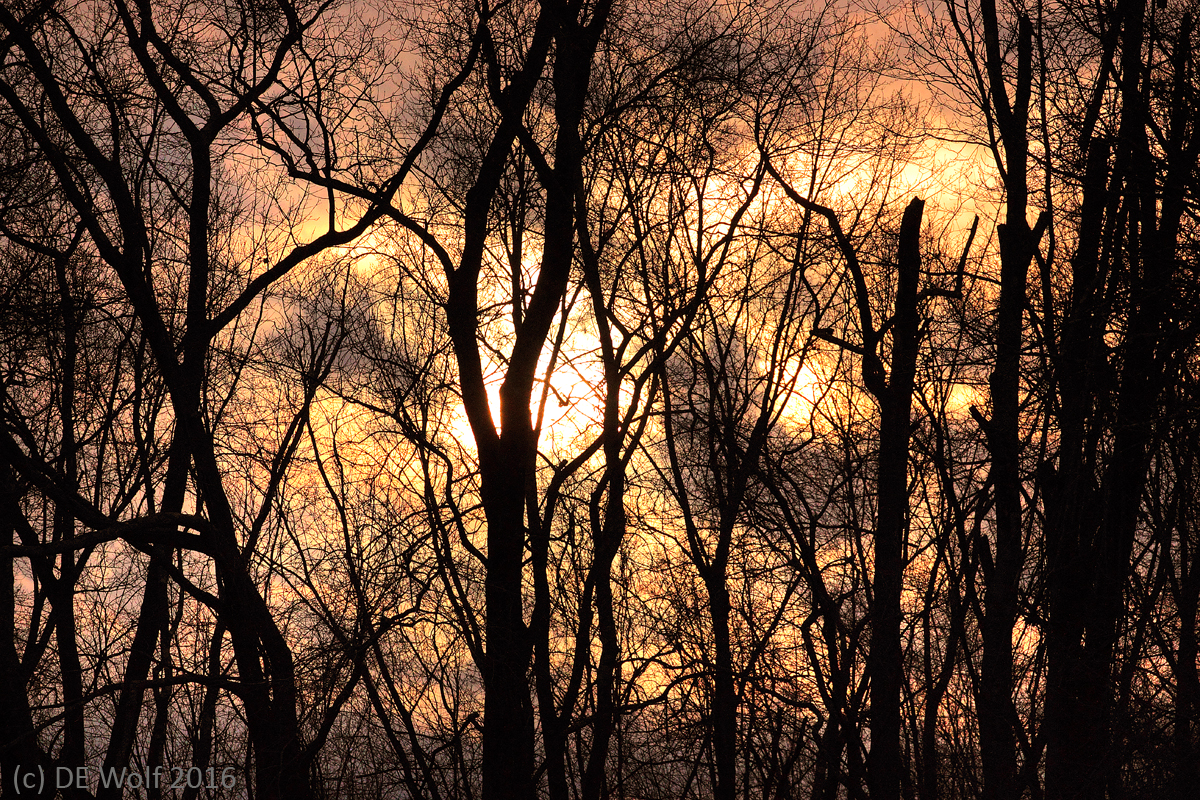
Figure 1 - Sunset through the trees Christmas Eve 2015, Heard Farm, Wayland, Massachusetts. (c) DE Wolf 2016.

Figure 1 – Sunset through the trees Christmas Eve 2015, Heard Farm, Wayland, Massachusetts. (c) DE Wolf 2016.

January 3, 2016 and it’s time to take stock in how I did on my photographic resolutions for 2015 and to make new or continued one’s for 2016.

Beginning with last year’s resolutions, we have:

  1. Focus on seeing.  Well, as I said last year: I think that this always must be there. Seeing and visualizing are really what photography is about – seeing the scene and visualizing how it is going to translate to the final picture. This is complicated, in that the visualized image is in your mind, so part of the process is formalizing how you are going to use your technical skills to achieve it – or to learn those skills. I am going to give myself a B+ on this as there is a lot of room for improvement. That after all is the real adventure.
  2. Spend more time taking photographs and have my camera with me more often. Another B+. I have become much better at this, but not perfect. Of course, the IPhone helps a lot.
  3. Slow down, concentrate on composing the image, on setting and checking the light. And yes, learn more about the camera controls, the one’s you don’t use, but should. This remains the key and is a lifelong lesson. Yes, indeed. I have been working a lot on this.  I always set my camera for bird photography, so as not to miss anything and when I am confronted with something else, I do think. First is invariably which set of focus points I need – set those. Often, I drop the ISO from my default 1600 bird ISO to achieve a less “grainy” image. What should be given priority exposure time or f-stop? Take the first images. Do I need exposure compensation or greater depth of focus? Do I need to shift viewpoint or from “landscape” to “portrait.” I start to worry about the framing of the image – about lines at the edges, tilted or rotated lines in the image. I review the image, zooming in to check the sharpness. I have started to notice a curious fact. I see something and visualize what I want. I start to take images. But typically this comes to an abrupt stop when I realize that I have gotten exactly what I want. So in a sense the whole image concept builds up. It isn’t a random snap, snap, snap. You could argue that more of the process should be visualizing through the lens and less by taking pictures. But that is the luxury of digital “35 mm” – quotes because it isn’t really that. OK, I’m so proud of myself – how about an A- here?
  4. Continue to learn to photograph trees.  They remain the most worthy of subjects – always, always.  I thought that I would celebrate them here with a picture that I took on Christmas eve at Heard Farm in Wayland, Massachusetts of the sun beginning to set. Again an A-!
  5. Work more on portraiture. I have tried hard to do this and as my “En Persona Gallery” and “The Swap” project with Donna Griffiths indicate I have had some decent success. I think I need to learn more technically about portraiture and to use more of the tools. So B+.
  6. Learn and utilize strobe-light techniques in portraiture. Those are some of the tools that I am talking about along with umbrellas and the like. Sorry, Wolf – only a C for this and that is probably a gift.
  7. Continue to photograph birds and to develop better technique. I think that I have had some good success with this, and in particular have learned how to use my mid-range zoom to better effect rather than struggling with the big lens. So here I give myself an A.

So now the big question is where to go next ,and I will make the following resolutions, many being continuations of last year.

  1. Focus on seeing.
  2. Spend more time taking photographs and have my camera with me more often.
  3. Slow down, concentrate on composing the image.
  4. Continue to learn to photograph trees.
  5. Work more on portraiture, learn more about the deliberate techniques.
  6. Continue the fun adventure of photographing birds.
  7. Go further with the pictorialism photography project.
  8. Learn more about using layers in imaging crafting Photoshop.

Well, that’s all for now. It is the first weekend of the year, and I had better get out and take some photographs.

Happy New Year, everyone!

Figure 1 – Canon T2i with EF70-200mm f/4L USM lens at 168 mm, ISO 1600, Aperture Priority AE Mode, 1/4000 at f/7.1 with no exposure compensation.

Backing out of the driveway – First snow winter of 2015/6

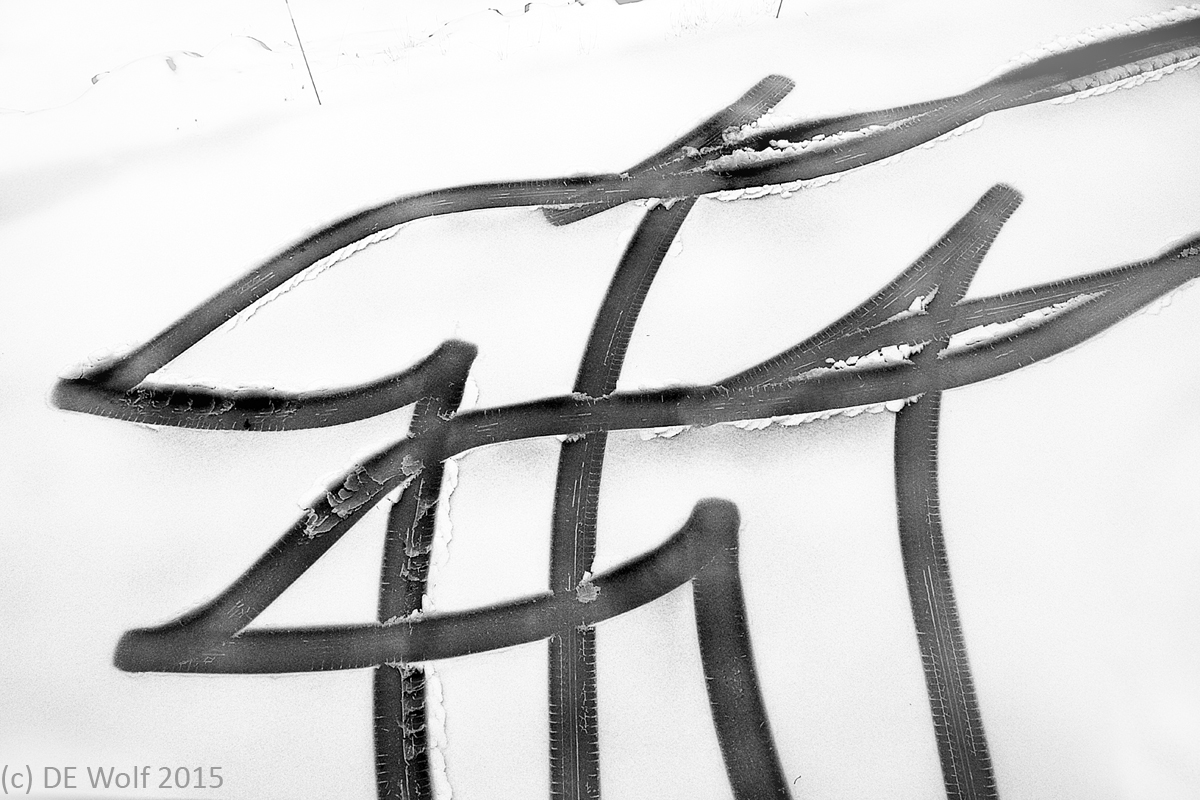
Firgure 1 -

Firgure 1 – Backing out of the driveway – First snow December 29, 2015. (c) DE Wolf 2015.

As many of you know in December this winter the weather has been remarkably warm in Boston. I kept hoping that we could achieve a record breaking December with no snow. But alas, it wasn’t meant to be, and on December 29 we had our first snowfall, which ended up as a slushy mess on the driveway.

I was pondering just how I might depict this less than lovely first coat. My wife had gone out on an errand, and when I saw the tracks of her tires where she had backed out of the driveway, it struck me that I had a novel catch on the theme.  I was excited enough by the potential image that I overcame indolence and not only changed to a wide angle zoom, but I also struggled to remove the screen from the window.

I am pretty happy with the end result. It is an abstract, of course, that reminds me of the parallel paths of a conductor’s baton. Then too, for those of us that drive in this mess, it is symbolic of the not so happy relationship between cars and snow.

At a technical level, I was surprised that the image did not, as most snow scenes do, require exposure compensation. In the case of snow this is a step or so over exposure, but not here! The image demanded pure black and white, that is no toning

Canon T2i with EF-S18-55mm f/3.5-5.6 IS STM lens at 24 mm IS on, ISO 200 Aperture Priority AE Mode 1/320th sec at f/7.1 with no exposure compensation.