Dark eyed junco – Junco hyemalis

Figure 1 - Dark eyed junco, Sudbury, MA, April 2015. (c) DE Wolf 2015.

Figure 1 – Dark eyed junco (Junco hyemalis), Sudbury, MA, April 2015. (c) DE Wolf 2015.

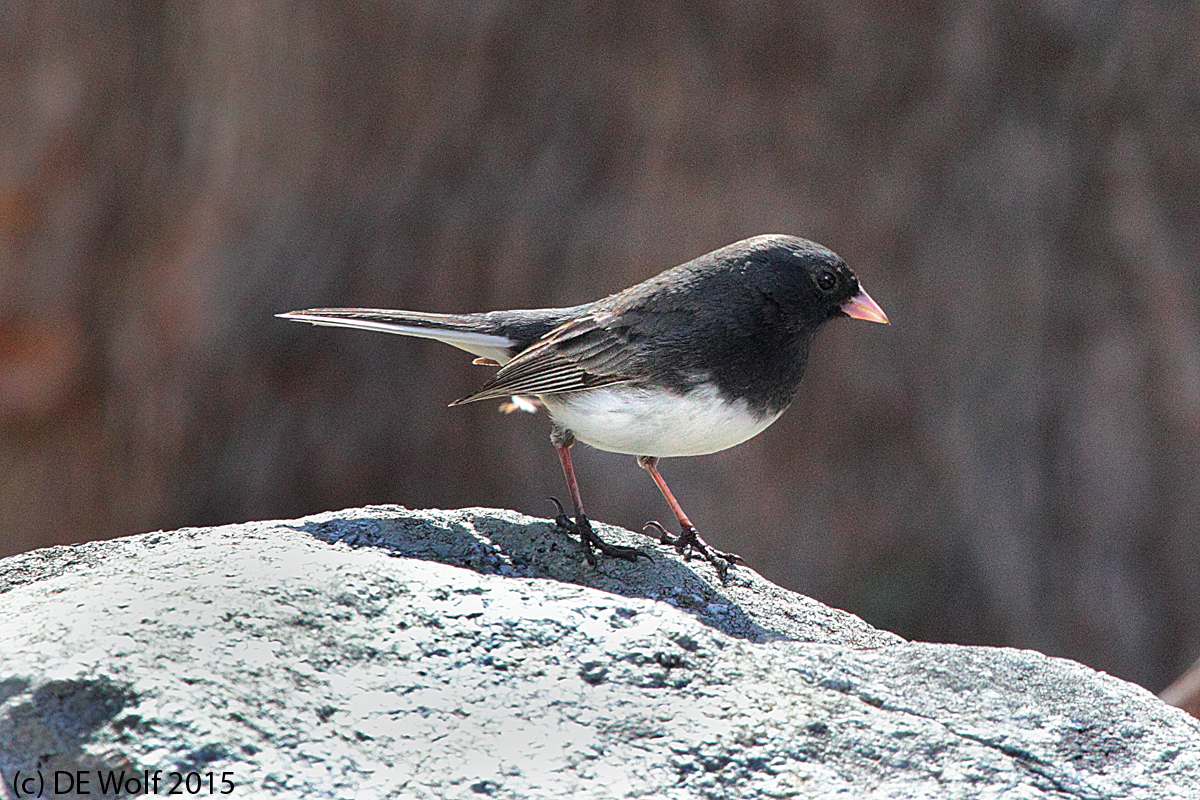
All winter long I have been trying to get a decent photograph of a dark eyed junco (Junco hyemalis).  The problem with him is within his name.  His eye is so dark as to be often invisible, especially when he is photographed against the snow, where the contrast can be overwhelming.  Still this little sparrow is a very appealing little bird.  The males have this dramatic slate color to them, that is truly anything but drab.

On Sunday I continued experimenting with by big lens.  I have discovered it works a lot better when manually focused.  This actually proved not be as difficult as I thought.  I had positioned myself in a lawn chair in front of my feeder.  I had read that birds are not as wary of you when you are seated as opposed to standing.  Well so much for that theory.  Still this littel guy was gregarious enough to pose for a photograph.  The lack of snow enabled me to eliminate the need for overexposure, and remarkably the image of Figure 1 was taken hand-held. I used every post=processing trick that I know of to get the image to come out right, that is with a clearly visible eye.

Canon T2i with EF100-400mm f/4.5-5.6L IS USM Lens hand-held at 400 mm IS on, ISO 1600, Aperture-Priority AE mode at 1/500th sec at f/10.0 with no exposure compensation and manual focus.
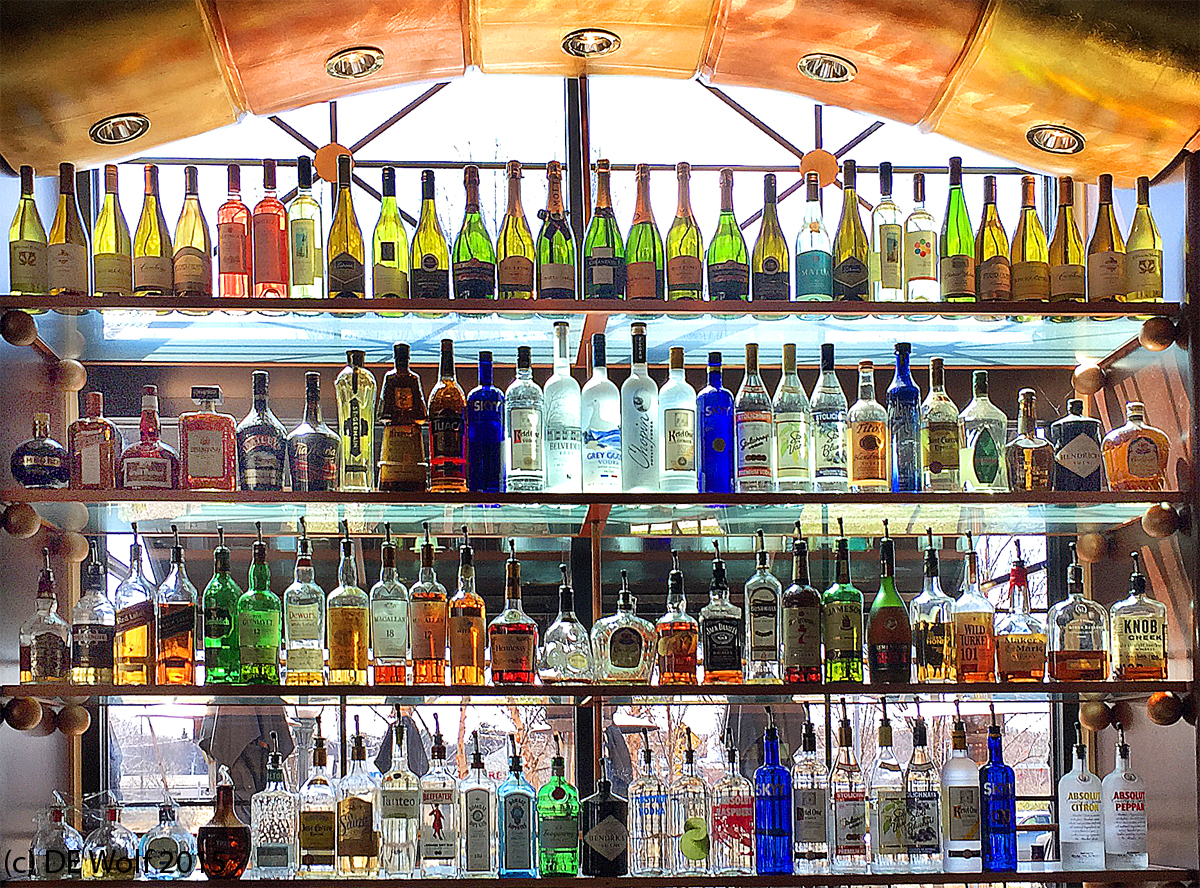
The altar of the god EtOH

Figure 1 - Alta of the god EtOH, Natick, MA. (c) DE Wolf 2015.

Figure 1 – Altar of the god EtOH, Natick, MA, IPhone photograph.. (c) DE Wolf 2015.

As I have said before the good thing about cell phone cameras is that they are always with you- always ready to take a photograph.  The bad thing, of course, is their lack of control, especially optical zoom.  Still while the world awaits the new cell phones with this zoom feature, we may be content to photograph within the camera’s limitations – after all the camera’s limitations are really our own. Now doesn’t that smack of profundity?

Saturday, my wife and I were having lunch at The Cheesecake Factory – made newly famous, I suppose, by Penny and Bernadette on “The Big Band Theory.The CheeseCake Factory decor is faux or pseudo-Egyptian.   suppose that this is meant to conjure up exotic mental images of a twenties style speakeasy, when the world was gaga about the discovery of King Tut’s tomb.  I was struck yesterday by the backlighting on all of the liquer bottles at the bar.  It required quite a bit of roatting and tilting to get the perspective right.  That, thanks to Adobe Photoshop, and then there was the cropping.  the result of all of this is Figure1, which in tribute to the Egyptian polytheist view of the world I have dubbed: “The Altar of the god EtOH.”

Mockingbird – Mimus polyglottos

Figure 1 - Mockingbird, Mimus polygllottus. Fresh Pond Reserve, April, (c) DE Wolf 2015.

Figure 1 – Mockingbird, Mimus polyglottos. Fresh Pond Reserve, April, (c) DE Wolf 2015.

The mockingbird of Figure 1 was a very obliging fellow. Usually the birds keep their social distance, but this one came surprisingly close, although he did prefer the cover of the bush. He did fool me for a very long time.  One of the photographs that I took of him showed a red cap on his head, and I kept searching the bird guides for a red-capped bird that resembles a mockingbird.  Finally, I realized that the red was due to an out of focus tree bud.  I guess that in fooling me he lived up to his name – in sight if not song.

When I was in grade school we did a school play about Abraham Lincoln and this made a big deal over the fact that “listen to the Mockingbird,” a ballad at the time of the American Civil War was a favorite of Lincoln’s. So I kept that with me and was delighted when I moved to Maryland years ago by all the mockingbirds there.  They do often fool you with their mimicry – the mime of many languages.

That play was my great stage debut.  I had one line “No comment,” which I said with great emphasis.  The part at least was speaking.  A friend Scott S. got to play a statue of Lincoln, and passed out with a great crash to the floor. Grade school was so much fun in those days.

Anyway, just a short time after photographing frazil and pancake ice on Fresh Pond, I am delighted to be photographing equally delighted spring birds.  They are all a flutter, well obviously.  It is spring and the great press to mate and have chicks is upon them. Yesterday, I posted on my Facebook page a photograph of the last of winter’s ice on my back patio.  And it is amusing to examine all the detritus scrapped up by the snow plow and deposited on my lawn this winter into what was once a huge mountain of packed snow.  I finally found the Fitbit cover that I lost while snow-blowing in January.  Unfortunately, it had been crushed by the plow as well.

Canon T2i with EF70-200mm f/4L USM lens at 126 mm, ISO 1600, Aperture-priority AE mode, 1/500th sec at f/10.0, with no exposure compensation.


Reassuring moments in physics #2 – frazil and pancake ice

Figure 1 - Frazil and pancake ice on the shores of Fresh Pond, Cambridge, MA, April 8, 2015. (c) DE Wolf 2015.

Figure 1 – Frazil and pancake ice on the shores of Fresh Pond, Cambridge, MA, April 8, 2015. (c) DE Wolf 2015.

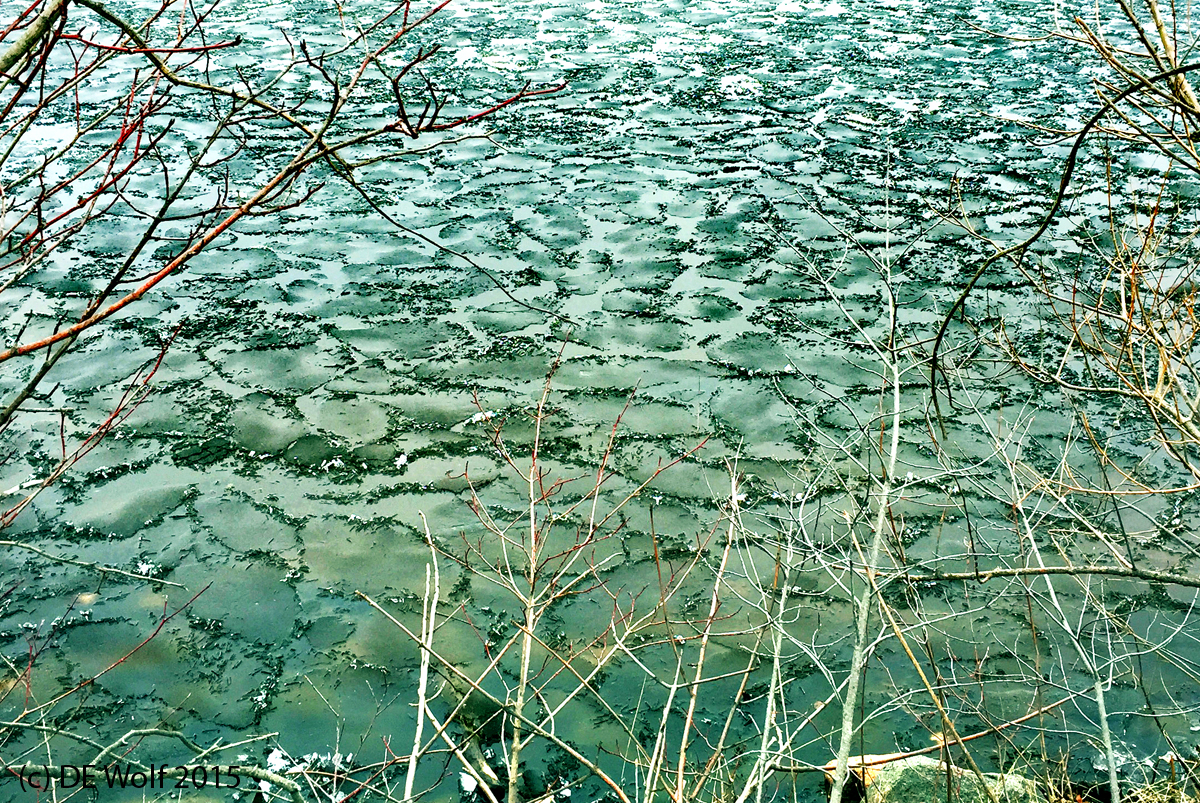
Yesterday was ridiculously cold and miserable.  So much so, that I left my camera behind and went out with the determination to finish my lunchtime walk as rapidly as possible but with enough distance to satisfy the Fitbit tyrant on my wrist.  Hmm! On the other hand conditions were perfect for all the glorious phenomena associated with melting ice.  More reassuring physics awe to sure.  So, to my delight yesterday there were ice pancakes on the pond, and I just couldn’t resist risking frozen fingers long enough to take a few IPhone images. Figure 1 is one of these images and I hope I may be excused the poetic license of a bit of over exaggerated color.  It was all so gloomy otherwise.

Pancake ice! Where does this come from? Well before I say anything more we have to realize that temperatures are such that the water world is ever on the edge of phase transition: ice to water and water to ice.  It is a precarious balance between entropy and enthalpy.  But most significantly, when you see physical structure, ice domains on the surface of a pond, like this you just know that somehow the root cause is going to be the interaction between water molecules on a scale way too small to see.  Therein, lies the reassuring awe that physics gives.

Ice crystals tend to form around particles in the water. It turns out that when things get really cold, but the water is in constant motion, these ice crystals are prevented from freezing into sheets and are pulled under the super-cooled water. Eventually they float to the surface and collect in round flat pancake like-blobs.  These blobs, called frazil, are prevented from further congealing by the currents, winds, and waves.  This is slush.  These pancakes will then cause further freezing where their edges are exposed to the water and as a result become raised.  The pancakes take on the appearance of great Victoria lilies.

Most interesting, perhaps, is that frazil and pancake ice are the start in Arctic regions of so-called sea ice.  Fresh Pond in the regard is a mini-North Pole, which is certainly what it felt like yesterday.

The ducks return to Fresh Pond in Cambridge

Figure 1 - Male Mallard, Little Fresh Pond, Fresh Pond Reserve, Cambridge, MA April 2015. (c) DE Wolf 2015.

Figure 1 – Male Mallard, Little Fresh Pond, Fresh Pond Reserve, Cambridge, MA April 2015. (c) DE Wolf 2015.

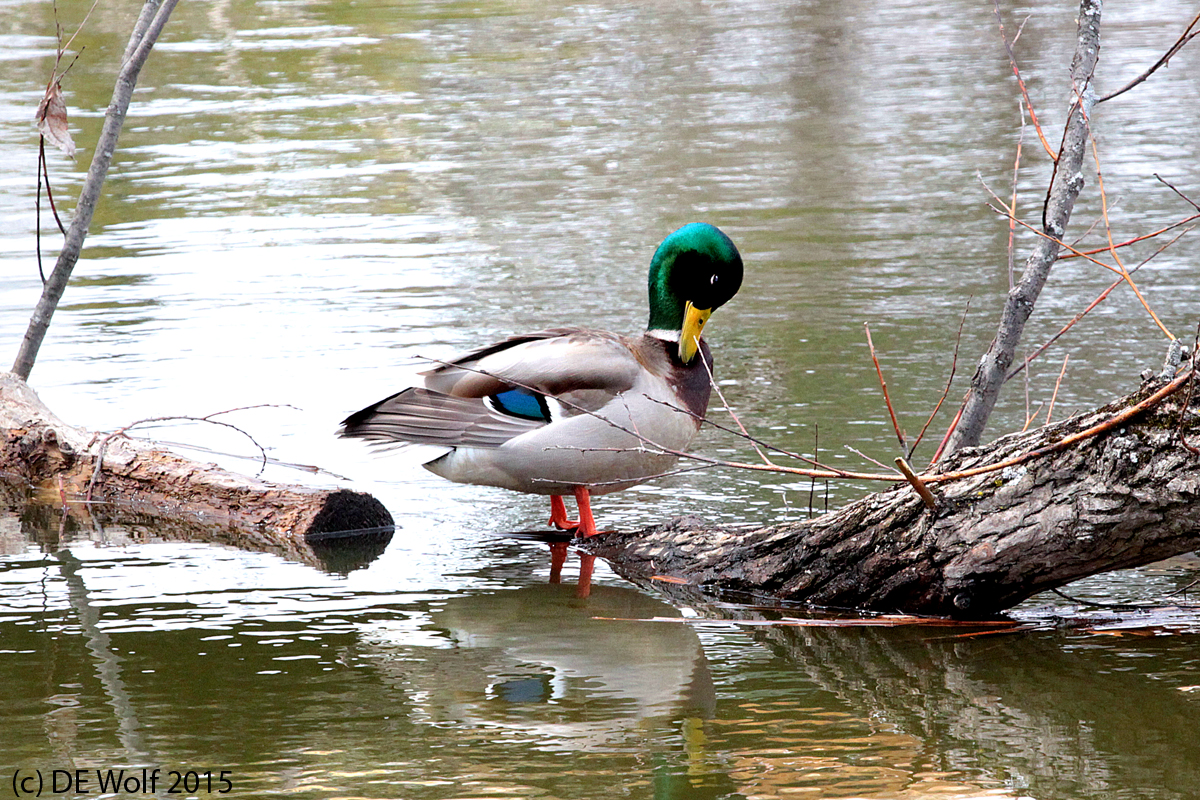
The other day I was walking around a still frozen Fresh Pond in Cambridge, MA and I was wondering just how long it would take the ducks to return after the melt.  The answer is not long at all.  Maybe there’s a link on Travelocity for ducks to check the ice conditions, like snow conditions for skiers.  But no sooner than a significant amount of water opened up, but the water fowl returned.  So far these have included, Mallards, Canadian geese, Herring gulls, American coots, and cormorants.  Yesterday I tried to photograph a coot on a nasty rainy day.  I succeeded in obtaining a grey picture of a grey bird, swimming and diving in grey water that reflected a grey sky.  The grey-test  but not the greatest of photographs.  I did however, find a beautiful male mallard (Anas platyrhyncus) posing and preening himself on a log – clearly to impress the nearby lady mallard.  Mallards are our most common duck, but still beautiful because of their iridescent green heads and the patch of blue on their wings.  As for Figure 1, I am happy with the pose, the scenery, and with the reflection of the bird in the pond.

Canon T2i with EF70-200mm f/4L USM lens at 200 mm, ISO 1600, Aperture-priority AE mode, 1/640th sec at f/10.0, with +1 exposure compensation.


Easter breakfast at Helen’s

Figure 1 - Easter morning at Helen's in Concord. (c) DE Wolf 2015.

Figure 1 – Easter morning at Helen’s in Concord. IPhone photograph. (c) DE Wolf 2015.

After a satisfying night watching the Wisconsin Badgers defeat the Kentucky Wild Cats in Big Four NCAA play, it was fun to get up late on Easter Sunday morning and go with our friend Jane to Helen’s in Concord for Breakfast.  You gotta get there early.  Helen’s has been the breakfast spot in Concord since 1936; so what is that four generations.  It is just a casual family place with good food and no pretension.

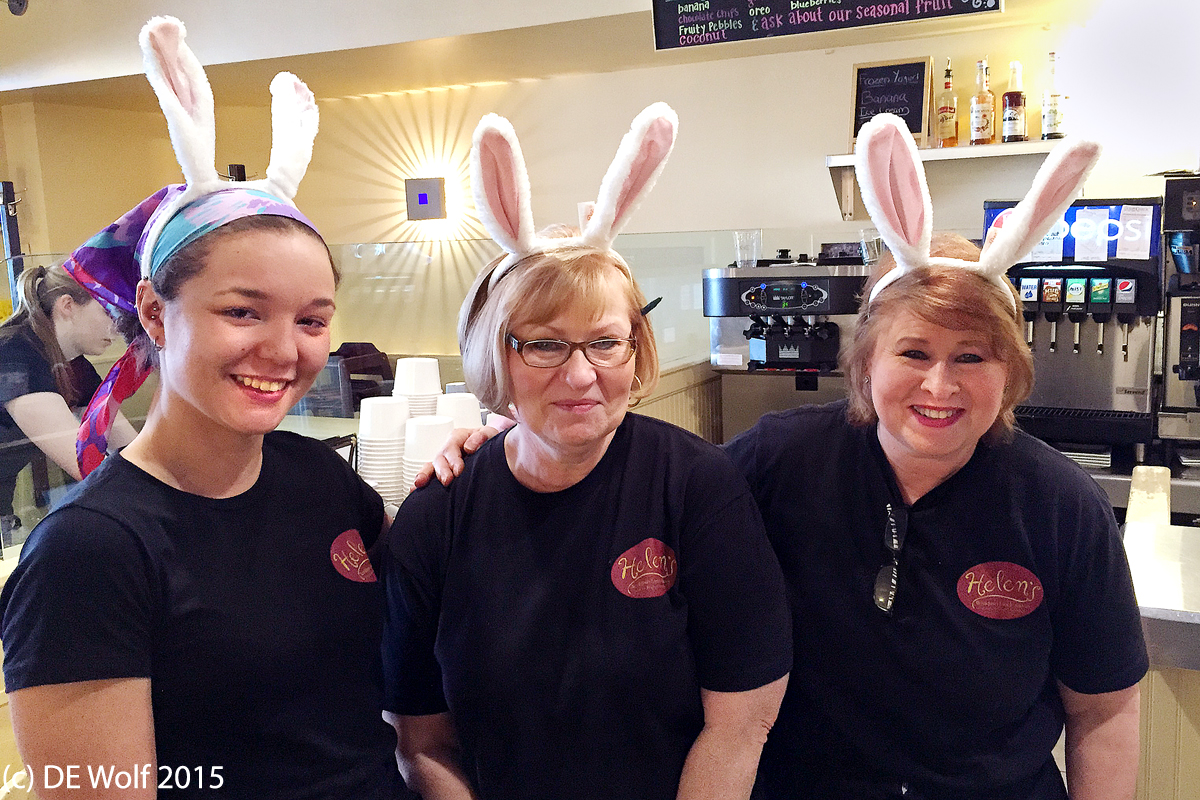
This morning the waitresses were adorned in Easter Bunny ears and I convinced them to pose for an IPhone photograph. Again not a great work of art, just an unpretentious snap shot into a somewhat harsh light. Although I do really like the flare and shadow pattern emanating from the wall fixture.  I had better take a Sunday nap and rest up for Monday’s night championship game, Wisconsin vs. Duke.  At the risk of allienating some of my readers, I have only one thing more to say:

“On Wisconsin!”

The opportunistic fisherman

Figure 1 - The opportunistic fisherman, Little Fresh Pond, Cambridge, MA, (c) DE Wolf 2015.

Figure 1 – The opportunistic fisherman, Little Fresh Pond, Cambridge, MA, (c) DE Wolf 2015.

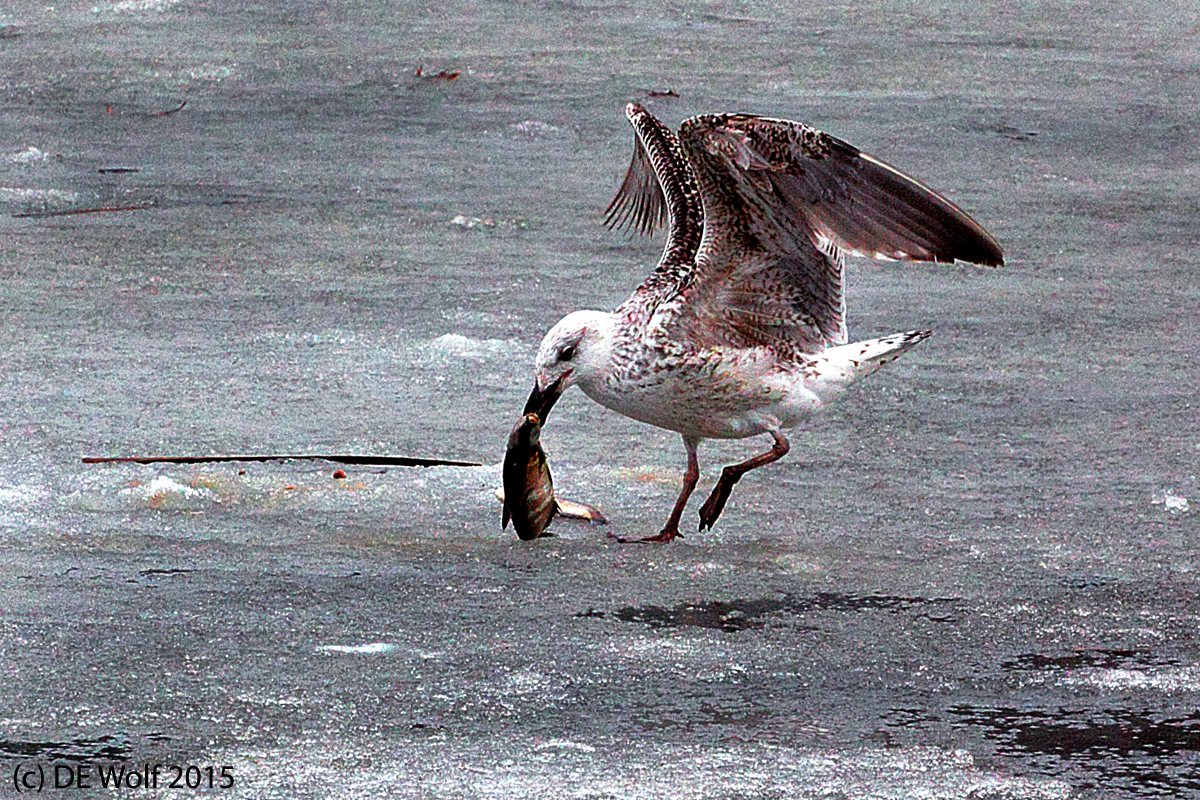
As the ice has been melting on our ponds I have noticed hundreds of dead fish first floating just below the ice and then in the melted water.  It is a disturbing scene but one quite nature.  This is winter pond kill. In shallow pods as ice and then snow block both exchange with the atmosphere and light penetration to fuel photosynthesis, the water becomes depleted of oxygen and the fish suffocate.  It is a gruesome scene, but quite a boon to the sea gulls, such as this herring gull (Larus argentatus), that have flown inland for the feast.

I found this guy on Little Fresh Pond in Cambridge, MA, feasting on not so fresh fish this past Friday.  The light was annoying, very dull and overcast.  But he was happy to pose for me and I kept taking pictures until I got just the right combination of bird, wing, and fish.

Canon T2i with EF70-200mm f/4L USM lens at 145 mm, ISO 1600, Aperture-priority AE mode, 1/1600th sec at f/10.0, with +1 exposure compensation.


Wood and ice

Figure 1 - Wood and ice, Black's Nook, Fresh Pomd Reserve, Cambridge, MA, March 2015. (c) DE Wolf 2015.

Figure 1 – Wood and ice, Black’s Nook, Fresh Pomd Reserve, Cambridge, MA, March 2015. (c) DE Wolf 2015.

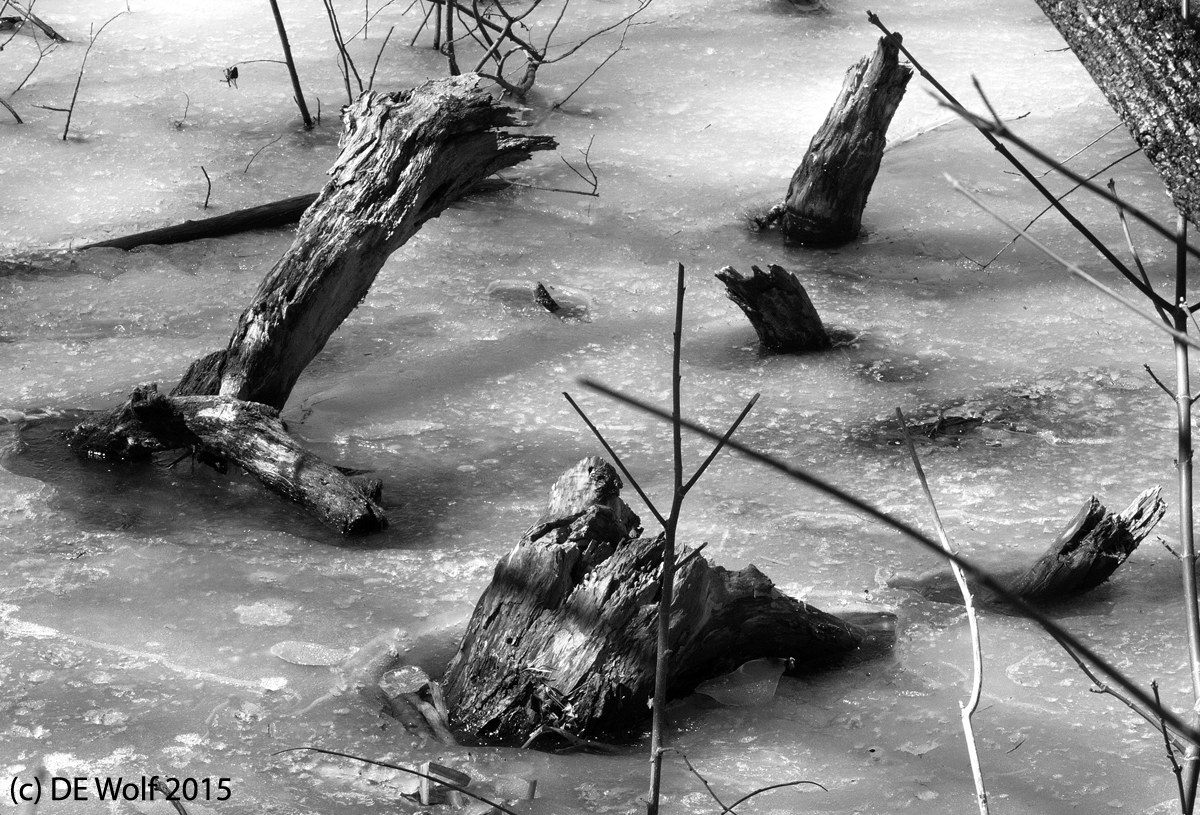
All winter long I have been intrigued by the trees that make their living with limbs dipped into the ponds and frozen in ice. It seems a tough existence, but they have evolved to a niche.  I made several attempts to photograph them but there was just too much whiteness to carry it off the way that I imagined it.  But now the ice is melting and the process has created some gorgeous textures and contrasts. I took the image of Figure 1 this past Monday at Black’s Nook, in Cambridge, MA around noon in a glorious late March light. The wonderful thing about March light as opposed to its counterpart September light is that the trees have not yet leafed out and the bare wood of the forest is bathed in warm sunlight. I debated keeping the original color, but in the end chose the way that I originally envisioned it in pure black and white without toning.

Canon T2i with EF70-200mm f/4L USM lens at 70 mm, ISO 1600, Aperture-priority AE mode, 1/320th sec at f/20.0, with +1 exposure compensation.

The wink

Figure 1 - The Wink, IPhone photograph (c) DE Wolf 2015.

Figure 1 – The Wink, IPhone photograph (c) DE Wolf 2015.

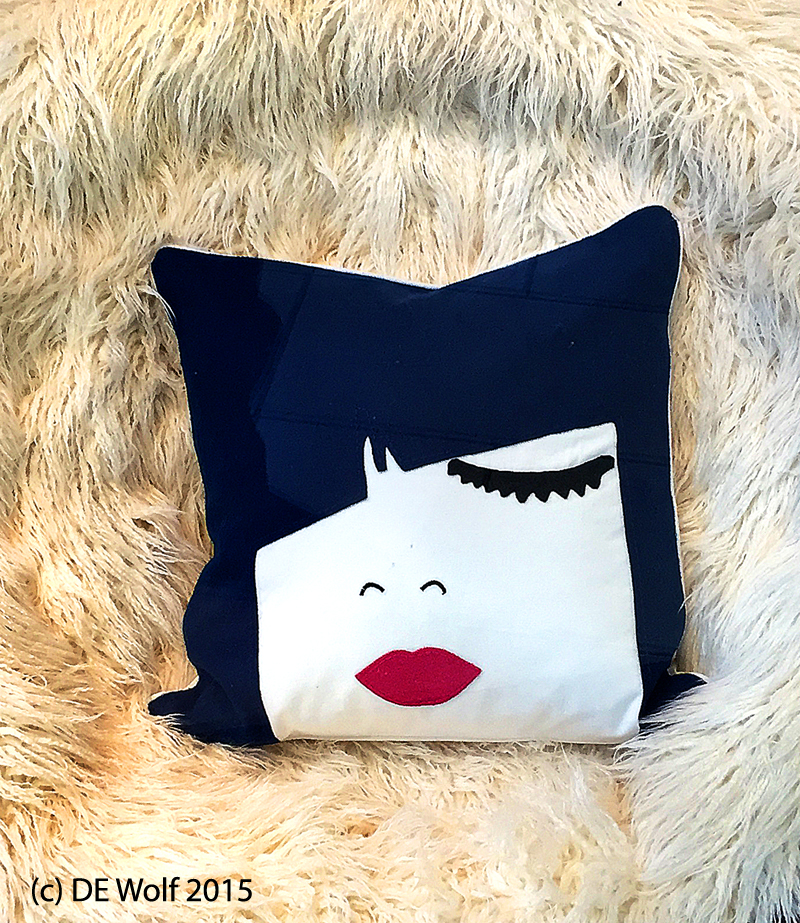
On my Saturday morning walk at the mall I encountered this woman, not quite real.  She was reclining on a furry chair and was ready to wink at all passersby.  I admired her friendly gaze and carmine lipstick that was ever so perfectly applied, as if printed on fabric. Hmm…