Sage

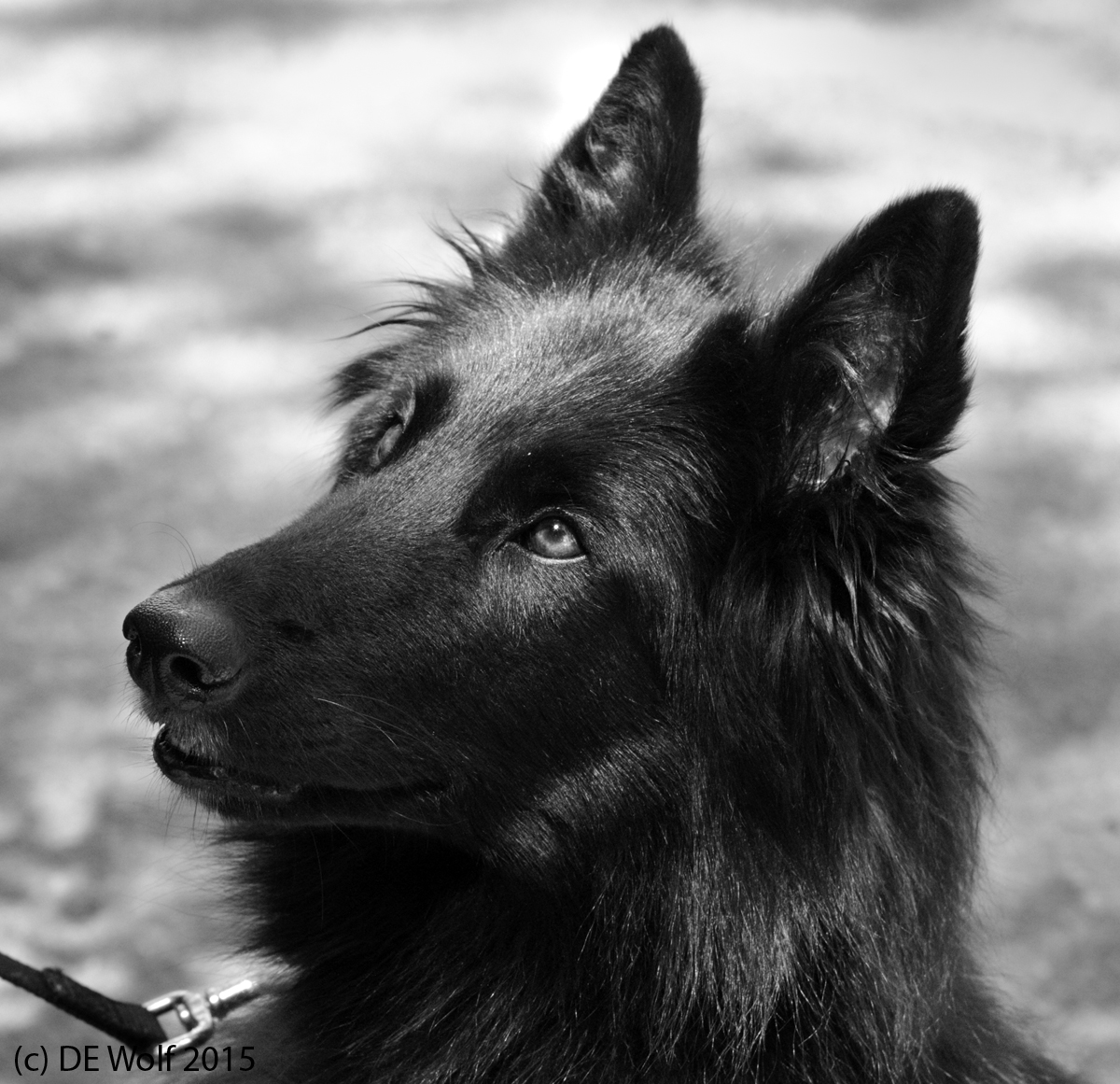
Figure 1 - Sage, Fresh Pond Resevation, Cambridge, MA. (c) DE Wolf 2015.

Figure 1 – Sage, Fresh Pond Resevation, Cambridge, MA. (c) DE Wolf 2015.

These are glorious sultry days, the dog days of summer when the Dog Star, Sirius, rises and the weather can be medicinally hot. People are on vacation; so everything is a little less crowded and maybe just a bit slower. I came upon Max the white dog walker on the path around Fresh Pond, and he was walking a black dog. It was a beautiful dog, a Belgian shepherd named “Sage,” who seemed to know his own beauty. He is a wary fellow and a little aloof. But ever contemplative, he seemed to live up to his name. But after I had given his chin a rub, he decided that I was OK and allowed me both to rub his ears and take his photograph.

Canon T2i with EF70-200mm f/4L USM lens at 70 mm, ISO 1600, Aperture Priority AE mode, 1/800th sec at f/7.1 with -1 exposure compensation.

American goldfinch – Spinus tristis

Figure 1 - American goldfinch, Little Fresh Pond, Cambridge, MA, August 2015. (c) DE Wolf 2015.

Figure 1 – American goldfinch, Little Fresh Pond, Cambridge, MA, August 2015. (c) DE Wolf 2015.

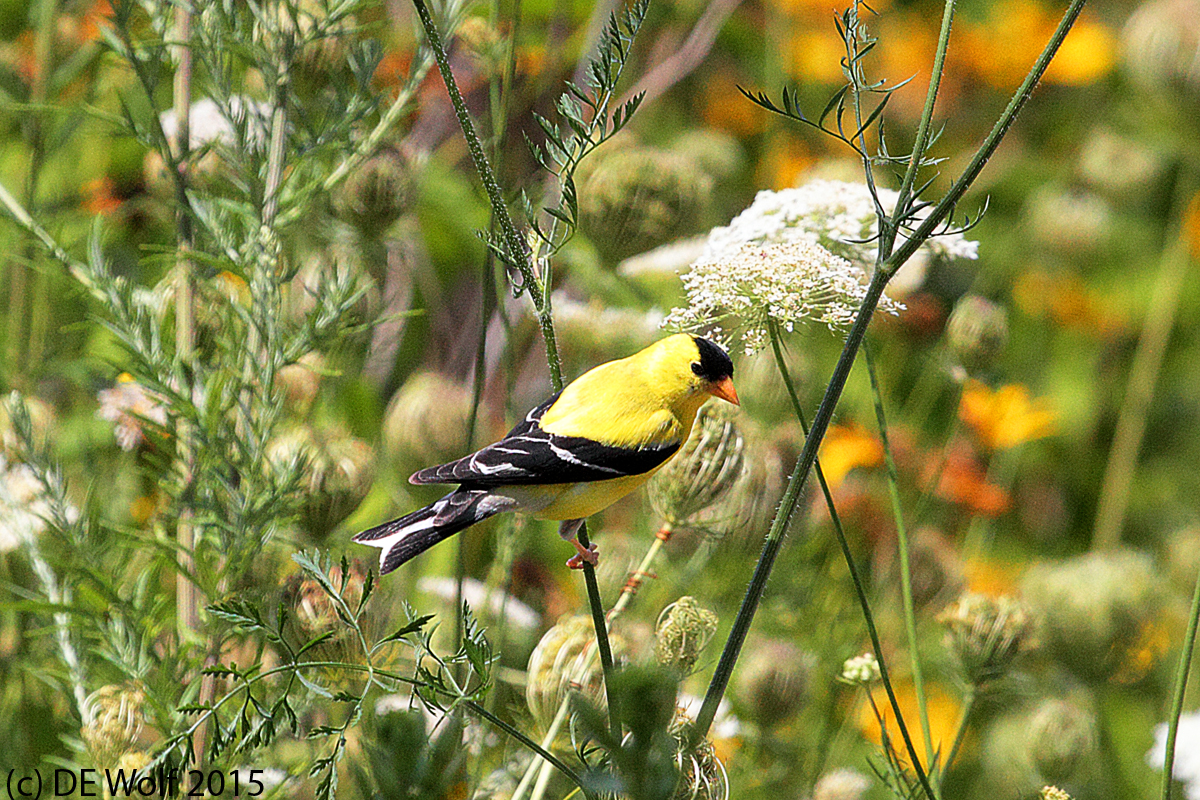
It is early August, and the weather in Massachusetts has been truly gorgeous. After that threatening storm, we got glorious warm and dry days. I was thinking about what defines this time if year. There is a special quality to the August light as the sky transforms slowly from the intensity of July to the mellow glow of September.  And then there is the Queen Ann’s lace in its myriad forms and, of course, it is the time for the goldfinches to show off their peak yellow color. I have tried to capture this sense of summer in this portrait of an American goldfinch – Spinus tristis– Figure 1. I have photographed the goldfinches before at my feeder, where they act as well behaved guests slowly dining on thistle seeds as if in polite conversation. But outside they are much more wary of humans, ever so peripatetic in their motions. You hear their characteristic chirping song, struggle to find them among the flowers or branches, try to frame and focus on them, and they quickly move on, as if you were some annoying paparazzi. This brilliant colored male was kind enough to allow me a few pictures against the perfect background of underbrush and flowers.

Canon T2i with EF70-200mm f/4L USM lens at 188 mm, ISO 1600, Aperture Priority AE mode, 1/4000th sec at f/7.1 with no exposure compensation.


Mammatocumulus over Cambridge

Figure 1 - Mammatus clouds over Cambridge, MA, August 4, 2015, and in the wake of a cyclonic storm over Woburn, MA.

Figure 1 – Mammatus clouds over Cambridge, MA, August 4, 2015, and in the wake of a cyclonic storm over Woburn, MA.

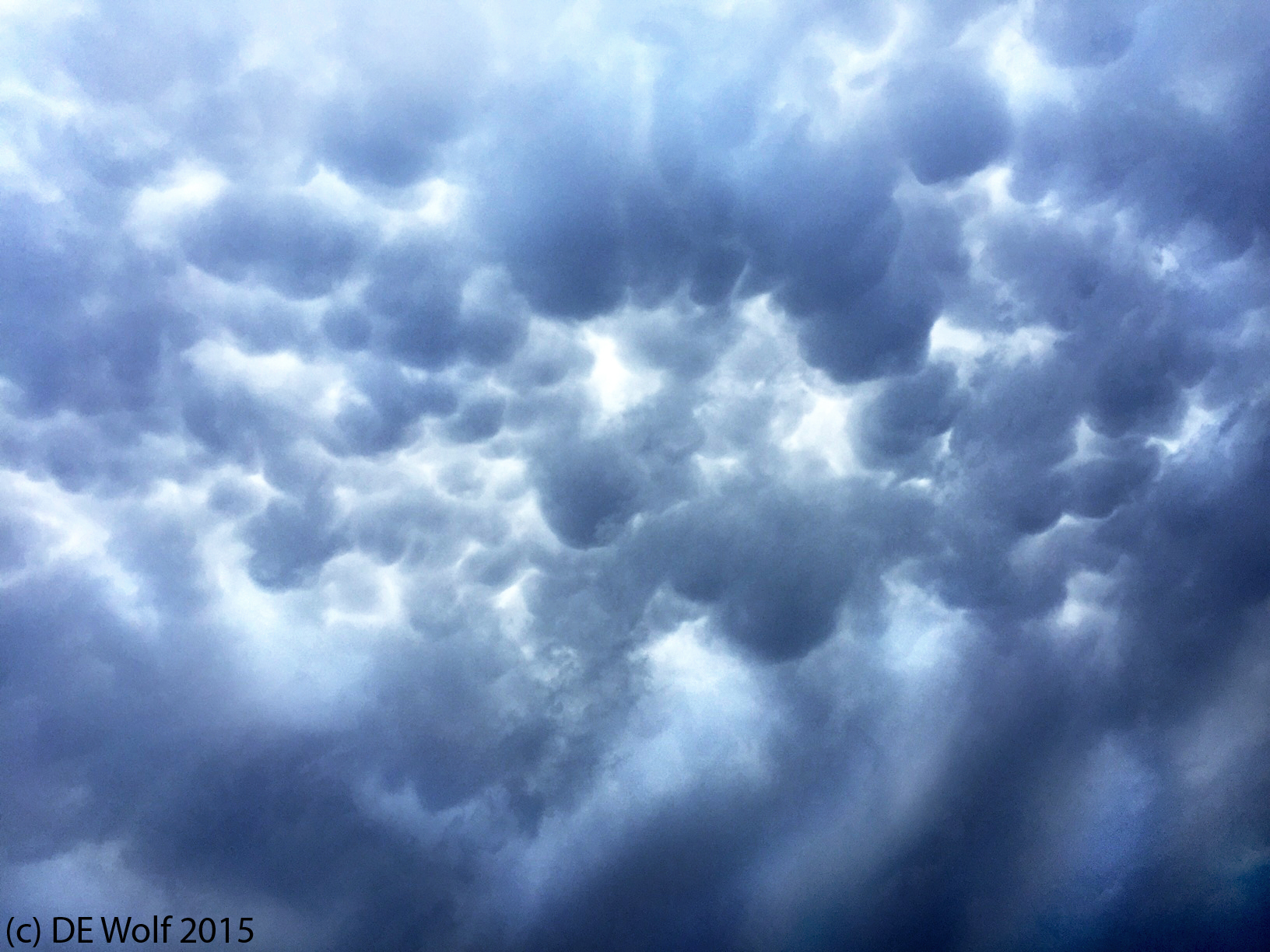
Two years ago, almost to the day, I blogged about mammatocumulus or mammatus clouds.  Mammatus clouds (named because they look like breasts or mammary glands) are patterns of cloud pouches seen bubbling beneath the base of larger clouds. They form following sharp gradients of temperature, moisture, and wind shear.  They can extend for hundreds of miles, and yes, they can mean trouble! I remember thinking at the time, “Oh how beautiful and that these would be spectacular to photograph.”

Fast forward, as Figure 1 illustrates  today I got my chance.  A colleague came into my office to announce that he had just seen on the web that a funnel cloud had been spotted over Woburn, MA, which is northeast of Cambridge. I looked out the window and said, “Hey! Those are mammatus clouds.” We all headed outside (me camera in hand) and were treated to a glorious display of cloud formations and a dark, ominous, and churning sky. My best pictures were taken with my IPhone because of its wide angle. I can now say that I have not only seen but photographically conquered mammatocumulus and they totally lived up to my expectations.

Semipalmated plover – Charadrius semipalmatus

Figure 1 - Semipalmated Plover, Goose Rocks Beach, Cape Porpoise, Maine. (c) DE Wolf 2015.

Figure 1 – Semipalmated Plover, Goose Rocks Beach, Cape Porpoise, Maine. (c) DE Wolf 2015.

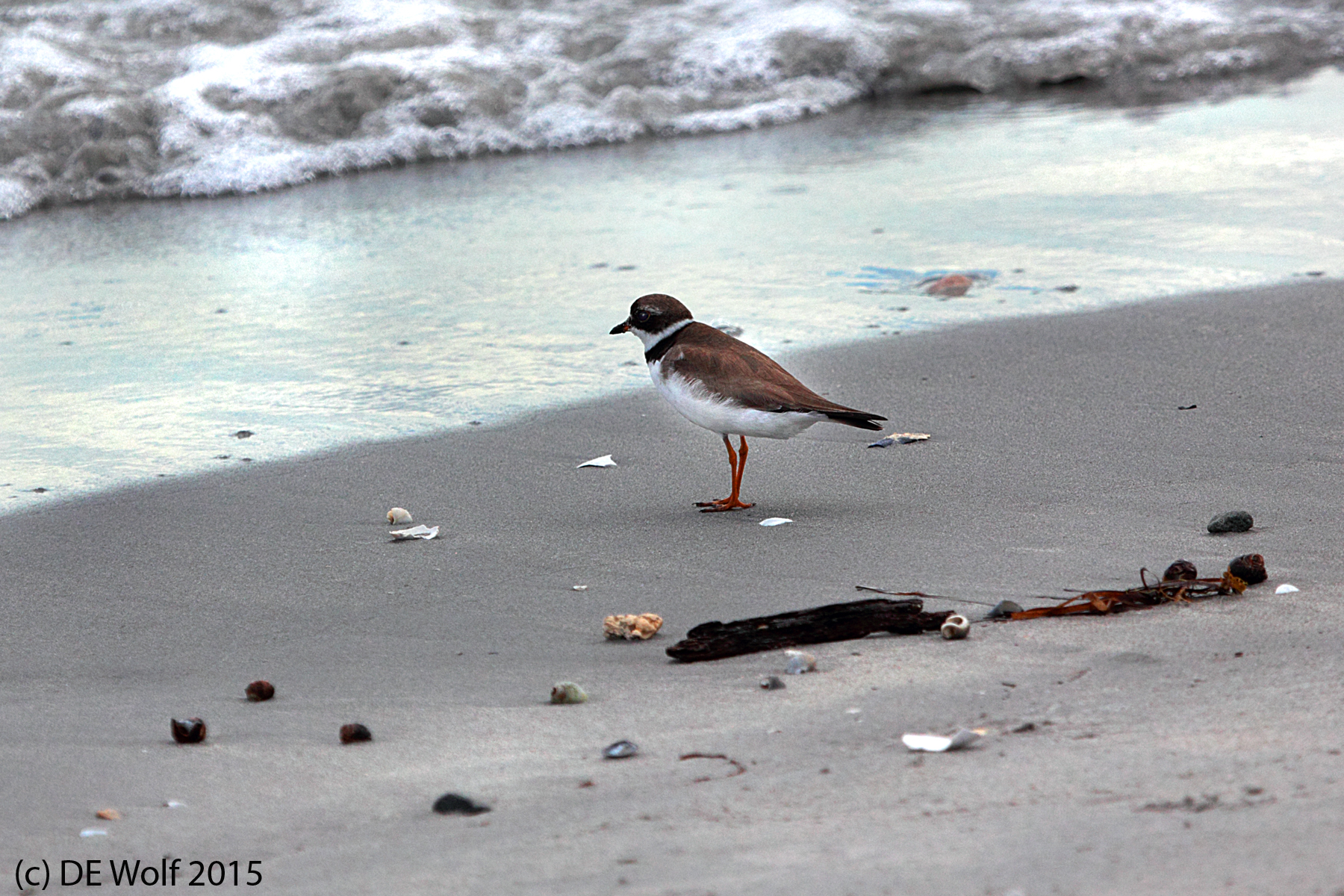
I have one more bird photograph to share from my recent mini-vacation in Kennebunkport, Maine. It shows a semipalmated plover – Charadrius semipalmatus  and was taken with my “big” lens. I love the plovers. They chase along the beach just at the surf’s edge in hunt for whatever is brought ashore. Like many such birds these plovers insist that you maintain an acceptable social distance. And this is not without reason. During the late nineteenth century they were hunted nearly to extinction. Happily the species has made a healthy return.

As for the name “semipalmated,” literally this means a plover with a partial palm. This refers to the fact that the bird’s toes are partially webbed together, creating what looks like the palm of the hand.

What I like about the bird in Figure 1 is that he is looking out to the sea and also the minimalism of the surrounding flotsam. We have a tendency to anthropomorphize and may wonder if he is contemplating the weighty issues of the universe. But I am pretty sure that he is only looking for his lunch and at the same time wary of aerial attack by raptors.

Canon T2i with EF100-400mm f/4.5-5.6L IS USM lens at 260 mm, ISO 400 Aperture Priority AE Mode 1/1600th sec at f/6.3 with no exposure compensation.

Snowy egret – Egretta thula

Figure 1 - Snow egret, Kennebunkport, Maine. (c) DE Wolf 2015.

Figure 1 – Snow egret, Kennebunkport, Maine. (c) DE Wolf 2015.

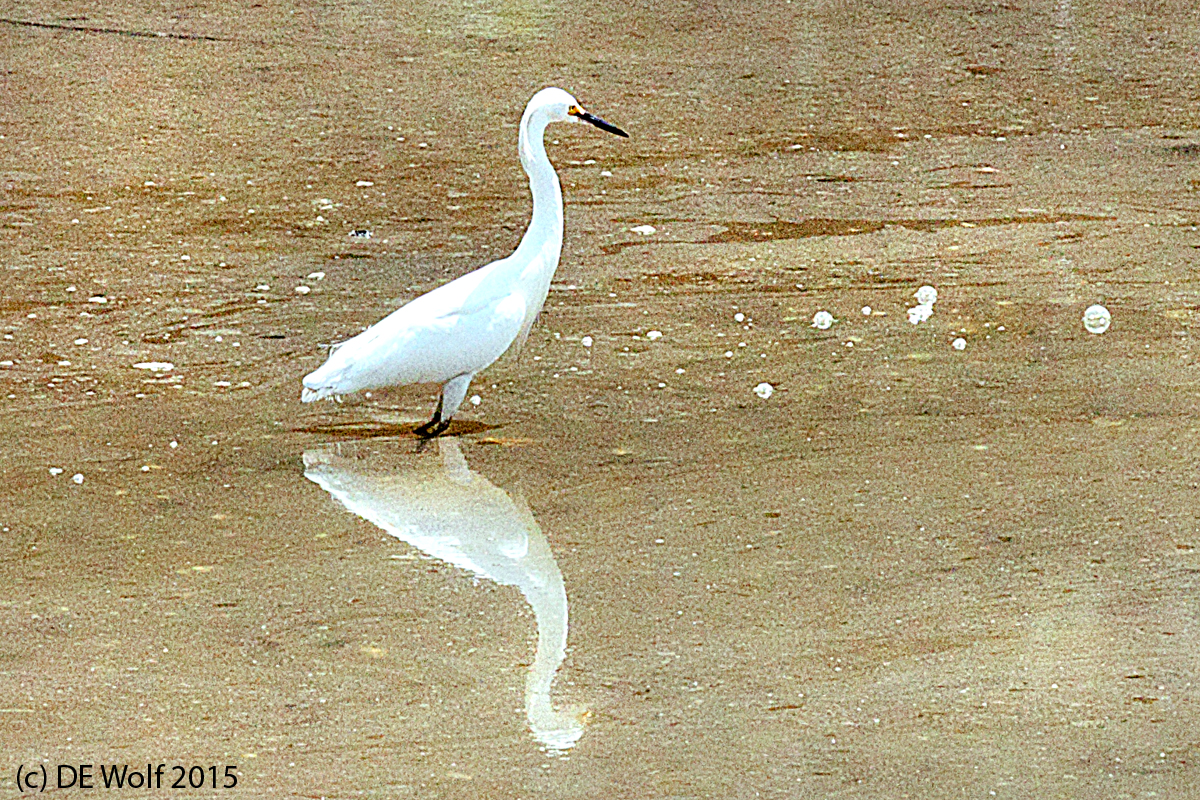
We had just reached our vacation destination and stopped for lunch.  My son called me to take a look and there in the mudflats of the inlet was a beautiful snowy egret – Egretta thula. They are beautiful both in their wedding white plumage and in the way that they stealthily walk on the hunt. Needless-to-say I had not brought my big lens; so I had to be content with my 70 to 200 mm. the narrow heads and tiny eyes present a challenge, and the image of Figure 1 took a bit of processing to get it right.  But I like the white bird contrasted against the brown mud, the pure symmetry of its reflection, and also the little bubbles on the surface of the sand.

Beyond any doubt the snowy egret is one of the most elegant of the herons. It’s plumage is truly immaculate, quite a feat for a mud walker. But, of course, for a water bird feather care is essential for survival. At one time the elegant plumes were in high demand for ladies’ hats and fetched huge sums. As a result, the snowy was almost driven to extinction. Fortunately, in the early twentieth century, conservations managed to get legislation to protect this bird and it has made a wonderful comeback in eastern United States coastal waters. Like all herons there is something gloriously prehistoric in their design and locomotion.

Canon T2i with EF70-200mm f/4L USM lens at 200 mm, ISO 1600, Aperture Priority AE mode 1/2000th sec at f/8.0 with no exposure compensation.

Ominous weather

Figure 1 - Ominous weather, Kennebunkport, Maine. (c) DE Wolf 2015.

Figure 1 – Ominous weather, Kennebunkport, Maine. (c) DE Wolf 2015.

I planned my July vacation right this year. I gave myself an extra day to “work up” images from the trip and even to find a few that I hadn’t really considered before. Part of the joy of a trip to the Maine coast is foul weather. You just don’t want all of it to be bad. But there is nothing quite so mood setting as a bad, rainy day or two by the sea. The image of Figure 1 I have entitled “Ominous weather.” That particular day was alternating sunshine and spot showers. The clouds were always there, hanging over us or at least in the distance. At one point we went to the beach and looking out over the ocean we could see showers in the distance, great columns, over the water.  It was really beautiful and inspiring.

The photograph of Figure 1 is of Dock Square in Kennebunkport. There are very ominous clouds and a bright stormy sky silhouetting a weather vane – storm’s a-brewin’. The giant masts of a tall ship hover in the background. One key to this image, for me was a little dodging to make certain that the shingles and the roof were just visible and not lost in the blackness – this is the meaning of dynamic range.

Canon T2i with EF70-200mm f/4L USM lens at 122 mm, ISO 1600, Aperture Priority AE mode 1/4000th sec at f/7.1 with no exposure compensation.

Wonder and the sphere

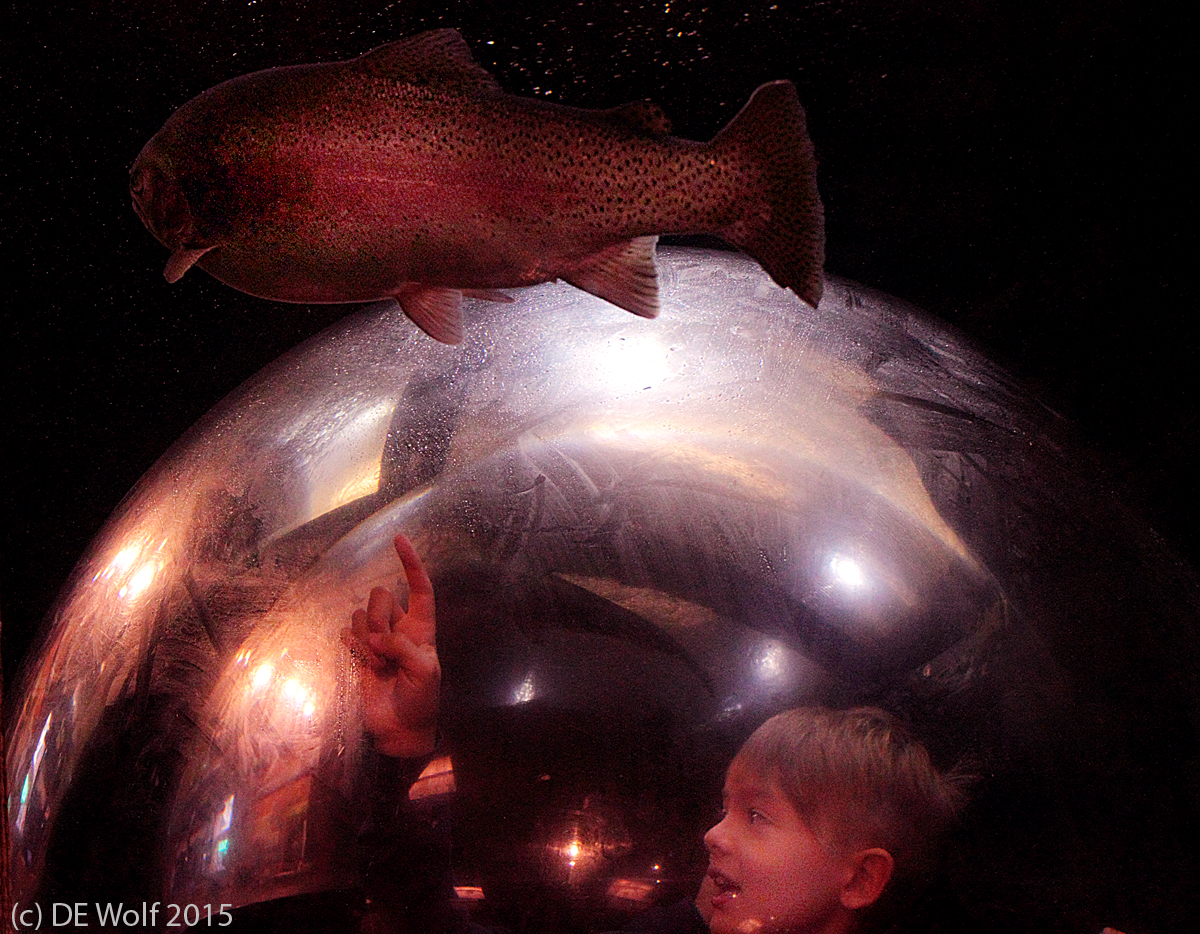
Wonder and the sphere, Freeport, Maine. (c) DE Wolf 2015.

Wonder and the sphere, Freeport, Maine. (c) DE Wolf 2015.

To begin with the simple facts, I took the photograph of Figure 1 at the L. L. Bean Riverbed Aquarium in Freeport, Maine. They have a plastic sphere, where you can stick your head into the tank, and the photograph shows a young boy doing just that. But here the magic begins because you can see both his delight and wonder. I took several images of the orb, but this was my favorite because of the expression on the boy’s face and the way that he points at the fish.

Part of the appeal to me of the subject is the subliminal meaning of such a sphere. There is the magic to the sphere, a collective mythic connotation. I return to Anne Brigman’s “The Bubble, 1909.” The bubble is the egg from which we all emerge into the river of life on which we must all journey. We are also reminded of Leonardo’s Salvator Mundi (Savior of the World), where the Christ holds in his hand a crystal orb, representative of the cosmos or the universe. No matter how profoundly you want to take it, a sphere is magical and symbolic of wonder.

Here the light explodes outward outward from the sphere. The light reflecting and refracting off multiple surfaces creates a myriad of planes in the photograph. This is similar to my image from Saturday “Double selfie in a store window.” The fish is only dimly lit, but the sphere is gloriously illuminated. Light is seen to emanate from it. And if you look very closely and try to sort it out, you see spheres within spheres, just like the celestial spheres of the ancients.

Canon T2i with EF70-200mm f/4L USM lens at 70 mm, ISO 3200, Aperture Priority AE mode 1/640th sec at f/4.5 with -1 exposure compensation.
Light and Water

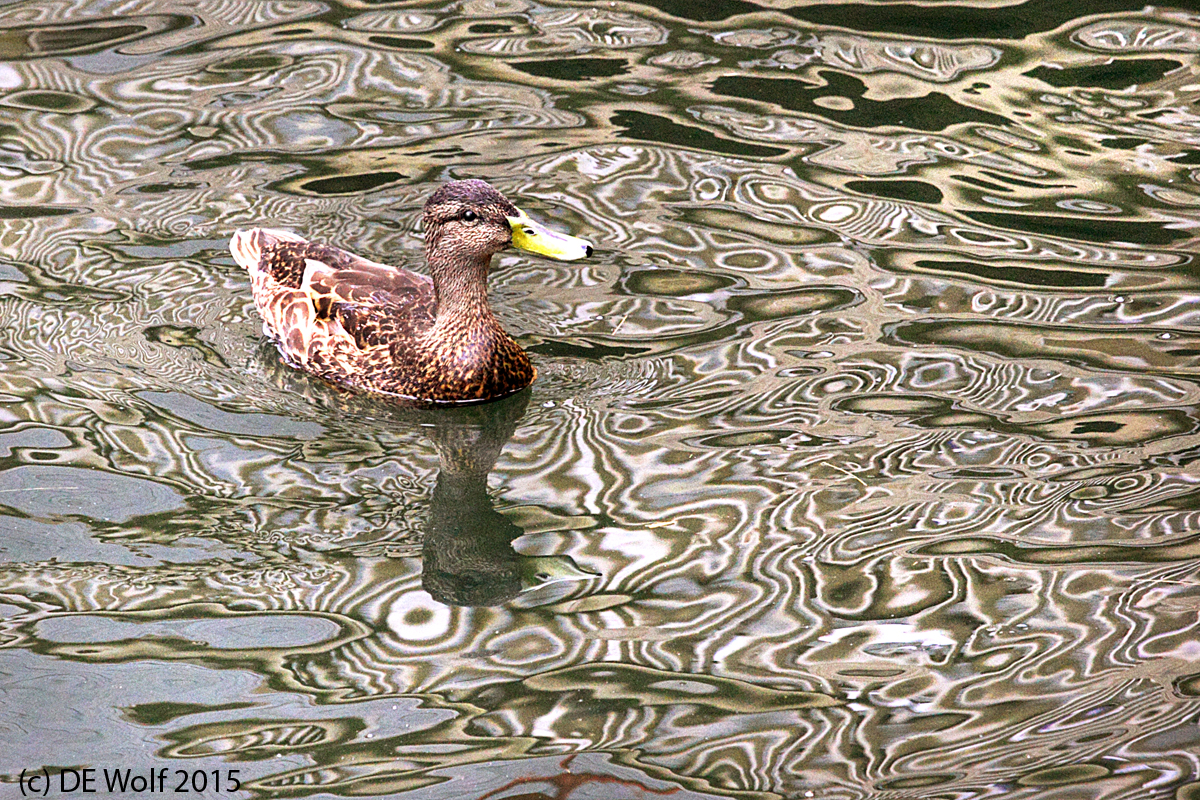
Figure 1 - American black duck. Kennebunkport, Maine. (c) DE Wolf 2015.

Figure 1 – American black duck. Kennebunkport, Maine. (c) DE Wolf 2015.

The great British painter J. M. W. Turner (1775-1851) was a greater believer and artistic practitioner of the power and magic of combining light and water. Indeed, during the history and development of his life’s work the combination of light and water slowly but irrevocably became the dominant force, as if in recognition that light gives life both figuratively and literally to the water.

This past Friday I was walking across the bridge at Dock Square in Kennebunkport, Maine when some American black docks – Anas rubripes caught my eye. they were in a bit of a frenzy as someone was throwing bread crumbs to them. There was a lot of quacking as ducks fought for the prized delight and new groups of ducks raced to join the feast. In the center of town, at least at this time of year, the black ducks appear to be dominant.

I was drawn to photograph these duck because I visually liked the scene. But it was not until I worked up the images that I realized completely what had so appealed to me. It was the reticulated pattern of swirling light and shadow on the water that resembled oil on water and created a complex but visually compelling background.

Background is of course a very key element of bird photography. A picture is often killed by the lack of a good background. But when you are lucky enough to have it, it can be truly magical.

Canon T2i with EF70-200mm f/4L USM lens at 200 mm, ISO 1600, Aperture Priority AE mode at 1/800th sec f/7.1 with no exposure compensation.

Common eider duck – Somateria mollissima

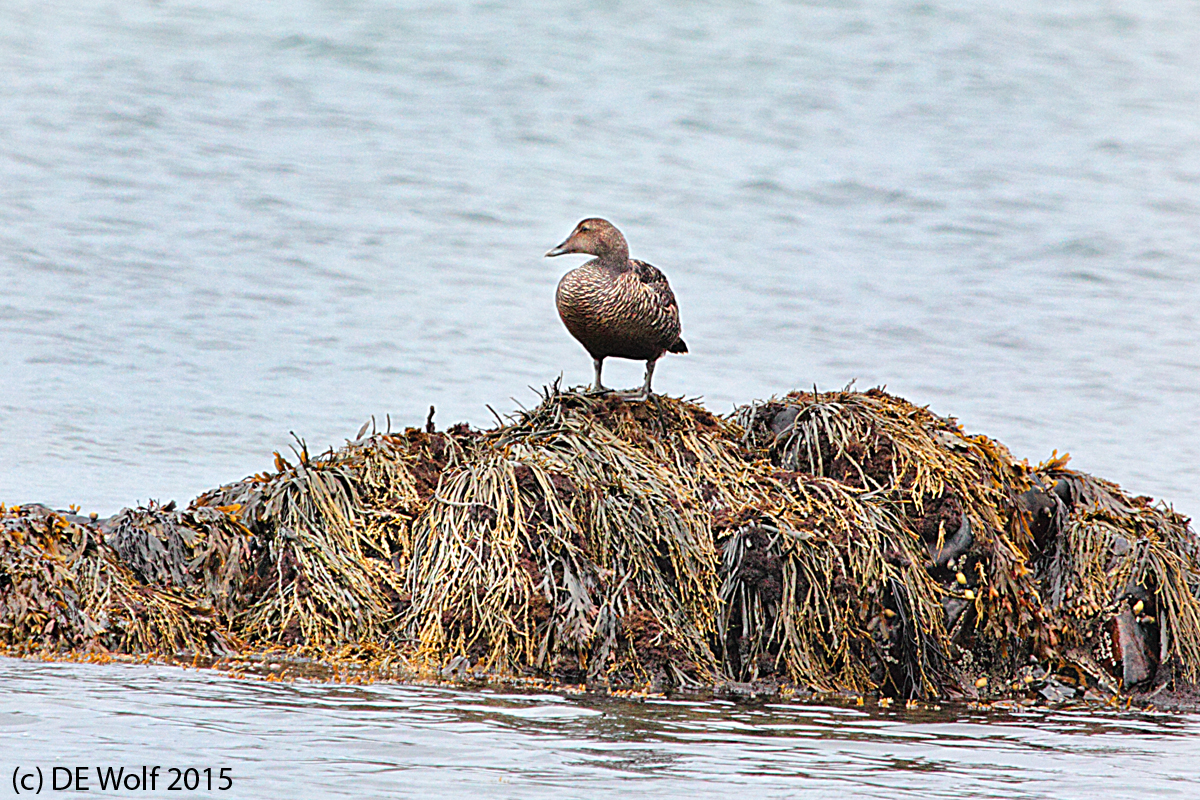
Figure 1 - Common eider duck (female) Kennebunk Beach, Kennebunkpot, Maine. (c) DE Wolf 2015.

Figure 1 – Common eider duck (female) Kennebunk Beach, Kennebunkport, Maine. (c) DE Wolf 2015.

I spent part of yesterday trying to photograph Common eider ducks – Somateria mollissima – off the Maine coast. These birds like to maintain their social distance, and who can blame them. There are stores at the nearby malls in Maine that feature pillows, comforters, and ski parkas stuffed with eider down. These are diving ducks and it was fun to watch them deliberately dive beneath the surface only to re-emerge a few minutes later with a fish in their moves. They then make a curious move, thrusting their fronts end out of the water and straightening their throats so as to swallow the fish whole.

The bird in Figure 1 is most probably a female. The males are dramatically black and white.  There were several males on a larger rock island, but these were too far off to capture clearly with my camera.

I am still studying the ins and outs of my big lens. I shot here very fast at f/6.3 or f/7.1, which appears to be the sharp focus sweet spot. It is remarkable how, even with a monopod, how hard it is to keep still long enough to set the focus on a distant bird. I need to explore using a tripod instead.

Canon T2i with EF100-400mm f/4.5-5.6L IS USM lens at 360 mm, ISO 1600, Aperture Priority AE mode 1/2500th sec at f/7.1 with +1 exposure compensation