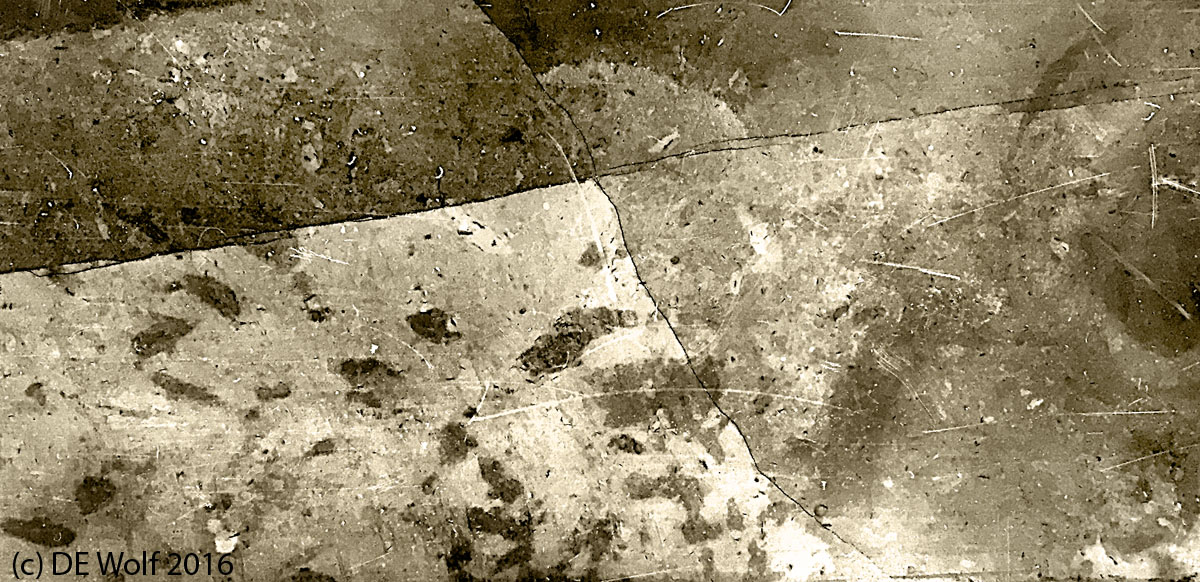
Floor-tile Study #2

Figure 1 - Floor-tile study #2, Natick, MA. (c) DE Wolf 2016.

Figure 1 – Floor-tile study #2, Natick, MA. (c) DE Wolf 2016.

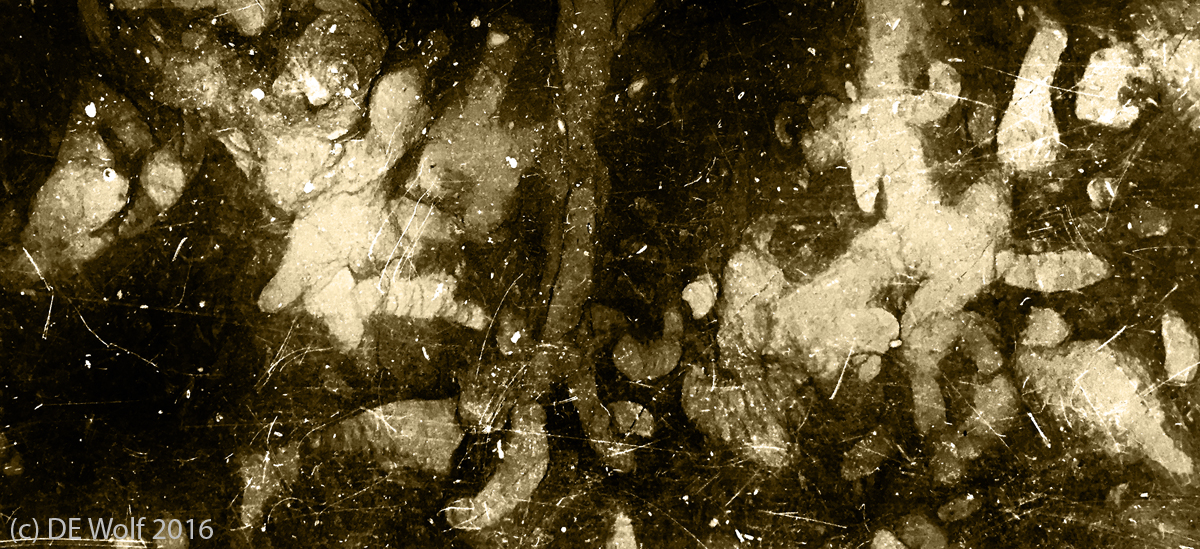
I just wanted to share Figure 1 today, which is my second floor-tile study. It was even more difficult than the one that I posted yesterday, in terms of the narrow contrast of the original; so again a challenging tone-on-tone. I processed it in a very similar fashion and again ended with a fairly deep sepia tone. Here the original was tan and tanner. I do not see anything specific in this tile only the intricate and magic of polished stone and in the image’s interpretive adherence to the “golden rule of thirds.”

A photographic Rorschach blot – the elephant and the unicorn

Figure 1 - Floortile study #1 - the elephant and the unicorn, Natick, Massachusetts. (c) DE Wolf 2016.

Figure 1 – Floor-tile study #1 – the elephant and the unicorn, Natick, Massachusetts. (c) DE Wolf 2016.

Following on the theme of abstraction, I took the photograph of Figure 1 of the pattern in a floor tile this past Sunday. It is a kind of photographic Rorschach blot, and the pattern that I see is that of a sitting elephant and a rather whimsical unicorn. This may confirm your suspicions about me.

The image was taken with my IPhone 6 and what attracted me was, as ever, the tone on tone nature of the tile. It was brown and browner with very little dynamic range. I took it to black and white, worked it up with all the usual tricks, and then sepia toned it deeply.

Looking for M.C. Escher at the mall

A tribute to M.C. Escher, Natick, Massachusetts. (c) DE Wolf 2016.

A tribute to M.C. Escher, Natick, Massachusetts. (c) DE Wolf 2016.

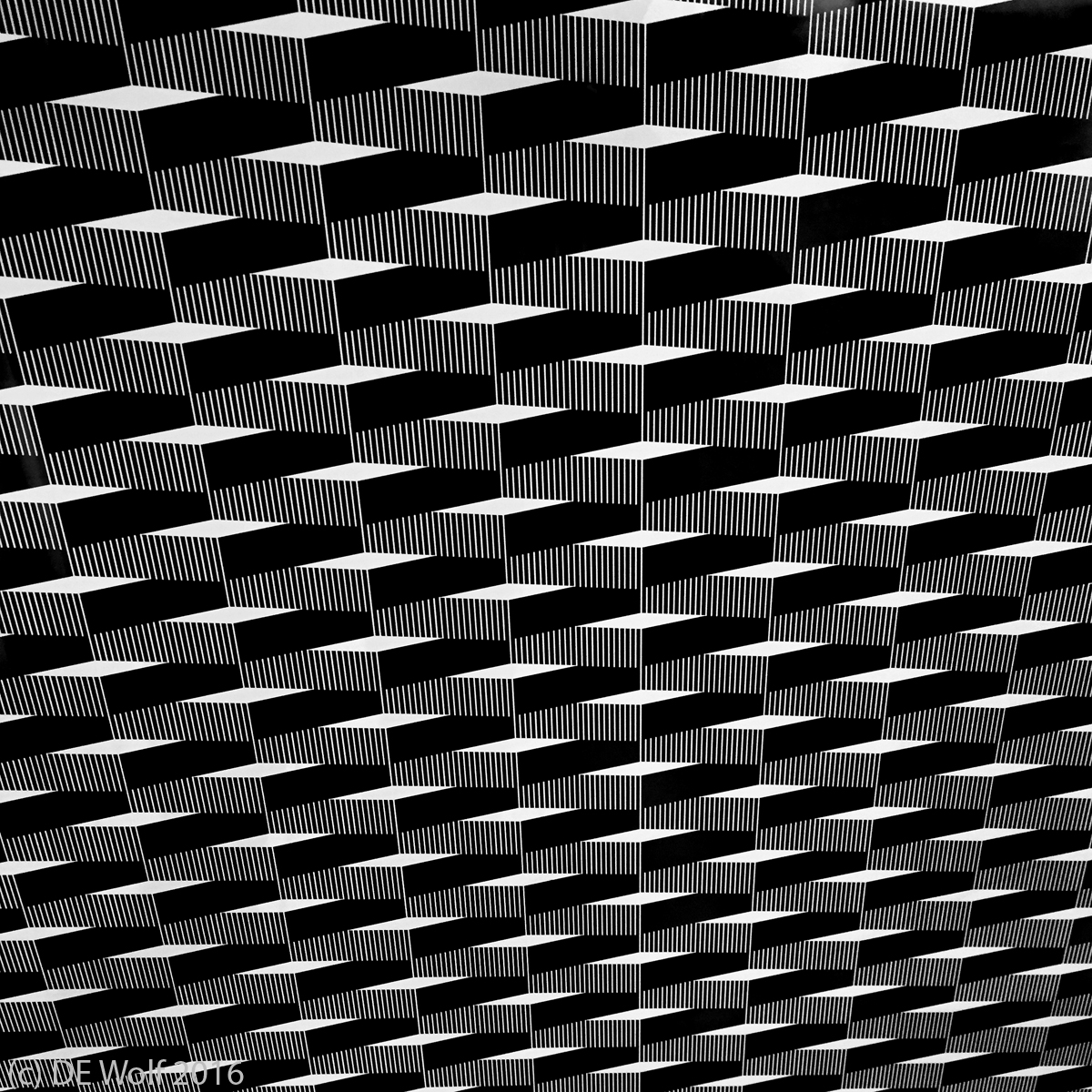
I think that most people both know of M. (Maurits) C. ( Cornelis) Escher and delight in his work. His drawings feature mathematical objects and operations and delightfully many of these can be termed “impossible objects,” like staircase that go up only to come back down. It is very much like a Twilight Zone of Mathematics and Escher is highly regarded among scientists and mathematicians . He featured prominently in Douglas Hofstadter‘s 1979 book Gödel, Escher, Bach: an Eternal Golden Braid. Escher did not consider himself to be a mathematician yet he interacted with many of the contemporary mathematicians of his day, notably including:  George Pólya, Roger Penrose, and Harold Coxeter.

A point in all of this is that infinity, symmetry, chaos, and fractals are everywhere. They surround us and will grace the receptive eye. Such is what immediately came to mind Sunday, when I was confronted by this store window decalled with this “infinite” mathematical pattern. It is the kind of pattern that wonderfully seems to blink between being flat and two dimensional alternative with appearing three dimensional.

Photographically, I spent a lot of time trying to hold the IPhone just right so as not to distort the image and to frame it just so. There was also a bit of a problem with window glare. But this I managed to eliminate: first by switching to black and white and second by burning or cloning out all of the glare. In the end I decided that the slightly tilted perspective greatly enhanced the sense of the infinite. Parallel lines are said to meet in infinity.

“If the doors of perception were cleansed every thing would appear to man as it is, Infinite. For man has closed himself up, till he sees all things thro’ narrow chinks of his cavern.”
William Blake, The Marriage of Heaven and Hell


Dinosaur tracks in the mud

Figure 1 - Goose tracks in the spring mud. Concord, MA. (c) DE Wolf 2016.

Figure 1 – Goose tracks in the spring mud. Concord, MA. (c) DE Wolf 2016.

In 1802 a twelve-year old farm boy, named Pliny Moody, was plowing a field in what was known as Moody Corner in South Hadley, Massachusetts, when he discovered a slab of rock which contained the first recorded dinosaur tracks ever discovered. These tracks were subsequently acquired by Dr. Elihu Dwight. They were dubbed “the tracks of Noah’s raven” after the biblical raven that Noah released to find dry land.  Dr. Dwight retained possession of the tracks until around 1839, when they were acquired by  Professor Edward Hitchcock for Amherst College. They can still be found there as number 16/2 in the Amherst College natural history collection.

Now, two centuries later, there are many fine examples of dinosaur tracks or footprints from all over the world. In some regards we may think of them as being akin to photographs – capturing an instant in time and holding that instant for millions of years. Indeed, in a sense, photographs pale by comparison. Dinosaur footprints or tracks are unique among fossils in that they capture a moment of life rather than a moment of death and decay. Always in these tracks is the tell-tale reptilian triple toe. And you probably are familiar with the evolutionary origin of modern birds as dinosaur if not from textbooks then from movies.

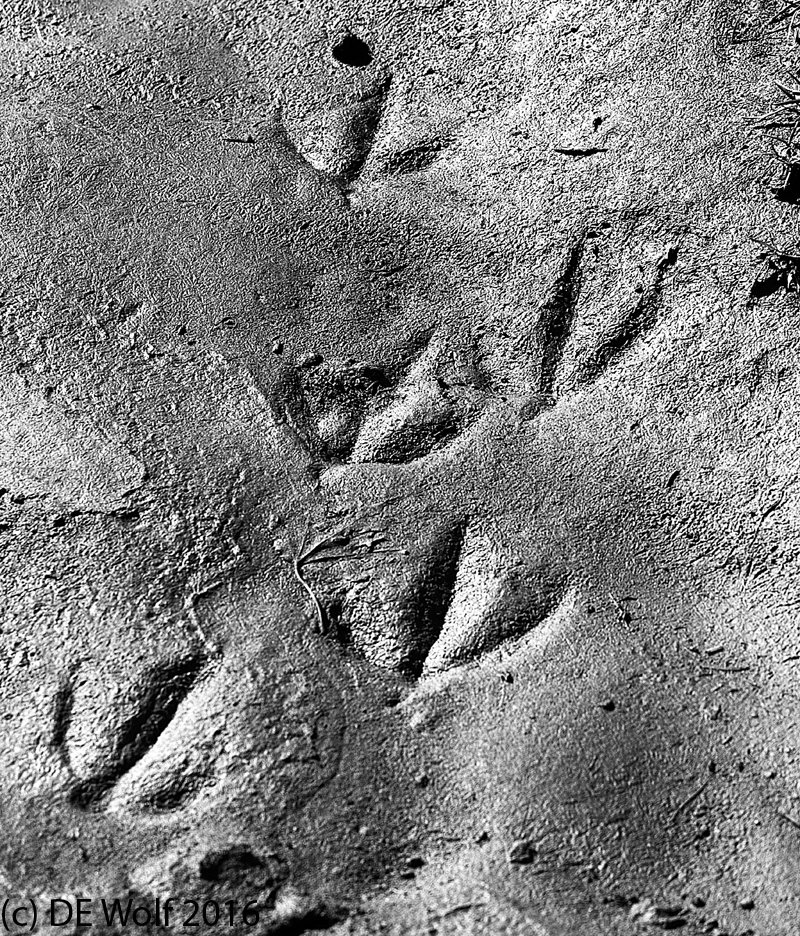
All of this came to my mind this afternoon, when I went for a first outdoor spring walk. Boy is it good to be out. Spring in New England has the alias as “Mud Season.” Indeed, all self-respecting New England houses have what is referred to as a “mud-room,” where you take off and put on your mud-caked boots. I was walking along the side of a farm field in Concord, mindful of the mud. It was the same field where I had gotten in trouble trying to photograph wild turkeys last fall- sinking ever so deeply in the grime and slush. In any event, I came upon the scene of Figure 1. These are the tracks of Canadian Geese, Branta canadensis. And you may note the delicate curvature of the between toe webbing. “Welcome to Jurassic Park.”

“She’s as headstrong as an allegory on the banks of the Nile”

Figure 1 - Alligator bread. IPhone photograph. (c) DE Wolf 2016.

Figure 1 – Alligator bread. IPhone photograph. (c) DE Wolf 2016.

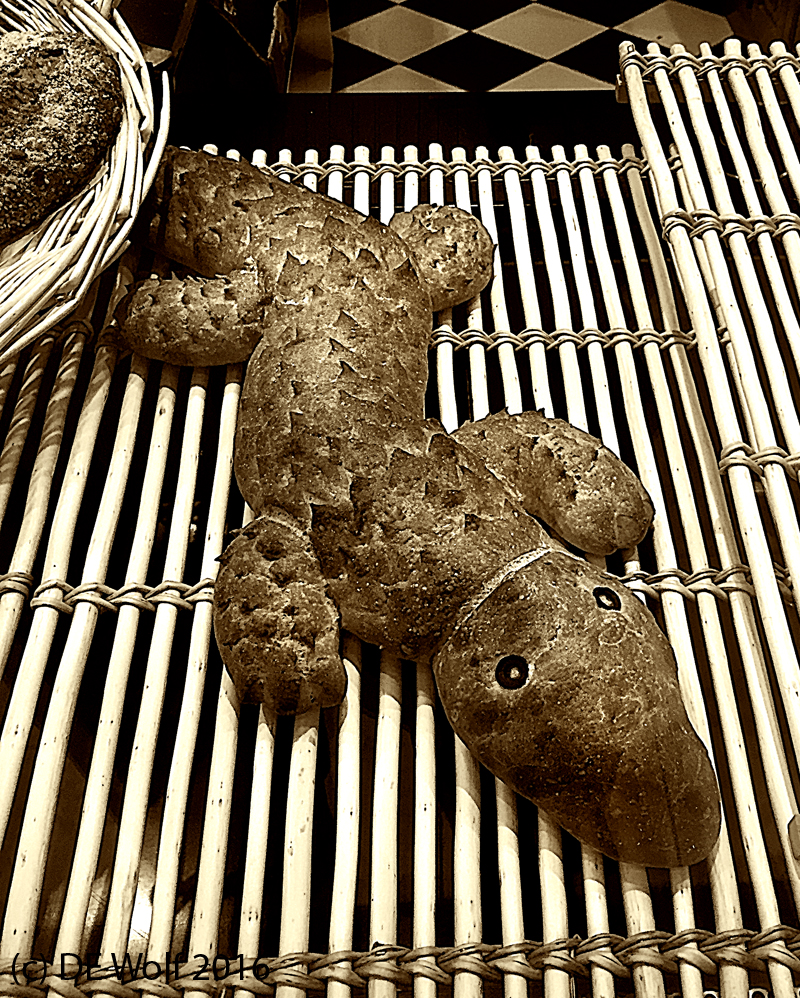
“She’s as headstrong as an allegory on the banks of the NIle,” is one of the famous malapropisms from Richard Brinsley Sheridan’s (1751-1816) wonderful play “The Rivals, 1775.” He [on the other hand] is “the very pineapple of politeness.” Dear, Mrs. Malaprop, where is she now when we poor souls need her so very much?

Anyway, whenever I hear the word “alligator,”  “allegory” springs to mind in its steed (neigh stead).

And so that is what I thought about this morning after “Super Tuesday” when I spotted the little French-bred [sic] alligator or allegory of Figure 1 at the local bakery. Clearly it was sculpted lovingly with children in mind. But we are all children at heart. Or as Mrs. Malaprop herself said: Oh! it gives me the hydrostatics to such a degree.”

Photopictorialist study # 12 – Tree at dusk on Christmas Eve

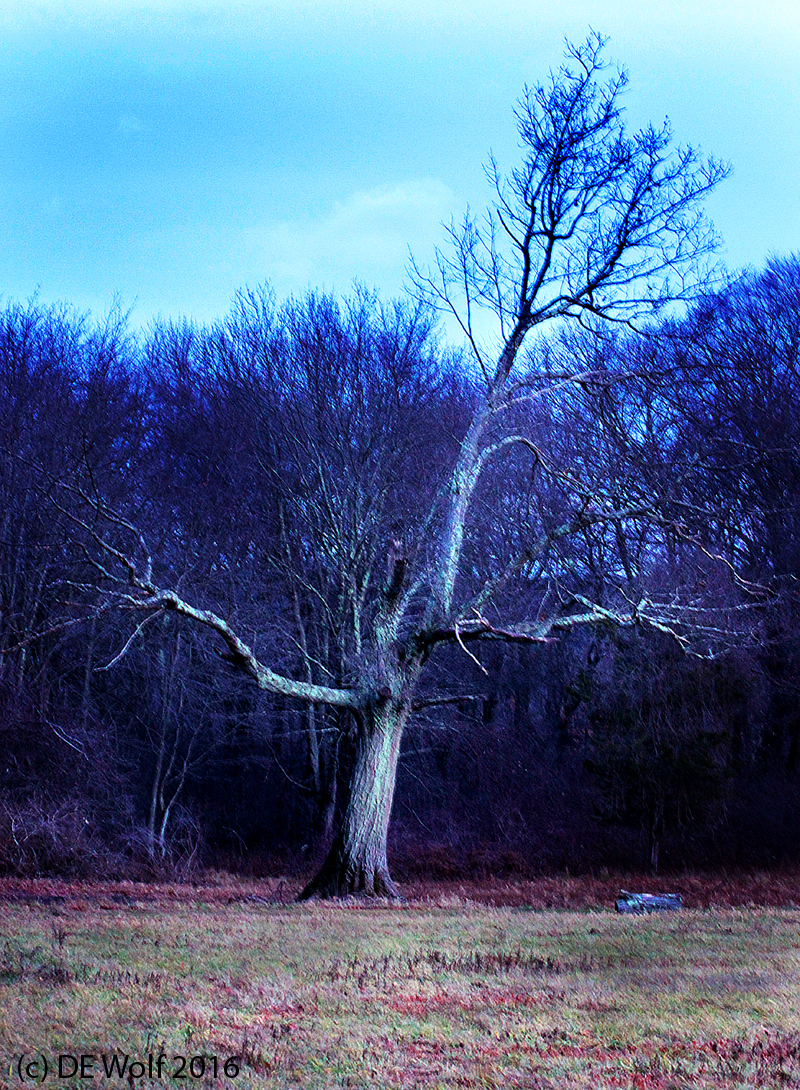
Figure1 - Tree at dusk on Christmas Eve 2015, Wayland, MA. (c) DE Wolf 2016.

Figure1 – Tree at dusk on Christmas Eve 2015, Wayland, MA. (c) DE Wolf 2016.

One of the fun aspects of digital photography is that every time you open your memory card you get to revisit photographs that you took earlier in the year. This is especially true on a cold winter’s day when you get to see the pictures that you took during summer vacation. Ah the warm and photographic joys of a leisurely summer’s day! I was doing this the other night and I decided to see whether there was anything that I had failed to “work-up.” That typically means that I am looking for difficult to process images. And I found the raw image of Figure 1 that I had taken at dusk, when it was already pretty dark, on this past, and very warm, Christmas eve.

I had been attracted by the ghostly contrasts at the time, as well as the clinging atmosphere.  While all of these aspects were in the image, it was  pretty flat, dark, and kinda boring. It was going to require a lot of manipulation in Adobe Photoshop. A lot of manipulation smacks of photopictorialism; so I though that I would take that tact with the image. The idea of photopictorialism is to work the image hard; so as to create a sense that it is a painting not a photograph.

Usually this painterly quality requires addition of noise, but I found that that did not work here. I did however, use my second favorite trick that of darkening so as to vignette the edges and create the sense of an antique lens and there was also the slight over saturation of the color. There was fuzziness enough from the slow shutter speed. The final result is the image of Figure 1 – failure or success? I am seeing shades of the story “Sleepy Hollow” in this and expect at any moment to see the Headless Horseman come bolting on his steed out of the woods.

“On mounting a rising ground, which brought the figure of his fellow-traveller in relief against the sky, gigantic in height, and muffled in a cloak, Ichabod was horror-struck on perceiving that he was headless!–but his horror was still more increased on observing that the head, which should have rested on his shoulders, was carried before him on the pommel of his saddle!”
– Washington Irving, “The Legend of Sleepy Hollow”

Canon T2i with EF70-200mm f/4L USM lens at 78 mm, ISO 1600, Aperture Priority AE Mode 1/25th sect at f/8.0 with -1 exposure compensation.
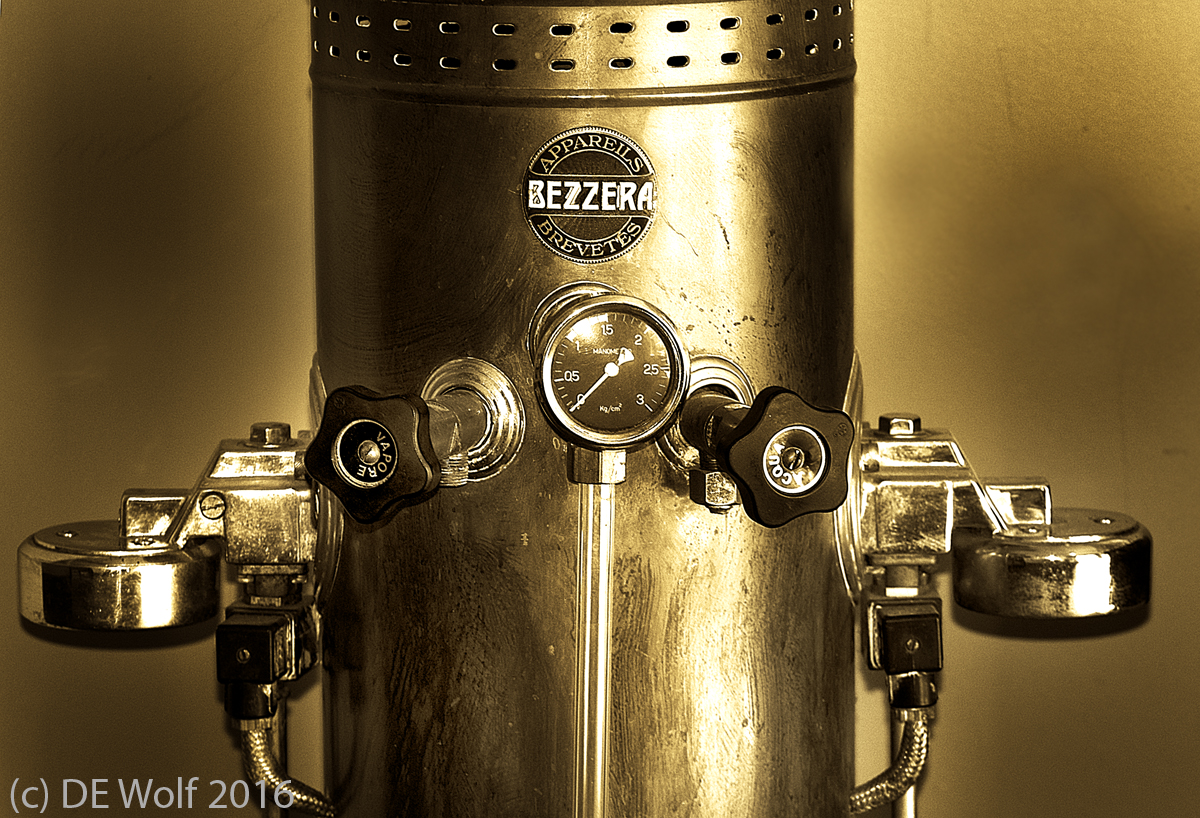
Bezzera

Reproduction Bezzera Eagle. (c) DE Wolf 2016.

Figure 1 – Reproduction Bezzera Eagle. (c) DE Wolf 2016.

I’d like to follow-up on my recent post about gumball machines. There is something aesthetically wonderful about shiny machines, especially when, like gumball dispensers, they yield up a delicious treat. What is a greater treat than a diminutive shot of espresso? It is the distillation of wonderfulness, the nectar and ambrosia of modern times.  The other evening I was leaving a favorite bakery, when I found discarded on the floor this wonderful antique looking espresso maker. I have done some research on it and I believe that it is, in fact, a reproduction – still available – of the Bezzera Eagle Dome. It is a faithful replica of machines produced by Bezzera during the “belle epoch,” although it does not have an eagle on top. My espresso tastes better already with such a pedigree.

The modern espresso machine appears to have been invented by Italian Angelo Moriondo, who in 1884 patented a steam-driven “instantaneous” coffee beverage making device, In 1901 Luigi Bezzera patented an improved espresso machine. This machine was exhibit at the 1906 Milan International Fair, and Bezzera has proudly and passionately pursued the ideal brew for 115 years. As I am very fond of saying: Un doppio espresso, per favore!

Canon T2i with EF70-200mm f/4L USM lens at 91 mm, ISO 800, Aperture Priority AE Mode, 1/50th sec. at f/5.6 with no esposure compensation.

Obsolete

Figure 1 - Gumball machine. (c) DE Wolf 2016.

Figure 1 – Gumball machine. (c) DE Wolf 2016.

We have spoken before about the role of photography as a recorder of the obsolete – as an archivist, if you will. Recently at the local mall the candy shop closed. This was one of those candy shops where children would load up plastic bags with individual candies – break the teeth and beak the bank. Shortly after the closing, I noticed these gumball machines appearing at strategic locations. Gumball machines were part of my youth. They hanker to New York City Subway vending machines for penny candies – part of the treat of a subway ride for children of the day.

According to the Wikipedia, itself out to obsolete the print encylopedia, vending machines for stick or block shaped gum as early as 1888, but the first machines to carry actual gumballs were introduced in 1907 (probably released first by the Thomas Adams Gum Co). Well, the candy is no longer a penny. They are now a quarter, as the label proclaims. Therein lies their ultimate demise. The price of candy goes up. The use of physical money, and among money of coinage, goes down. A gumball machine is a purely mechanical thing. Unless the government issues a dollar coin, which is unlikely, they will soon be, well, gone with the wind. A chrome sphere filled with luscious gum balls with a protruding electronic credit card reader is a sacrilege.

So I paused a moment the other day to take the photograph of Figure 1. It shows a soon to be obsolete gumball machine in all its prismatic glory. I spent a few moments in reverent contemplation. While someone is still turning a profit, the days of such machines cannot be long.

Marble wall

Figure 1 - Marble wall, Natick, Massachusetts. IPhone photograph. (c) DE Wolf 2016.

Figure 1 – Marble wall, Natick, Massachusetts. IPhone photograph. (c) DE Wolf 2016.

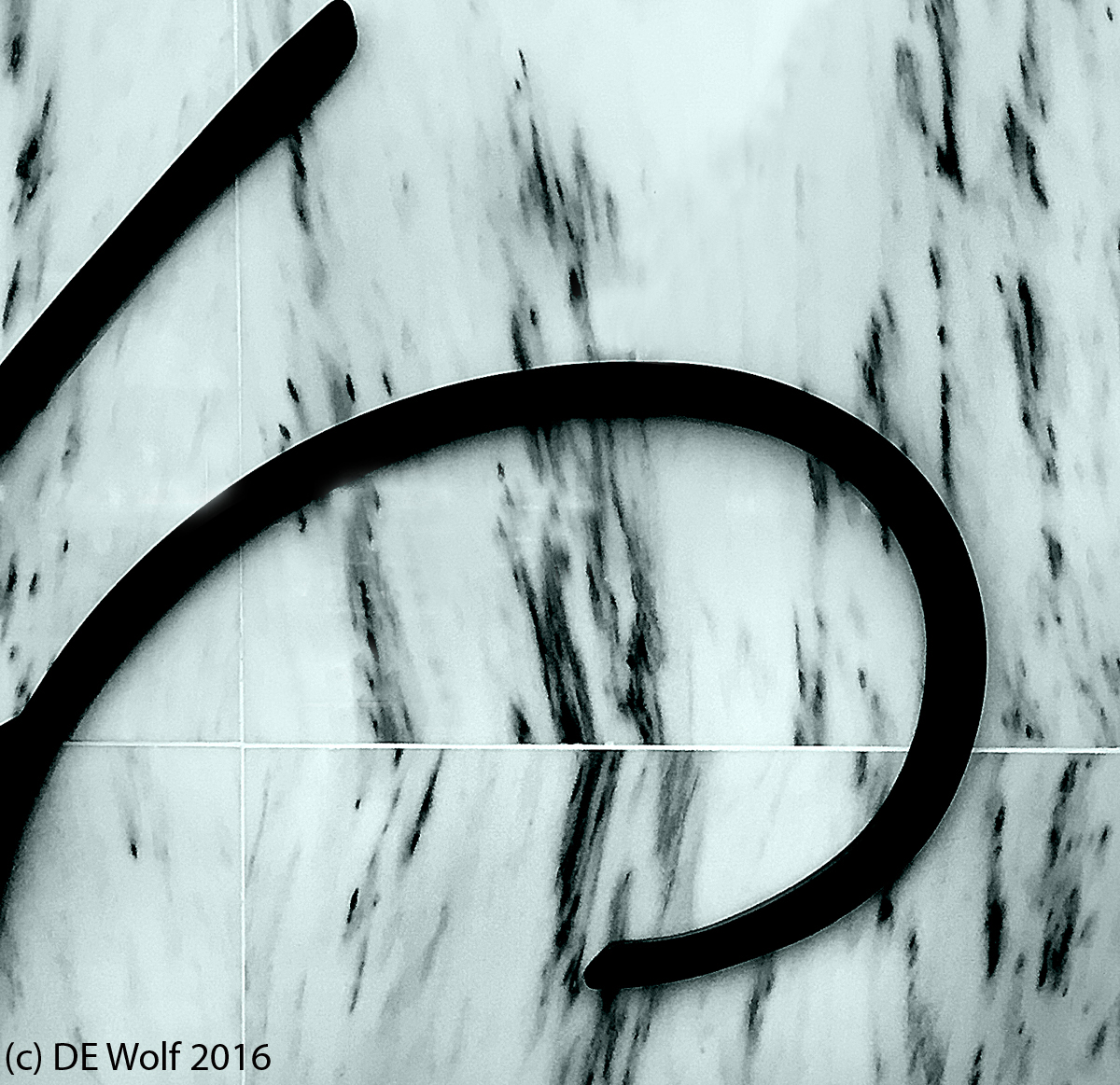
I thought that I would go, or offer up, today an example of photominimalism. The Wikipedia defines “minimalism” in the visual arts and music as style that uses pared-down design elements. This paring down, I think, is key to its appeal. When you look at what might be called a “complex” photograph full of details, it is usually made or broken by fundamental design elements” the golden rule of thirds, sweeping curves, vertical or horizontal lines. But these can be hidden, buried in complexity, to be dug or teased out. Minimalism emphasizes these design elements. We are delighted by its simplicity.

So Figure 1 is an example of photominimalism. I am happiest when I can do it in black and white, which is, in and of itself, a minimalizing element. My eye delights in the curves, the tiles, the glossy texture the marble background contrasted with the matte black of the sweeping lines. For me there is a kind of meditative simplicity to it.