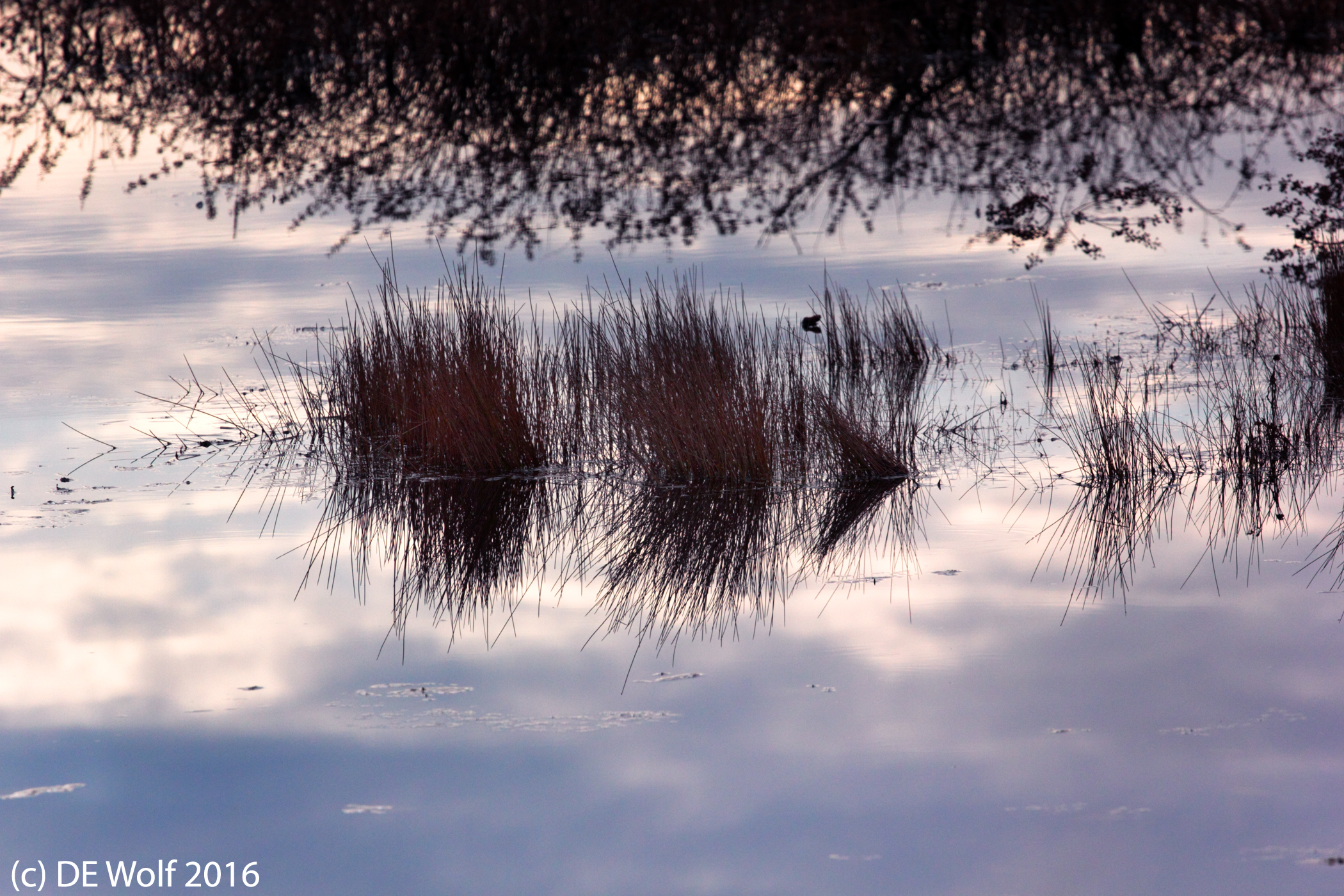
The pond in a November light

Figure 1 - The pond in a November light, Assabet River National Wildlife Refuge, Maynard, MA. (c) DE Wolf 2016.

Figure 1 – The pond in a November light, Assabet River National Wildlife Refuge, Maynard, MA. (c) DE Wolf 2016.

Years ago, I would drive every morning past this little pond or lake. Of course, I was caught up in the rush hour desire to get to work. Still every morning the combination of sky and water struck me, and I imagined stopping at exactly the same spot every day and taking a photograph. I was certain that no two would be the same, and that many would be dramatic and striking.

Yesterday, I went back to the Assabet River National Wildlife Refuge for the first time in about a month. It was, as I have said, dreary and dull. But it seems always the case that there is something interesting and dramatic to be seen on the pond. Figure 1 is the aspect from yesterday. Reeds coming out of a moody, surface, reflecting clouds and sky. I had imagined the scene in black and white. But as is often the case, I wanted capture the muted colors, the angry blue reflections and the ever so subtle redness of the reeds. I studied my results, afraid at first that I had over dramatized the scene, but in the end I found it true to the vision of the moment.

Canon T2i with EF70-200mm f/4L USM lens at 109 mm, ISO 1600, Aperture Priority AE Mode 1/3200th sec at f/7. with no exposure compensation.

An apparition of summer

Figure 1 - An apparition of summer, Assabet River National Wildlife Refuge, Sudbury, MA. (c) DE Wolf 2016.

Figure 1 – An apparition of summer, Assabet River National Wildlife Refuge, Sudbury, MA. (c) DE Wolf 2016.

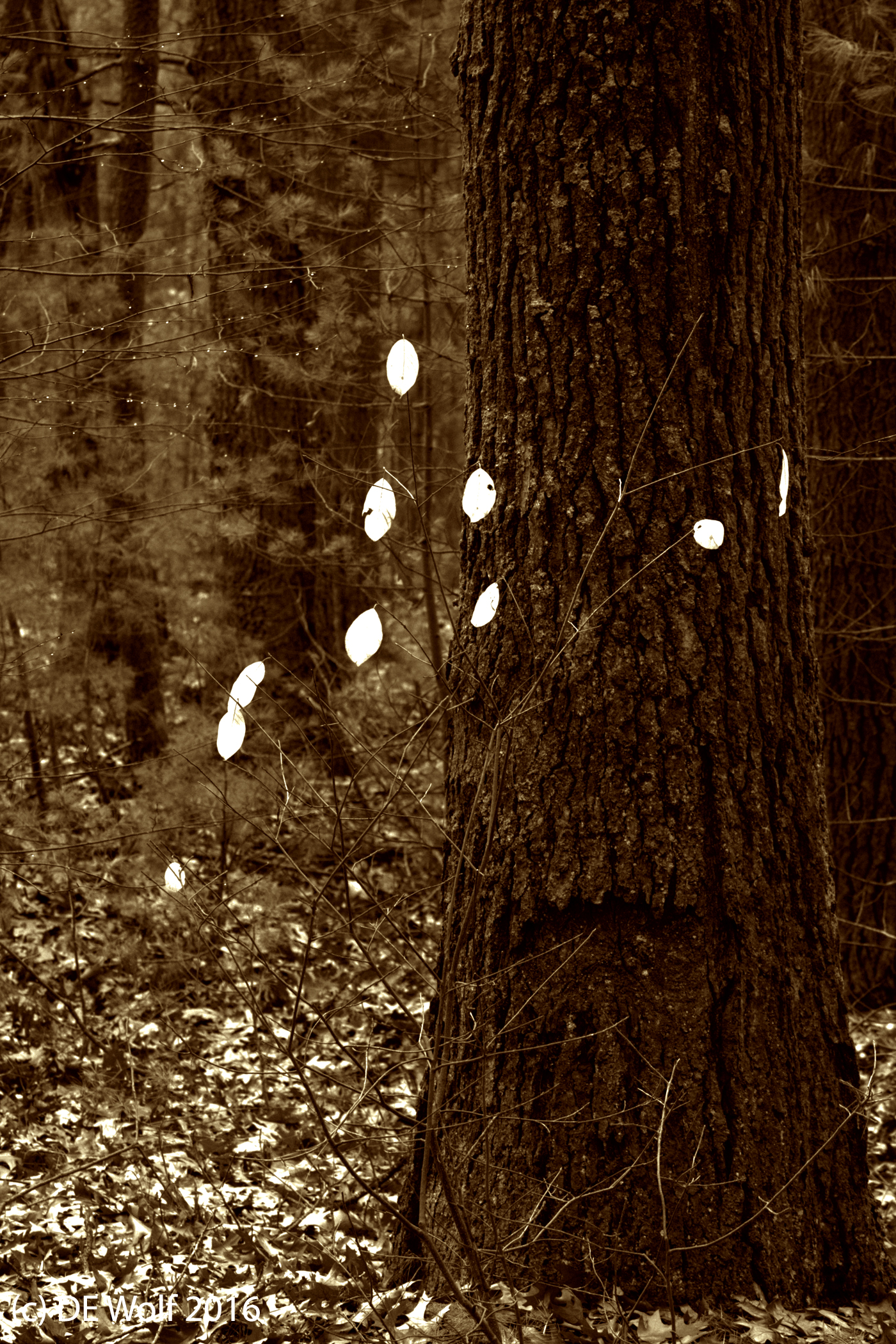
I’d like to follow-up on yesterday’s blog with an image that I took yesterday along a similar vein. I am calling it an “An Apparition of Summer.” This is Figure 1, and I did it in black and white, because what struck me here was the dark trees of the pine barren and a few remaining deciduous leaves on a little sapling that seemed to my mind’s eye to be floating like little planets in a void. And the second point that struck me is that the tree trunk seems to have a face, or at least a mouth frozen in a kind of frown.

This really captures my sense of late November in woods. A dreary darkness prevails, but flashes of light illuminate. The image appears to me to have a three-dimensionality. The little bright leaves seem to float in front of a flat background.

Canon T2i with EF70-200mm f/4L USM lens at 70 mm, ISO 1600, Aperture Priority AE Mode 1/250 th sec at f/7. with -1 exposure compensation.

The bleak time

Figure 1 - Fall's last color, Assabet River National Wildlife Refuge, Sudbury, MA. (c) DE Wolf 2016.

Figure 1 – Fall’s last color, Assabet River National Wildlife Refuge, Sudbury, MA. (c) DE Wolf 2016.

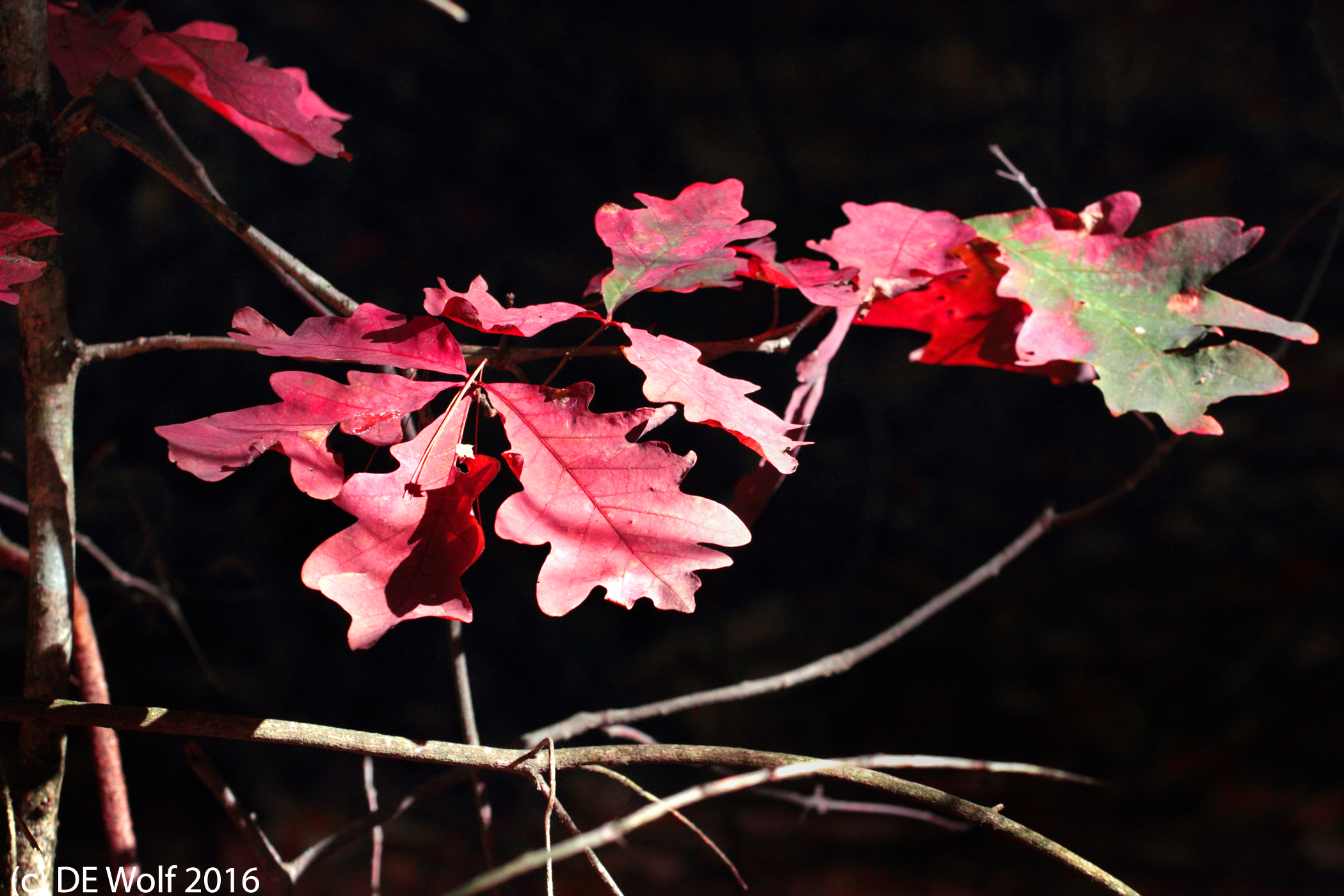
Thanksgiving in the United States can be a wonderful holiday. You’ve got to picture damp, dreary, and chilly days filled with the warmth of family and fireplaces. And that is the whole point. Outside it is the “bleak time.” The sun sets early, plunging us into unforgiving darkness. The fall color is gone, well almost so. As Figure 1 testifies there are a few holdout leaves. Well maybe not holdouts so much as luck of the draw survivors.

Winter is coming and with it snow. But in the meantime we’ve got to put up with mininmalist landscapes. Of course, and on the other hand the whole forest has opened up. Familiar places become something other. And even the pale light can glow and trickle in to nooks and crannies that in summer defy illumination.The whole temperate world seems to be taking a breath before it goes about the process of storing up its energy in generative anticipation of next spring.

The picture of Figure 1, I took a few weeks ago. I loved the vivid color against black. Indeed, I would suggest that if you photograph flowers and want something different try shoot with flash at night. This picture proved very tricky to get what I saw, what I visualized, just so. But I like autumn’s swan song quite well.

Canon T2i with EF70-200mm f/4L USM lens at 109 mm, ISO 1600, Aperture Priority AE Mode 1/1600 th sec at f/7. with -1 exposure compensation.

A Christmas star

Figure 1 - Christmas star. IPhone photograph. (c) DE Wolf 2016.

Figure 1 – Christmas star. IPhone photograph. (c) DE Wolf 2016.

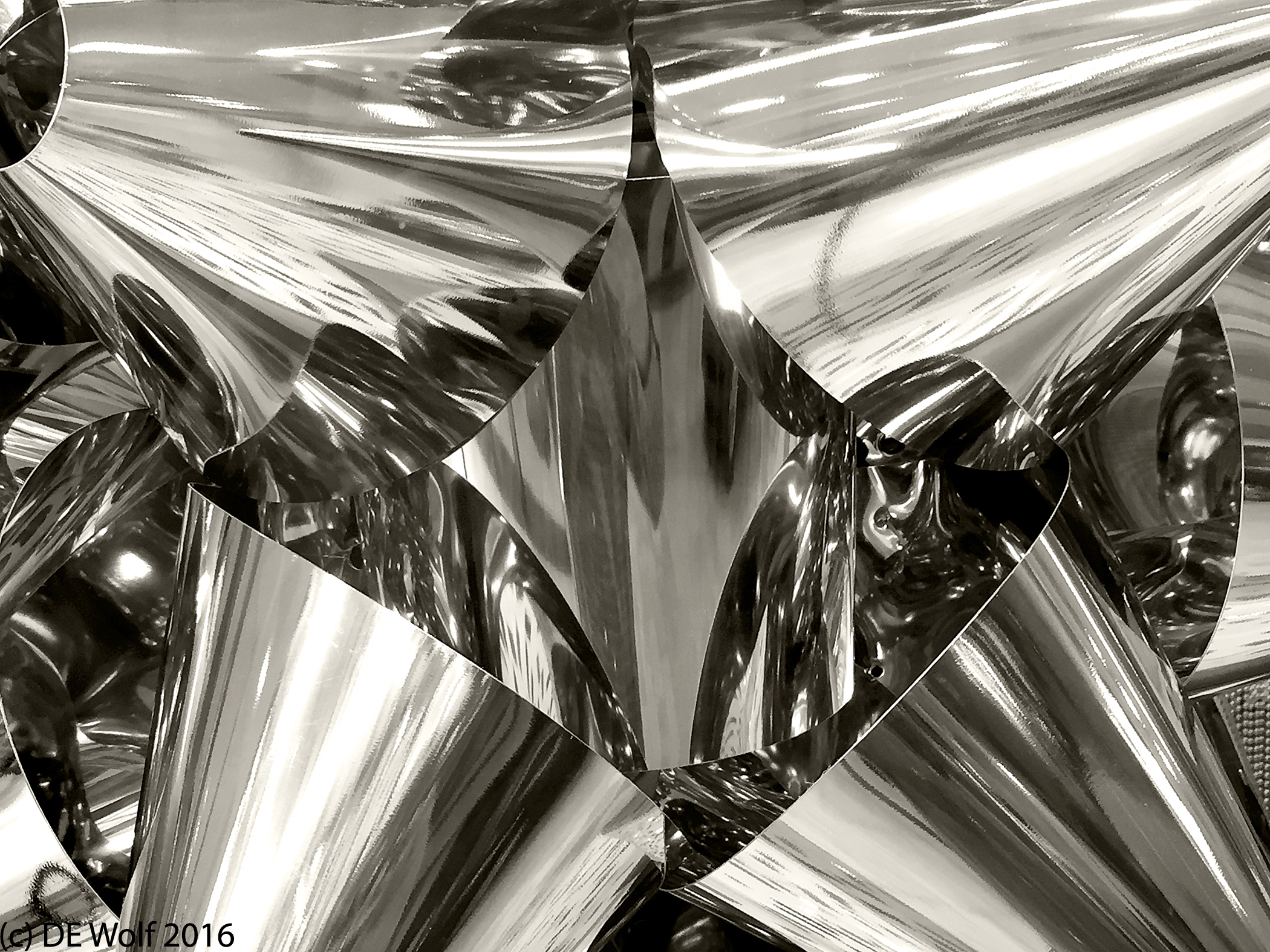
This morning it was cold and bleak in Massachusetts. There is a raw beauty in this that New Englanders love and that causes them to swear that there is no better place on Earth to live. I went over to the local mall. It is not as lovely or as vigorous a place to walk, but it does have the advantage of coffee at the end, which makes for a perfect Sunday morning. For some reason, I found myself in a good mood, enjoying the kids running around and the seasonal decorations. This one store had giant Christmas decorations, and I took the image of Figure 1, a giant Christmas Star, with my IPhone.

What I like about the subject is the metallic specular reflections. In my experience, metal surfaces of this sort can be surprisingly difficult to capture – especially with the complexity of surfaces like with this star. They seem to be exciting subjects to photograph, but often they do not live up to expectations. It is all a matter of the play of the light and the skill of the artist.

The up escalator

Figure 1 - IPhone photograph of the escalator at the Cambridge Porter Square Red Line MBTA stop. (c) DE Wolf 2016.

Figure 1 – IPhone photograph of the escalator at the Cambridge Porter Square Red Line MBTA stop. (c) DE Wolf 2016.

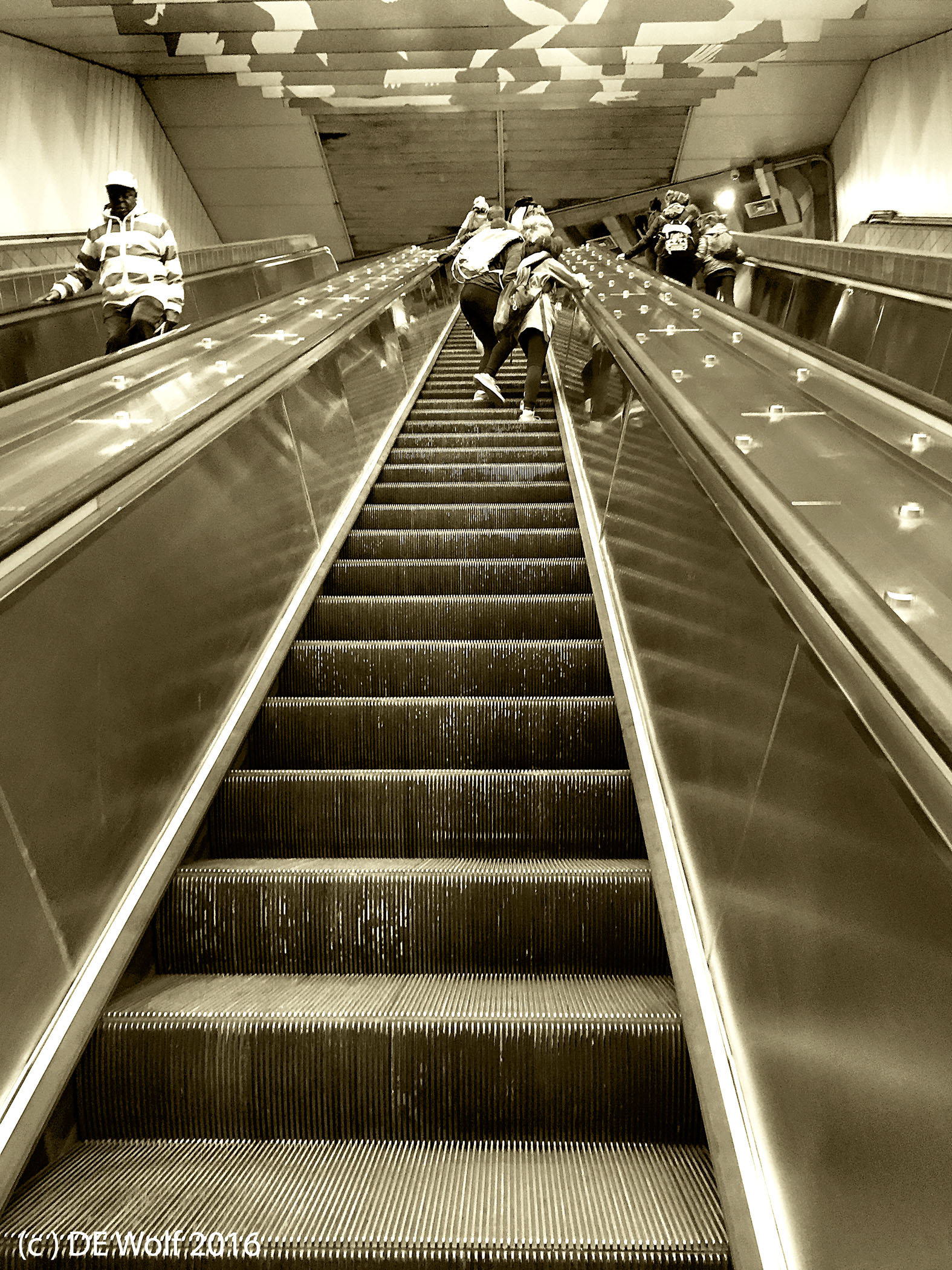
Figure 1 is a photograph that I took while riding up the escalator at the Porter Square MBTA stop in Cambridge, Massachusetts. Your alternative is to take the 199 step adjacent staircase. The longest span, the one shown, is 143 feet long. That’s 43.6 m.; so not anywhere near a record. The longest single-span escalator in the United States is at the Wheaton Station Stop on the Washington Metro Red Line, coming in at 230 feet or 70 m. The longest escalators in the world are installed in the Saint Petersburg Metro coming in at 449 feet or 137 m.

Arising from beneath the Earth in Cambridge, Massacchusetts the “Athens of America,” is instantly reminiscent of Dante rising at last from the depths of the underworld to once again see the stars.  

The Guide and I into that hidden road

Now entered, to return to the bright world;

And without care of having any rest

We mounted up, he first and I the second,

Till I beheld through a round aperture

Some of the beauteous things that Heaven doth bear;

Thence we came forth to rebehold the stars.

While merely an IPhone photograph, I want this picture to be the kind that people look at 100 or 200 years hence, and say, “Oh how quaint! See the silly way people dressed and transported themselves a century or two ago.” So this raises two questions. First, is whether this is a transitional technology. Second, whether it is soon to be replaced by something better.

The first escalator was patented (U.S. Patent #25,076) on August 9, 1859 by Nathan Ames. There is no evidence that this device was ever built. In 1889, Leamon Souder successfully patented the “stairway,” but, again, it was never built. On March 15, 1892, Jesse W. Reno patented the “Endless Conveyor or Elevator.” Shortly after that, George A. Wheeler patented a moving staircase escalator. As for tangible reality, Reno built his first prototype and installed it alongside the Old Iron Pier at Coney Island, New York City in 1896. In 1895, Charles Seeberger who ultimately teamed with the Otis Elevator company began designing moving stair-based escalators similar to those patented by Wheeler in 1892. His first commercial escalator won the first prize at the Paris 1900 Exposition Universelle in France. All this means that escalators have been around for at least a century; so are not transitional technologies and are not likely to be replaced soon.

The question of what next is an interesting one. I do not hold my breath for transporter beams, as anyone who has had a call drop on their cell phone should agree. Star Trek’s Dr. Bones McCoy, on the transporter: I signed on this ship to practice medicine, not to have my atoms scattered back and forth across space by this gadget.” It was never quite clear what the writers of Star Trek wanted the transporter to be. However, there are certain issues of reality and the quantum mechanical paradox that you might not become who you are. It gives one pause. And while Star Trek writers tell us that this problem is fixed by “Heisenberg Compensators,” one’s gotta wonder.

So what is next? By definition we do not know. But at a future date, when we are nothing more than electrons captured in an array that defines an image, those who look at us will know and they will nod knowingly at our dogmatic quaintness.
Sabre dance

Figure 1 - Sabre Dance, IPhone photograph. (c) DE Wolf 2016.

Figure 1 – Sabre Dance, IPhone photograph. (c) DE Wolf 2016.

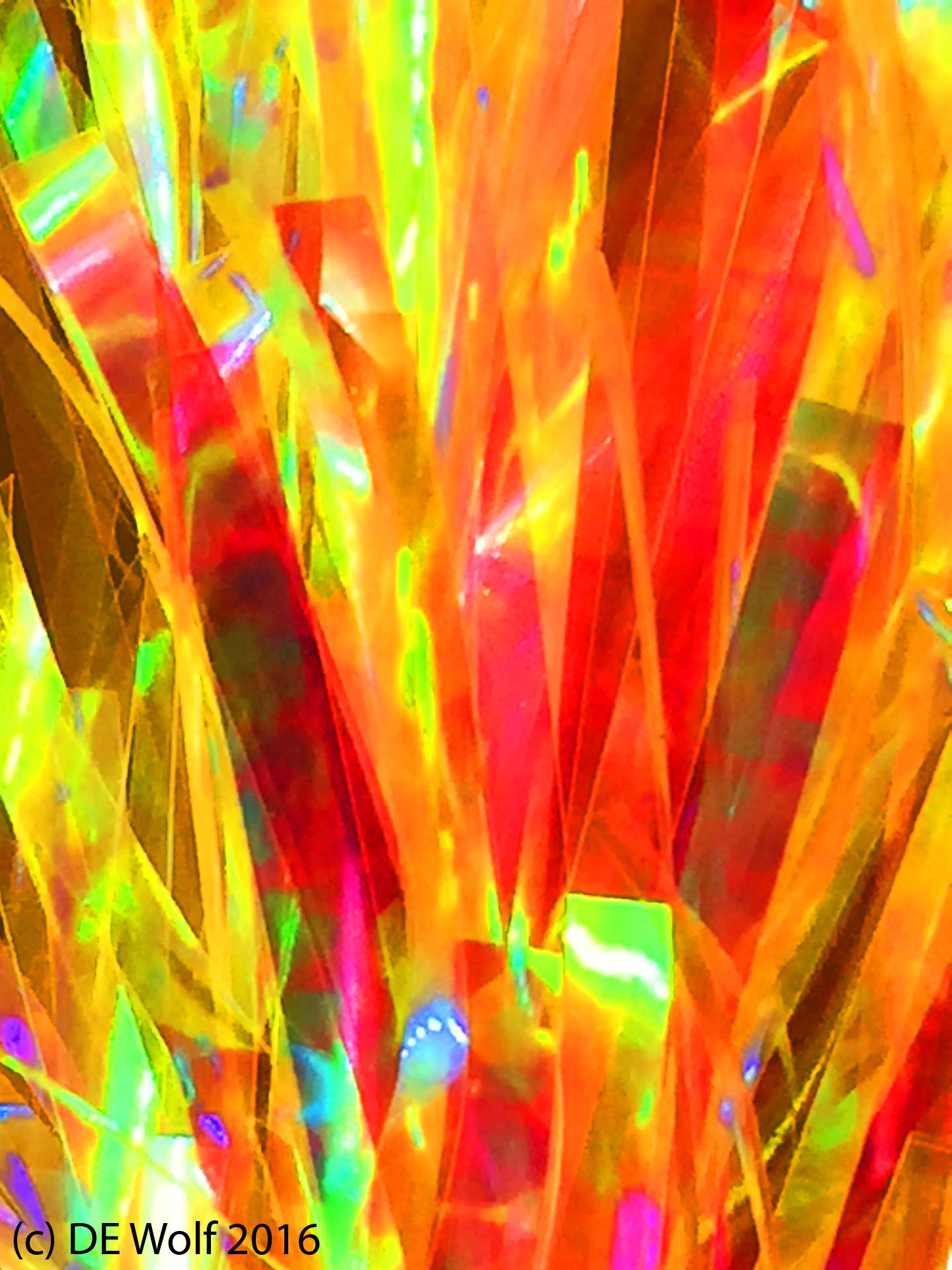
I came upon the scene of Figure 1 while taking a walk at the mall the other day. It is, of course, another quirky IPhone photograph – a display of iridescent colored ribbons of plastic. It so fitted my mood, my desire for a vibrant splash of color. And it reminds me of Aram Khachaturian’s “Sabre Dance.” Intense music elicits an intensely personal visual image, and this may be completed with a photographic image.

Photominimalism on the train

Figure 1 - The notebook. IPhone photograph. (c) DE Wolf 2016.

Figure 1 – The notebook. IPhone photograph. (c) DE Wolf 2016.

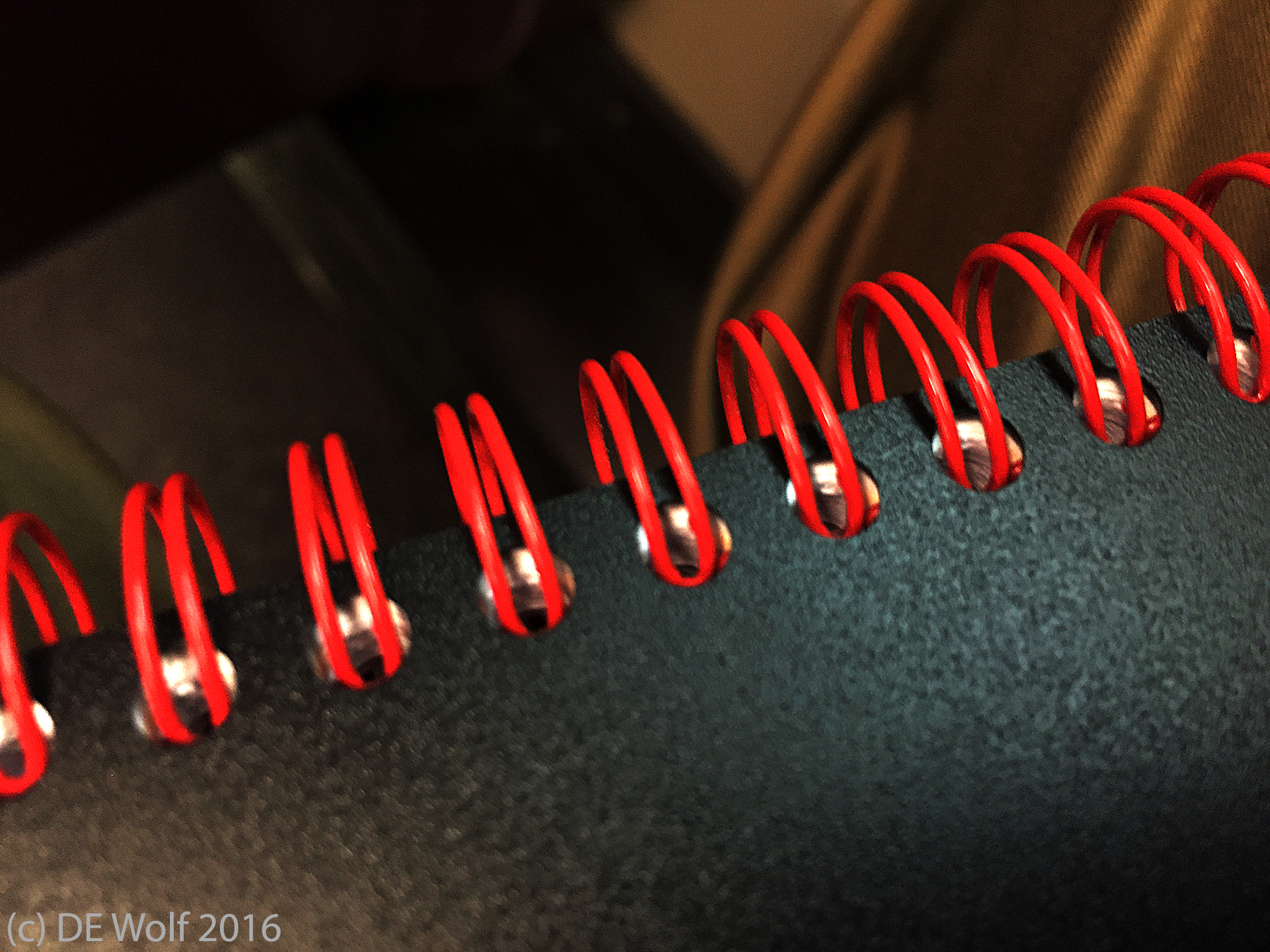
It’s been a while since I posted about photominimalism. In this case it goes back to my train pictures “through a dirty window.” I’ve noticed that invariably when I take IPhone photographs, I wind up taking an additional picture, usually of my feet. This takes me to the image of Figure 1. I was reviewing the images in my phone, the dirty window images, when I noticed that the live image was of my red ring-bound notebook, which was sitting in my lap. I am not going to tell you that this was an inadvertent image. It was not, and I, in fact, framed and focused it fairly carefully. I think that what makes it, for me, is the intense orange-red color of the rings and the grain on the black notebook. I suspect also that for many of us it is reminiscent of school days, of the smell of fresh notebooks and the promises that they hold.

Still on the train

Figure 1 - Image through a dirty window on a moving train #2. IPhone photograph. (c) DE Wolf 2016.

Figure 1 – Photograph through a dirty window on a moving train #2. IPhone photograph. (c) DE Wolf 2016.

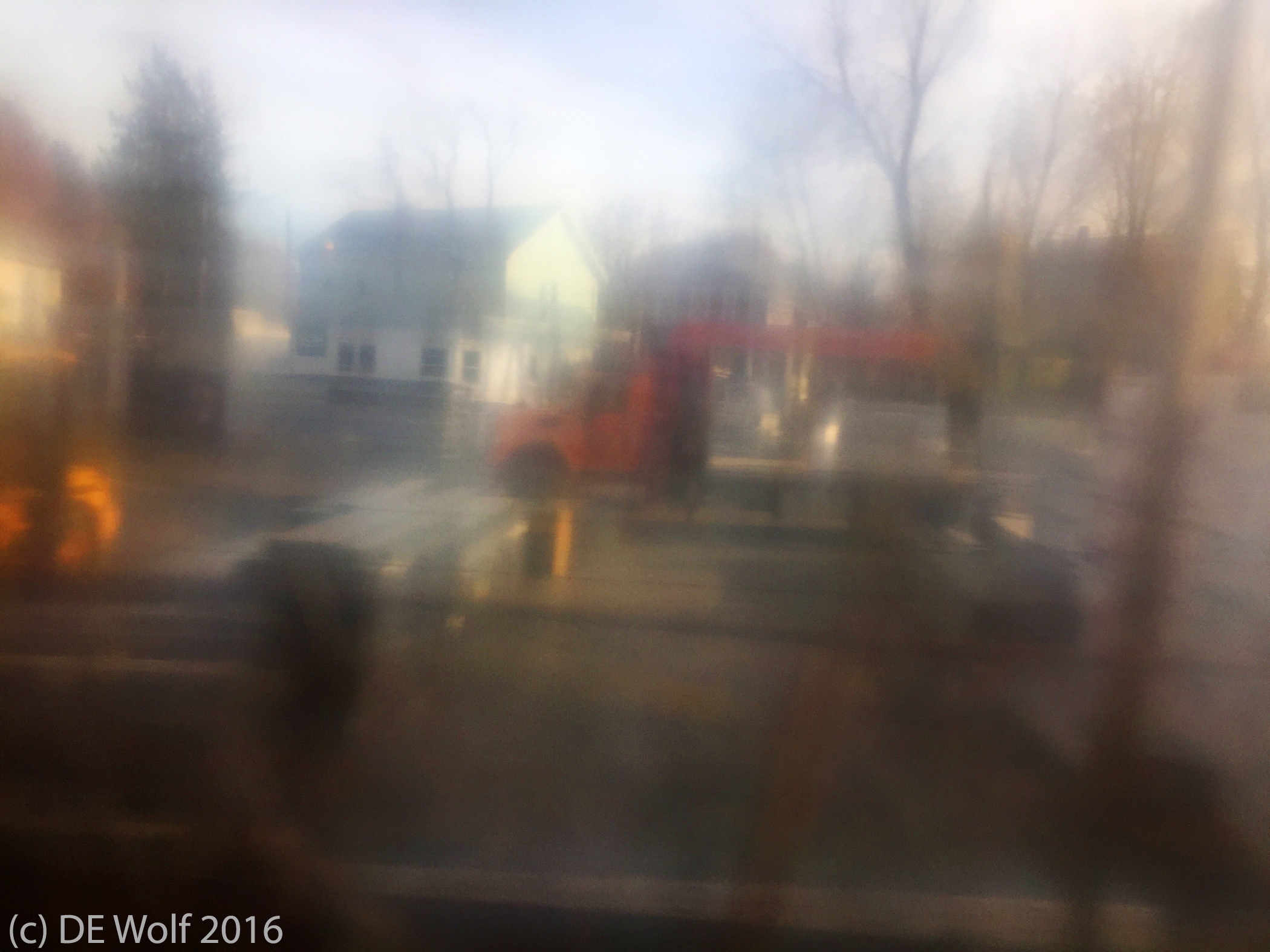
Before changing subject, I’d like to share another of the through a dirty window on a moving train photographs that I took yesterday with my IPhone as Figure 1. This one shows a house and a red truck. I have to admit that I am, in general, not enamored of “the out-of-focus photograph.” But I do have to say that it does achieve three things. First, it creates a sense of the surreal. Second, and as a result, it makes the otherwise mundane interesting. You feel a sense of satisfaction at discerning what exactly you are looking at. And third, it creates a kind of dynamism, a sense of motion. You feel that if you blink your eyes or just swim to the surface there will be clarity again. Combined what happens is a very static composition, becomes filled at least with the expectation of motion.