The orange and white scarf

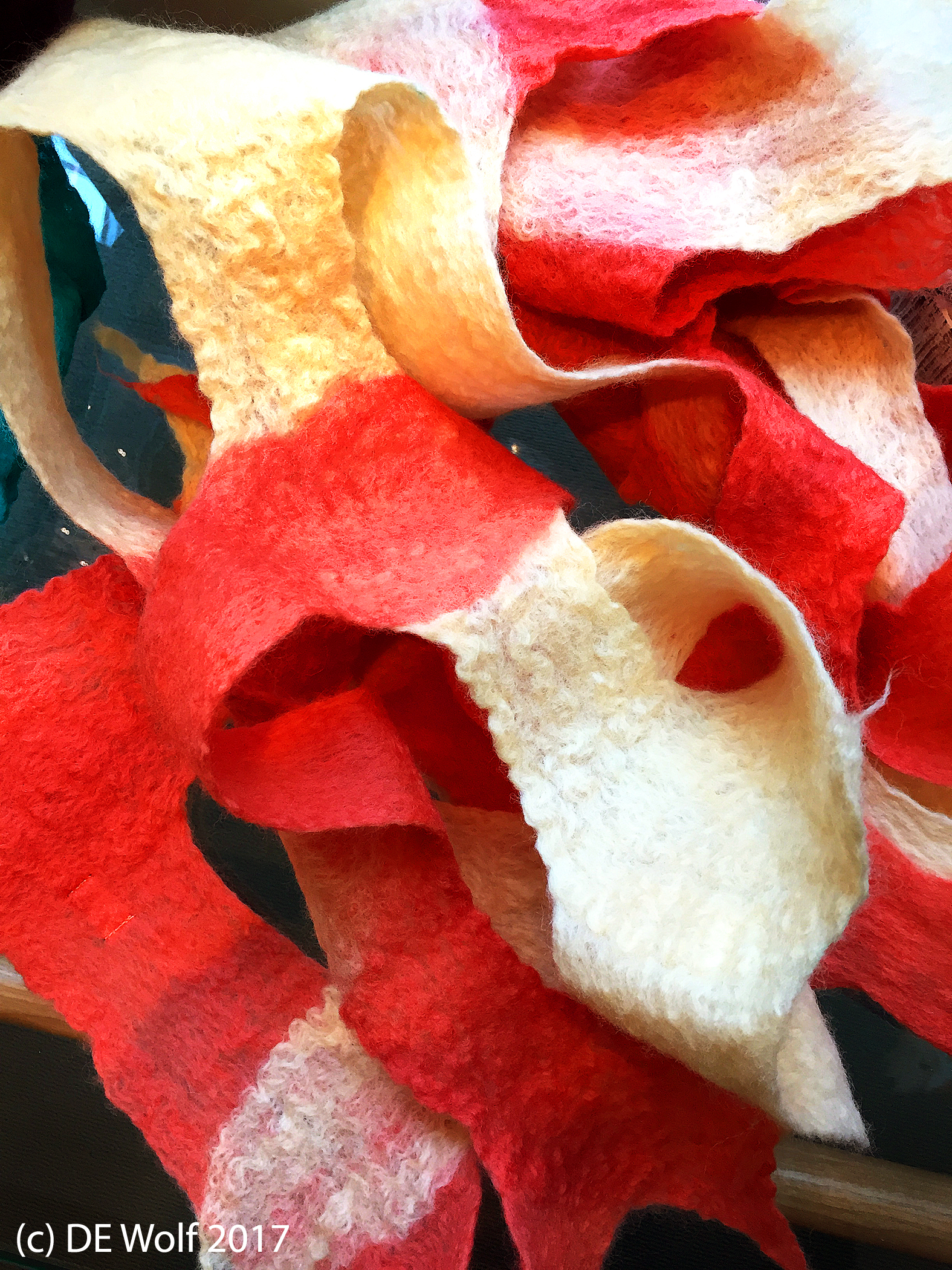
Figure 1 – The orange and white scarf, Salem, MA. (c) DE Wolf 2017.

I have to admit that I took the image of Figure 1 because I liked the colors and the pattern of the orange and white scarf tossed essentially randomly on a table. I am very enamoured of photographing fabric. Yes, this is largely a matter of form, texture, and color. But there is something else, something that fabric and weaving, wool in particular, connotes. 

The story begins with the “Fates” of ancient Greek mythology, Moirai, the Fates of Greek mythology who control the Threads of Fate. Such beings are a common theme in European polytheistic religions. The Fates were often depicted as weavers of a tapestry on a loom. This tapestry dictates the destiny of men and women. It is foretold.

Wait, wait! Weaving the destiny of men. Is that not the story of Madame Defarge in Charles Dicken’s “A Tale of Two Cities?” She knits and her knitting contains the names of those who, come the revolution, will be executed. Very creepy!

In another context, we have the story of “Sleeping Beauty” the spinning wheel upon which the Princess Aurora (Dawn) pricks her finger and comes under the witches spell. Spinning and weaving here are symbolic of womanhood. I would argue that the story of the Sleeping Beauty complements the myth of the Fates and Madame Defrage, because despite all of her parents’ efforts, she could not escape her destiny. It had to be lived out.

And finally we have Mahatma Ghandi spinning and weaving cloth. On the surface he was acting in defiance of British rule and British goods. He was leading his countrymen to return to old ways of self-sufficient manufacture. But the power of the images has less to do with unremembered protest than with subliminal common themes of spiritualism that return us once more to the Fates and the fabric of both life and world order.

All of this in an encountered piece of orange and white cloth and an image taken with my IPhone.

White breasted nuthatch

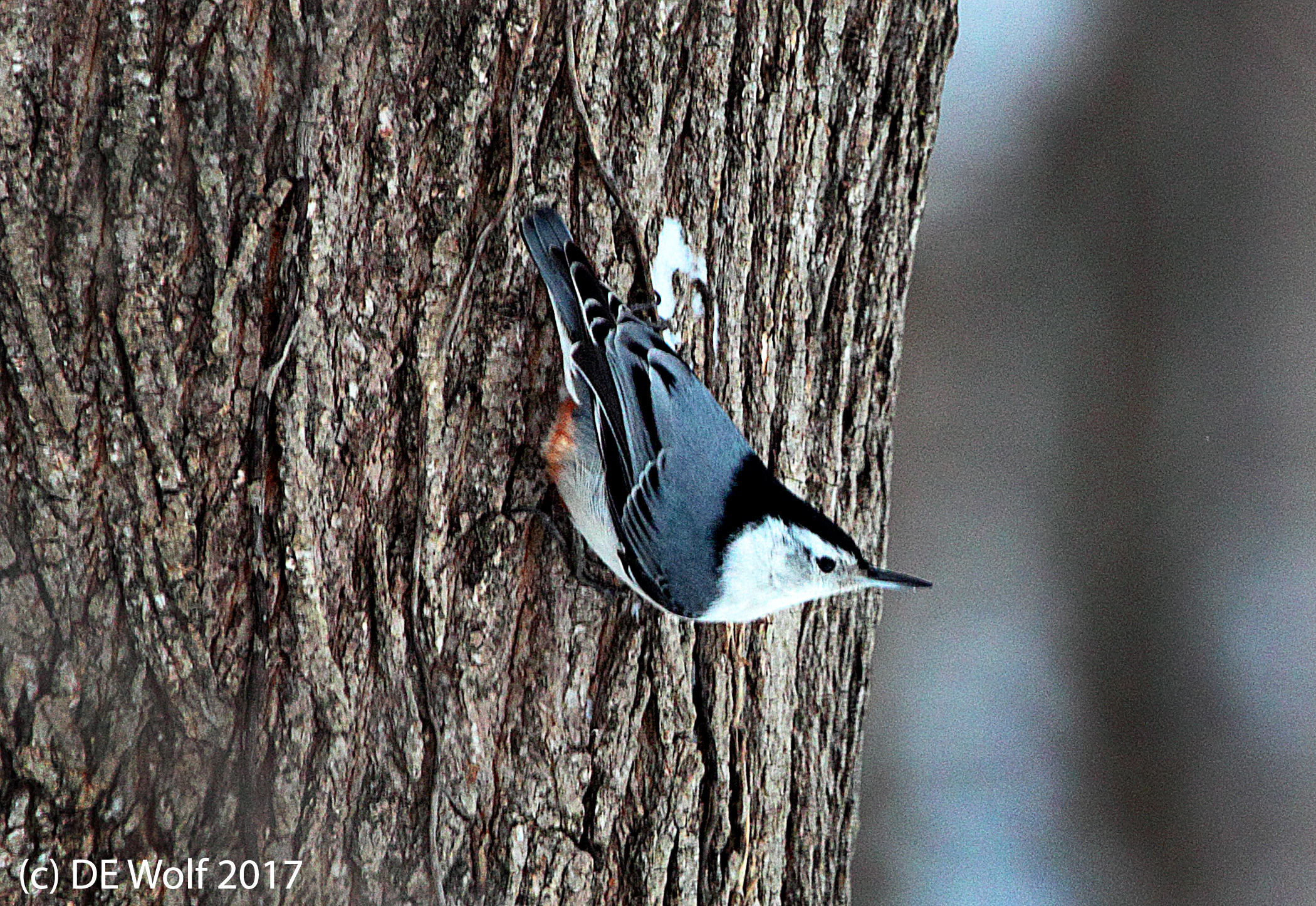
Figure 1 – White breasted nuthatch, Sudbury, MA. (c) DE Wolf 2017.

Figure 1 is my first successful image of a white breasted nuthatch – Sitta carolinensis. These are common feeder birds in the Northeast. But they are small and move fast; so it is hard to get close enough for a decent image, especially if you encumber yourself with the rule of only natural settings, that is no feeder allowed in the photograph. The other self-imposed rule is that you want them in their characteristic head down pose, which is how they climbed down trees. Note here the poisoned ivy vines.

I asked my self, self, why are they called nuthatches? They get this common name because of the way that they jam large nuts, such as acorns, into the bark of a tree and then pound on them with there sharp bills so as to “hatch” out the seed from the inside.That according to the Cornell Laboratory of Ornithology, the final arbiter in all things avian.

Canon T2i with EF100-400mm f/4.5-5.6L IS USM lens at 365 mm, ISO 800, Aperture Priority AE Mode 1/640 th sec at f/7.1 with no exposure compensation. 

A song sparrow in the snow

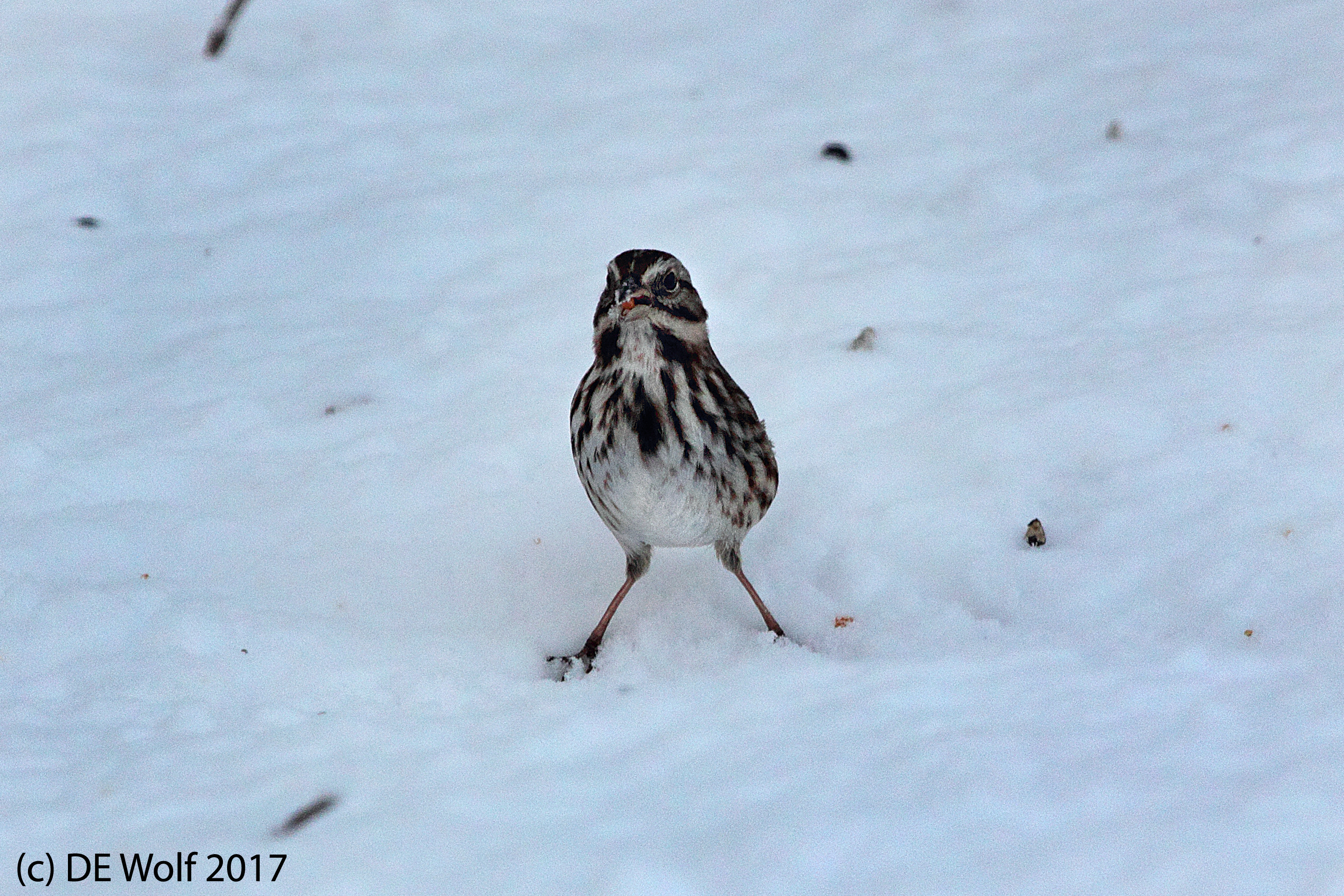
Figure 1 – Song sparrow in the snow, Sudbury, MA. (c) DE Wolf 2017.

Well, Ollie the Bobcat has been returned to his home at the National Zoo. Where was he found? In front of the Zoo’s birdhouse, of course. I thought of this yesterday as I was photographing birds from my family room window. The ritual is that I open the blind on the window that I use. Then my cat lines up expecting me to lift the floor blind up to cat height; so that she too can watch, She does not seem to intimidate the birds, who ignore her completely.

I took Figure 1 yesterday. It is kind of meant to be a joke. The bird in question is a meager Song Sparrow – Melospiza melodia.  They are minimized simply because they are common. Shakespeare, on the other hand recognized the significance of sparrows. “Not a whit, we defy augury. There is special providence in the fall of a sparrow” (V. ii. 197-198). Such augury, unfortunately for the sparrow, requires its being disemboweled and its entrails examined. Blech!

I also very rarely photograph birds head-on. But here the aspect is perfect – a little sparrow with its snow-covered beak holding a seed in its mouth and its feet positioned in the snow as if it were skiing.

This is the perfect “Tweet Pie.” “I tawt I taw a puddy tat!” and “I did! I did taw a puddy tat!” This, of course takes us right back to Ollie the Bobcat and to my cat watching the birdie from the window.

At another level, what is most striking about this image is the bleakness of the snow and what is essentially a colorless or mundane colored bird. We are struck by the challenge that birds endure in the northern forests. Winter is unforgiving.Yet these little birds endure.

Canon T2i with EF100-400mm f/4.5-5.6L IS USM lens at 365 mm, ISO 800 Aperture Priority AE Mode,1/2500 th sec at f/7.1 with no exposure compensation.

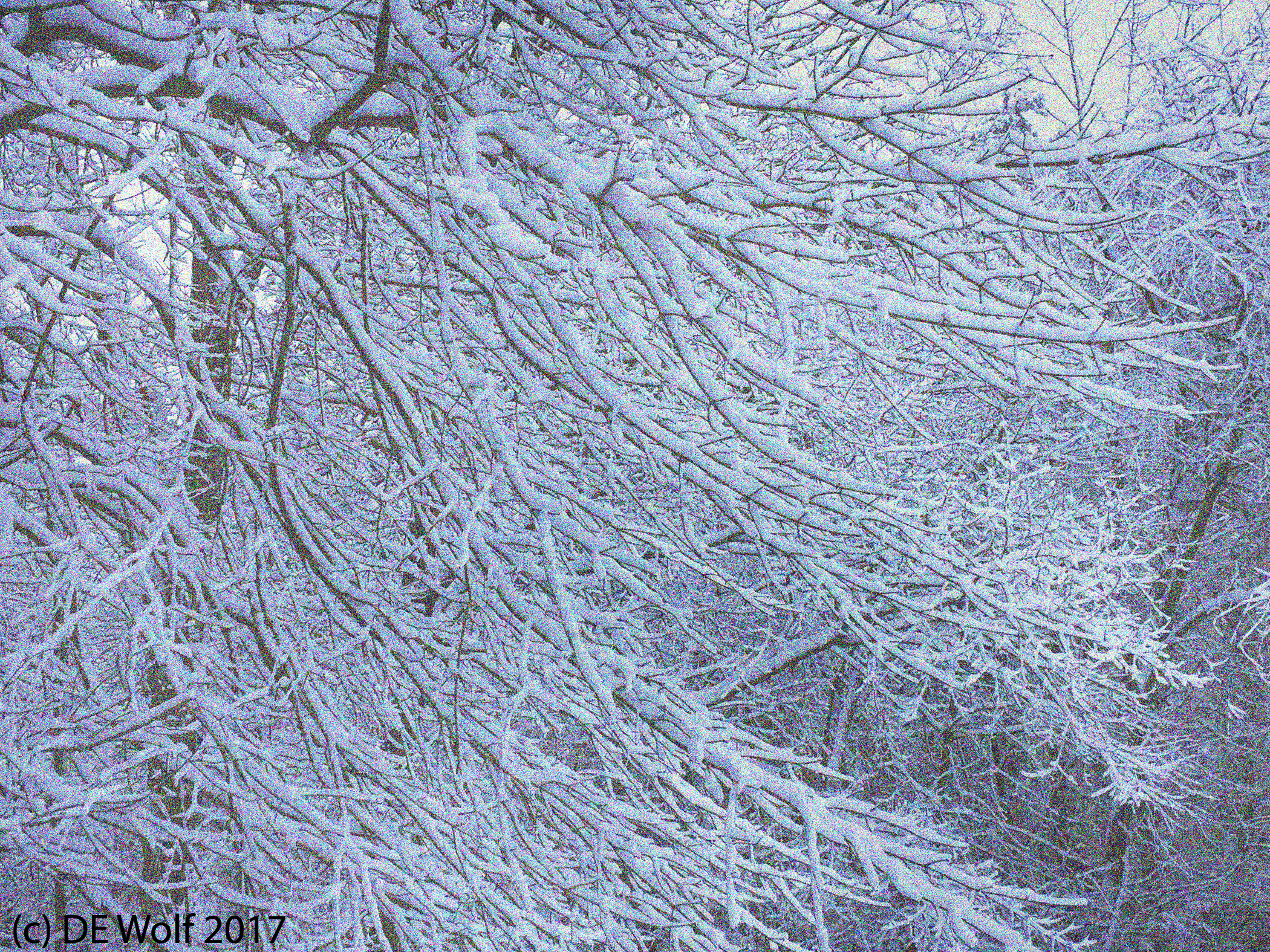
Dawn February 13, 2017

Figure 1 – Just before dawn February 13, 2017, Sudbury, MA. (c) DE Wolf 2017.

I took Figure 1 with my IPhone through my back window just before dawn this morning, The trees were covered heavily in snow from yesterday’s very wet storm. Here again is the beauty that drives us to live in New England. I have added noise to the image to give it the photopictorialism sense that I love so much and also to capture the indistinct sense of the early morning light. The blueness comes both from the (Rayleigh) light scattering off the snow and also from the cloudy greyness of the stormy morning. It is a blessing to behold such light. And it is an assertion of both the bitterness of a northern winter and of the coming spring.

Deceptive lines

Figure 1 – Linear, Natick, MA. (c) DE Wolf 2017.

Lines are the simplest of geometric shapes. Because of the instinctive behavior of human perception, they come with expectations. We are so programmed. In classic painting these expectations define perspective. In photography these can easily become distorted and the perspective thrown out of whack. Figure 1 is a perfect case in point. It is an IPhone image that I took of a store window. I was enjoying the contrasts, the ambiquity of what the lines were psychologically saying, the shadows, and the highlights. I intentionally didn’t aling the lines perfectly with the edges of the frame, nor did I correct for camera tilt. The result, I believe, is a very dynamic statement to the eye, which tries to figure out not only what is going on, but how the brain should interpret the perspective. The very confined space of the windows corner becomes infinite. What is really surprising here is the optical illusion of the right hand edge of the frame, which while perfectly perpendicular to the top and bottom appears narrower at the top than at the bottom. “Things are not always as they seem.

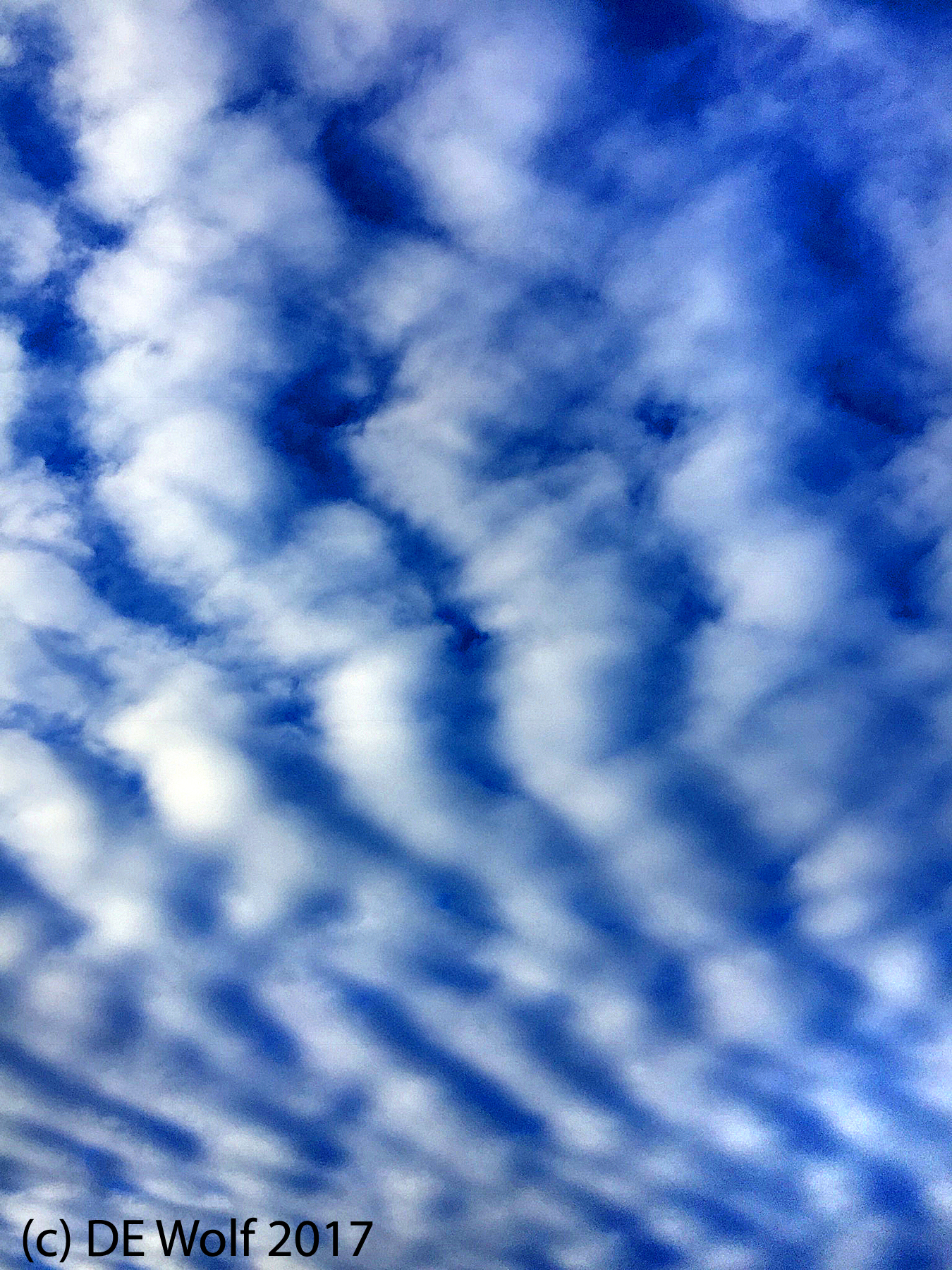
Striated clouds

Figure1 – Striated clouds, sidebands of a cyclonic weather system, IPhone photograph, Wilmington, MA, Feb. 6, 2017. (c) DE Wolf 2017.

It was a cold February day today in Boston – this in anticipation of a storm tomorrow that is going to sock us with snow and rain. When I went out for a short walk this afternoon, I discovered the entire sky filled with ominous striated clouds stacked in periodic rows as far as the horizon. I thought at first of mammatus clouds, which we have spoken about before. But that was not quite right. Still there was the sense of a turbulent and boiling sky. The weather was definitely up to no good.

When I got back to my computer, I looked it up and sure enough these striations are indicative of cyclonic weather events, of hurricanes and worse tornadoes. Here I think the culprit is a huge storm churning in the Atlantic. I tried to capture it all with my IPhone and the result is Figure 1. which gets the color and pattern right if not the extent and drama of the scene.

Black boot with white laces

Figure 1 – Black boots with white laces, Salem, MA. (c) DE Wolf 2017.

Continuing with my experiments taking close-ups with my IPhone, here is Figure 1, which shows a black leather boot with white laces. Looks like a major pain to get on, leave alone to tie.  Now boots are interesting, especially metaphorically. The most recent is the phrase “boots on the ground,” meaning to send in ground troupes.  There are, of course, the sexual connotations, as in Nancy Sinatra and her famous, “These boots are made for walking,” as in “Are you ready boots? Start walkin'”  And of course, there is “boot camp” and “bootstrapping.”

As far as this photograph is concerned, I like the pure white on black contrast. I like the texture of both the leather and the laces. And, of course, I like the elongated aspect ratio, which I have tried to capture and accentuate with the cropping, and I was even tempted to crop irregularly to accommodate the bow, which forces you “outside the box.” And finally, I am taken back to college English literature class – always a joyful moment – and to Rudyard Kipling’s poem “Boots.”

INFANTRY COLUMNS

We’re foot—slog—slog—slog—sloggin’ over Africa —
Foot—foot—foot—foot—sloggin’ over Africa —
(Boots—boots—boots—boots—movin’ up an’ down again!)
                There’s no discharge in the war!

Seven—six—eleven—five—nine-an’-twenty mile to-day —
Four—eleven—seventeen—thirty-two the day before —
(Boots—boots—boots—boots—movin’ up an’ down again!)
                There’s no discharge in the war!

Don’t—don’t—don’t—don’t—look at what’s in front of you.
(Boots—boots—boots—boots—movin’ up an’ down again);
Men—men—men—men—men go mad with watchin’ em,
                An’ there’s no discharge in the war!

Try—try—try—try—to think o’ something different —
Oh—my—God—keep—me from goin’ lunatic!
(Boots—boots—boots—boots—movin’ up an’ down again!)
                There’s no discharge in the war!

Count—count—count—count—the bullets in the bandoliers.
If—your—eyes—drop—they will get atop o’ you!
(Boots—boots—boots—boots—movin’ up an’ down again) —
                There’s no discharge in the war!

We—can—stick—out—’unger, thirst, an’ weariness,
But—not—not—not—not the chronic sight of ’em —
Boot—boots—boots—boots—movin’ up an’ down again,
                An’ there’s no discharge in the war!

‘Taint—so—bad—by—day because o’ company,
But night—brings—long—strings—o’ forty thousand million
Boots—boots—boots—boots—movin’ up an’ down again.
                There’s no discharge in the war!

I—’ave—marched—six—weeks in ‘Ell an’ certify
It—is—not—fire—devils, dark, or anything,
But boots—boots—boots—boots—movin’ up an’ down again,
                An’ there’s no discharge in the war!

 
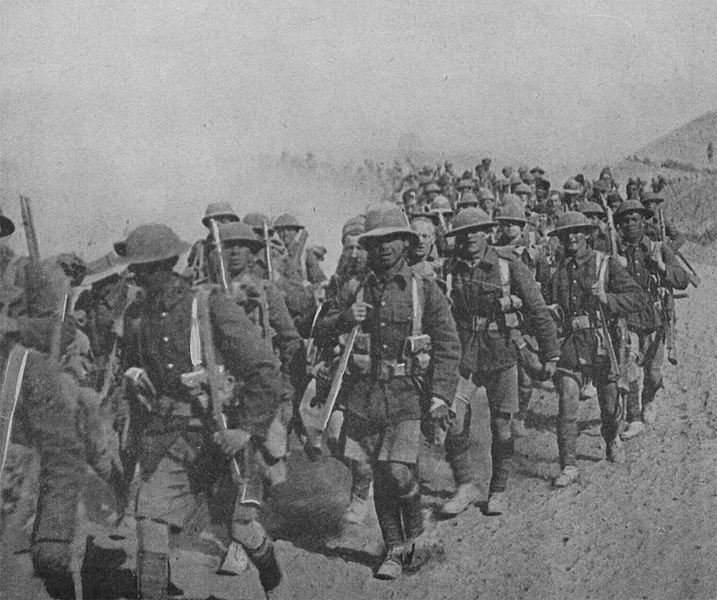
And I’ll offer as illustration to Kipling’s poem Figure 2, which shows British troupes in Mesopotamia in 1917. Mesopotamia? That’s Iraq and basically the same war a century later.

Figure 1 – “Boots on the ground.” British troupes in Mesopotamia c 1917. From the US LOC and in the public domain in the United States because of its age.

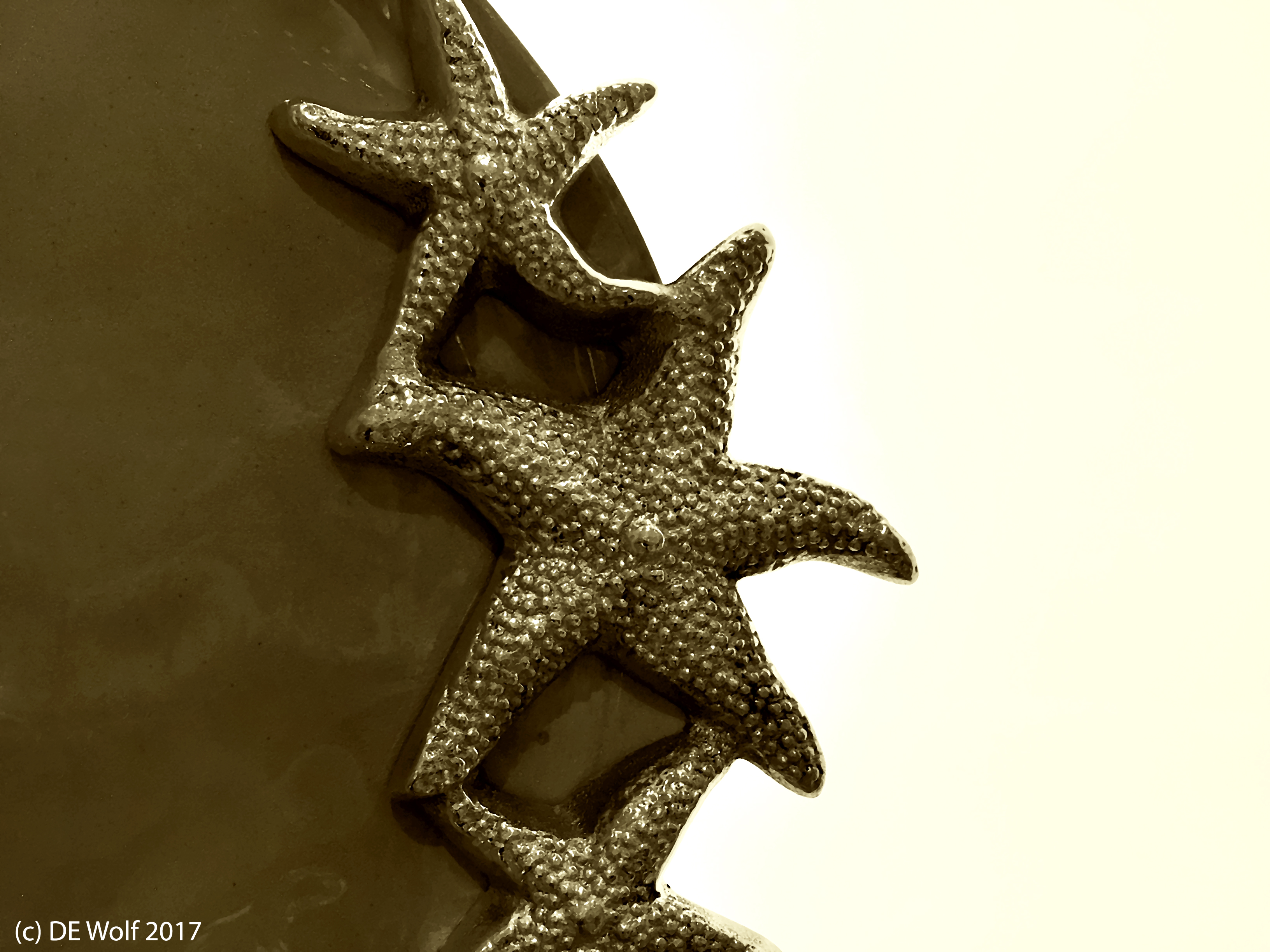
The starfish plate

Figure 1 – The starfish plate. (c) DE Wolf 2017

Figure 1 is another of my quirky IPhone close ups. It shows a ceramic dish with metal starfish along the edge. This was back illuminated with a translucent white panel. I carried my Canon with me all day Sunday, but took photographs only with my cellphone, which I guess places it in the :”go figure” category. I continue to be ever so impressed by the IPhones ability to get really close. Recently, I had my Steve the Dog image blown up to a 12″ x 12″ print and was very pleased with the results. All of the sharpness and detail remained despite the degree of enlargement. All the expression of that wrinkled loving face remained.

Jenny Wren

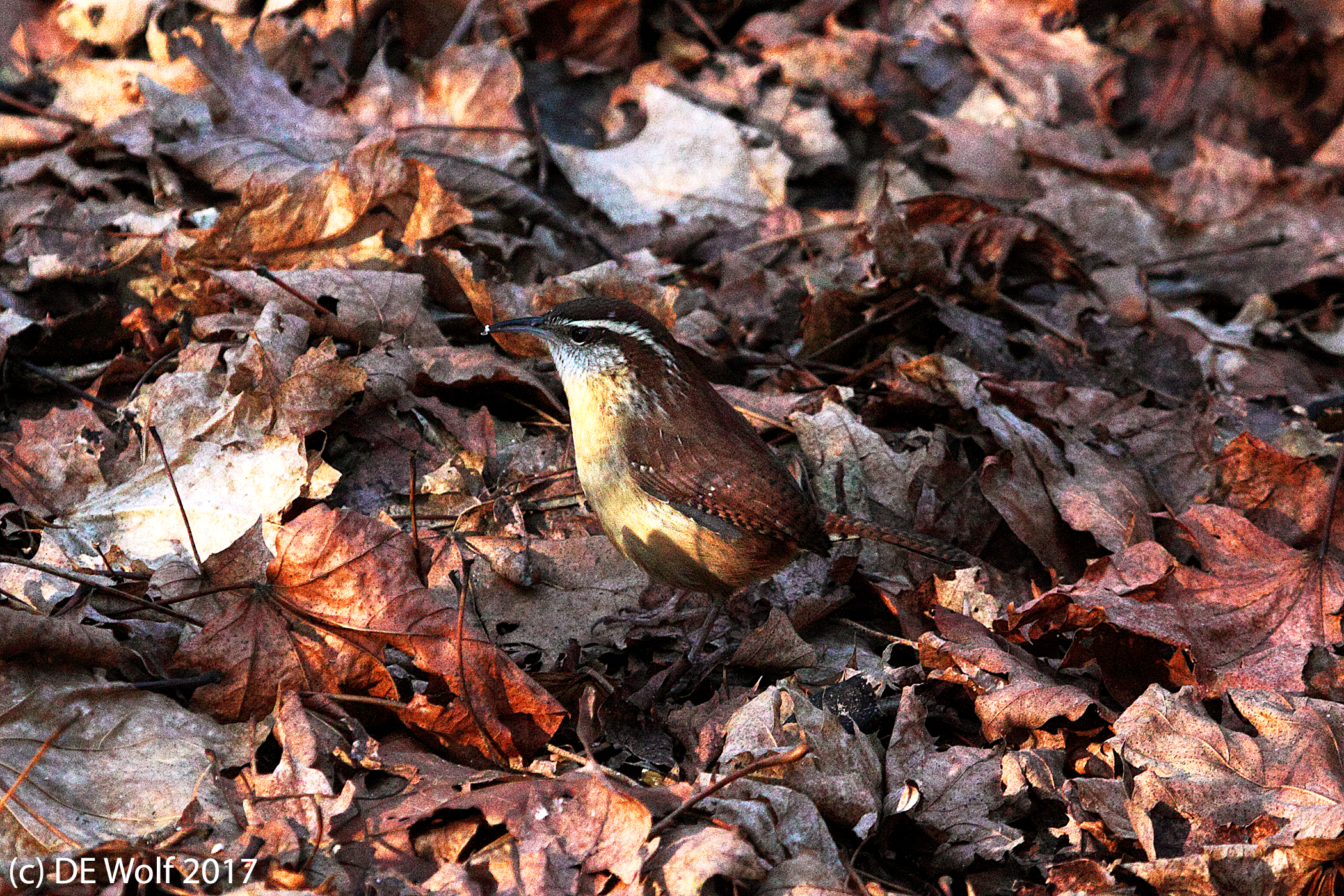
Figure 1 – Carolina wren, Sudbury, MA, January 2017. (c) DE Wolf 2017.

A couple of years ago, I photographed a grouse in Wisconsin and what struck me was how perfect this little bird’s camouflage was. I had the same sensation the other morning when I photographed this little Carolina wren – Thryothorus ludovicianus –  against the background of last fall’s leaves. You have to look closely or you might miss it and wrens supplement this by a cautious shyness. They seldom stay long enough to be photographed.

It is reported that the Carolina Wren is vulnerable to cold winters and that northern populations decrease markedly after severe winters. It is, perhaps, the case, at least in the short-term, that the Carolina wren is benefiting from global warming, since over the last century their northward range has expanded since the mid-1900s.

There is a little poem called the “Courtship of Cock Robin and Jenny Wren” that is believed by scholar to have its base in the Norse myth relating the death of Balder, resulting from the intrigues of Loki, the trickster. But it gained new life as an allegory of the 1742 intrigues that brought down the government of, Sir Robert Walpole, referred to as the “Robinocracy.” It has nothing to do with photography, but is delightful just the same. So I reproduce it here.

It was on a merry time,
When Jenny Wren was young,
So neatly as she danced,
And so sweetly as she sung–

Robin Redbreast lost his heart:
He was a gallant bird;
He doffed his hat to Jenny,
And thus to her he said.

“My dearest Jenny Wren,
If you will but be mine,
You shall dine on cherry pie,
And drink nice currant wine.

“I’ll dress you like a Goldfinch,
Or like a Peacock gay;
So if you’ll have me, Jenny,
Let us appoint the day.”

Jenny blushed behind her fan,
And thus declared her mind:
“Then let it be to-morrow, Bob;
I take your offer kind.

“Cherry-pie is very good;
So is currant-wine;
But I will wear my brown gown,
And never dress too fine.”

Robin rose up early,
At the break of day;
He flew to Jenny Wren’s house,
To sing a roundelay.

He met the Cock and Hen,
And bade the Cock declare,
This was his wedding-day
With Jenny Wren the fair.

The Cock then blew his horn,
To let the neighbors know
This was Robin’s wedding-day,
And they might see the show.

And first came Parson Rook,
With his spectacles and band;
And one of Mother Hubbard’s books
He held within his hand.

Then followed him the Lark,
For he could sweetly sing;
And he was to be clerk
At Cock Robin’s wedding.

He sang of Robin’s love
For little Jenny Wren;
And when he came unto the end,
Then he began again.

The Goldfinch came on next,
To give away the bride;
The Linnet, being bridesmaid,
Walked by Jenny’s side.

And as she was a-walking,
Said, “Upon my word,
I think that your Cock Robin
Is a very pretty bird.”

The blackbird and the Thrush,
And charming Nightingale,
Whose sweet “jug” sweetly echoes
Through every grove and dale;

The sparrow and Tomtit,
And many more were there;
All came to see the wedding
Of Jenny Wren so fair.

The Bullfinch walked by Robin,
And thus to him did say:
“Pray mark, friend Robin Redbreast,
That Goldfinch dressed so gay;

“What though her gay apparel
Becomes her very well;
Yet Jenny’s modest dress and look
Must bear away the bell !”

Then came the bride and bridegroom;
Quite plainly was she dressed;
And blushed so much, her cheeks were
As red as Robin’s breast.

But Robin cheered her up;
“My pretty Jen,” said he,
” We’re going to be married,
And happy we shall be.”

“Oh, then,” says Parson Rook,
“Who gives this maid away ?”
“I do,”says the Goldfinch,
“And her fortune I will pay;

“Here’s a bag of grain of many sorts,
And other things beside;
Now happy be the bridegroom,
And happy be the bride !”

“And will you have her, Robin,
To be your wedded wife ?”
“Yes, I will,” says Robin,
And love her all my life.”

“And you will have him, Jenny,
Your husband now to be ?”
“Yes, I will,” says Jenny,
And love him heartily.”

Then on her finger fair
Cock Robin put the ring;
“You’re marrried now,” says Parson Rook;
While the Lark aloud did sing:

“Happy be the bridegroom,
And happy be the bride!
And ,nay not man, nor bird, nor beast
This happy pair divide.”

The birds were asked to dine;
Not Jenny’s friends alone,
But every pretty songster
That had Cock Robin known.

They had ;cherry-pie,
Besides some currant-wine,
And every guest brought something,
That sumptuous they might dine.

Now they all sat or stood,
To eat and to drink;
And every one said what,
He happened to think.

They each took a bumper,
And drank to the pair,
Cock Robin the bridegroom,
And Jenny Wren the fair.

The dinner things removed,
They all began to sing;
And soon they made the place
Near a mile around to ring.

The concert it was fine;
And every bird tried
Who best should sing for Robin,
And Jenny Wren the bride,

When in came the Cuckoo
And made a great rout;
He caught hold of Jenny,
And pulled her about.

Cock Robin was angry,
And so was the Sparrow,
Who fetched in a hurry
His bow and his arrow.

His aim then he took,
But he took it not right;
His skill was not good,
Or he shot in a fright;

For the cuckoo he missed,
But Cock Robin he killed!—
And all the birds mourned
That his blood was so spilled.

Who killed Cock Robin?
“I,” said the Sparrow,
“With my bow and arrow,”
I killed Cock Robin.”

Who saw him die
“I” said the Fly,
“With my little eye,
And I saw him die.”

Who caught his blood?
“I,” said the Fish,
“With my little dish,
And I caught his blood.”

Who made his shroud?
“I,” said the Beetle,
“With my little needle,
And I made his shroud.

Who shall dig his grave ?
“I,” said the Owl,
“With my spade and show’l,
And I’ll dig his grave.”

Who’ll be the parson ?
“I” said the Rook,
“With my little book,
And I’ll be the parson.”

Who’ll be the clerk ?
“I,” said the Lark,
“If it’s not in the dark,
And I’ll be the clerk.”

Who’ll carry him to the grave ?
“I,” said the Kite,
“If tis not in the night,
And I’ll carry him to his grave.”

Who’ll be the chief mourner ?
“I,” said the Dove,
“I mourn for my love,
And I’ll be chief mourner.”

Who’ll carry the link ?
“I,” said the Linniet,
“I’ll fetch it in a minute,
And I’ll carry the link.”

Who’ll sing a psalm ?
“I,” said the Thrush,
As she sat in a bush,
“And I’ll sing a psalm.”

And who’ll toll the bell ?
“I,” said the Bull,
“Because I can’ pull ;”
And so, Cock Robin, farewell.

Canon T2i with  EF100-400mm f/4.5-5.6L IS USM lens at 260 mm, ISO 1600, Aperture Priority AE Mode, 1/640 th sec at f/7.1 with -1 exposure compensation.