Green on black and white

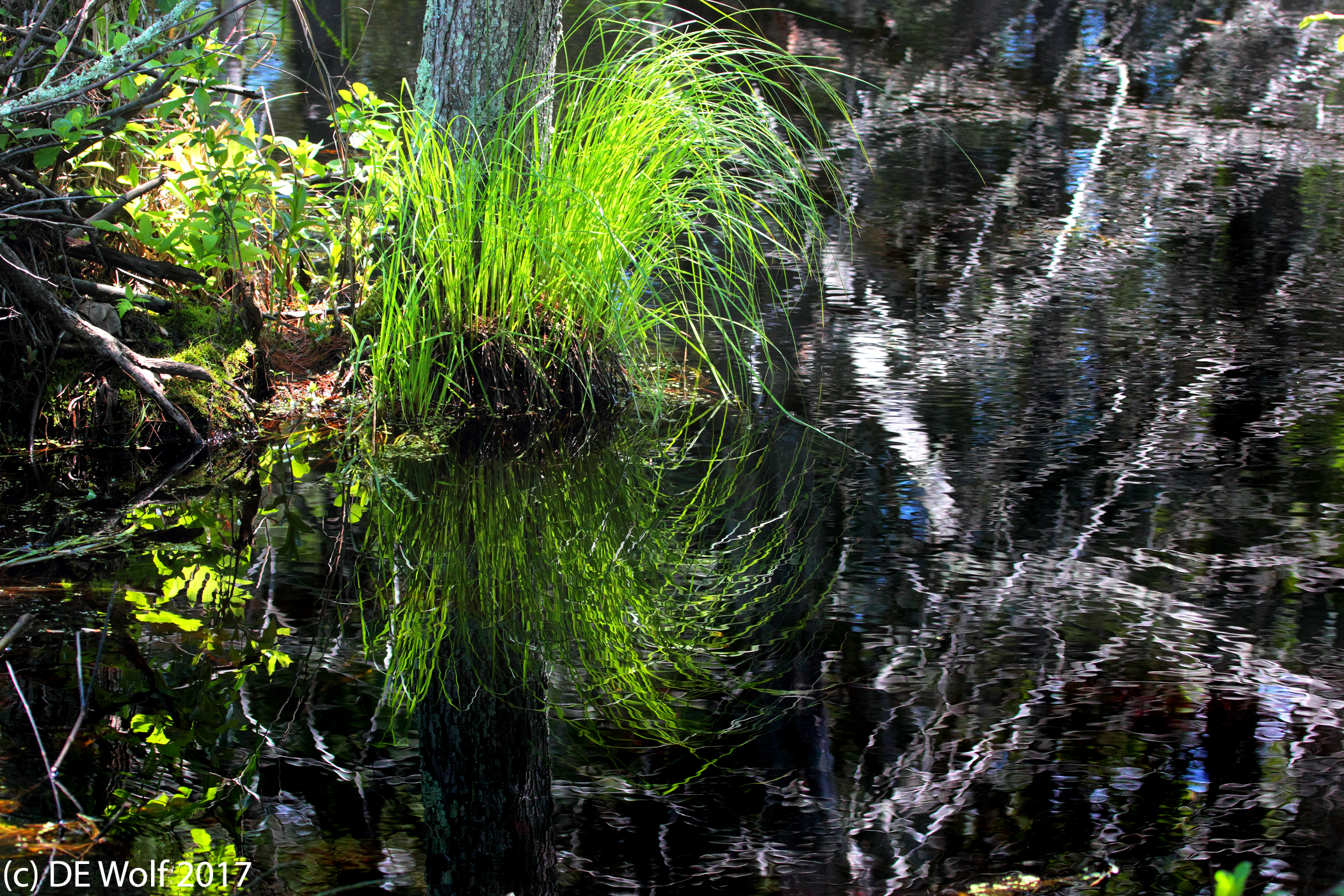
Figure 1 – Green grass on the pond in late spring, Assabet River National Wildlife Refuge, Sudbury, MA (c) DE Wolf 2017.

Something that I find dramatic are photographs where most of the image is black and white which serves emphasize a brilliantly colored subject. Such was my sense of Figure 1. I loved the intensity of the swirling green grass, perfectly complemented by its reflection in the cold black late spring pond. I loved the way that the ripples on the water distorted the trees reflecting off the surface. But most of all I liked that sense of color on black and white, Here it is all natural, a fact emphasized by the little blue patches of sky. This is the peace that we seek in the woods – bright flashes of light highlighted against primordial darkness.

Canon T2i with EF100-400mm f/4.5-5.6L IS USM lens at 100 mm, ISO 800, Aperture Priority AE Mode 1/400th sec at f/7.1 with -1 exposure compensation.

Twins

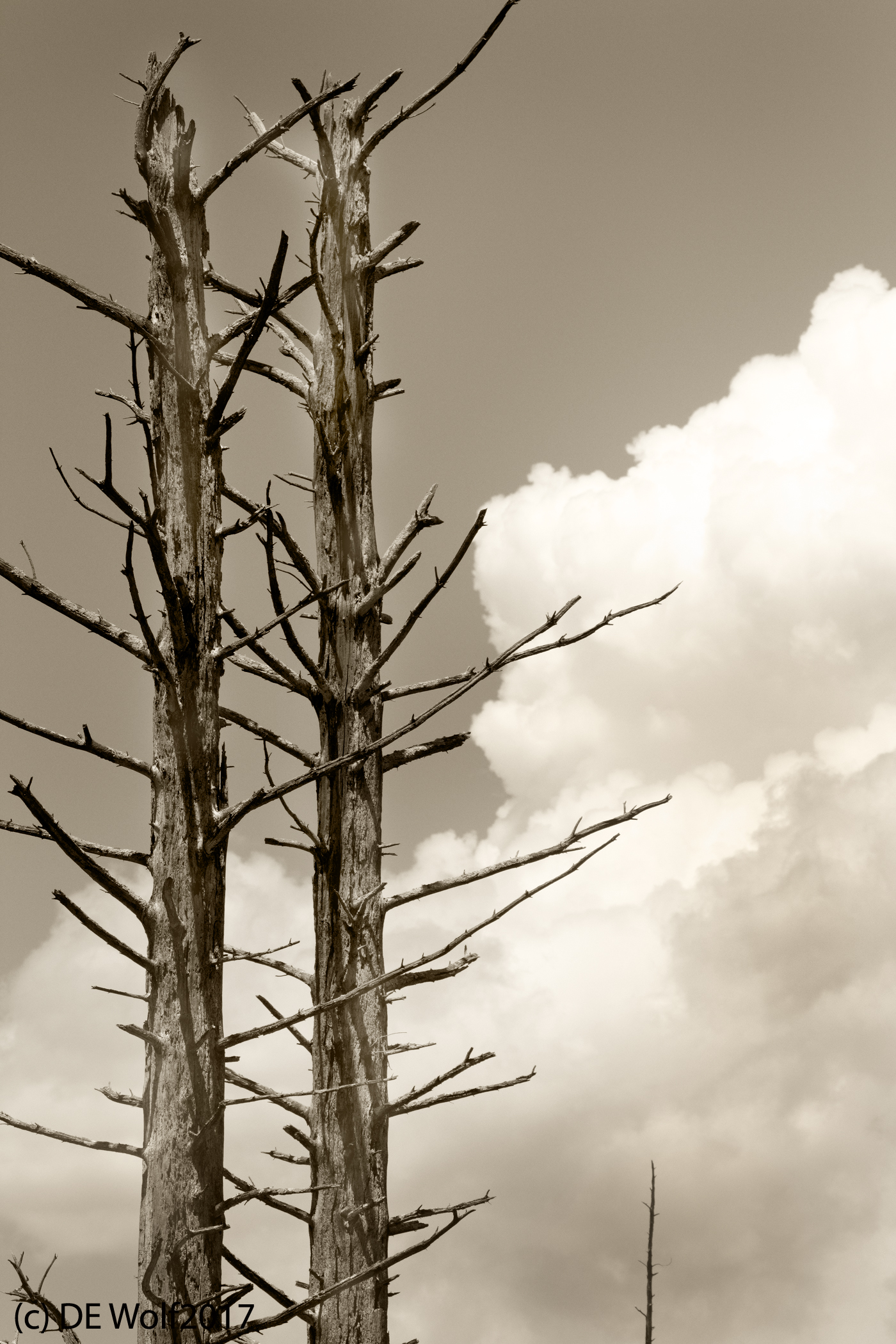
Figure 1 – Decaying pines on the pond, spring 2017, (c) DE Wolf 2017.

I have hiked by the twin trees of Figure 1 many times. They are a feature on the pond, the kind of dead trees that the great blue herons favor as their nesting grounds. I have found them difficult to photograph, but was happy on this particular day to find a suitable cloud formation as a background that speaks to their magnificent height. They tower above the water, and the birds like to perch in their branches and screech out a song.

I have always had the sense that they were a feature on the pond – something timeless. But in reality that is not the case. The meaning of the pond is not timelessness per-say, but timelessness against a background of endless change. I have watched these two ancient trees metamorphose over the last couple of years, their tops breaking off, their bark peeling, and the way that they yield slowly to the endless attack of insects. Soon they will fall.

“Between every two pine trees there is a door leading to a new way of life.”

John Muir

Porphyria’s lover

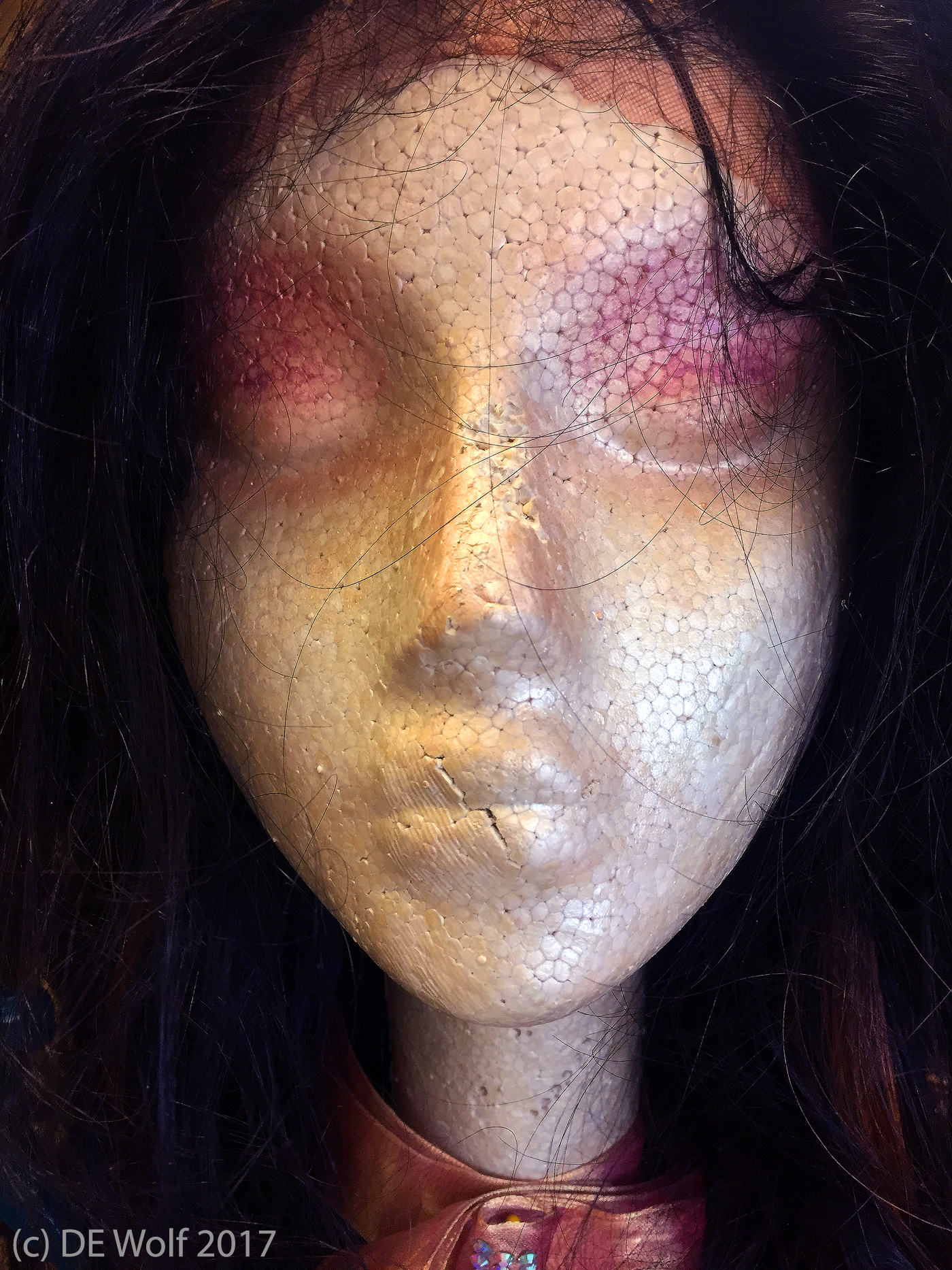
Figure 1 – Porphyria’s Lover, Wig Mannequin, Waltham, MA. (c) DE Wolf 2017.

I took my wife to her hairdresser this weekend and I was a bit stunned by the wig mannequin of Figure 1. She is very reminiscent of a Tim Burton character – utterly vampiric. Most striking is the violet eye shadow, her closed eyes, pale tessellated complexion, and cracked lips. You forget that she is a mannequin and find yourself taken up in the ambiguity of alive or dead. It will come as no surprise to regular readers of this blog that I made a poetic association with this pale ghost.

She immediately brought to my mind Robert Browning’s dark poem “Porphyria’s Lover.” I reproduce it in its entirety below, because I believe that it is essential reading for English speakers. Despite its macabre subject matter, or perhaps because of it, it is a milestone in the exploration of psychosis, of the darkest regions of the disturbed and murderous mind. It speaks of love, hate; life, death, and possession most ambiguously, and in those regards, it hearkens to another Browning masterpiece My Last Duchess.

The wonderful mystery of Porphyria’s Lover is that the meaning of the name is obscure. Robert Browning was home-schooled and as such he often made obscure personal associations with classicism. So, in the end, we really don’t know why it is called “Porphyria’s Lover.” Perhaps that is all part of the charm. “And yet God has not said a word!”

Porphyria’s Lover
The rain set early in to-night,
       The sullen wind was soon awake,
It tore the elm-tops down for spite,
       And did its worst to vex the lake:
       I listened with heart fit to break.
When glided in Porphyria; straight
       She shut the cold out and the storm,
And kneeled and made the cheerless grate
       Blaze up, and all the cottage warm;
       Which done, she rose, and from her form
Withdrew the dripping cloak and shawl,
       And laid her soiled gloves by, untied
Her hat and let the damp hair fall,
       And, last, she sat down by my side
       And called me. When no voice replied,
She put my arm about her waist,
       And made her smooth white shoulder bare,
And all her yellow hair displaced,
       And, stooping, made my cheek lie there,
       And spread, o’er all, her yellow hair,
Murmuring how she loved me — she
       Too weak, for all her heart’s endeavour,
To set its struggling passion free
       From pride, and vainer ties dissever,
       And give herself to me for ever.
But passion sometimes would prevail,
       Nor could to-night’s gay feast restrain
A sudden thought of one so pale
       For love of her, and all in vain:
       So, she was come through wind and rain.
Be sure I looked up at her eyes
       Happy and proud; at last I knew
Porphyria worshipped me; surprise
       Made my heart swell, and still it grew
       While I debated what to do.
That moment she was mine, mine, fair,
       Perfectly pure and good: I found
A thing to do, and all her hair
       In one long yellow string I wound
       Three times her little throat around,
And strangled her. No pain felt she;
       I am quite sure she felt no pain.
As a shut bud that holds a bee,
       I warily oped her lids: again
       Laughed the blue eyes without a stain.
And I untightened next the tress
       About her neck; her cheek once more
Blushed bright beneath my burning kiss:
       I propped her head up as before,
       Only, this time my shoulder bore
Her head, which droops upon it still:
       The smiling rosy little head,
So glad it has its utmost will,
       That all it scorned at once is fled,
       And I, its love, am gained instead!
Porphyria’s love: she guessed not how
       Her darling one wish would be heard.
And thus we sit together now,
       And all night long we have not stirred,
       And yet God has not said a word!
 

From the garden of the Hesperides

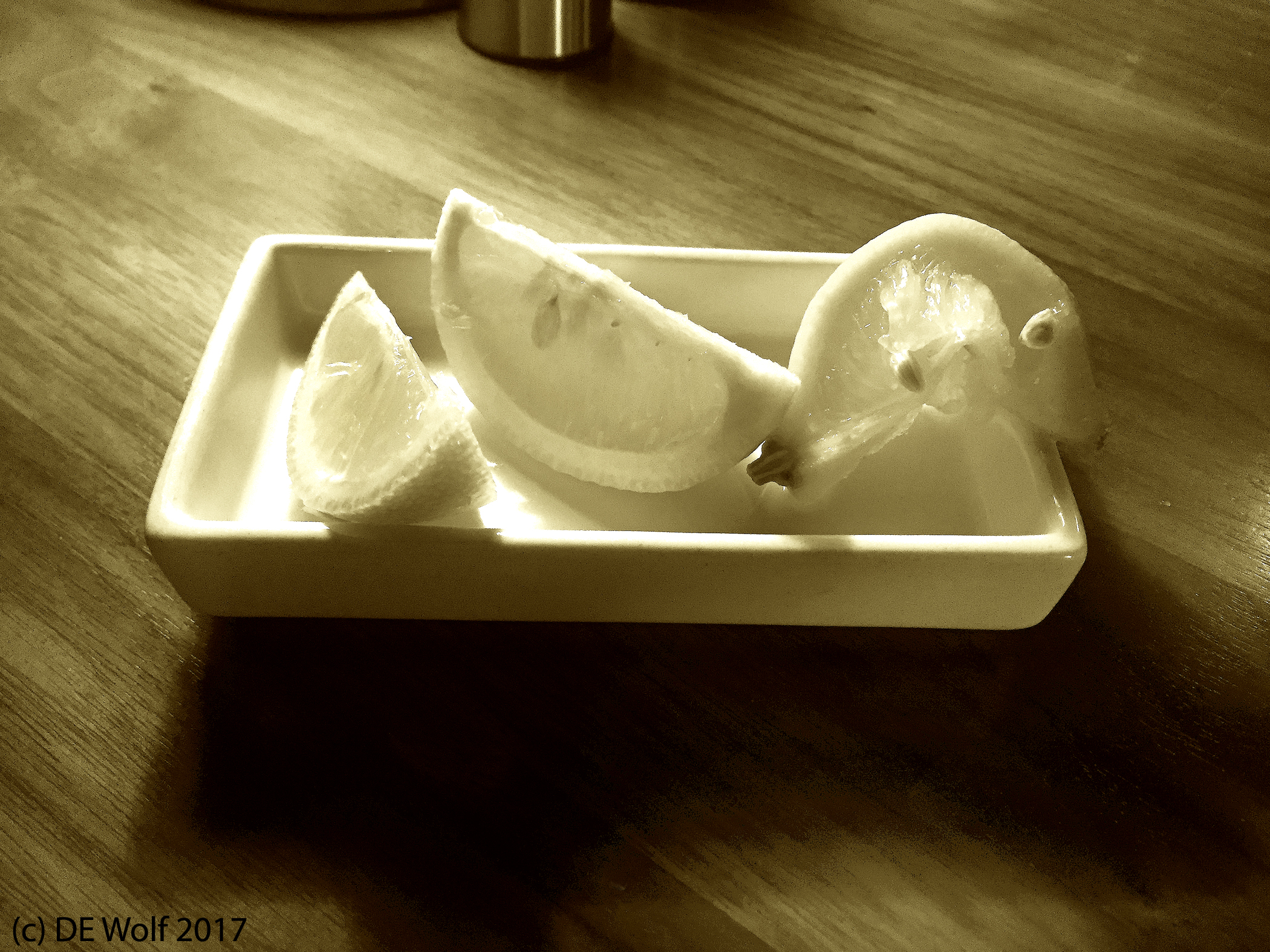
Figure 1 – Lemons in a luscious light, Burlington, MA. (c) DE Wolf 2017.

I am always looking for a special light to capture, and it often occurs in unexpected places. I was out for lunch with my wife on Saturday. We were sitting in a darkened restaurant when I saw the possibility of three lemons on a plate: two slices cut the other squeezed in the glowing light of an incandescent table lamp. It was a matter of positioning first lemons then IPhone. I love the IPhone for this kind of image. With it you can get surprisingly close, and if this picture lack a touch of ultimate sharpness, it more than makes up with a fuzziness that complements the sense of glow.

It was a wonderful lunch; so I will end in a quote from chef Padma Lakshmi that reflects the divinity of this citrus fruit. I will not call it a humble fruit, for it truly symbolizes the sun, the Earth, and life. In ancient Greek mythology the Hesperides were the nymphs of evening and the golden light of sunset. They were the “Daughters of the Evening” or “Nymphs of the West”. Lemons grew in the Garden of the Hesperides and to the ancient Greeks all citrus species were referred to as Hesperidoeidē.

“From the simple stringing together of lemon garlands for the goddess Durga, to dividing the prasadam or blessed foods for the children first, I came to associate food not only with femininity, but also with purity and divinity.”
 

Into the woods again

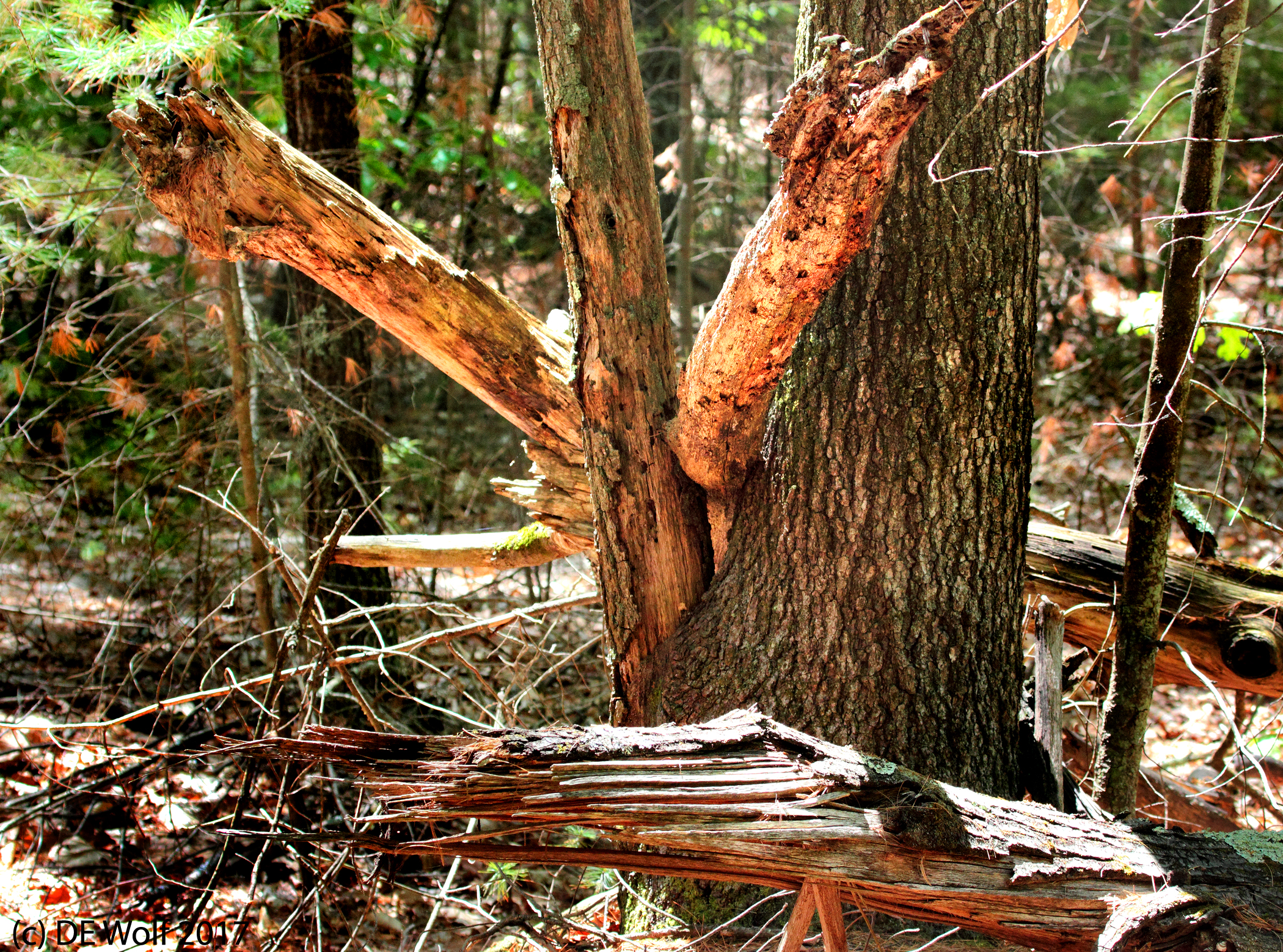
Figure 1 – Fallen trees in the morning sunlight, Assabet River National Wildlife Refuge, (c) DE Wolf 2017.

It is a long story, but today I ventured back into the woods for the first time since December. It was an opportunity to survey the damage of winter, the fallen and snapped off trees as well as to explore the consistency of where certain bird species frequent. Of course, the second is largely a matter of habitat. I saw no great blue herons on the ponds, though I have seen many high up in their nests in the rookeries. The canadian geese were there with their newly hatched goslings. The towhees still tormented and teased my camera in the same spot. And the blue jays squawked loudly in all the same places.

The woods never disappoint, even if I fail to get good bird pictures. There is a kind of timelessness present and I quickly revert to the sense of my youth, where the world seems both timeless and young, where your own age evaporates. It is rejuvenating. I took the picture of Figure 1 in the pine barren, trees snapped off and intertwined captured in an intense beam of warm morning sunlight. The rich ochre shades were compelling; so I chose to keep the image in color. Ochre is the color of the Earth. Mixed with sunlight it suggests that out of the carnage there will be renewal.

There are painters who transform the sun into a yellow spot, but there are others who with the help of their art transform a yellow spot into sun.”

Pablo Picasso


Green grow the lilacs

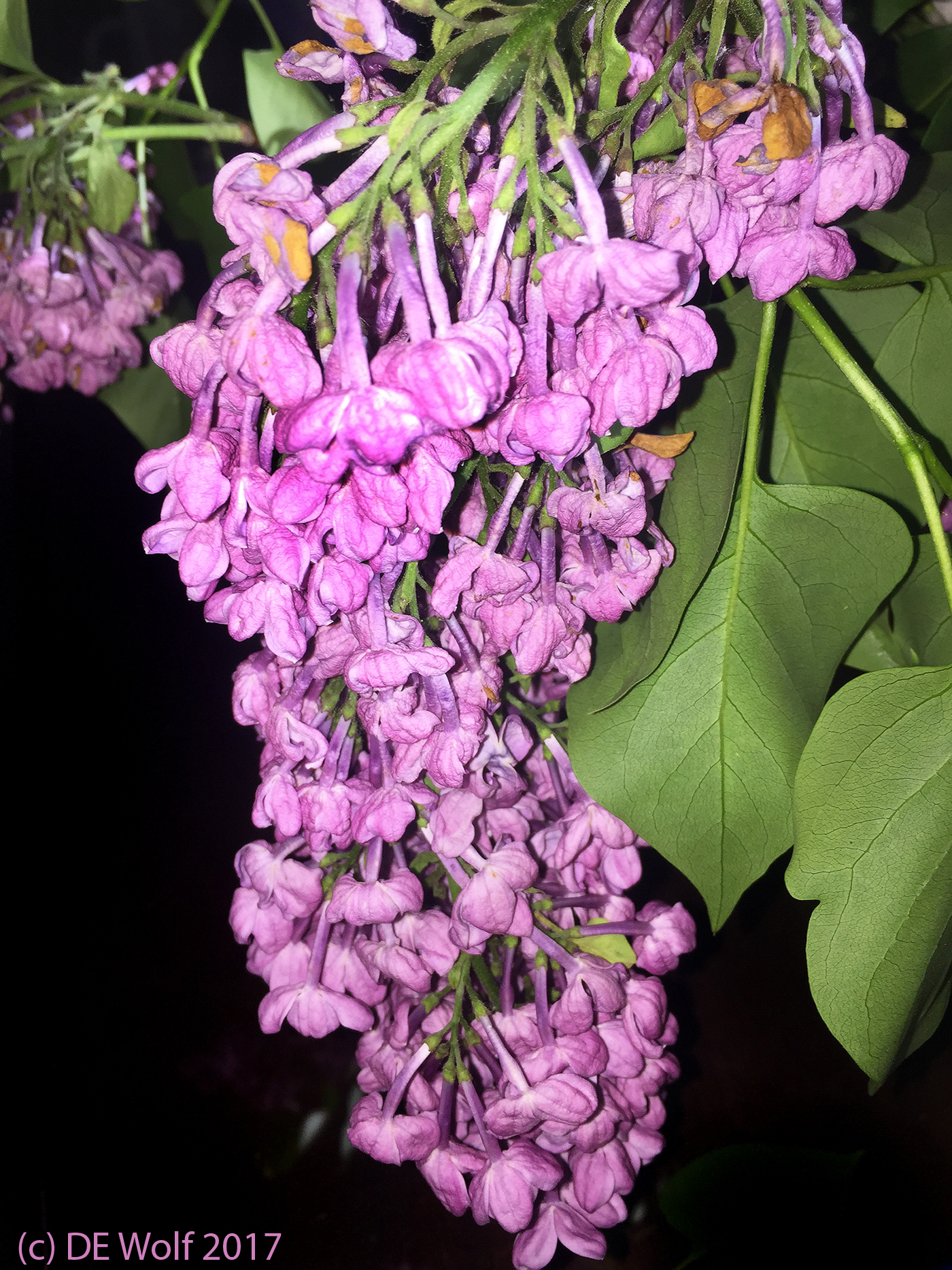
Figure 1 – Lilacs, (c) DE Wolf 2017.

Late May is lilac time in New England. First the scientific facts, the common lilac is Syringa vulgaris from the olive family Oleaceae. It was originally native to the Balkan Peninsula, but because of its beauty and subtle sweet smell has been widely cultivated in much of Europe and North America. It is not an aggressive plant. Its presence in the woods invariably represents a nearby forgotten homestead – a kind of remembrance.

A friend brought some cut lilacs for my wife, and yesterday afternoon I was taken by the dramatic illumination of these flowers by a ray of late afternoon sunlight. I took the image of Figure 1 with my IPhone, but discovered that it greatly benefited by a fill flash. The added bonus was the night like background. I suggest this to flower photographers. Highlight them with coal black night.

Nothing is without connotation. And for my generation- bring out your racoon skin hats friends – it conjures up Fess Parker singing the traditional Irish folsong “Green Grow the Lilacs” in the 1956 movie “Westward Ho the Wagons.” Apologies to those of different generations. Please do not yawn too loudly.

“Green grow the lilacs, all sparkling with dew

I’m lonely, my darling, since parting with you;

But by our next meeting IU’ll hope to prove true

And change the green lilacs to the Red, White and Blue.


I once had a sweetheart, but now I have none

She’s gone and she’s left me, I care not for one

Since she’s gone and left me, contented I’ll be,

For she loves another one better than me.


I passed my love’s window, both early and late

The look that she gave me, it makes my heart ache;

Oh, the look that she gave me was painful to see,

For she loves another one better than me.


I wrote my love letters in rosy red lines,

She sent me an answer all twisted and twined;

Saying,”Keep your love letters and I will keep mine

Just you write to your love and I’ll write to mine”.

I always think of that song when I pass lilacs on the road, and childhood associations come immediately to mind. I invariably wind up singing what was once my theme song – Davy Crockett. Those were simpler times.

Reflections on the aura on my garage door

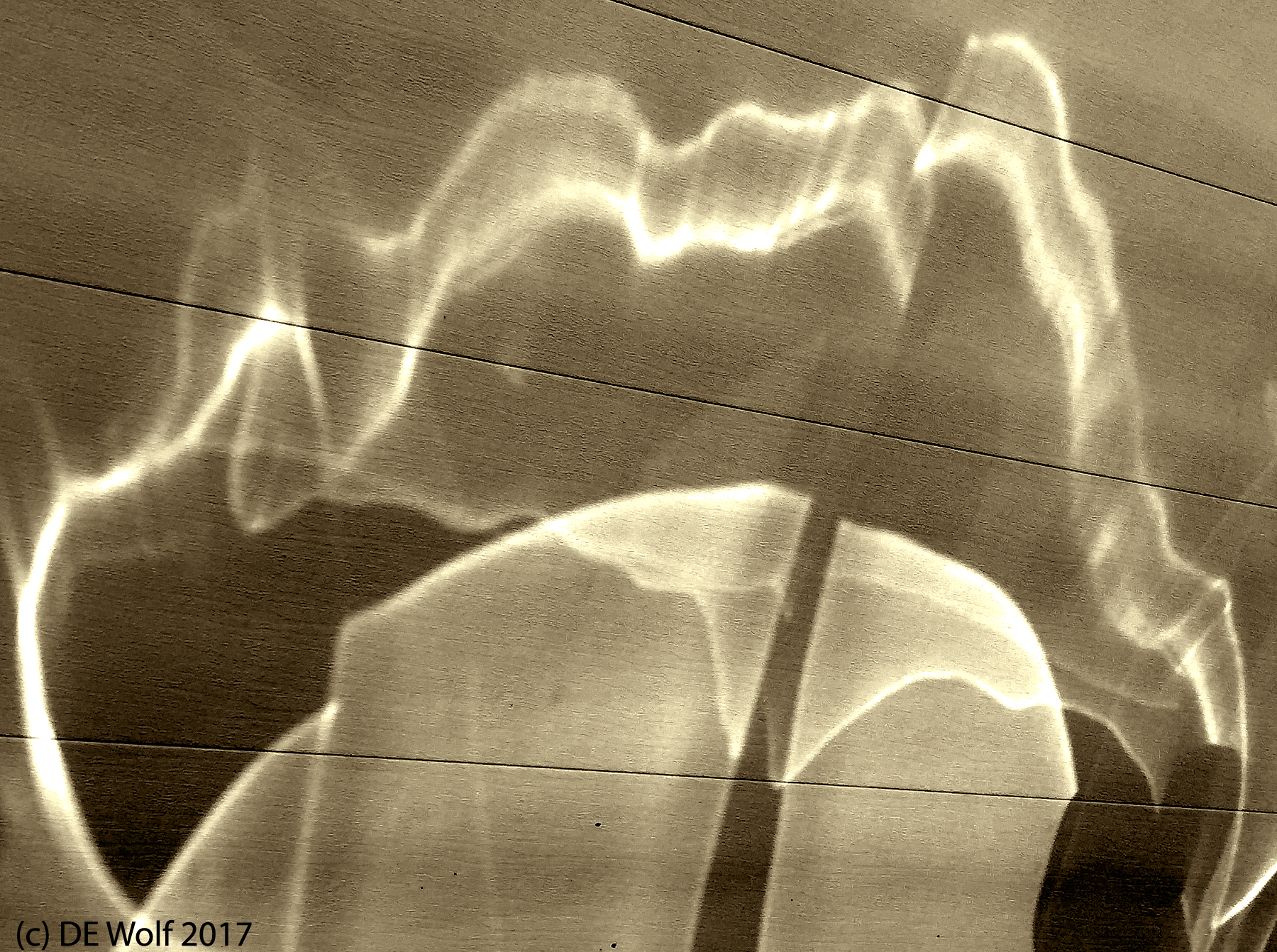
Figure 1 – The aura on my garage door. (c) DE Wolf 2017.

I took the image of Figure 1 with my IPhone yesterday. Simply, it is a photograph of my garage door, and the abstraction raises the question, what is it? So  first point, abstractions seem to demand an explanation, or at least we look for them in the belief that everything demands and deserves an explanation. But at another level the what it is, the solutions that our imaginations offer us give us insight into the character and nature of our times. And, of course, the other “neat” point is that our interpretation of an abstraction is both personal and memetically shared.

So what are the possibilities?

First, I suppose it could be the reflection of the sun off my car. However, appealing because of its seemingly simple scientifically-based explanation, it is boring! However, it may be pointed out that this explanation does contain implicitly the view that light illuminates. Also this explanation is not void of the ominous, because such solar illuminations are well known for their ability to melt paint and siding and even to set fires.

Second, is that it marks the nebulous portal of a wormhole. Yes Star Trek and Deep Space Nine fans, we are talking about the ability to traverse great distances effectively much faster than the speed of light, and even just possibly, to go forward and backwards in time. It flies in the face of Marcus Aurelius’ belief that you only possess the moment, the present, neither future or past.

“No one can lose either the past or the future – how could anyone be deprived of what he does not possess? … It is only the present moment of which either stands to be deprived: and if this is all he has, he cannot lose what he does not have.”

Marcus Aurelius, Meditations

I did not attempt to enter this wormhole. To even think of such an explanation is a twentieth/twenty-first century interpretation dependent on, at least, a rudimentary understanding of Einstein’s four dimensional space time. Space time is certainly a pervasive product of our times. Curiously, while wormholes fall out of what is referred to as gravity theory, even the derivers, when cornered in a room over wine or whiskey will admit that they do not quite believe in them. But the wormhole is a kind of mathematical singularity and the existence of black-holes, another kind of gravitational singularity, fuels the imagination with: yes, it might be possible. There is a counter argument often made that if such time travel were possible, we would be inundated with time travelers. The argument may be countered with the fact that as mind-boggling large, perhaps infinite, as the three-dimensional physical universe is  imagine how much more vast and infinite it truly is when you add the fourth dimension of time. It is not hard to imagine that a few time-travelers would be so diluted in density as to be inconsequential. Even an infinite number of time travelers might not be encountered in this four-dimensional variant of Hilbert’s infinite room Grand Hotel. I should have seen what would happen if I tried to walk into my garage door. Would I have passed into another time and place?

A mathematician makes plans to travel backwards in time through a wormhole to a parallel universe when he can’t even make it to Mars with the fastest rocket on hand today.

Third, and speaking of four-dimensional travel, is it the aura, perhaps of some sort of Cthulhulian four-dimensional creature only partially perceived, much like how a tennis ball would be perceived by the two-dimesional inhabitants of Edwin Abbott Abbott’s Flatland. We are assured that the gods of H. P. Lovecraft’s Cthulhu Mythos are merely fictional, albeit written in the context of Einstein’s theories. But they were conjured up in Lovecraft’s mind as a reflection of the evil of mankind and chillingly

the short story [Call of Cthulhu] asserts the premise that, while currently trapped, Cthulhu will eventually return. His worshippers chant “Ph’nglui mglw’nafh Cthulhu R’lyeh wgah’nagl fhtagn” (“In his house at R’lyeh, dead Cthulhu waits dreaming.”)

There does seem to be the potential of so much evil in a simple aura. As a result there was a cathartic reassurance in the fact that opening and closing my car door altered the nature of the door.

The birch grove

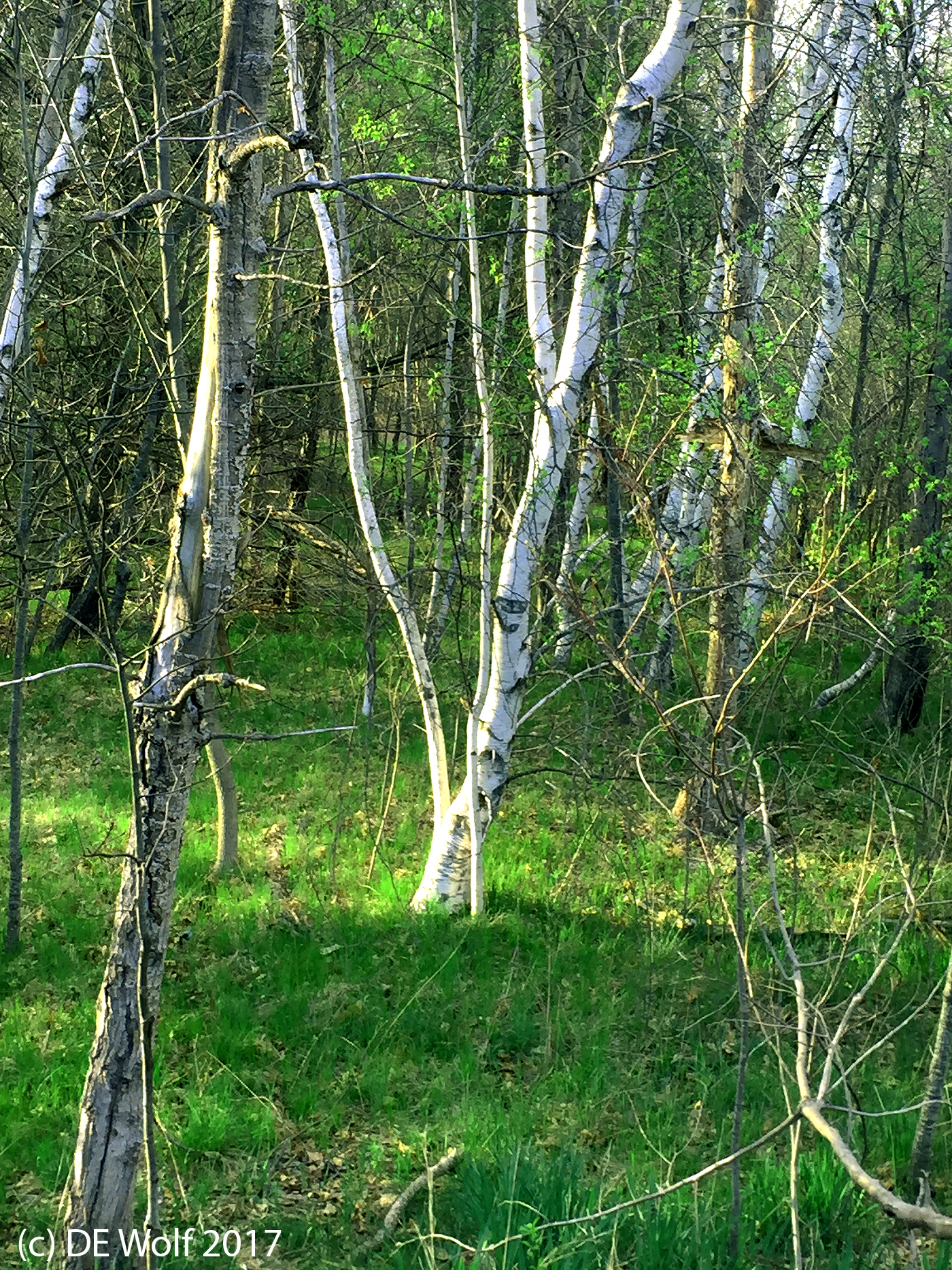
Figure 1 – Birches, Westborough, MA. Iphone photograph. (c) DE Wolf 2017.

The image of Figure 1 fulfills my fantasy of a birch grove. There is an opening in the woods that even sports a covering of grass.  The bone white birches stand proudly, bathed in the warm yellow light of sunset. They bear scares and are broken not just by the ravages of this winter but the last several winters. You can read the seasons in them. Nearby, out of the picture, is an ancient stonewall, put there by a long forgotten farmer. By the size of the stones we may judge that this was not to grow crops but rather to herd in sheep – most probably in the early nineteenth century. Such stones sprout each spring, compelled and driven by geology and the glacial history of Massachusetts.The scene is every appealing and ever bucolic. But the reality is that I found this little coven of trees beneath a roaring highway. The sound was so loud that it was hard to think about how to compose the image. And the scene was in many places spoiled by litter blown off the road.

Such is the context of our lives and the ambiguity of the modern world, which so often forgets its trees.  But these little birches were quick to bring to mind Robert Frost’s wonderful poem – a poem from my youth – and named aptly “Birches.” The birches call us back to something simpler. In Frost’s own words:

“So was I once myself a swinger of birches.

And so I dream of going back to be.

It’s when I’m weary of considerations,

And life is too much like a pathless wood…”

In your face

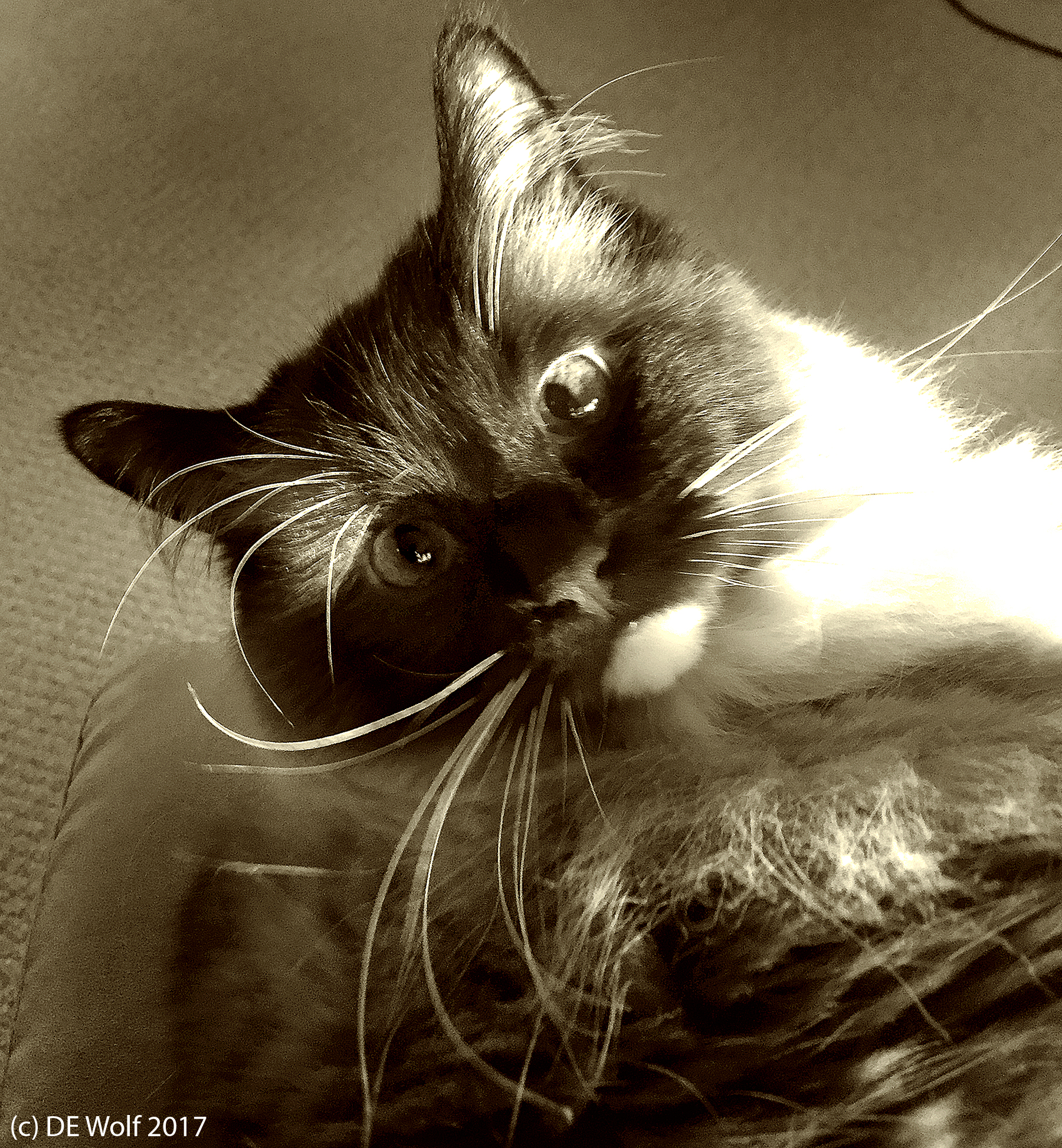
Figure 1 – You are so in my space. (c) DE Wolf 2017.

I thought that it was high time to capture another “in your face” animal portrait with my IPhone, trying to grab a moment of intense anthropomorphic expression. I love how close you can get with the cellphone and how easy the whole process of picture taking is. Here it is my cat. And the questions are complex. Why are you in my face? What is that thing you are always shoving in my face? Can I sniff it? And, of course, there is: rub my ears and I love you.