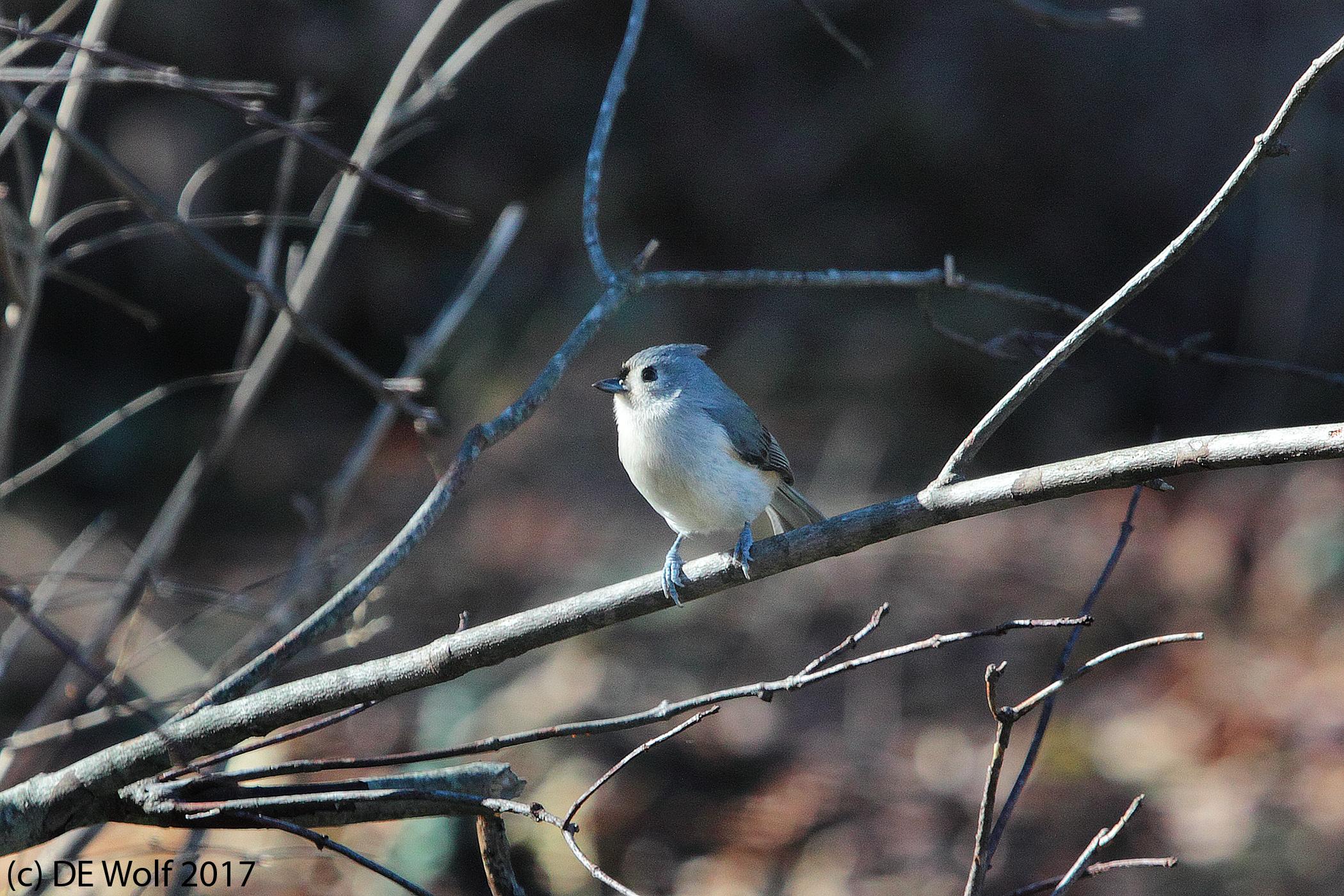
Tufted titmouse

Figure 1 – Tufted titmous, Sudbury, MA. (c) DE Wolf 2017.

Before we get too far into winter, I wanted to post the photograph of Figure 1. Just after Thanksgiving I put up mu bird-feeder for the winter and literally within minutes it was swarming with birds. One of my favorite feeder birds is the little greyish blue tufted titmouse, Baeolophus bicolor, shown in the photo. I can, of course not resist reference here to Gilbert and Sulivan’s Mikado.

“On a tree by a river a little tom-tit
Sang “Willow, titwillow, titwillow”
And I said to him, “Dicky-bird, why do you sit
Singing ‘Willow, titwillow, titwillow'”
“Is it weakness of intellect, birdie?” I cried
“Or a rather tough worm in your little inside”
With a shake of his poor little head, he replied
“Oh, willow, titwillow, titwillow!”

Well, yesterday we had our first snowfall of the season and the titmice (or mouses) (I will not go into that argument again) are scurrying about very busily. Their size make them very hard to photograph well. But you have to love the little Elvis bouffant and the jet black eyes, that speak so well to their reptilian origin.

They will be outside my window all winter now flit to and from the feeder and foraging for fallen seeds in the snow. One cannot help but admire their ability to endure the vicious Northern winter.
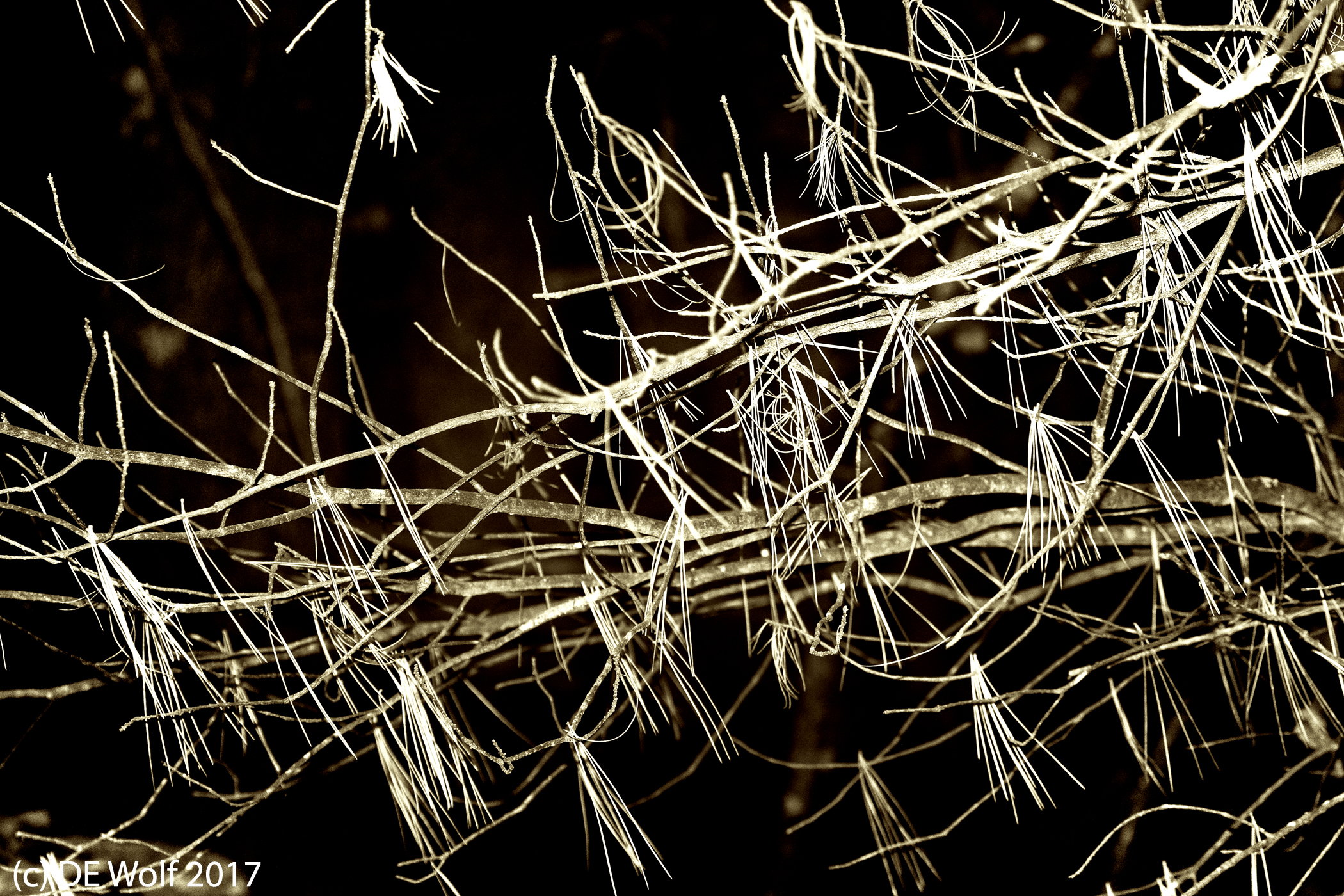
Pine needles shed

Figure 1 – Pine needles shed, Stow, MA. (c) DE Wolf 2017.

First, a reminder to all of you in the Boston area who can make my show Thursday night, it will be great to see you all.

You can always learn from nature – and “things are not always as they seem.” I came upon this little bush in the woods the other day and was intrigued photographically by the little dried pine needles glistening in the light. I thought that I was looking at a dying pine tree. But in fact, on closer examination, I realized that what I was seeing were needles being shed from the canopy and getting caught upon the twigs of a leafless shrub. The result is Figure 1.

It is, in fact, the case that pines and other evergreens do participate in the annual shed. It is just that they hold onto a particular crop of needles for several years before dropping them. This autumnal release is part of the forest’s life cycle. I remember the comparative mythologist Joseph Campbell talking about how when you reach the end of your life, it is time to give in to the shedding of leaves. So the pine needles falling to the ground, here caught for a few moments, as forests and trees measure time, is a symbol of the recuring mythic trilogy of birth, death, and resurrection.

There are few places more calming than a pine forest. No better place to walk silently than on the needle carpet. It is certainly the case that there in a pine barren the world is both simple and explained. There we may be closest to the ambiguity of mortality and immortality.Henry David Thoreau remarked that “Ever little pine needle expanded and swelled with sympathy and befriended me.

Canon T2i with EF100-400mm f/4.5-5.6L IS USM at 100 mm, ISO 800 Aperture Priority AE Mode 1/100th sec at f/7.1 with -2 exposure compensation.

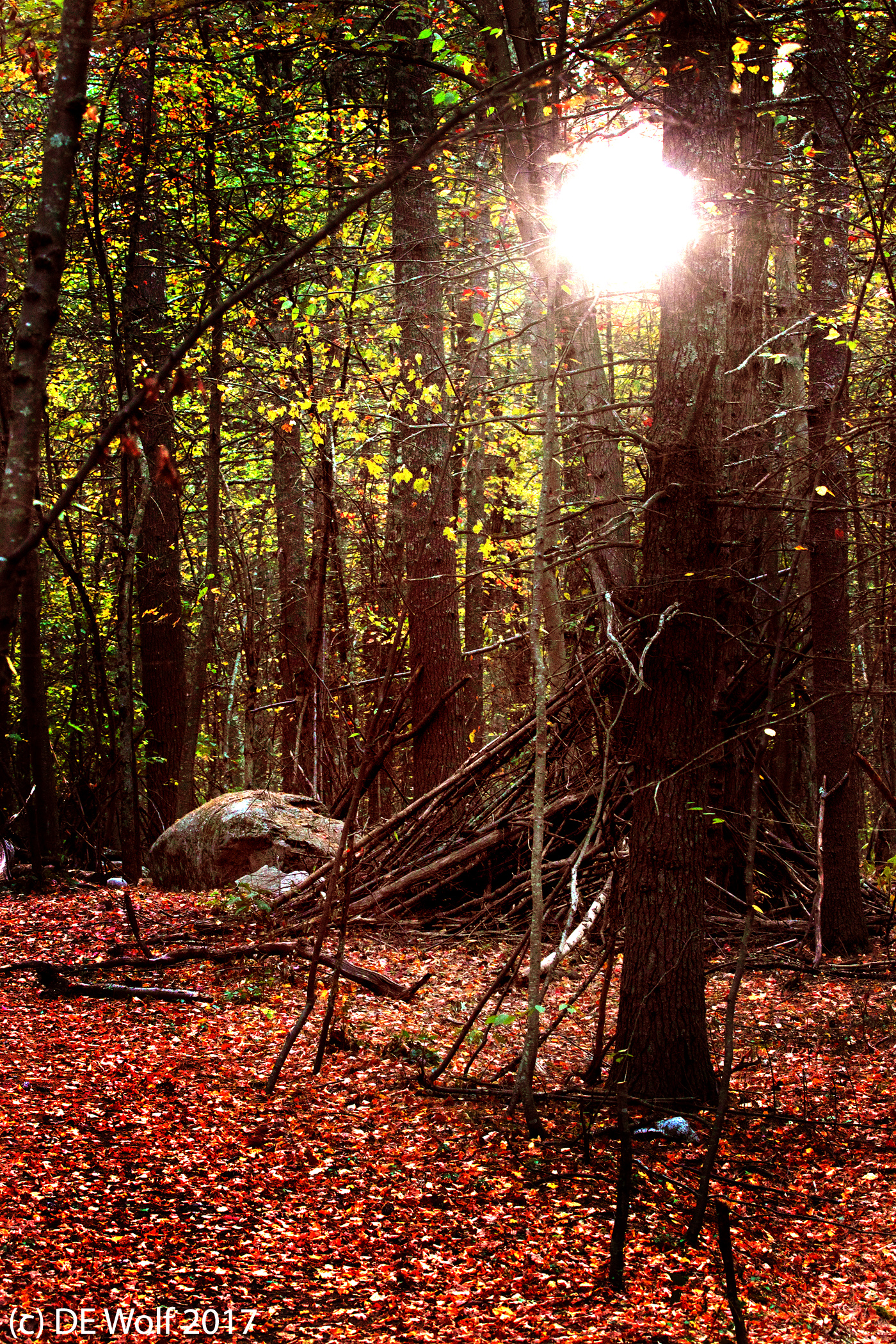
More light in the forest

Figure 1 – The sun breaks into the Pine Barren. (c) DE Wolf, 2017, Stow, MA.

I posted last week about Light in the Forest, but I’d like to pick up the theme again with today’s Figure 1. It captures that moment when the sun suddenly floods the pine barren, and you witness it like a mini-Stonehenge as if caught between two giant limbs. It is, needless-to-say, a photographic challenge in terms of dynamic range. In the moment you squint at it, and all the grey tones seem to collapse into nothingness. There is the sensation of fuzzy darkness. And most curiously there is the sense of silence. How is it that the suppression and collapse of tonality tricks the senses into feeling that you are sound deprived as well.

My mind immediately raced to images of the so-called Manhattan henge effect. I never expect less than magic in these particular woods. For some reason there are very few birds on this side of the forest. It is as if they defer to this fundamental magicality. Magic exists, expresses itself most strongly, where nature and our minds resonate.

Killdeer

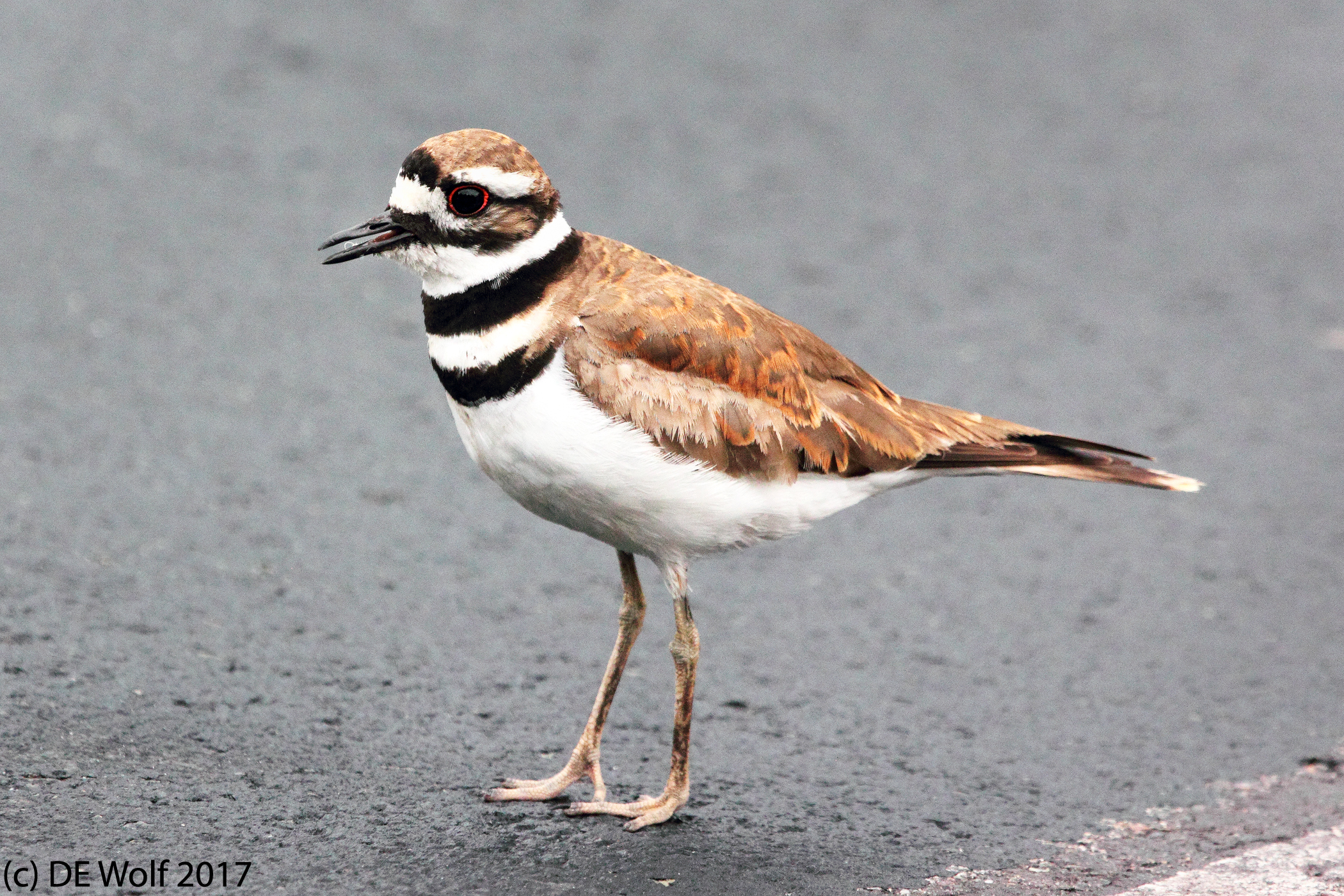
Figure 1 – Adult killdeer, June 2017, Wilmington, MA. (c) DE Wolf 2017.

I was driving home from work yesterday and was passing an abandoned section of the parking lot. Abandoned here means a section never used that has in part surrendered to grass and weeds. I noticed two killdeers (Charadrius vociferus) and so decided to bring my bird lens in today to see if I could find them again.

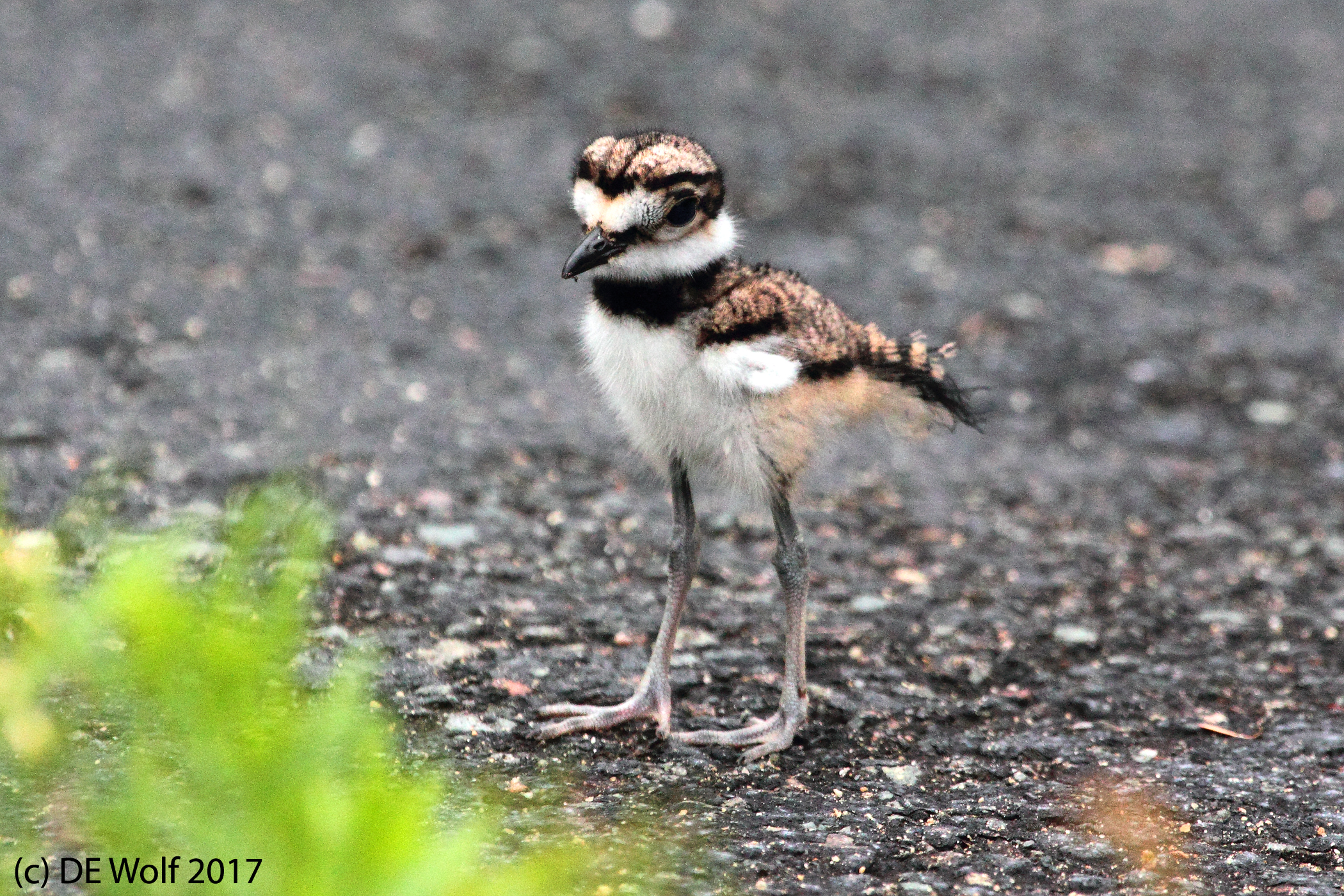
I also decided to bring my car. I had heard that birds run or fly away from humans but not from automobiles. They seem to see cars as part of the landscape; so they are the perfect birding blind. Well, I can now say “true enough.” I immediately found the killdeers and the fuss. They had their fledge with them, and this little bird was darting about but staying close to its parent’s cry. With the car I was able to get remarkably close. And they didn’t seem to be particularly bothered by my slowly driving into a more advantageous position.

The Cornell Laboratory of Ornithology’s website makes the interesting point that with the inland killdeer, you don’t have to go to the beach to find this close relative of the semipalmated plover. The killdeer is another one of those birds whose name derives onomatopoeically from its call – here a distinctive “Kill-Deer.” Their most dramatic behavior is the broken wing act that they use to distract predators away from the nest.

Figure 2 – Fledgling killdeer, June 2017, Wilmington, MA. (c) DE Wolf 2017.

Figure 1 – Canon T2i with EF100-400mm f/4.5-5.6L IS USM lens at 310 mm, ISO 800, Aperture Priority AE Mode,1/2000 sec at f/7.1 with -1 exposure compensation.

Figure 2 – Canon T2i with EF100-400mm f/4.5-5.6L IS USM lens at 400 mm, ISO 1600, Aperture Priority AE Mode,1/4000 sec at f/7.1 with -1 exposure compensation.

Golden Christmas balls

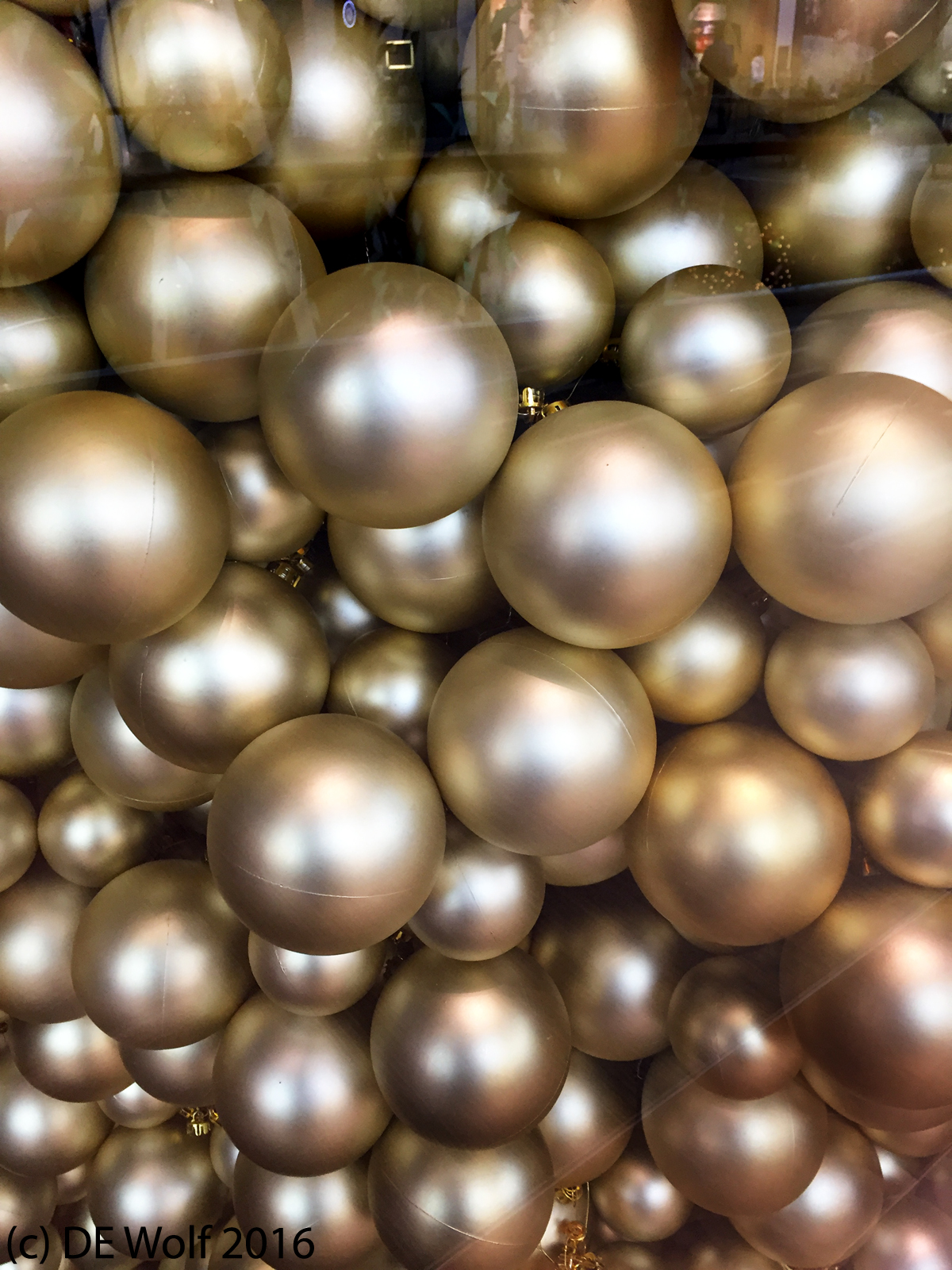
Figure 1 - Golden Christmas balls, Natick, MA. (C) DE Wolf 2016.

Figure 1 – Golden Christmas balls, Natick, MA. (C) DE Wolf 2016.

Figure 1 is another photograph of Christmas. These are golden Christmas balls. And of course, there are connotations or memories that they invoke. An obvious one is bubbles, perhaps a soapy foam. But for me, as a scientist, I cannot help but think of molecular packing. Spheres will tend towards close backing, and this reminds me very much of a crystal lattice, perhaps the molecular packing of a gold nanoparticle, and, of course, of planets.

Crystal packing is like its opposite, the random fractal. The crystal is supreme order and like the fractal occurs at all scales. And then there is the curious paradox that, in general, crystals are assembled by the fractal random process of diffusion. It is the ultimate example of order out of chaos. The structure of the crystal is locked within the physical properties of the individual atoms and they assemble like so many Legos according to physical law.

A Day on the Coast

This is a blog post. You can login, go to Posts, and edit each of these to get some initial blog posts set up. Just update the title, change the featured images, and add a paragraph or two of text. Image courtesy of www.unsplash.com.

Important Days

This is a blog post. You can login, go to Posts, and edit each of these to get some initial blog posts set up. Just update the title, change the featured images, and add a paragraph or two of text. Image courtesy of www.unsplash.com.

Along the Shore

This is a blog post. You can login, go to Posts, and edit each of these to get some initial blog posts set up. Just update the title, change the featured images, and add a paragraph or two of text. Image courtesy of www.unsplash.com.