Standard Post Format

Adventure_47The Road Not Taken
BY ROBERT FROST

Two roads diverged in a yellow wood,
And sorry I could not travel both
And be one traveler, long I stood
And looked down one as far as I could
To where it bent in the undergrowth;

Then took the other, as just as fair,
And having perhaps the better claim,
Because it was grassy and wanted wear;
Though as for that the passing there
Had worn them really about the same,

And both that morning equally lay
In leaves no step had trodden black.
Oh, I kept the first for another day!
Yet knowing how way leads on to way,
I doubted if I should ever come back.

I shall be telling this with a sigh
Somewhere ages and ages hence:
Two roads diverged in a wood, and I—
I took the one less traveled by,
And that has made all the difference.

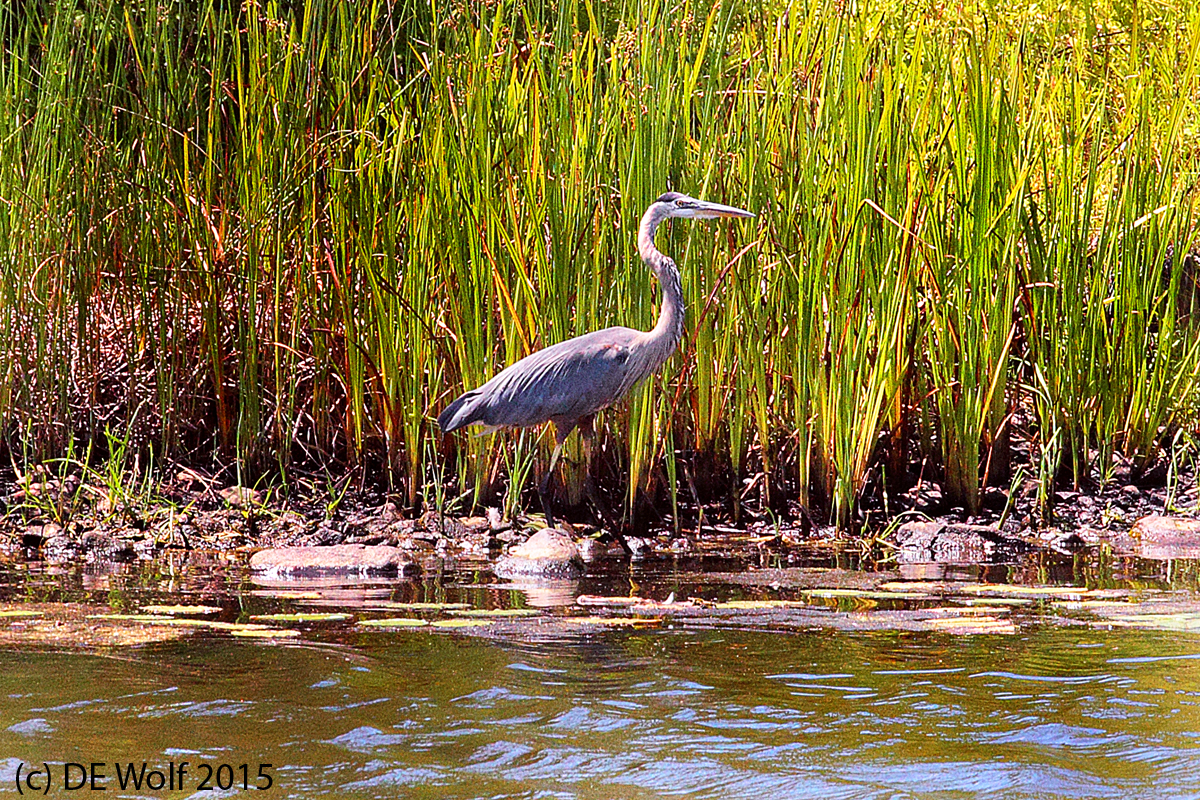
Great blue heron – Ardea herodias

Figure 1 - Great blue heron on Little Fresh Pond, Cambridge, MA. (c) DE Wolf 2015.

Figure 1 – Great blue heron on Little Fresh Pond, Cambridge, MA. (c) DE Wolf 2015.

By far the king of Massachusetts water birds is the elegant Great Blue Heron – Ardea herodias. They walk stealthily along the sides of ponds and nest high in inundated trees creating an inspiring sense of timelessness and Jurassic splendor. I have been away from Fresh Pond for two weeks. So yesterday I braved what the weatherman had warmed me was “oppressive” heat and humidity and went out for my usual walk. I was rewarded by a great blue heron across Little Fresh Pond from me just in front of the bull rushes. He was arguably a little further than my 70 to 200 mm could really handle. But he was glorious.

Canon T2i with EF70-200mm f/4L USM lens, ISO 1600, Aperture Priority AE mode, 1/2000th sec at f/7.1 with no exposure compensation

What’s wrong with this picture?

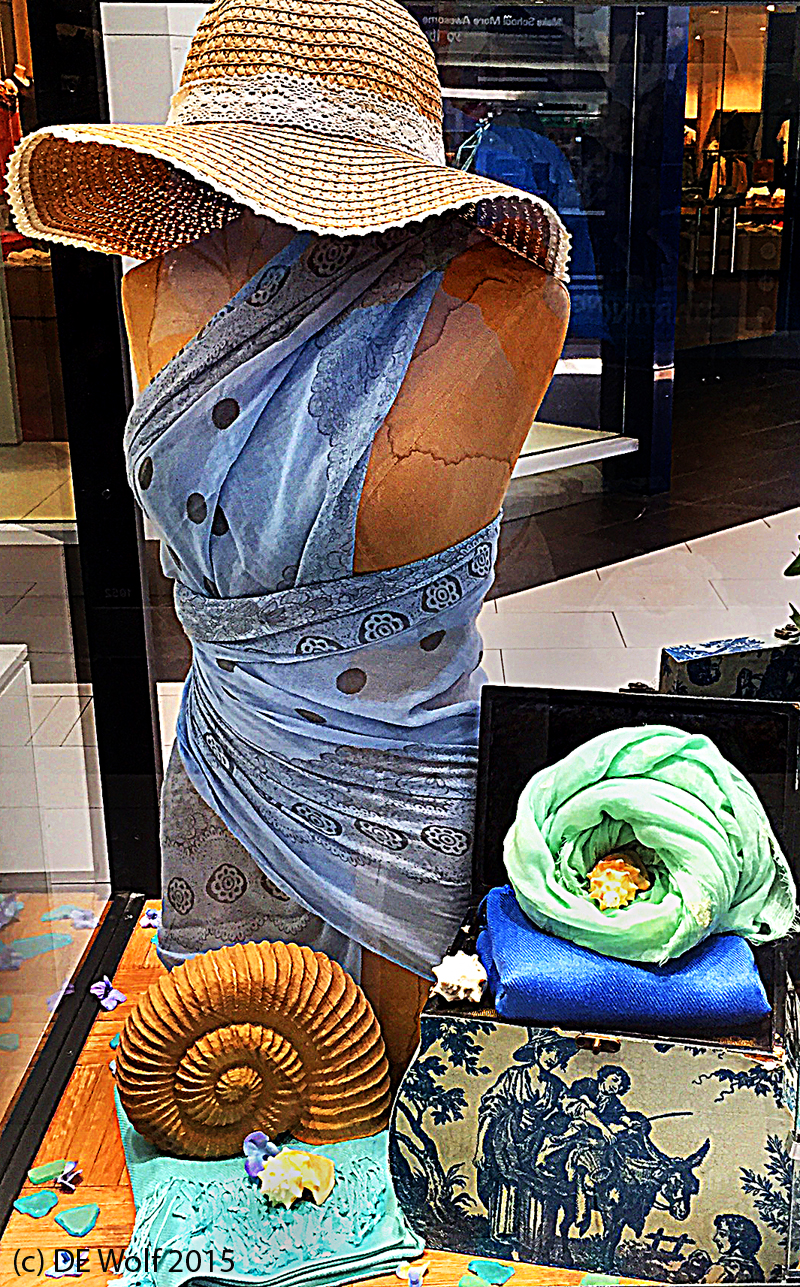
Figure 1 - By a Cretacious sea - IPhone image. (c) DE Wolf 2015.

Figure 1 – By a Cretacious sea – IPhone image. (c) DE Wolf 2015.

As the song goes: “By the sea, by the sea, by the beautiful sea…” So it is summer here in New England, and on a hot muggy Sunday I was walking around the local mall, mercifully air conditioned, and came across a display case, where I took the IPhone snap of Figure 1. It is not of great photographic interest to be sure. The display is meant to convey the sense of a summer’s outing to the beach. Great! But what’s wrong with this picture? What beach where? Or more importantly what beach when?

That curly sea shell is actually a fossil ammonite. The ammonoid cephalopods first appeared 400 million years ago in the Devonian and became extinct at the close of the Cretaceous about 66 million years ago. The Shakespeare 1500 year anachronism of a clock in Julius Caesar pales by comparison to this scene off by 66 million years at least. The fact is that for much of their time, ammonites ruled the sea as fearsome predators. Recognize that some species were enormous, much bigger than us. I once saw a National Geographic documentary where a diver went down at night to photograph giant Humboldt red squid and almost got eaten alive.  So have a little respect. But fortunately this summer, you do not need to worry about aggressive cephalopods, and if you are swimming along the US east coast need only concern yourself with great white sharks. Or you could just stay out of the water, people!

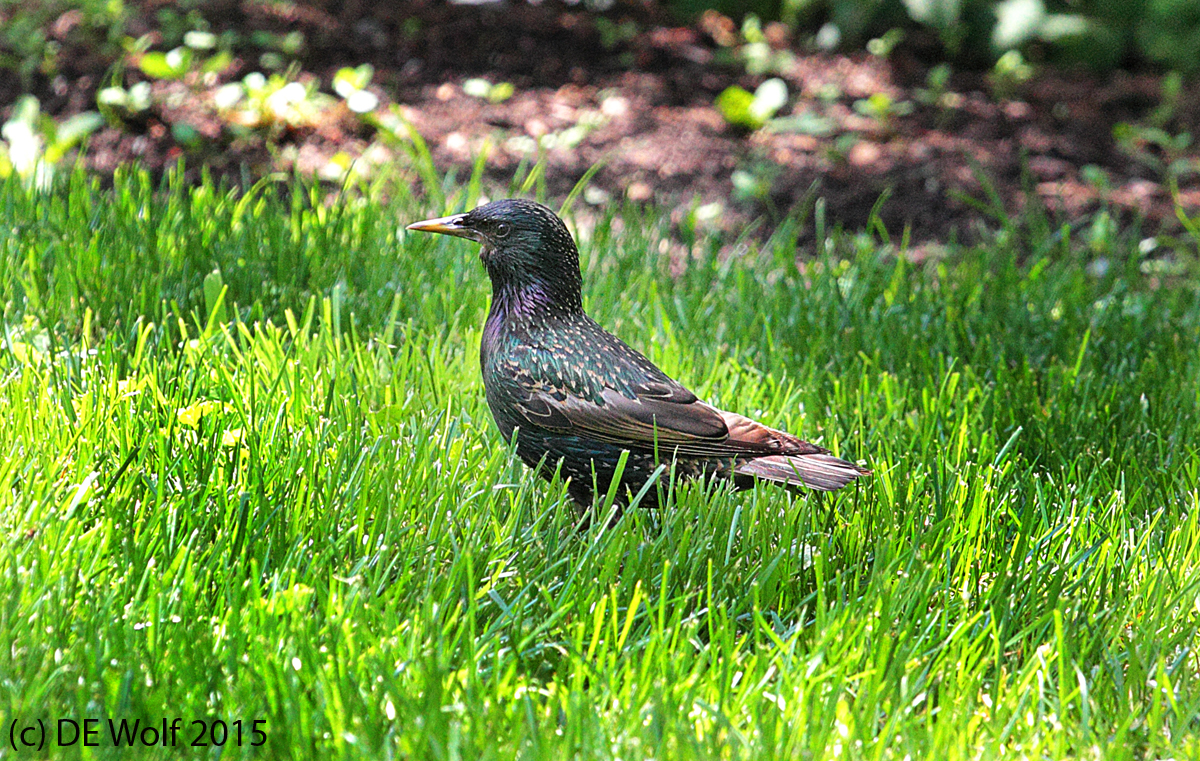
European starling – Sturnus vulgaris

Figure 1 - European Starling, Fresh Pond Reservation, Cambridge, Massachusetts. (c) DE Wolf 2015

Figure 1 – European Starling, Fresh Pond Reservation, Cambridge, Massachusetts. (c) DE Wolf 2015

Hmm! The starling is another one of those Rodney Dangerfield bird species that, like the American robin, whose Latin name is turdus migratorius and who “don’t get no respect.”  The European starling’s Latin name is Sturnus vulgaris. I mean really? Sure they are aggressive and can wipe out a bird feeder in minutes. But they gotta eat too! How would you like to go through life with the last name “vulgaris?” They are the black clouds of birds that flock and delight us in winter. And as I hope Figure 1 reveals. they are in fact quite beautiful in their iridescence (Jacob’s amazing dream coat for sure) and delicate spots.

The story of the starling in America is one of literary origin. They are an introduced species. Some sixty starlings were released in 1890 into New York’s Central Park by Eugene Schieffelin, who was president of the American Acclimatization Society, which tried to introduce every bird species mentioned in the works of William Shakespeare into North America. A Today such behavior would not be encouraged. Around the same time, the Portland Song Bird Club released thirty-five pairs in Portland, Oregon. The west coast birds disappeared by 1902. But the tenacious east coast birds have followed the American western migration swelling in number and distribution. Today it is estimated that there are 150 million European starlings distributed from southern Canada and Alaska to Central America.  This includes Portland, Oregon and it includes the Fresh Pond Reservation in Massachusetts. I found this beautiful example in the grass by the Water pump house.

“The king forbade my tongue to speak of Mortimer.  But I will find him when he is asleep, and in his ear I’ll holler ‘Mortimer!’ Nay I’ll have a starling shall be taught to speak nothing but Mortimer, and give it to him to keep his anger still in motion.”

Henry the Fourth, Part I

William Shakespeare

Canon T2i with EF70-200mm f/4L USM lens at 184 mm, ISO 1600, Aperture Priority AE Mode, 1/1000th sec at f/7.1 with no exposure compensation.
The Reverse Turing Test

Not surprisingly, I spend a lot of time maintaining the Hati and Skoll website.  All websites nowadays have several levels of protection against “them evil spammers and hackers.” Recently WordPress, which is the fundamental engine beneath all of this added a simple “CAPTCHA” to the administrative login and this has worked wonders. A CAPTCHA, as I’m sure many of you know, is a simple question that, hopefully, only a human can answer.  In WordPress’ case its a simple math question like “1 + 3 = ?.” If you try to comment on Hati and Skoll you’re asked to read a little bit of graphic text. That’s another form of CAPTCHA.

What struck me was that the CAPTCHA is a “Reverse Turing Test.”  Alan Turing was interested in the concept/question of machine intelligence. He introduced his test in his landmark 1950 paper “Computing Machinery and Intelligence,  Turing begin the paper with the words: “I propose to consider the question, ‘Can machines think?'” He then morphs this question to one that is, perhaps, more accessible “Can machines do what we (as thinking entities) can do?”  We imagine an interaction between a human and a computer where the computer tries to prove to the human that he/she too is human by answering questions. As you can imagine there is a rich Science Fiction literature around this concept and for 65 years we have been intrigued with the question (and creeped out by the movies) how a machine could trip us up and prove to us that it is also human.

Well, fast forward to the modern day.  The question has essentially reversed. Indeed, the acronym CAPTCHA stands for “Completely Automated Public Turing test to tell Computers and Humans Apart.” Computers are not proving to us that they are human. Rather we are proving to them that we are human, remain human. The deeper  question is, of course, who’s in charge?

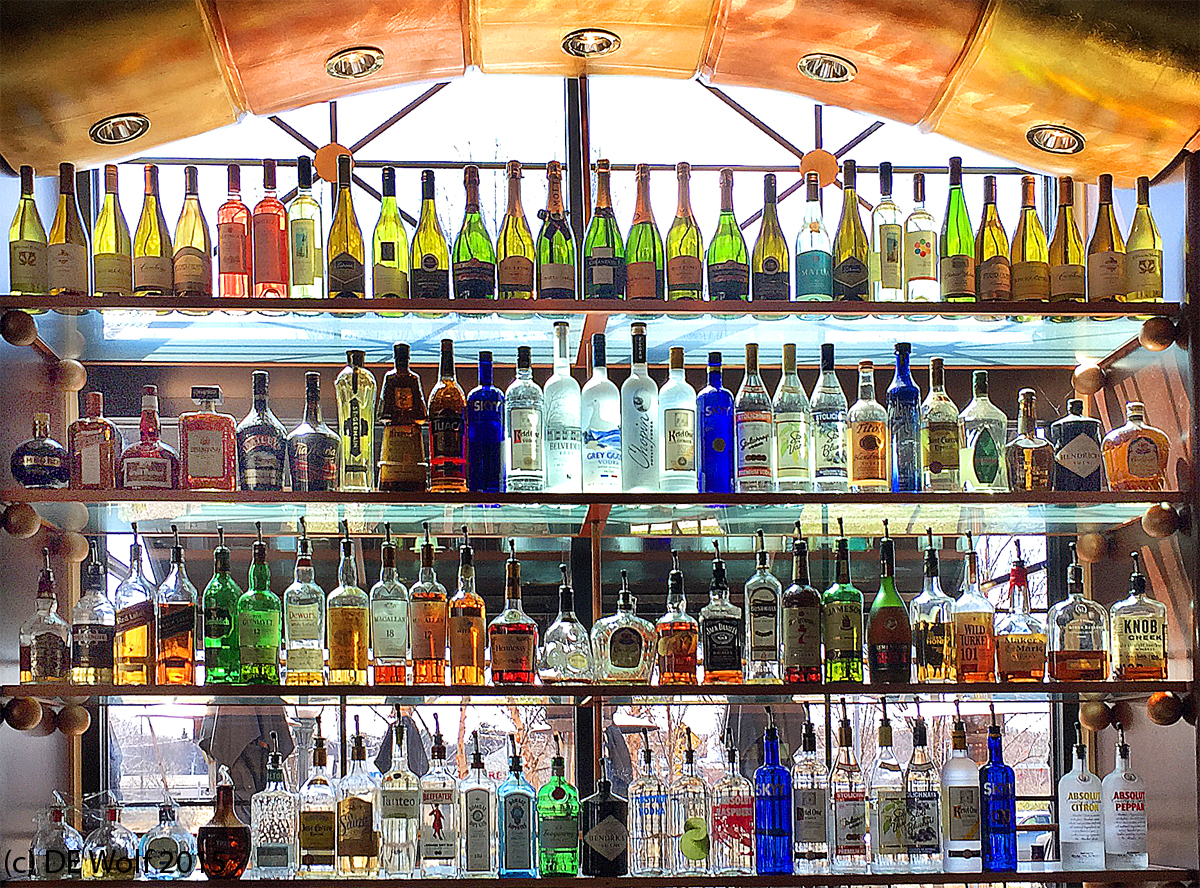
The altar of the god EtOH

Figure 1 - Alta of the god EtOH, Natick, MA. (c) DE Wolf 2015.

Figure 1 – Altar of the god EtOH, Natick, MA, IPhone photograph.. (c) DE Wolf 2015.

As I have said before the good thing about cell phone cameras is that they are always with you- always ready to take a photograph.  The bad thing, of course, is their lack of control, especially optical zoom.  Still while the world awaits the new cell phones with this zoom feature, we may be content to photograph within the camera’s limitations – after all the camera’s limitations are really our own. Now doesn’t that smack of profundity?

Saturday, my wife and I were having lunch at The Cheesecake Factory – made newly famous, I suppose, by Penny and Bernadette on “The Big Band Theory.The CheeseCake Factory decor is faux or pseudo-Egyptian.   suppose that this is meant to conjure up exotic mental images of a twenties style speakeasy, when the world was gaga about the discovery of King Tut’s tomb.  I was struck yesterday by the backlighting on all of the liquer bottles at the bar.  It required quite a bit of roatting and tilting to get the perspective right.  That, thanks to Adobe Photoshop, and then there was the cropping.  the result of all of this is Figure1, which in tribute to the Egyptian polytheist view of the world I have dubbed: “The Altar of the god EtOH.”

A thin veneer

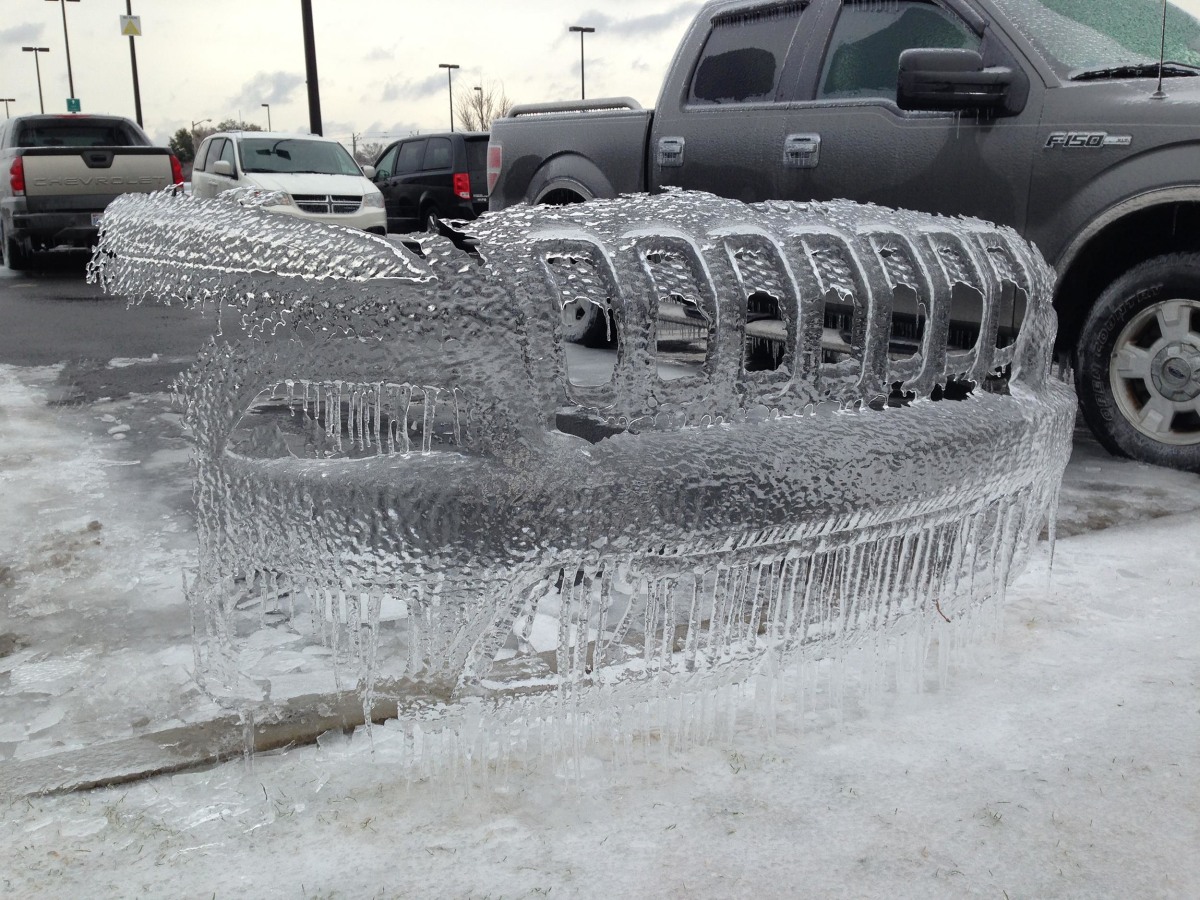
I’m seeing more and more bizarre images this winter – sights that stretch credulity and imagination.  This evening I came across this image from WITN out of Greenville, NC.  It shows an unusual ice formation actually cast into shape by a Jeep’s grill. It was snapped at a parking lot at the Vidant Medical Center in Greenville on Feb 17. An eyewitness reported that  the vehicle’s owner warmed up the engine and left behind this imprint., and the imprint remained after the driver backed out of the parking space. The ice was attached to the curb. It is a kind of modern fossil, a sense that is accentuated by its reminiscence of some kind of carnivorous dinosaur. OK I’ve got a strong imagination. Stranger than truth and you saw it first at Hati and Skoll!


Ruffed Grouse, Bonasa umbellus

Figure 1 - Ruffed Grouse, Madison, WI. (c) DE Wolf 2014.

Figure 1 – Ruffed Grouse, Madison, WI. (c) DE Wolf 2014.

I have not yet figured out all of the unofficial legitimacy rules concerning bird photography. But hey, a photograph’s a photograph in the end. I took Figure 1 of a Ruffed Grouse, Bonasa umbellus, with my EF70-200mm f/4L USM lens at 200 mm and handheld (1/40th sec f/6.3) ISO 1600 at the Olbrich Botanical Gardens in Madison, WI. The bird was free to wander off, but seduced by a bowl of bird seed, and the conditions were really quite dark and challenging. Also my lens kept fogging over. Despite its relatively short maximum focal length and lack of IS capabilities. I am finding this lens really convenient for stalking birds. I was very pleased with how it came out. The eye is in good sharpness and I like the catch-light. The image captures the grouse in a very natural and well camouflaged surrounding.

Robert deBruce defeating Edward the Second

In follow-up to yesterday’s post about cool events this summer, what could beat this past weekend reenactment in Stirling Scotland, of the Battle of Bannockburn, where Robert the Bruce in 1314 defeated the forces of Edward II in 1314. This year’s action was masterfully captured by Andrew Milligan for the PA.  It is one of the absolute best reenactment photographs that I have seen.

The Bruce was, of course, the great founder and champion of Scottish independence.  But the most bizarre element of his life occurred after his death.  It was his wish to have his heart buried at the holy sepluchre  in the Holy Land.  As he himself explained:”

“I will that as soone as I am trespassed out of this worlde that ye take my harte owte of my body, and embawme it, and take of my treasoure as ye shall thynke sufficient for that enterprise, both for your selfe and suche company as ye wyll take with you, and present my hart to the holy Sepulchre where as our Lorde laye, seyng my body can nat come there.”

The Bruce died 685 years ago on June, 7, 1329. His body was interred at Dunfermline Abbey.  His loyal friend agreed and pledged to take the embalmed heart on a pilgrimage and crusade to the Holy Sepluchre.  Douglas however, only reached Granada where he fell in battle laying the siege to Teba.  The embalmed heart was found upon the field of battle and returned to Scotland by Sir William Keith of Galston. It was buried at Melrose Abbery in Roxburghshire.