9/11 from Space

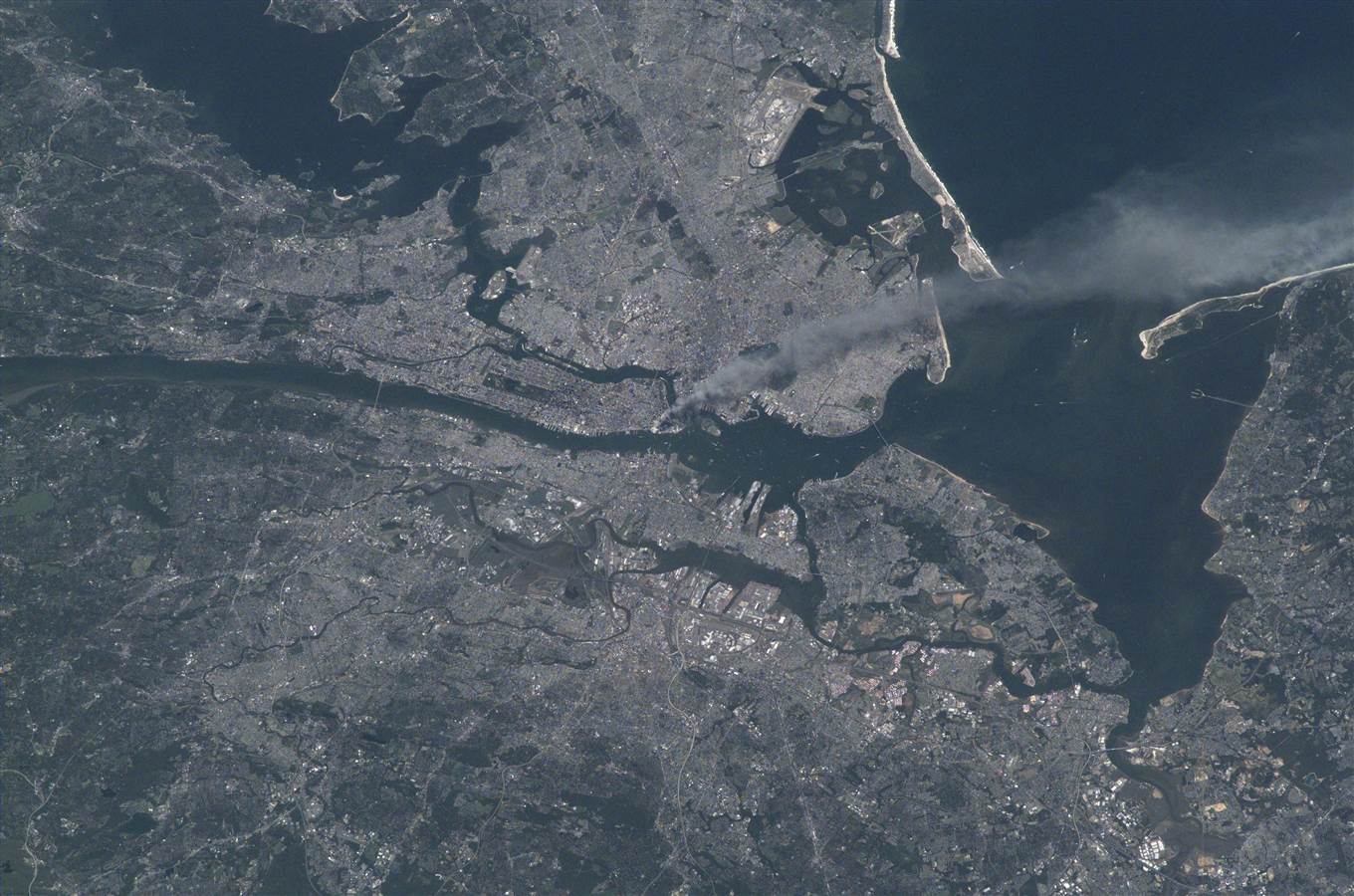
Figure 1- Photograph by astronaut Frank Culbertson from the International Space Station showing the 9/11 attack on the World Trade Center in New York City. From NASA and in the public domain.

Figure 1- Photograph by astronaut Frank Culbertson from the International Space Station showing the 9/11 attack on the World Trade Center in New York City. From NASA and in the public domain.

Thursday marked the thirteenth anniversary of the 9/11 Attack on the World Trade Center.  I came upon this amazing photograph of the event taken by then NASA astronaut Frank Culbertson. Culbertson was the only American not present on the planet that September day.  He was ~ 250 miles (400 kilometers) above Earth in the, then under construction, International Space Station with two Russian cosmonauts. He saw the huge column of smoke streaming from Lower Manhattan, where the Twin Towers fell and captured both video and still photographs of site from space for NASA.

Culbertson recalls his call to the ground that morning to give the results of some physical exams to his flight surgeon at Mission Control Houston, Steve Hart, and was told, “Frank, we’re not having a very good day down here on Earth.”

Culbertson saw that the space station was about to pass over New England. So he grabbed his camera and positioned himself to have a clear view of New York City. Later, Culbertson was also able to see the damage to the Pentagon. Ironically, his good friend and U.S. Naval Academy classmate Charles “Chic” Burlingame was the pilot of hijacked American Airlines Flight 77 that struck the Pentagon.

“Every orbit we kept trying to see more of what was happening,” Culbertson said. “One of the most startling effects was that within about two orbits, all of the contrails that are normally crisscrossing the United States has disappeared because they had grounded all the airplanes and there was nobody else flying in U.S. airspace — except for one airplane that was leaving a contrail from the central U.S. toward Washington, and that was Air Force One headed back to D.C. with President Bush. It was a very sobering time for us.”

Photographic firsts #12 – The first mobile phone photograph

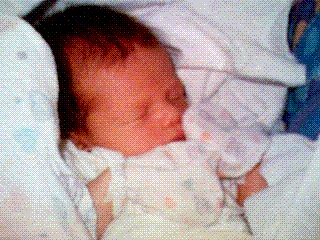
Figure 1 - The first publicaly shared mobile phone image. Transmitted on June 11, 1997 by Phillipe Kahn of his newborn daughter Sonya.  From the Wikimediacommons and put in the public domain by Phillipe Kahn.

Figure 1 – The first publicaly shared mobile phone image. Transmitted on June 11, 1997 by Phillipe Kahn of his newborn daughter Sophie. From the Wikimedia Commons and put in the public domain by Phillipe Kahn.

It’s been a while since I posted a photographic first. But this week brought us the IPhone 6, the IPhone6 plus, and the IWatch and this got me thinking about the rapid, blink of the eye, history of both the mobile phone and the digital camera on the mobile phone.  For those of us brought up on Star Trek, it has all been wonderful, although the flip phone, which was designed to give you the feel of the Star Trek communicator had only a brief moment in the sun or some other star before we move on.  Indeed, even standard Federation of Planets communicator models evolved rapidly through the seasons of the show.  The flip communicator rapidly became integrated into the Federation medallion worn by crews.  Even the short lived “red shirts” wore them.  Oops! I am digressing again.

I found myself wondering this morning what the first mobile phone image was.  It sounded like the kind of thing that I could find with a simple Google Search, and sure enough.  On June 11, 1997, Philippe Kahn instantly transmitted what is widely believed to be the first publicly shared photographs ever.  In some sense it marks the birth of social media.  The image shown in Figure 1, fittingly is of his then newborn daughter Sophie from the maternity ward. It was shared simultaneously with a then amazing 2000 people.

Look at the picture and note its relatively low resolution.  Do a quick calculation.  It was taken a mere seventeen years ago.  The telephone was invented somewhere between 1833 and 1876 – don’t want to weigh in on a controversial issue.  Television was invented a half century later.  The current rate of innovation is truly staggering.

The thigh bone’s connected to the hip bone

Figure 1- Image from Mars Rover showing putative "Thigh Bone." From NASA and in the public domain.

Figure 1- Image from Mars Rover showing putative “Thigh Bone.” From NASA and in the public domain.

Well jumpin’ pareidolia! The world of UFO enthusiasts and other wanna believers was set into an internet frenzy with NASA’s release last week of an image (see Figure 1) from the Mars Rover showing what looks very much like a human thigh bone.  Well sometimes a rock is just a rock, and such is the case here. Sorry!

I want to admit that there is nothing that would excite me more than the discovery of a fossil on Mars. And while Mars Rover has conclusively shown that Mars was once dripping in water, geologists and exobiologists think it very unlikely that Mars ever harbored large creatures – the atmosphere and environment are not believed to have ever been sufficiently sustaining for evolution to progress in that direction.

On the other hand, we may continue to wonder what if – and such is the thought provoking nature of images like this.  Mars indeed has long been a refuge for seeing things, for associating natural inanimate phenomena with objects of human or even divine origin.  There were the “Canals of Mars,” the “Face on Mars, “the Mars Rat,” and now this thigh bone.

Two years ago when I launched this blog, I promised that one of the points that it would feature was the pure magic of photographs.  Well, the Martian Thigh Bone now joins the ranks of images that titillate and fire off the associative neurons of our brains.  Just as we post our selfies in pursuit of connection, just as we look at nineteenth century photographs and see connectivity, so too we look at the alien worlds that NASA brings into crystal clarity and seek something familiar, a connection with what we know that goes beyond a bit of iron rich rock lying in the sand.  We seek the magic of the image.

Other worlds of the mind

In the mood for other worldliness I was struck last week by this dreamy photograph by Jim Urquhart for Reuters showing a scene from this years “Burning Man Arts and Music Festival” in the Black Rock Desert of Nevada.  The art installation shown is “Pulse and Bloom.” Once  a year tens of thousands of people descend upon the desert to create an arts city o:f art, community, self expression, and self reliance. A week later they depart leaving no trace of their having been there.

As for the picture, the dusty redness of the scene and of the clouds transports you visually to another, perhaps a Martian, world.  The indistinct but looming figure in the background evokes so many science fiction movies and thus creates a certain element of for foreboding.  Where do we go next? As our own world becomes so strange and mean, we all perhaps, begin to yearn for an element of utopian other worldliness.  This image, at least, gives us that escape.


Seduced by scarlet

We spoke recently about the dimensionality of a photograph and how adding color adds dimensions. The point is well taken, but is expressed in purely physical terms. Beyond its personification as wavelength adding color adds a psychological dimension as well because we associate colors with emotion.

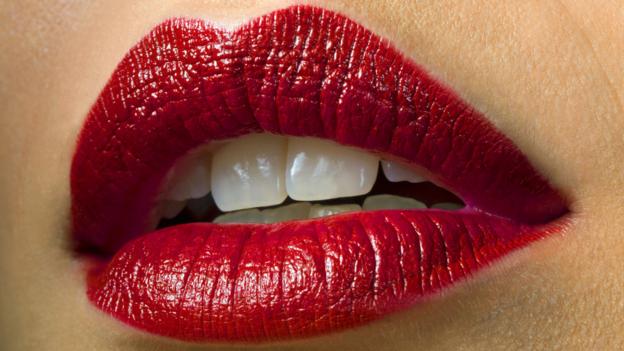
I was attracted this morning to an interesting article on the BBC website about the color red, “How the colour red warps the mind,” by David Robson.  What attracted me to this article was a seductive photographs of lips covered with an intensive lipstick (from Getty Images).  I love the forties retro lipstick vogue currently in fashion.  But the point here is well taken: red, scarlet, crimson, or carmine lips are all shades of seduction.  Case in point, the Scarlet Whore of Babylon.

Red can symbolize seduction. It can also symbolize anger and aggression. Dobson cites some interesting studies that demonstrate a commanding edge that red can impart.  Two psychologists, Russell Hill and Robert Barton at the University of Durham, found that in the 2004 Olympics randomly assigned red clothes, for instance, in boxing and tae kwon do, gave competitors a distinct edge.  Similarly playing with red poker chips at casinos tend to make people bet more than people with blue or white chips. While men who wear red ties project authority and dominance in their workplaces.

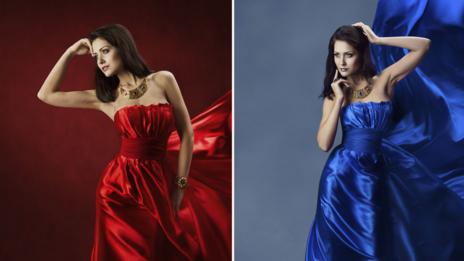
Dobson shows a pair of photographs of a beautiful, and yes, seductive woman, in red and in blue (from Thinkstock). The images are fascinating.  I keep trying to figure out what my perception of the color effect is.  They both indicate elegance and style.  In both cases I have the sensation of smooth satin. The red one is intense, strong, and dominating.  While the blue one is soft, cool, and mellow.  I am not sure that I would characterize one as more sensual than the other, but the fact that they are evoking a different set of emotions is clear.

We already know that the perception of color is not merely a physical one but a physiological one as well.  But perception of color, and the its psychological effects, go way beyond the physiology of the firing of rods and cones in your retina.  It is a deeply seated brain function. This is what is unleashed, or harnessed depending upon your spin, when you add the dimension of color to a photograph.

British Wildlife Photography awards for 2014

It is time for something beautiful and fortunately for us the British Wildlife Awards have just been announced for 2014.  There is a lot to choose from among this year’s awardees, but if forced to make choices I’m going to vote, as “best of show” for the truly gorgeous and impressionist image by Peter Cairns, winner in the Wild Woods Category, entitled “Autumn Jewels, Woodland, Cairngorms.”  And then there is equally magnificent image, both the overall competition and the urban wildlife award winner, of a grey goose on the River Thames by Lee Acaster from Wortham in Suffolk.  The tonal quality and mood of the image are just wonderful, and you almost get the sense that the goose is just a bit confused by his very urban surroundings. Really wonderful! Note also the beautiful way that the light comes in from the left side. Oh, and really for fun take a look at Alan Price’s highly commended black and white image of two Jackdaws stealing wool from an all-knowing and amused sheep  in Gwynedd, Wales.

So here’s my suggestion.  First, get through your work day.  Then take a few moments to visit the competitions website and see all of the winners and commendations.  It will make for a good end to your day.

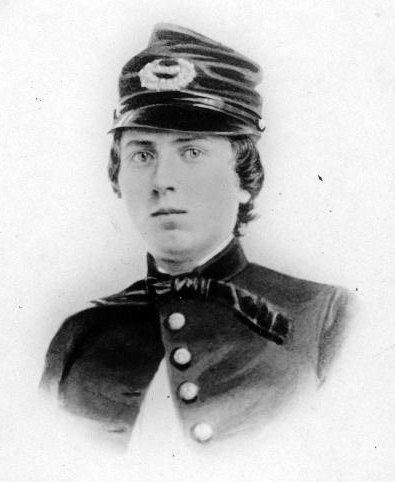
Portrait of Alonzo H. Cushing

Figure 1 - First Lt. Alonzo H. Cushing, from the Wisconsin Historical Society and the Wikimedia Commons. Uploaded by DIREKTOR and in the public domain.

Figure 1 – First Lt. Alonzo H. Cushing, from the Wisconsin Historical Society and the Wikimedia Commons. Uploaded by DIREKTOR and in the public domain.

We have spoken before about the nineteenth century faces that stare back at us from antique photographs. They seem to possess a haunting element of awareness. None are more haunting than the faces of soldiers from the American Civil War. You wonder just what was in store for these people. And while you might not know, what you do know is how terrible the statistically odds were and the inevitable fact that at the very least the person in the photograph would experience hell.  The tense is confusing.  Would experience? Did experience? It is the photograph itself that creates the ambiguity.

This morning I came upon the photograph of Figure 1 in the New York Times.  If the face is anonymous what do I experience in the seeing? I am are taken by the soft, handsome, youthfulness of the subject. Notice the eyes. They probably were blue. They look slightly way from us in distractedness and the catch-light is there to give the portrait life.  And the catch-light is a connecting point, because any of us would light the eyes in just this way if we were taking the image today. There is a certain jauntiness to the tie. Yes it all makes you wonder and it all brings the subject back to life.

But in this case there is no need to wonder. The image is of First Lt. Alonzo H. Cushing. Cushing was a West Point graduate and he was there at the battle, at the spot, and at the most pivotal and momentous of moments. Cushing stood his ground on Cemetery Ridge at Gettysburg against Pickett’s Charge 151 years ago last month. Despite mortal wounds he kept firing his canon. Cushing is credited with playing a major role in turning the tide that day, an event which arguably led to preservation of the Union.which shows West Point graduate and Lt. Alonzo H. Cushing.  It seems just a bit incomprehensible.  These were the battles of a century and a half ago and a lot has happened since, the world and America have moved on.  Yet it was important and for this bravery, Cushing was just posthumously awarded the Congressional Medal of Honor by President Obama.

When he went off to fight, Cushing told a cousin that “I may never return…I will make a name for myself.” Now a hundred years later the promise seems both prophetic and ironic. It makes us realize all the more that everyone of these soldier images, Union and Confederate, is a silent witness to something both monumental, something beyond themselves, and at the same time something intensely personal.

It is really kind of odd the importance we attach to historic photographs of people. Read a biography and you inevitably find yourself drawn to the portraits. Somehow the visage in the photograph gives genuineness and life to the story. In this case what a horrible yet courageous story it was.

The Panama Canal Centenary

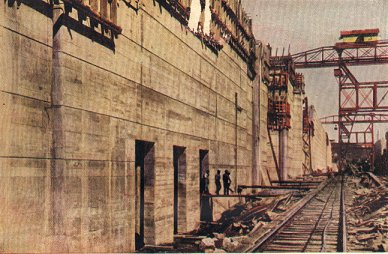
Figure 1 - The Pedro Miguel Locks of the Panama Canal photographed by Earle Harrison in color using the Autochrome Process.  From the Wikimedia Commons uploaded by Mschlindwein and in the public domain because its was photographed before 1923.

Figure 1 – The Pedro Miguel Locks of the Panama Canal photographed by Earle Harrison in color using the Autochrome Process. From the Wikimedia Commons uploaded by Mschlindwein and in the public domain because its was photographed before 1923.

In addition to the centenary of the start of the First World War, this August, August 15th to be precise, marked the opening of the Panama Canal, that great dream of a “Path Between the Seas.” I have been looking at a lot of photographs of the construction of the canal, including, of course, many pictures of that larger than life and somewhat controversial figure, President Theodore Roosevelt.

Most interesting among them are the color autochromes of Earle Harrison.  Figure 1 is an example of these and you might also what to check out the link above for some more dramatic examples. The whole collection of these images was recently reissued.

I have spoken at length about the autochrome process and will, in fact, admit to be really intrigued by it. The Autochrome process works as follows.  An adhesive layer was coated onto a glass plate. Potato starch grains graded to 5 to 10 um where attached to this layer.  The starch grains were dyed with either red orange, green, or blue violet dye (an unusual color wheel). Gaps between the grains were filled with lamp black (essentially soot).  This fragile layer was coated with a shellac and then overlain with a conventional silver halide gelatin emulsion.  Because of the high sensitivity of these emulsion to UV light from the sun, a yellow orange filter needed to be placed in front of the camera lens when taking a photograph to block-out these rays.

When a photograph was taken the colored potato starch grains acted as minute filters.  The silver halide emulsion was developed by conventional means and then reversed to a positive by what is effectively a bleaching process.  Since the colored starch matrix remains intact, when the positive image (say illuminated from behind) will become colored as light passes back through the filter matrix.

Like our own time, the early twentieth century was a period of huge technological advancement, posing a series of complex moral an ethical issues.  Indeed, it is all really an accelerating continuum.   And again like our own time, it was a period of great ethical hypocrisy.  World War I represented the worst that technology had to offer, highly efficient mechanized killing.  The Panama Canal represented the middle ground. There was the dream, powered by visions of huge profit, that drove men to build the canal, which was the ultimate Herculean project.  It took over thirty years to complete, and was a triumph (?) over nature both in terms of the actual digging and reinforcement and in terms of overcoming yellow fever.  The autochrome, I would argue, ever subtle, was the best.

Humans see in color, and as long as photography was confined to black and white there was something important missing. Color represents a significant dimension of reality.  Actually, as we have seen it really adds three dimensions.  And thanks to the Lumiere brothers we can look back and marvel, as if we were there for the events.  Shackleton set sail for his destiny in the Antarctic.  The Panama Canal opened. And Europe leaped head first into disaster.  All caught on camera.

A hideous cocoon

Hmm!  It was another hideous week, and there are lots of very dark thoughts.  I came upon an unattributed picture yesterday from Reuters on the BBC that pretty much sums it all up.  It shows two men intertwined and sleeping on a kind of disgusting bridge over a railroad station in Yangon (Rangoon) Myanmar.  They are covered in mosquito netting.  The disconcerting element for me, other than the desperateness of their lives, which is a little made up story in your mind, is the red floral pattern in the netting, which make the sheet look bloodied.

A year ago I posted about E. E. McCollum’s incredible “Cocoon Series.”  They are such gorgeous images, woven to tell a tale of rebirth, emergence, and resurrection.  In the Myanmar image we have the opposite effect where netting tells a tale of desperation, crucifixion, and death.  It is a very powerful image to my eye.